
Motion Energy and Safer Collisions
Students investigate how an object’s speed affects its motion energy and use evidence to recommend a collision-safety rule.
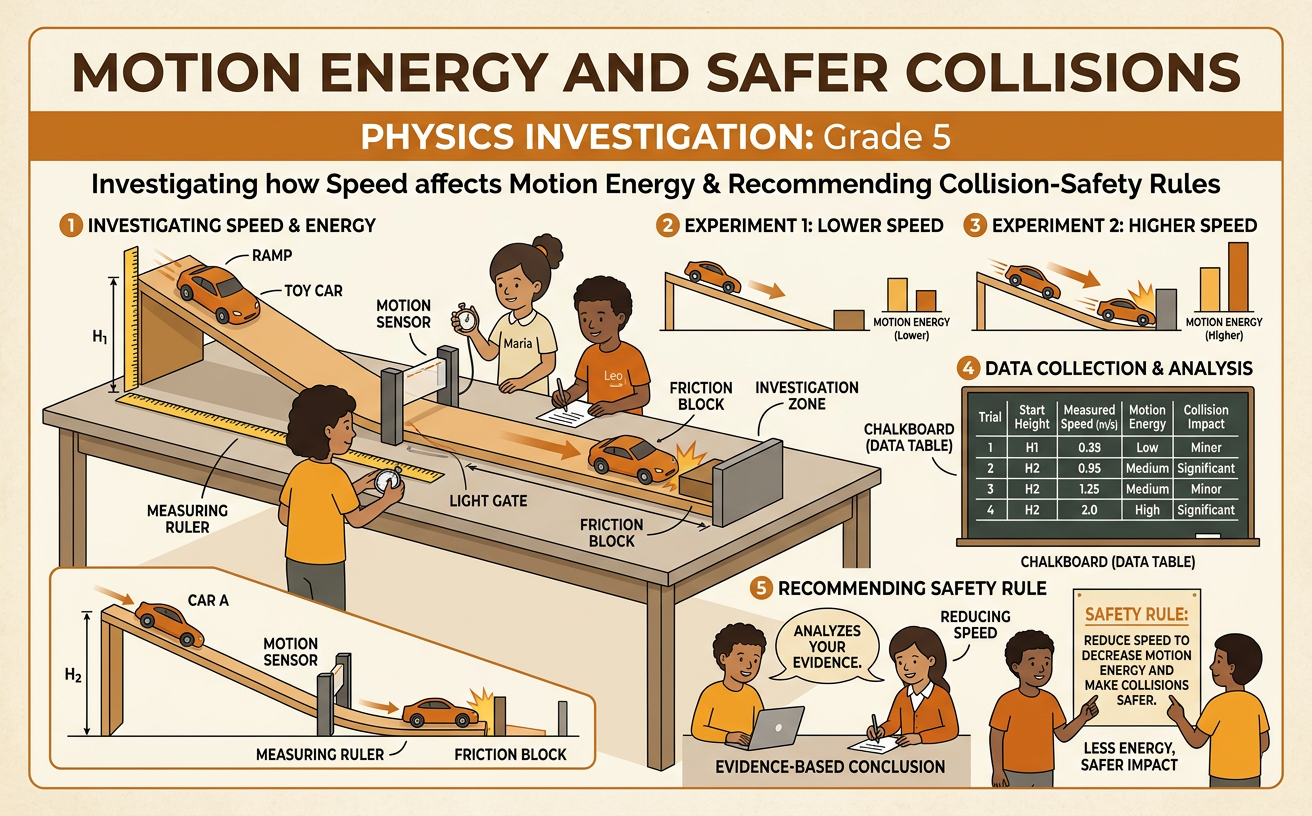
Illustrations are auto-generated and may be placeholders. They can be refreshed to match the narration.
Energy of Moving Objects
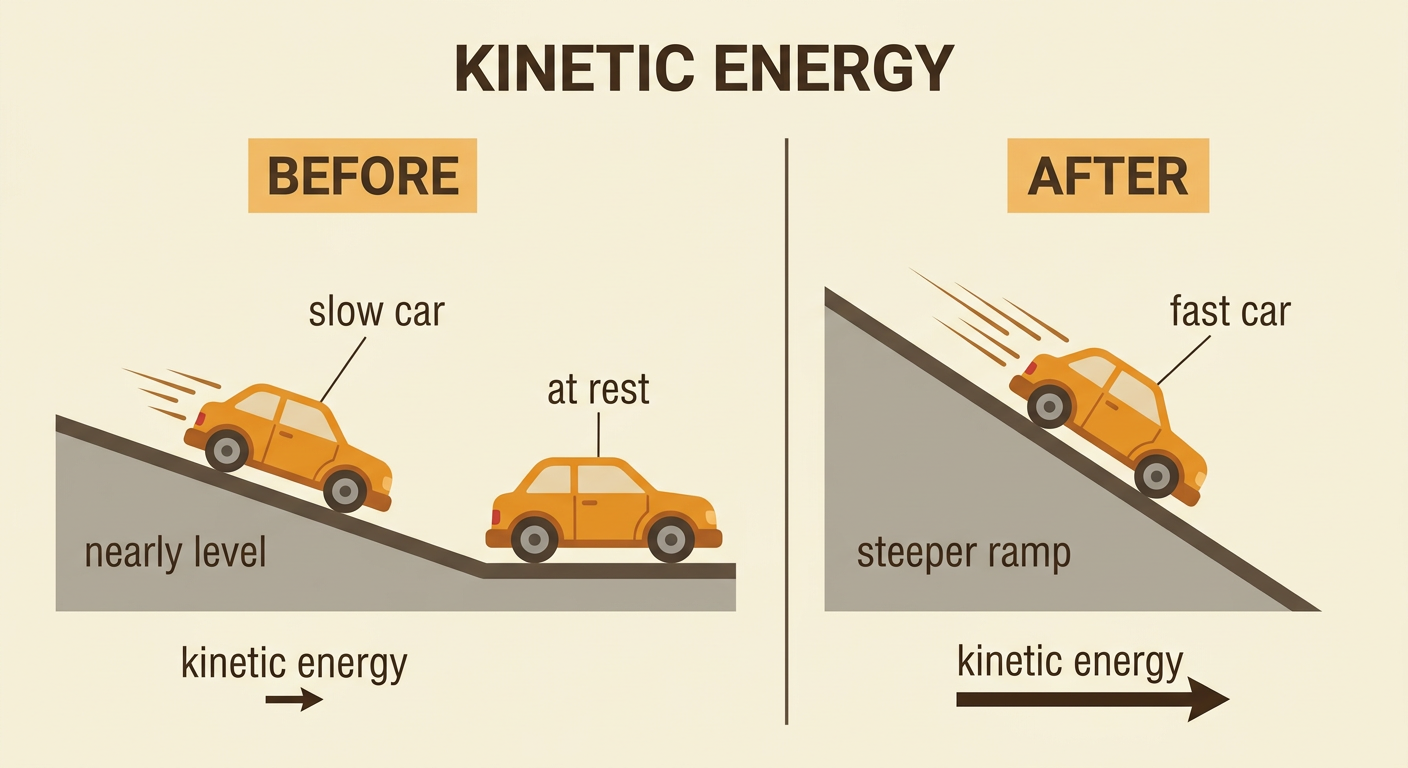
A moving object has motion energy. Scientists call this kinetic energy. An object at rest has no kinetic energy, but it may have other forms of energy. Speed affects how much kinetic energy an object has. When the same object moves faster, it has more kinetic energy. For example, gently rolling a toy car across a floor gives it less motion energy than sending the same car down a steep ramp. The faster car can travel farther or move another object farther when it bumps into it. Mass matters too, so a fair speed investigation uses the same car each time. By keeping the car and other conditions the same, you can focus on how changing speed affects energy.
Comparing Slow and Fast Collisions
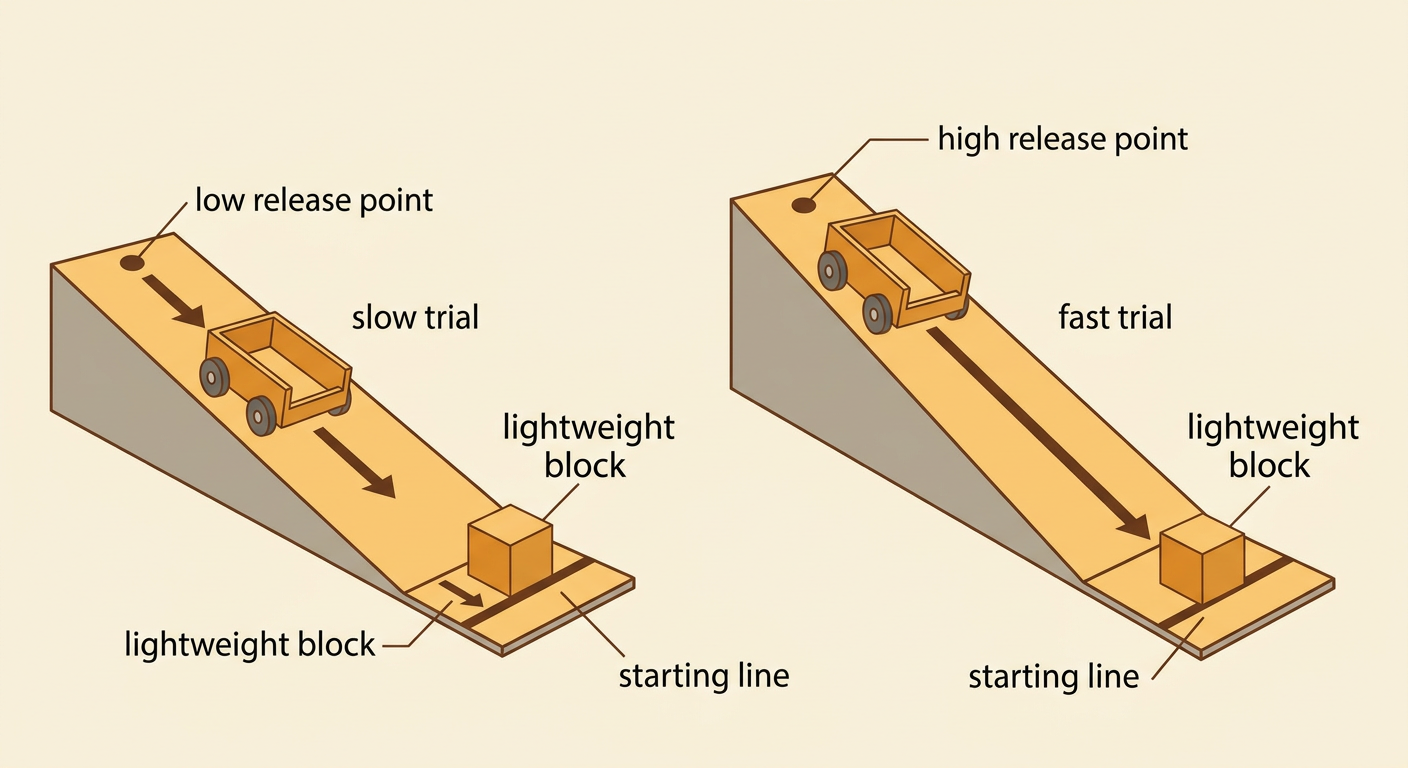
A collision happens when a moving object hits another object. To compare collisions fairly, use the same cart, barrier, surface, and starting direction. Change only the cart’s speed. In a slow trial, release the cart from a low point on a ramp. In a fast trial, release it from a higher point. Let the cart hit a lightweight block placed in the same location each time. The slow cart may move the block a short distance. The fast cart may move it much farther. That difference is evidence that the faster cart had more motion energy to transfer during the collision. Never test collisions with people, animals, glass, or heavy objects. Use classroom materials and keep hands away from the cart’s path.
Recording Observations
Scientists record observations so they can compare evidence instead of relying on memory. Make a data table with columns for trial number, release point, speed description, and distance the block moved. Measure distance from the block’s starting line to its final position using a ruler or measuring tape. Use the same unit, such as centimeters, for every trial. For example, a cart released from 10 centimeters up a ramp might move the block 4 centimeters, while the same cart released from 30 centimeters might move it 15 centimeters. Repeat each setup at least three times because small differences can happen. Record every result, not only the results you expect. Careful measurements make your explanation and safety recommendation more trustworthy.

Speed and Energy Patterns
A pattern is a result that appears again and again. Look across all the trials and compare the cart’s speed with the distance the block moved. If faster trials usually move the block farther, the evidence supports this claim: the same object has more motion energy when it moves faster. For example, suppose slow trials move a block 3, 4, and 4 centimeters, while fast trials move it 13, 15, and 14 centimeters. The fast results are consistently greater, even though they are not identical. Differences between repeated trials may come from measuring, friction, or slightly different releases. Do not claim that every fast collision will have the same result. Instead, explain the overall pattern and identify which measurements support your conclusion.

Evidence-Based Safety Rules
Evidence about motion energy can help communities develop rules that address collision dangers. A strong recommendation states an opinion, gives reasons, and uses investigation results. For example: “Our school should require students to walk scooters near crowded entrances because faster objects have more motion energy and can cause stronger collisions.” Support the rule with data, such as the fast cart moving a block about 14 centimeters while the slow cart moved it about 4 centimeters. School leaders could identify the problem, listen to students, families, and staff, compare possible solutions, and adopt a clear rule. They might add signs, mark a walking zone, and teach the rule. Later, they should review reports and observations to decide whether the policy improves safety or needs revision. Good policies balance safety, fairness, cost, and community needs.
