
Multiply a Fraction by a Whole Number
Students use repeated addition, visual models, and equations to multiply a fraction by a whole number and solve related word problems.

Illustrations are auto-generated and may be placeholders. They can be refreshed to match the narration.
Connect Multiplication and Repeated Addition
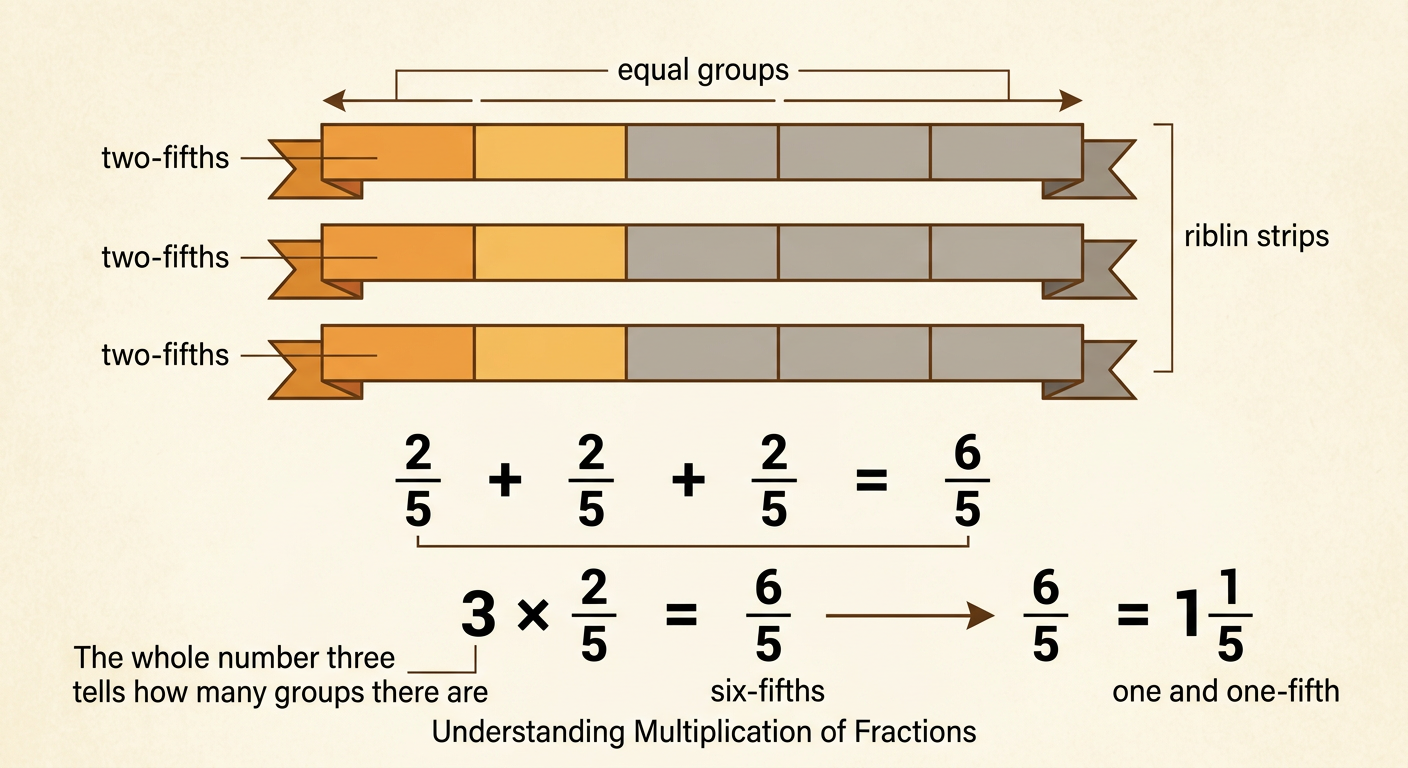
Multiplication can represent equal groups of a fraction, just as it represents equal groups of whole numbers. Suppose you have 3 pieces of ribbon, and each piece is 2/5 yard long. Add the equal lengths: 2/5 + 2/5 + 2/5 = 6/5. You can write the same idea as multiplication: 3 × 2/5 = 6/5. The whole number 3 tells how many equal groups there are. The fraction 2/5 tells the amount in each group. Since each fraction has the same denominator, add the numerators and keep the denominator: 2 + 2 + 2 = 6 fifths. Because 6/5 is greater than one whole, it can also be written as 1 1/5.
Model Fraction Multiplication
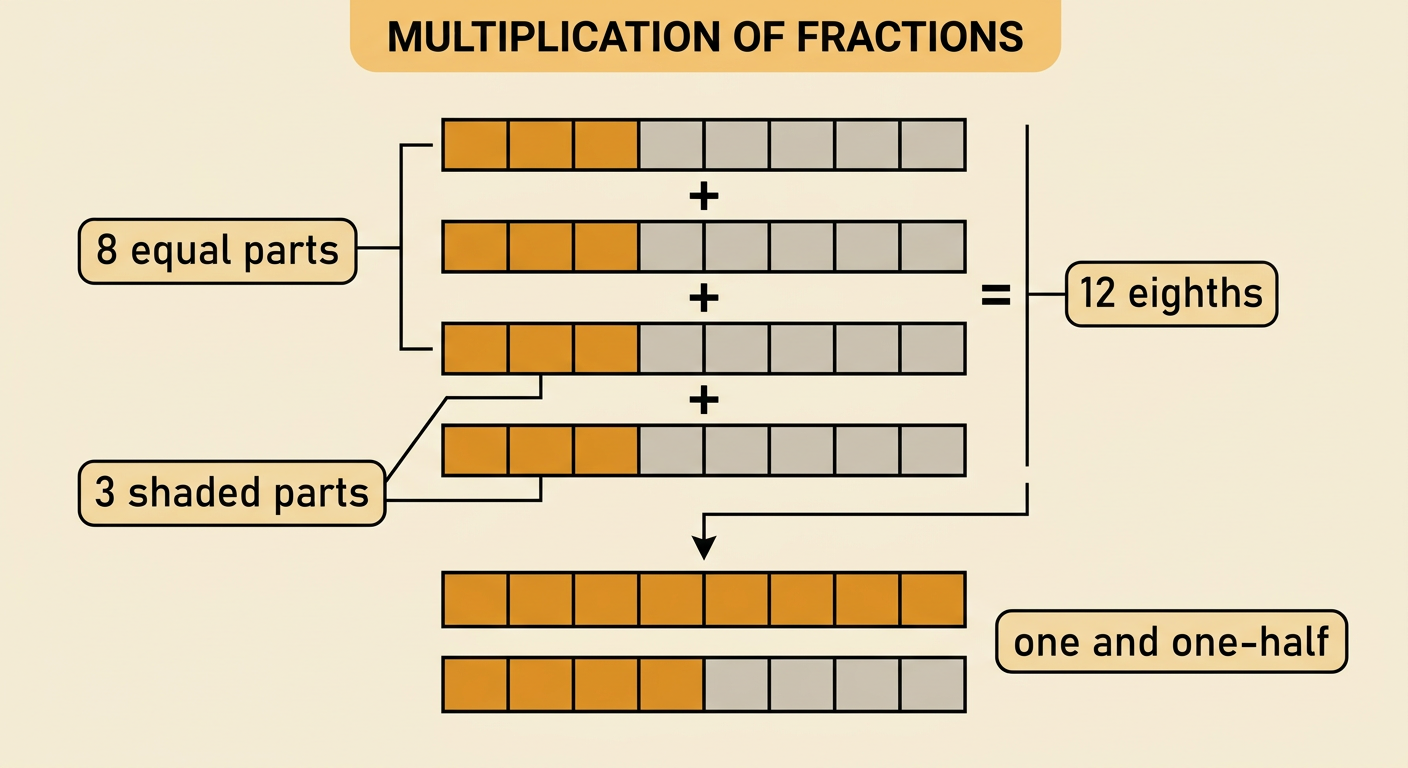
A fraction model helps you see what happens when a fraction is multiplied by a whole number. To model 4 × 3/8, draw four equal bars. Divide every bar into 8 equal parts because the denominator is 8. Shade 3 parts in each bar because the numerator is 3. Altogether, you have shaded 3 + 3 + 3 + 3, or 12 eighths. Therefore, 4 × 3/8 = 12/8. Combine every 8 eighths to make one whole. Then 4 eighths remain, so 12/8 = 1 4/8. Since 4/8 is equal to 1/2, the product is also 1 1/2. The model shows both the multiplication and the size of the answer.
Write Multiplication Equations
You can multiply a fraction by a whole number by multiplying the numerator by the whole number and keeping the denominator. For example, find 5 × 2/6. Multiply 5 × 2 to get 10, and keep the denominator 6. This gives 5 × 2/6 = 10/6. The denominator stays 6 because the size of each part has not changed; the parts are still sixths. Only the number of sixths changes. Convert 10/6 to a mixed number by making one whole from 6/6. Four sixths remain, so 10/6 = 1 4/6. You can simplify 4/6 to 2/3. Therefore, 5 × 2/6 = 1 2/3. An equation records each step clearly.

Solve Real-World Problems
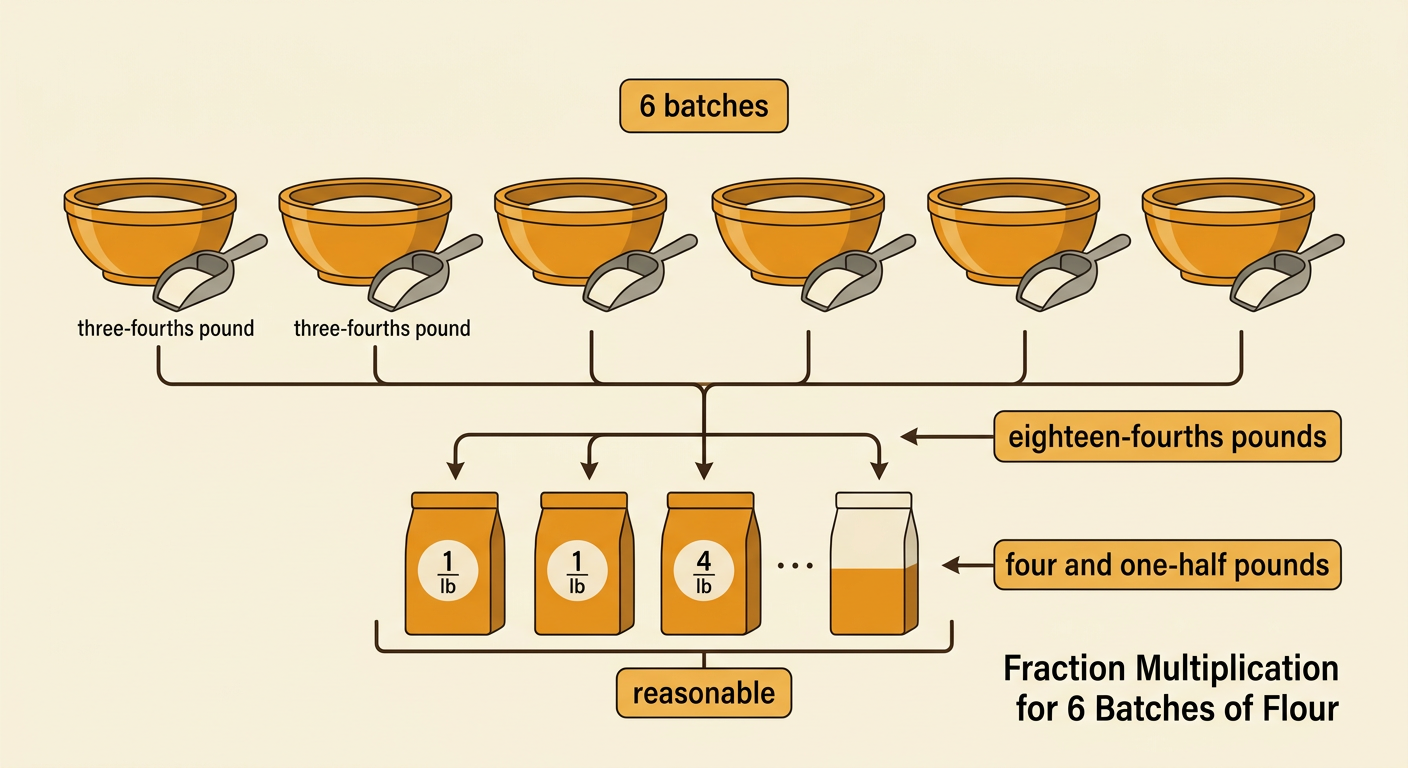
Fraction multiplication can help solve problems involving equal amounts. Imagine that a baker uses 3/4 pound of flour for each batch of bread. The baker makes 6 batches. To find the total amount of flour, multiply the number of batches by the amount for each batch: 6 × 3/4 = 18/4. Convert 18/4 to a mixed number. Four fourths make one whole, so 16/4 makes 4 wholes, with 2/4 left. Thus, 18/4 = 4 2/4, or 4 1/2. The baker uses 4 1/2 pounds of flour. Check that the answer is reasonable: each batch uses a little less than 1 pound, so 6 batches should use a little less than 6 pounds. Four and one-half pounds is reasonable.
Explain and Check
After finding a product, explain what each number means and check whether the answer makes sense. Consider 3 × 5/6. This means 3 equal groups of 5/6. Multiply the whole number and numerator: 3 × 5 = 15. Keep the denominator 6, so 3 × 5/6 = 15/6. Regroup 15 sixths as 12 sixths and 3 sixths. Since 12/6 = 2 and 3/6 = 1/2, the product is 2 1/2. Check with repeated addition: 5/6 + 5/6 + 5/6 = 15/6. You can also estimate. Each group is a little less than 1, so three groups should total a little less than 3. The answer 2 1/2 fits that estimate.
