
Multiplying a Fraction by a Whole Number
Students use visual models and multiplication strategies to find and explain the product of a fraction and a whole number.
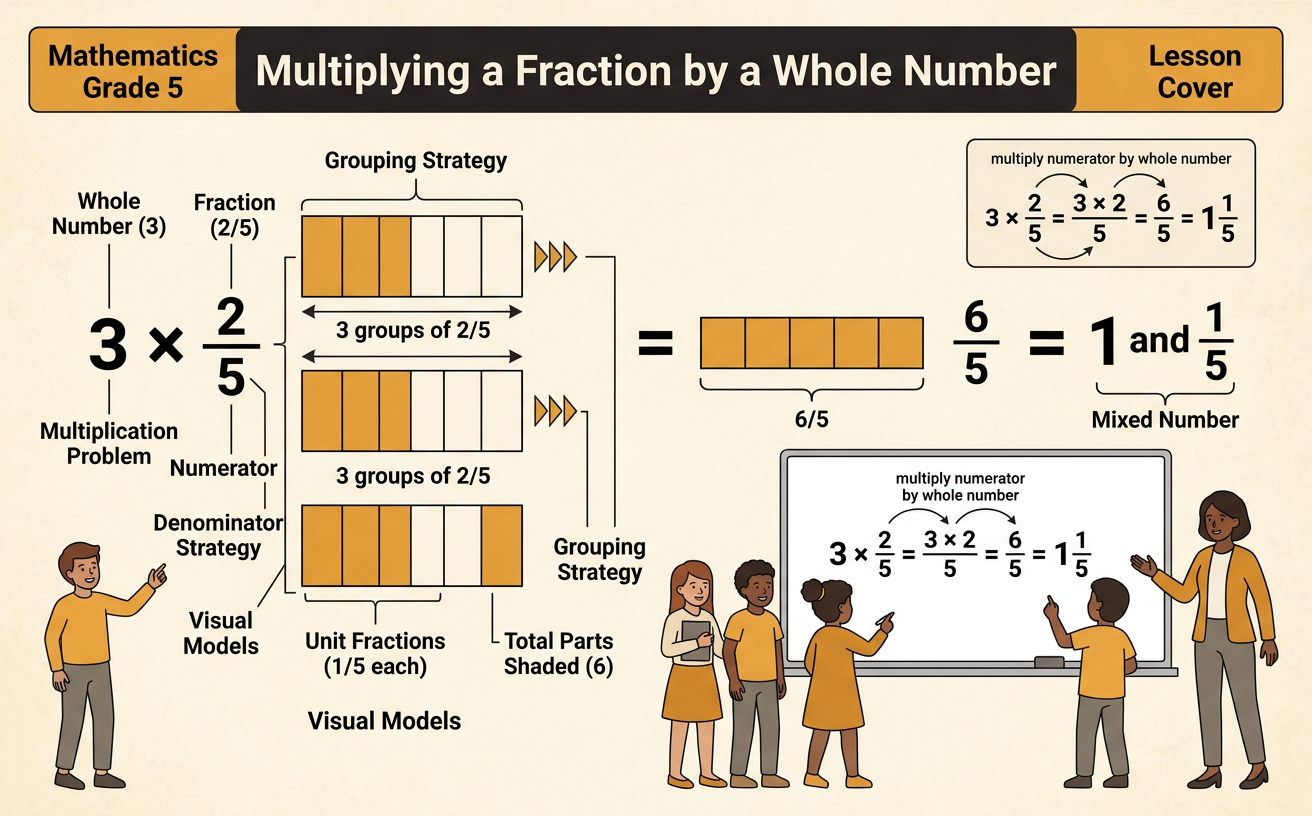
Illustrations are auto-generated and may be placeholders. They can be refreshed to match the narration.
Review Fractions as Equal Parts
A fraction describes equal parts of one whole. In 3/4, the denominator 4 tells us that the whole is divided into four equal parts. The numerator 3 tells us that three of those parts are being counted. Imagine a rectangular pan of cornbread cut into four equal pieces. If three pieces remain, then 3/4 of the pan remains. The pieces must be equal in size for the fraction to be accurate. Fractions can also be greater than one. For example, 5/4 means five one-fourth pieces. That is the same amount as one whole and 1/4 more. Understanding the size of each fractional part will help us combine equal groups of a fraction.

Model Equal Groups of a Fraction
Multiplying a fraction by a whole number means making equal groups of that fraction. Suppose three students each have 2/5 of a yard of ribbon. There are three equal groups of 2/5. Draw three fraction bars, divide each bar into five equal parts, and shade two parts in each bar. Altogether, six one-fifth parts are shaded. Therefore, 3 groups of 2/5 equal 6/5. Since five fifths make one whole, 6/5 can also be written as 1 1/5. The model helps us see both the equal groups and the total amount. Each group must contain the same fraction because multiplication represents equal groups.

Connect Models to Multiplication
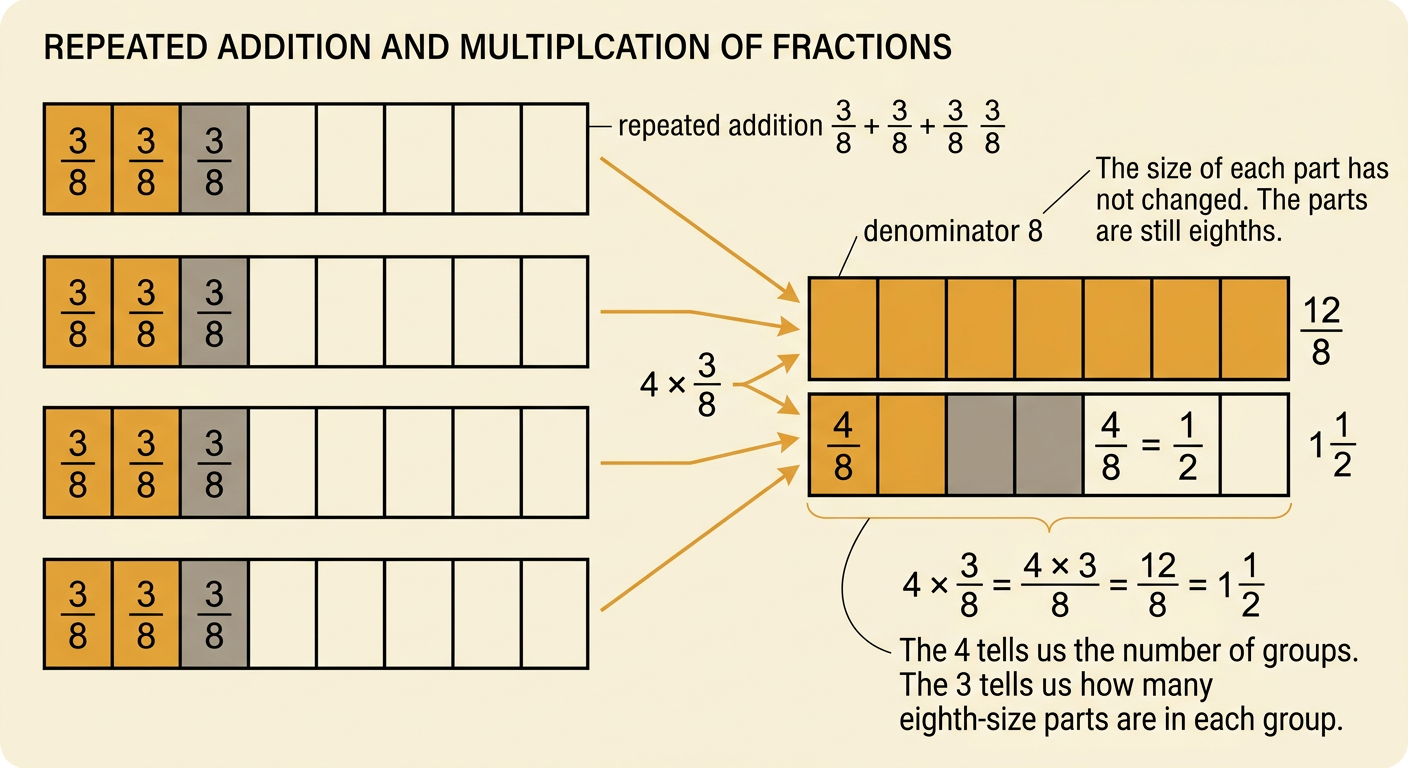
A visual model can be written as repeated addition and then as multiplication. Consider four groups of 3/8. Repeated addition gives 3/8 + 3/8 + 3/8 + 3/8. Multiplication records the same idea more briefly: 4 × 3/8. There are four groups, and each group contains three eighths, so the total contains 4 × 3, or 12, one-eighth parts. Thus, 4 × 3/8 = 12/8 = 1 1/2. The denominator stays 8 because the size of each part does not change; the parts are still eighths. Only the number of eighth-size parts changes. This gives the rule 4 × 3/8 = (4 × 3)/8.
Practice Finding Products
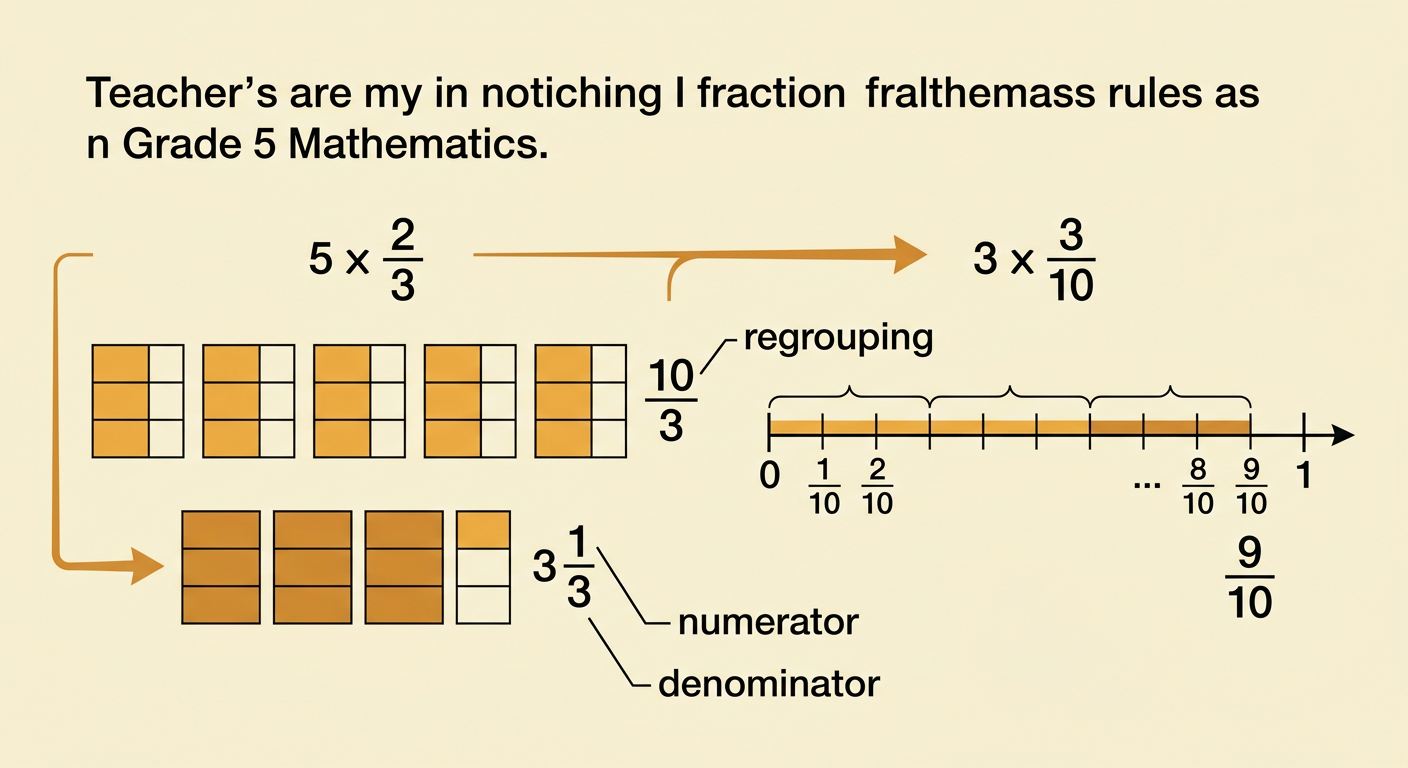
To multiply a whole number by a fraction, multiply the whole number by the numerator and keep the denominator. Then simplify or rename the product if needed. For example, 5 × 2/3 = (5 × 2)/3 = 10/3. Ten thirds can be regrouped as three wholes and 1/3, so the product is 3 1/3. Try another example: 3 × 3/10 = 9/10. Because 9 and 10 have no common factor greater than 1, the fraction is already in simplest form. Before calculating, identify the number of groups and the amount in each group. After calculating, decide whether the answer is less than one, equal to one, or greater than one.
Explain and Check Solutions
A complete solution tells what the factors and product mean, not just the answer. Suppose six bottles each hold 1/4 liter of water. The equation is 6 × 1/4 = 6/4 = 1 1/2 liters. You can explain that six equal groups of one-fourth make six fourths, which can be regrouped as one whole and two fourths. Since 2/4 equals 1/2, the product is 1 1/2. Check the result with estimation: four groups of 1/4 make exactly one, so six groups should make more than one but less than two. The answer 1 1/2 is reasonable. You can also compare your equation with a fraction model to confirm that every equal group is represented.
