
Multiplying and Dividing Rational Numbers
Students use sign rules, number patterns, and real-world contexts to multiply and divide positive and negative rational numbers.

Illustrations are auto-generated and may be placeholders. They can be refreshed to match the narration.
Reviewing Rational Numbers and Signs
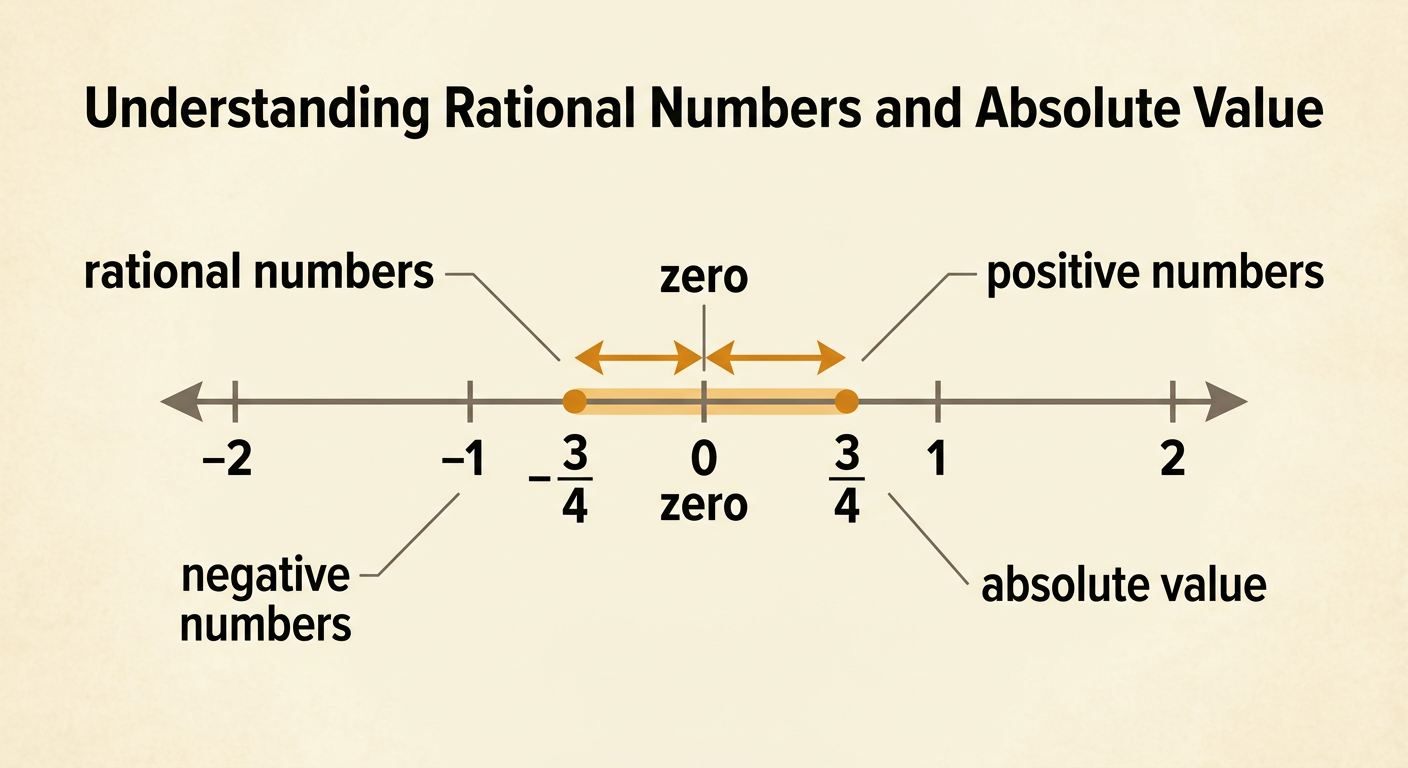
A rational number is any number that can be written as a fraction of two integers, with a denominator that is not zero. Rational numbers include integers, fractions, terminating decimals, and repeating decimals. Positive numbers are greater than zero, while negative numbers are less than zero. On a number line, positive numbers appear to the right of zero and negative numbers appear to the left. The absolute value of a number is its distance from zero, so it is always nonnegative. For example, −3/4 and 3/4 have the same absolute value, 3/4, but they are on opposite sides of zero. When multiplying or dividing rational numbers, first consider their signs. Then calculate using their absolute values. Keeping these two steps separate can prevent sign errors.
Discovering Multiplication Sign Rules
Patterns reveal the sign rules for multiplication. Begin with 3 × 2 = 6. If the second factor decreases by one each time, the products also decrease by 3: 3 × 1 = 3, 3 × 0 = 0, and 3 × (−1) = −3. This shows that a positive number times a negative number is negative. A similar pattern shows that a negative number times a negative number is positive. For example, (−4) × 3 = −12, while (−4) × (−3) = 12. In general, factors with the same sign have a positive product. Factors with different signs have a negative product. After deciding the sign, multiply the absolute values. Thus, (−2.5) × 4 = −10 because the signs differ and 2.5 × 4 = 10.

Dividing Positive and Negative Numbers
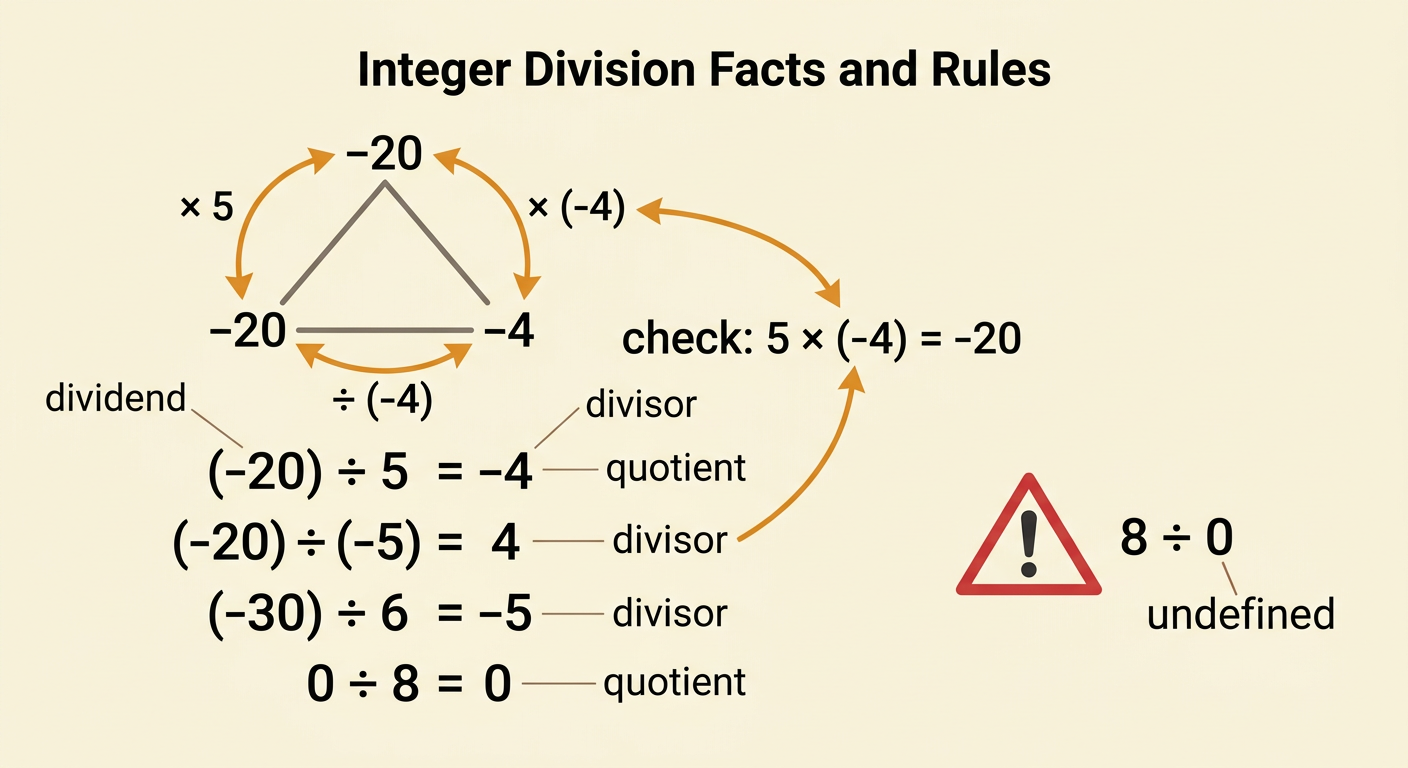
Division follows the same sign rules as multiplication because division and multiplication are inverse operations. A quotient is positive when the dividend and divisor have the same sign. A quotient is negative when they have different signs. For example, (−20) ÷ 5 = −4 because the signs differ. You can check the quotient by multiplying: 5 × (−4) = −20. Also, (−20) ÷ (−5) = 4 because both numbers have the same sign, and (−5) × 4 = −20. To divide, first determine the sign of the quotient. Then divide the absolute values. Remember that zero divided by any nonzero number equals zero, but division by zero is undefined. For instance, 0 ÷ (−8) = 0, while 8 ÷ 0 has no value.
Working with Fractions and Decimals
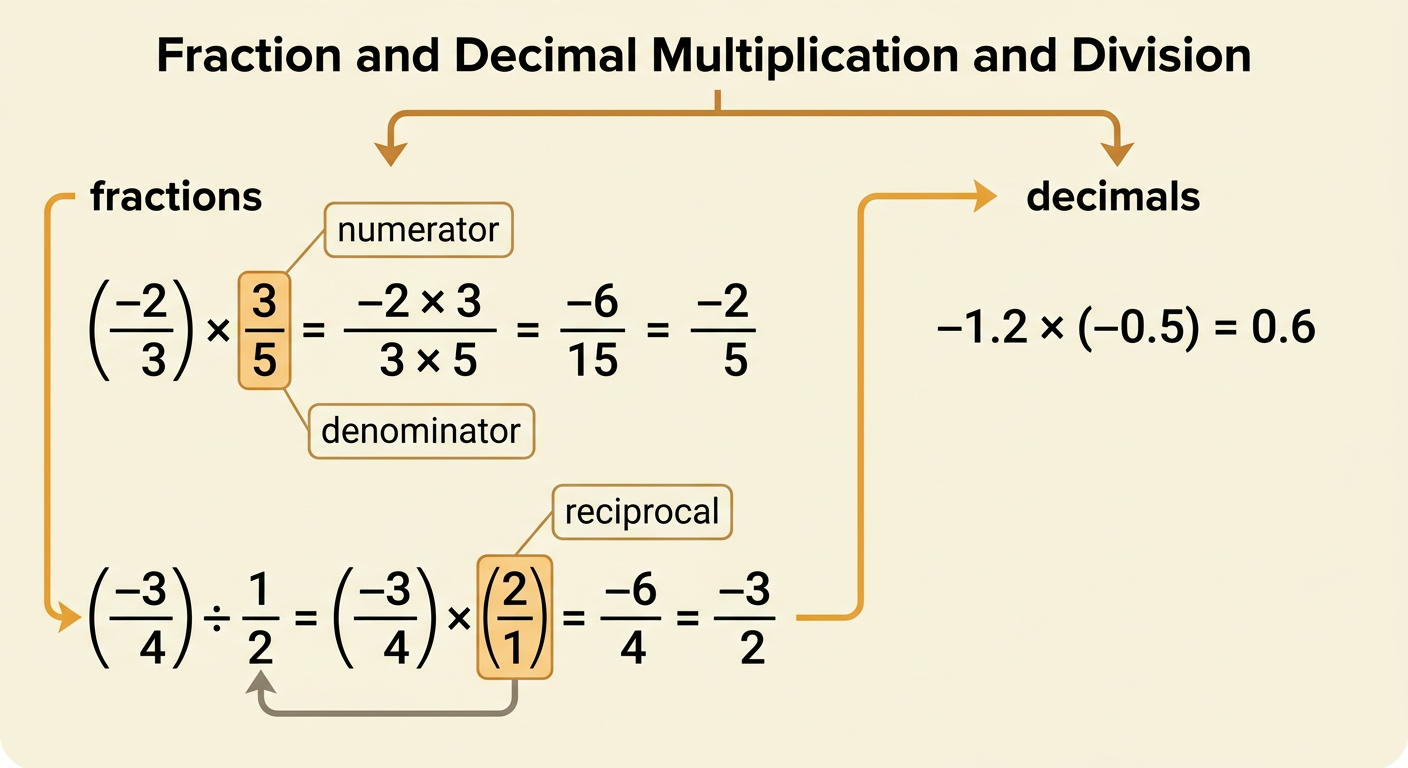
The sign rules apply to fractions and decimals just as they apply to integers. To multiply fractions, decide the sign, multiply the numerators, multiply the denominators, and simplify. For example, (−2/3) × (3/5) has different signs, so the product is negative. Multiplying gives −6/15, which simplifies to −2/5. To divide by a fraction, multiply by its reciprocal. Thus, (−3/4) ÷ (1/2) becomes (−3/4) × (2/1) = −6/4 = −3/2. With decimals, use ordinary decimal multiplication or division and then apply the sign. For example, −1.2 × (−0.5) = 0.6 because the factors have the same sign. Converting decimals to fractions can also help: 1.2 = 6/5 and 0.5 = 1/2.
Solving Real-World Problems
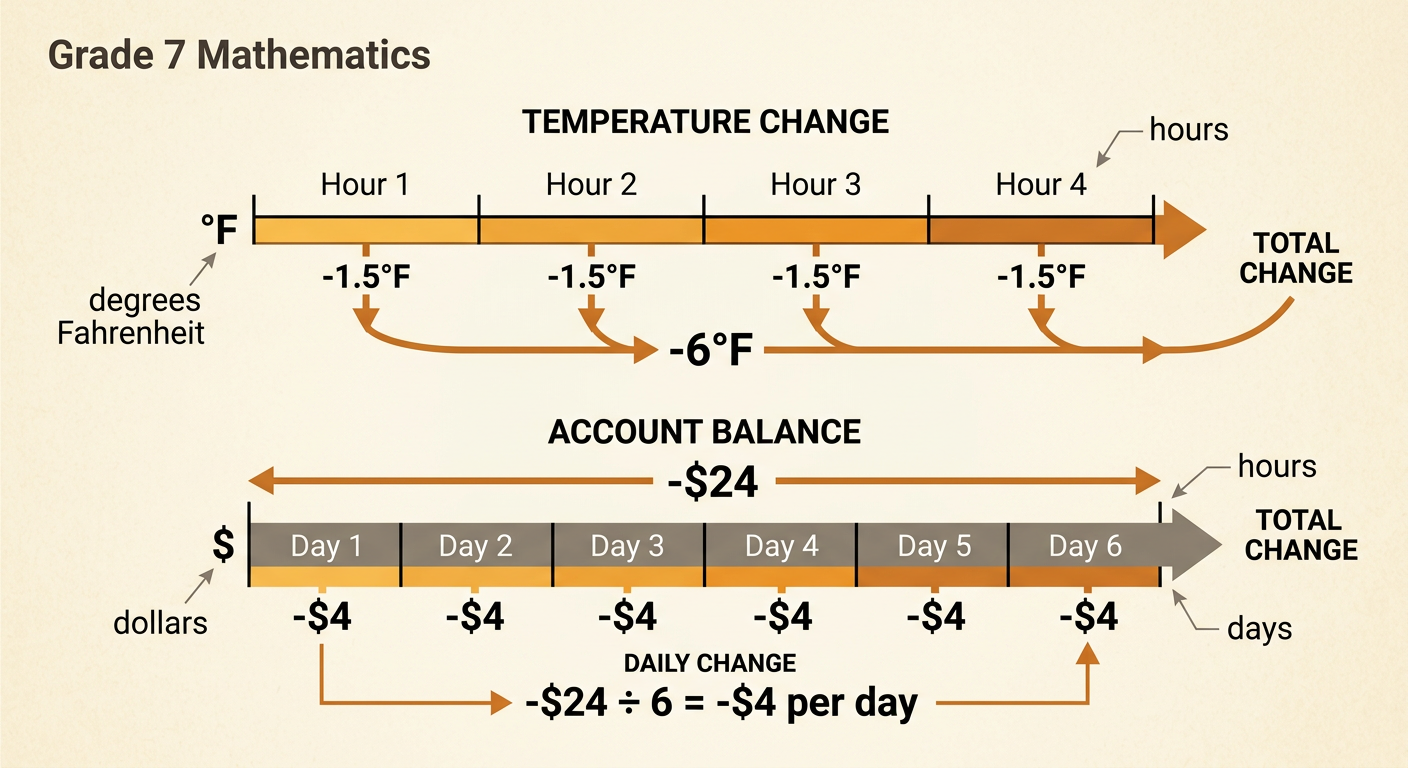
Positive and negative rational numbers can represent changes, debts, temperatures, elevations, and rates. Pay attention to what each sign means in the situation. Suppose a temperature changes by −1.5 degrees Fahrenheit each hour for 4 hours. The total change is 4 × (−1.5) = −6 degrees Fahrenheit, so the temperature drops by 6 degrees. Division can help find an equal rate or share. Suppose an account balance changes by −$24 over 6 days at a constant rate. The daily change is (−24) ÷ 6 = −4, meaning the balance decreases by $4 each day. A negative answer does not always mean something is wrong; it often describes a decrease or a direction. Include units in the answer and explain the meaning of the sign in context.
Checking Signs and Reasonableness
Before calculating, predict whether the answer should be positive or negative. Same signs produce a positive result, while different signs produce a negative result. Next, estimate with nearby numbers to see whether the size of the answer is reasonable. For example, consider (−7.2) ÷ 1.8. The signs differ, so the quotient must be negative. Since −7.2 is close to −8 and 1.8 is close to 2, an estimate is −8 ÷ 2 = −4. The exact quotient is −4, which agrees with the estimate. Finally, use the inverse operation to check: 1.8 × (−4) = −7.2. If the sign, estimate, and inverse-operation check do not agree, review the calculation. These quick checks help catch misplaced decimals, incorrect signs, and arithmetic errors.
