Multiplying and Dividing Rational Numbers
Students use sign rules, number properties, and real-world contexts to multiply and divide positive and negative rational numbers.

Illustrations are auto-generated and may be placeholders. They can be refreshed to match the narration.
Reviewing Rational Numbers and Absolute Value
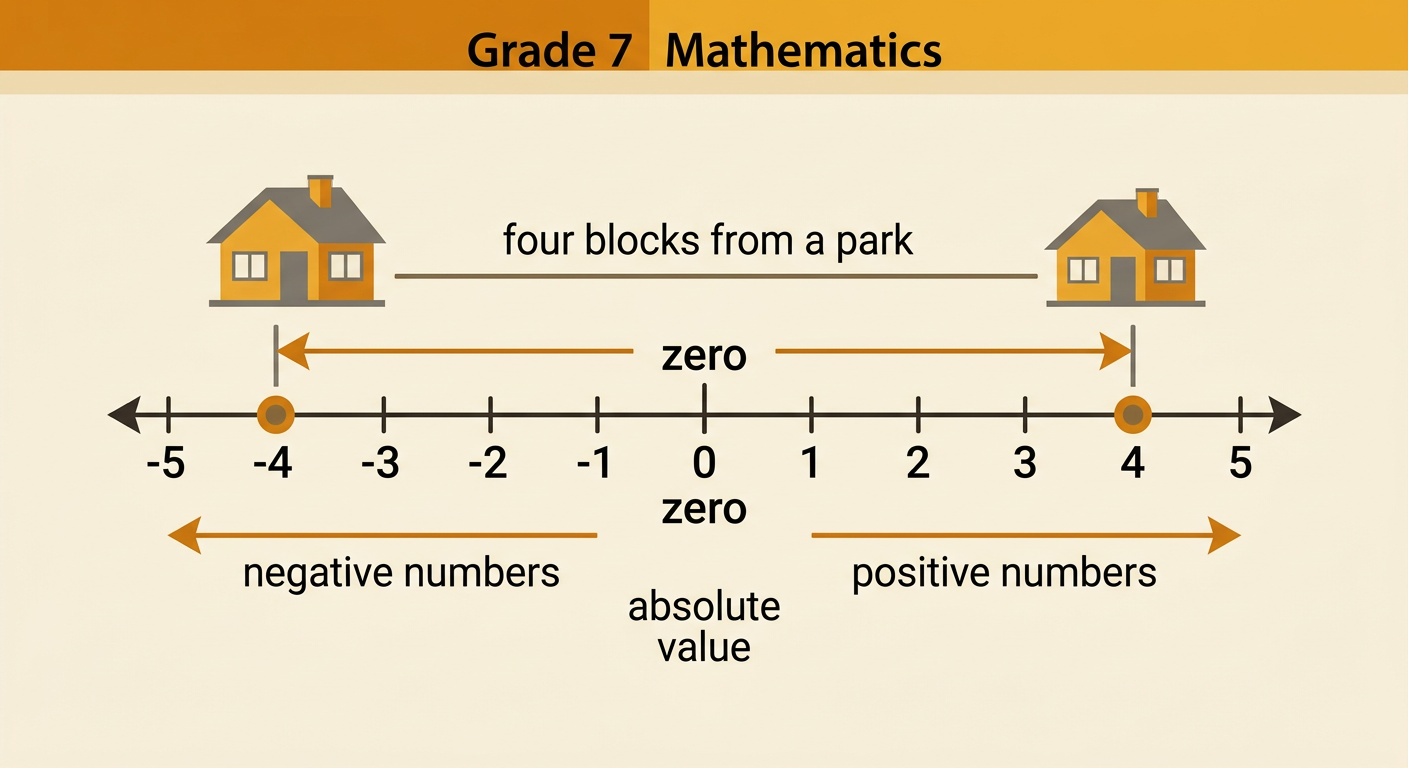
A rational number is any number that can be written as a fraction of two integers, with a nonzero denominator. Integers, fractions, terminating decimals, and repeating decimals are rational numbers. Positive numbers lie to the right of zero on a number line, while negative numbers lie to the left. A number’s absolute value is its distance from zero, so absolute value is never negative. For example, −4 and 4 are opposites because they are the same distance from zero in different directions. Both have an absolute value of 4. Absolute value helps compare sizes before multiplying or dividing. For instance, |−3.5| = 3.5 and |2| = 2, so the product of their absolute values is 7. The signs determine whether the final product is positive or negative.
Discovering Sign Rules for Products
To multiply rational numbers, multiply their absolute values and then determine the sign. Two factors with the same sign have a positive product. Two factors with different signs have a negative product. A pattern helps explain these rules. Consider products with −3: (−3)(2) = −6, (−3)(1) = −3, and (−3)(0) = 0. As the second factor decreases by 1, each product increases by 3. Continuing the pattern gives (−3)(−1) = 3 and (−3)(−2) = 6. Therefore, a negative times a negative is positive. For more than two factors, count the negative factors. An even number of negative factors produces a positive product, while an odd number produces a negative product. For example, (−2)(−4)(3) = 24.

Dividing Positive and Negative Rational Numbers
Division follows the same sign rules as multiplication. A quotient is positive when the dividend and divisor have the same sign. A quotient is negative when they have different signs. First divide the absolute values, and then apply the correct sign. For example, −24 ÷ 6 has factors with different signs, so the quotient is negative: −24 ÷ 6 = −4. In contrast, −24 ÷ −6 has two negative signs, so the quotient is positive: −24 ÷ −6 = 4. You can justify a quotient by using the related multiplication equation. Since 4 × (−6) = −24, it follows that −24 ÷ −6 = 4. Remember that zero divided by any nonzero number equals zero, but division by zero is undefined.

Working with Fractions and Decimals
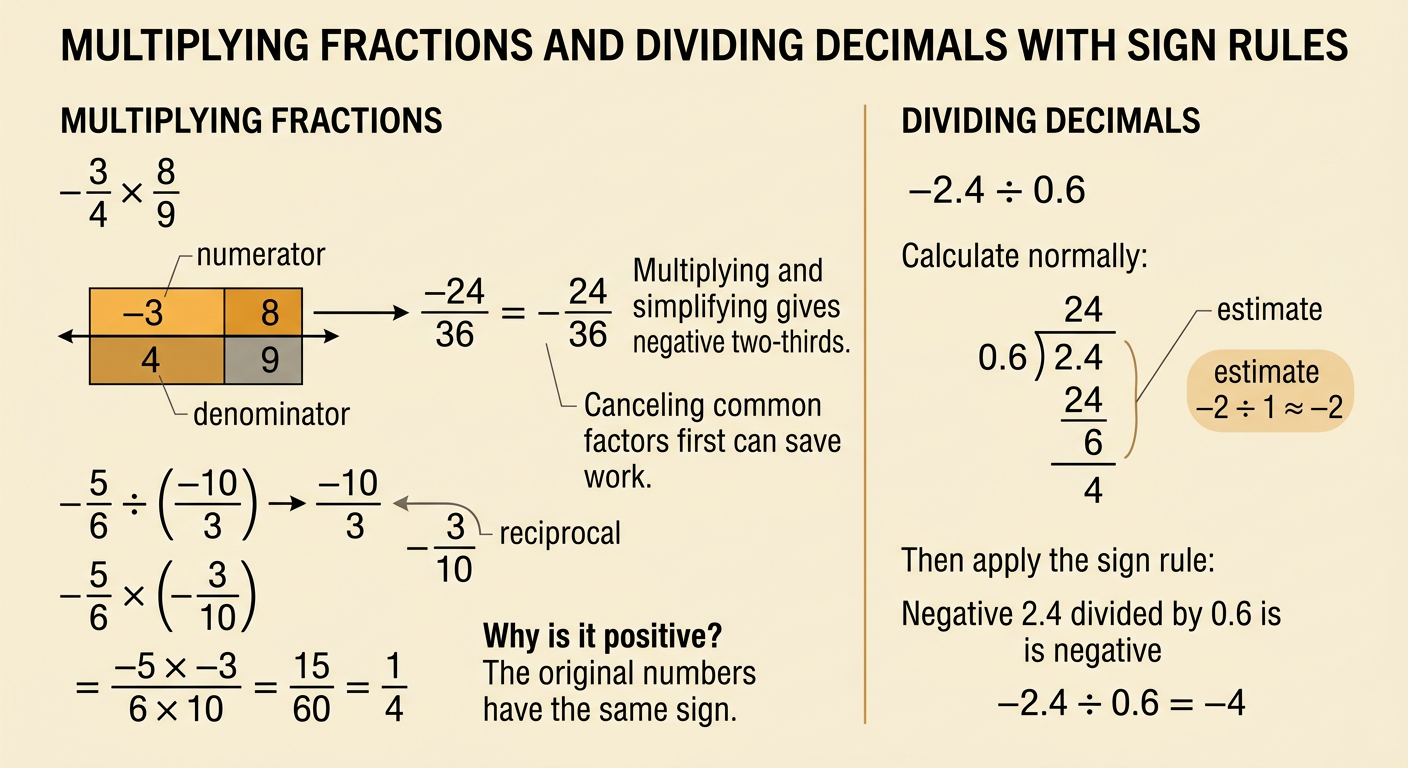
The sign rules apply to rational numbers in fraction and decimal form. To multiply fractions, multiply the numerators, multiply the denominators, and simplify. For example, (−3/4)(8/9) = −24/36 = −2/3 because the factors have different signs. Canceling common factors before multiplying can make the calculation easier. To divide fractions, multiply by the reciprocal of the divisor. For example, (−5/6) ÷ (−10/3) becomes (−5/6)(−3/10) = 15/60 = 1/4. With decimals, use the usual multiplication or division procedure and then apply the sign rule. For example, −2.4 ÷ 0.6 = −4. Estimate first when helpful: 2.4 ÷ 0.6 is 4, and the different signs make the answer negative.
Solving Real-World Problems
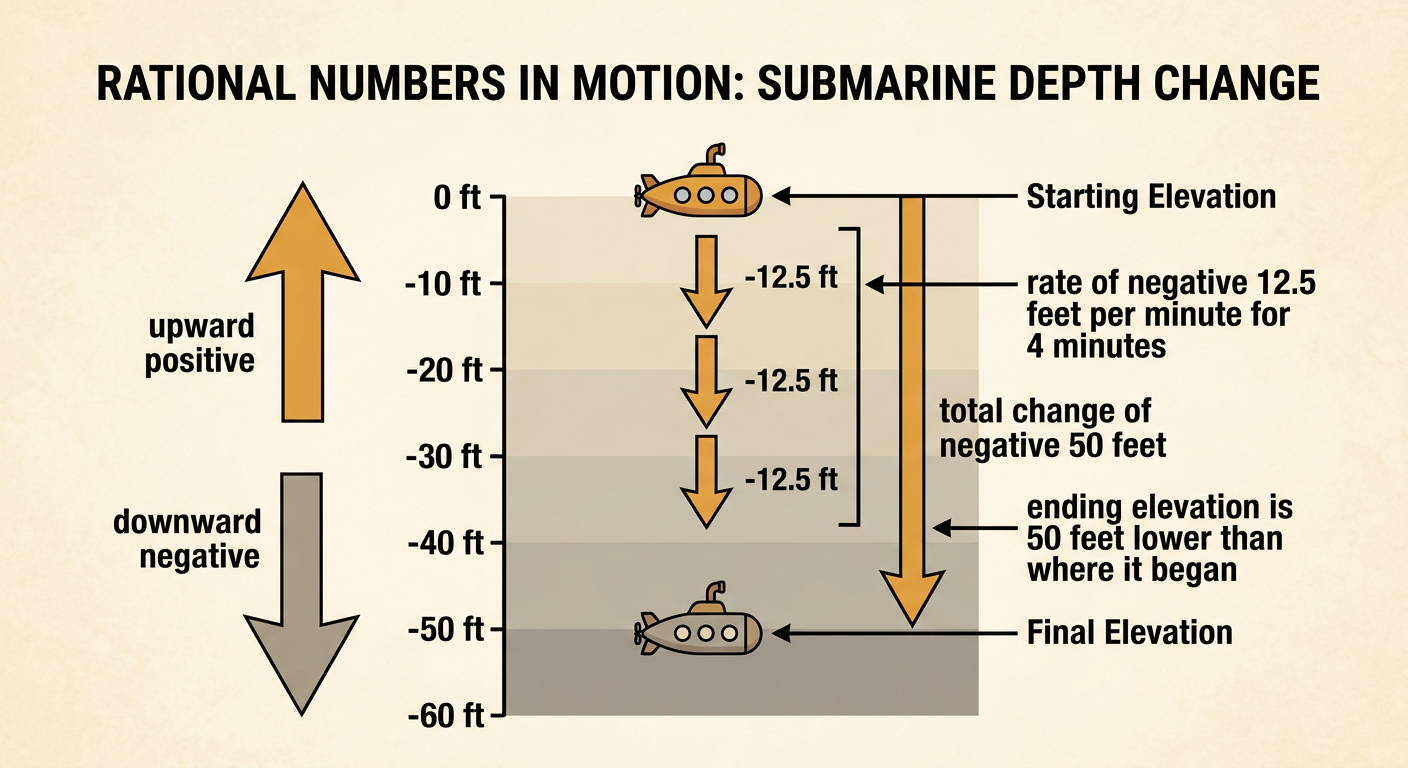
Positive and negative rational numbers can represent changes, rates, elevations, money, and temperature. Choose a positive direction and interpret negative values as movement or change in the opposite direction. Suppose a submarine descends at 12.5 feet per minute for 4 minutes. If upward is positive, the rate is −12.5 feet per minute. The total change is (−12.5)(4) = −50 feet, so the submarine ends 50 feet lower than where it began. Division can answer a related question. If the submarine changes elevation by −50 feet at a rate of −12.5 feet per minute, the elapsed time is (−50) ÷ (−12.5) = 4 minutes. The positive answer makes sense because time elapsed is positive. Always include units and explain what the sign means in the situation.
Checking Signs and Reasonableness
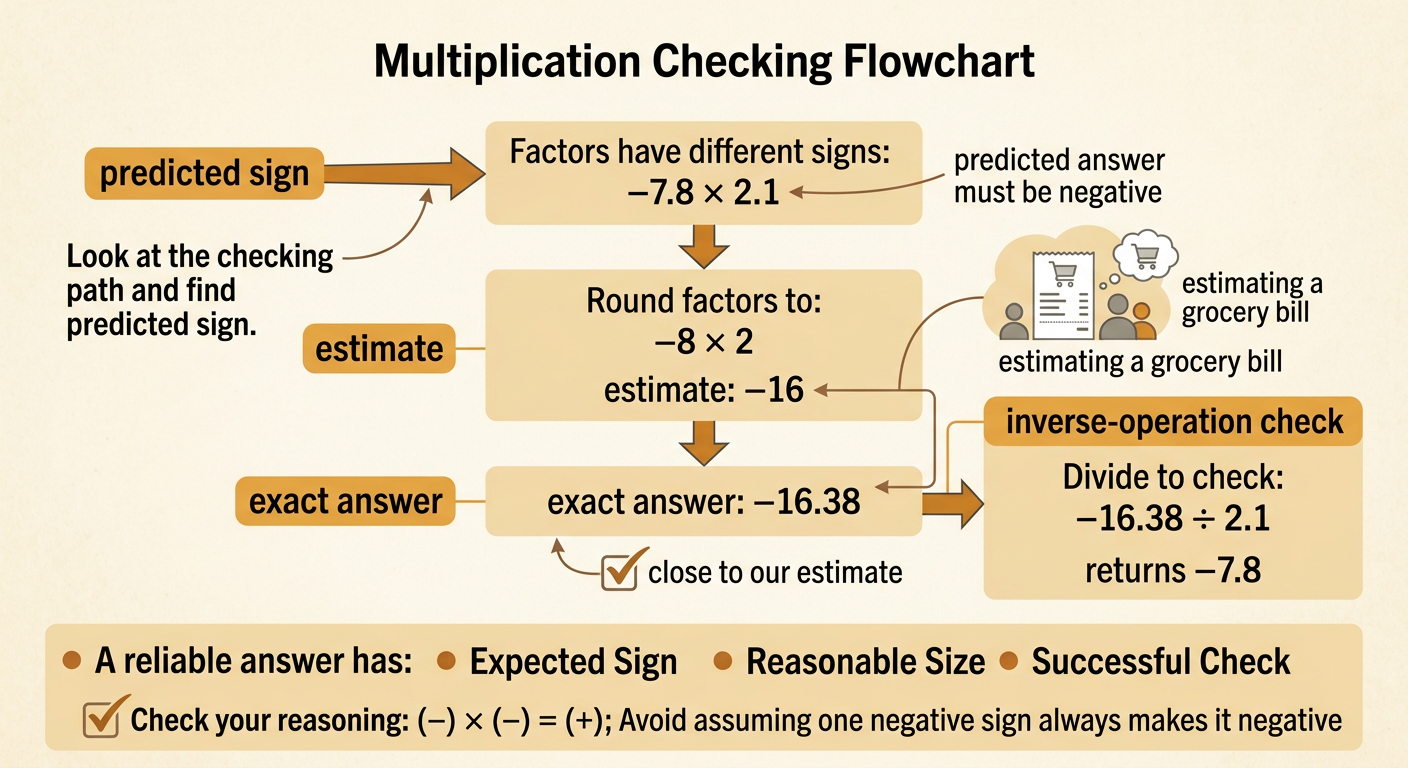
Before calculating, predict the sign of the answer. Then estimate using nearby numbers to decide whether the magnitude is reasonable. For example, consider (−7.8)(2.1). The factors have different signs, so the product must be negative. Rounding gives (−8)(2) = −16, so the exact answer should be close to −16. Calculating gives −16.38, which matches both predictions. You can also check multiplication with division: −16.38 ÷ 2.1 = −7.8. For a quotient, multiply the quotient by the divisor to recover the dividend. Watch for common errors, such as treating every negative sign as making the answer negative or forgetting that two negative signs produce a positive result. A correct solution should have the expected sign, a reasonable size, and a valid inverse-operation check.