
Multiplying and Dividing Rational Numbers
Students use sign rules, number sense, and real-world contexts to multiply and divide positive and negative rational numbers.

Illustrations are auto-generated and may be placeholders. They can be refreshed to match the narration.
Review Rational Numbers and Signs
A rational number is any number that can be written as a fraction of two integers, with a nonzero denominator. Integers, fractions, terminating decimals, and repeating decimals are rational numbers. A positive number is greater than zero, while a negative number is less than zero. The absolute value of a number is its distance from zero, so it is always nonnegative. For example, the absolute values of −4 and 4 are both 4. Before multiplying or dividing rational numbers, notice each number’s sign and size. In the expression (−3)(5), the factors have different signs, and their absolute values are 3 and 5. These observations help determine both the sign and the absolute value of the product.

Model Multiplication with Integers
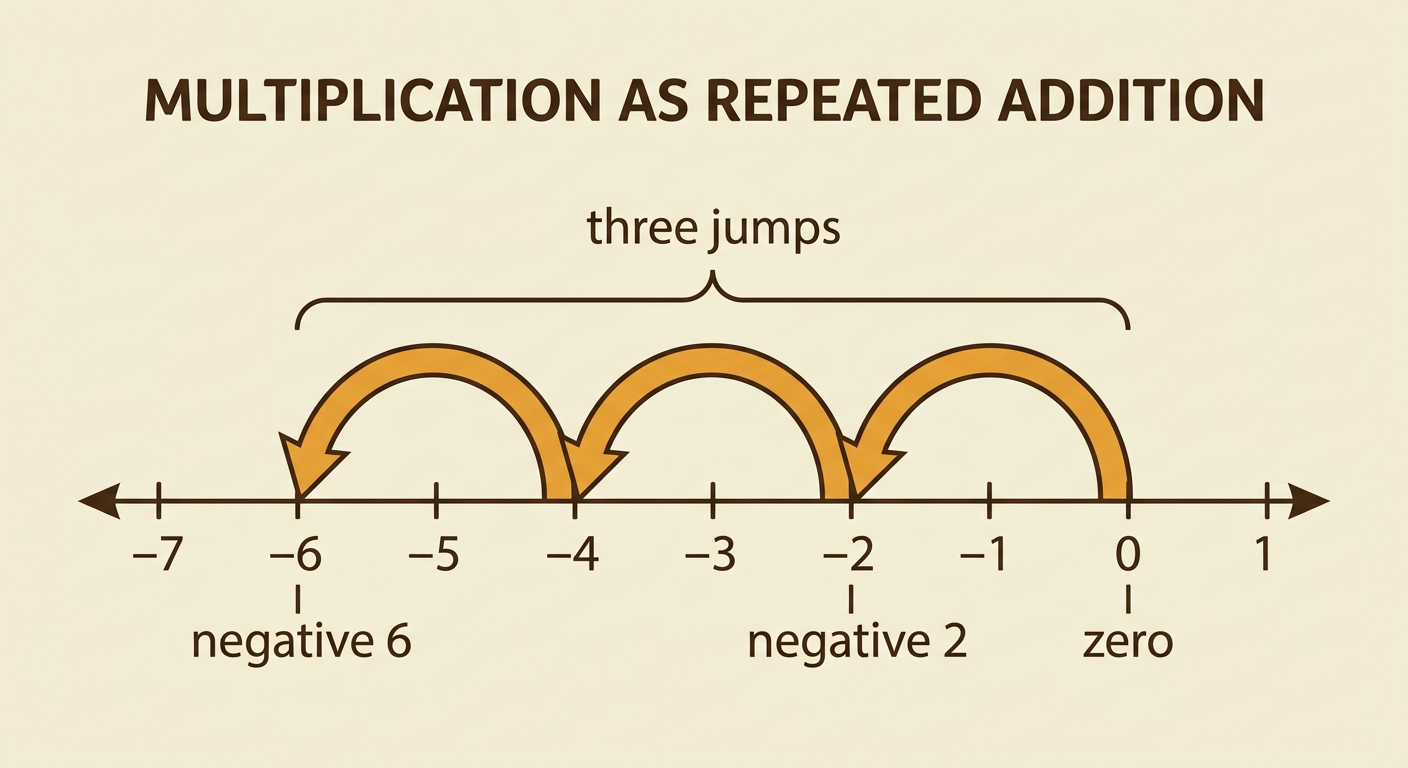
Multiplication can represent repeated addition. For example, 3 × (−2) means three groups of −2. Adding the groups gives (−2) + (−2) + (−2) = −6. On a number line, begin at zero and make three jumps of 2 units to the left. You land at −6, so 3 × (−2) = −6. The factor 3 tells how many equal jumps to make, and the factor −2 gives the direction and length of each jump. In the same way, 4 × 3 is four jumps of 3 units to the right, giving 12. Number-line models make it clear that repeated addition of a negative number produces a negative product.
Develop Rules for Products
Patterns reveal the sign rules for multiplication. Consider products with −3: 2 × (−3) = −6, 1 × (−3) = −3, and 0 × (−3) = 0. As the first factor decreases by 1, each product increases by 3. Continuing the pattern gives (−1) × (−3) = 3 and (−2) × (−3) = 6. This shows why the product of two negative numbers is positive. The complete rules are: factors with the same sign have a positive product, and factors with different signs have a negative product. First multiply the absolute values, and then apply the sign rule. For example, (−7)(−4) is positive, and 7 × 4 = 28, so (−7)(−4) = 28.

Connect Division to Multiplication
Division and multiplication are inverse operations. To find −24 ÷ 6, ask, “What number multiplied by 6 equals −24?” Because 6 × (−4) = −24, the quotient is −4. Division follows the same sign rules as multiplication: numbers with the same sign have a positive quotient, and numbers with different signs have a negative quotient. For example, (−35) ÷ (−7) = 5 because (−7)(5) = −35. To divide rational numbers, determine the sign, divide the absolute values, and check by multiplication. Division by zero is never defined because no number multiplied by zero can produce a nonzero dividend. However, zero divided by any nonzero number equals zero, such as 0 ÷ 8 = 0.

Practice with Fractions and Decimals
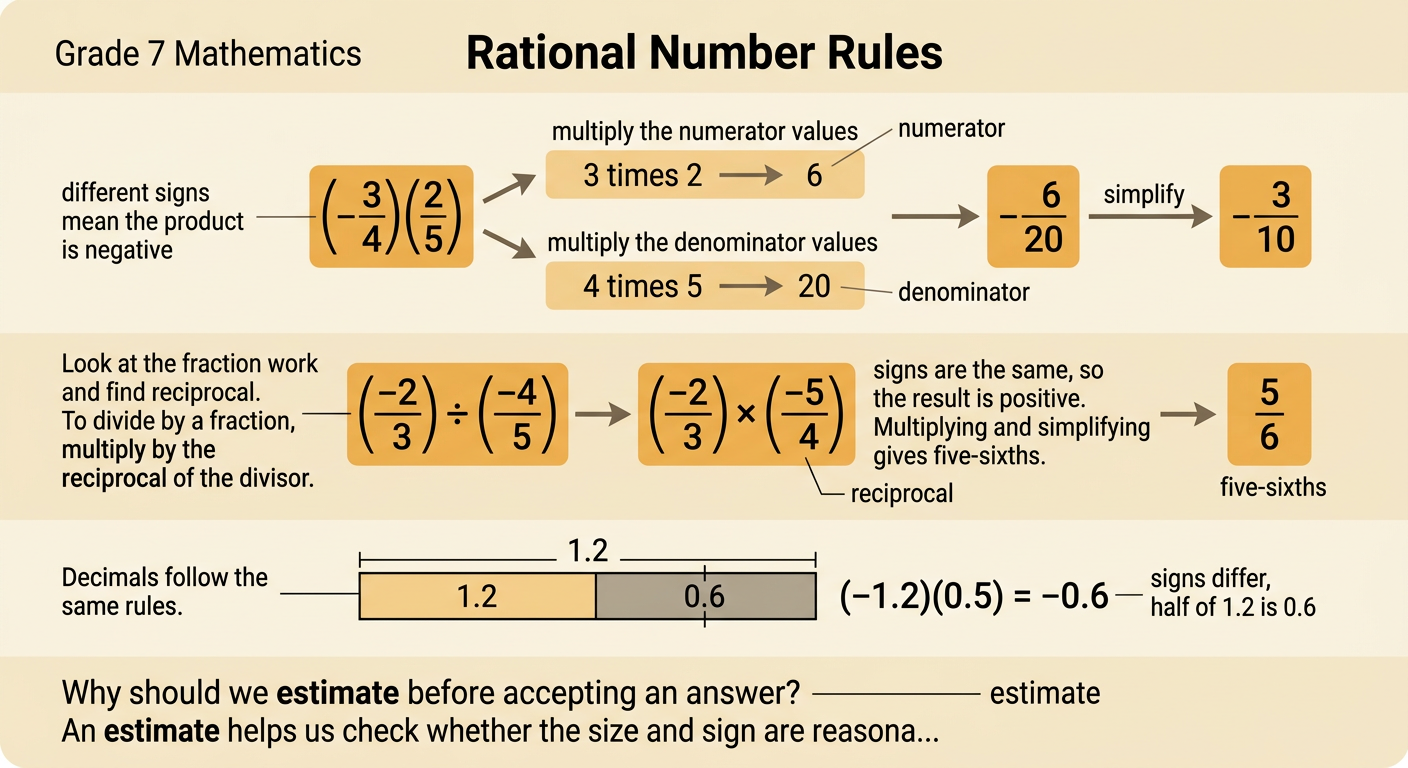
The sign rules apply to all rational numbers, including fractions and decimals. To multiply (−3/4)(2/5), first determine that different signs give a negative product. Multiply the numerators and denominators: 3 × 2 = 6 and 4 × 5 = 20. Simplify −6/20 to −3/10. To divide fractions, multiply by the reciprocal of the divisor. For example, (−2/3) ÷ (−4/5) becomes (−2/3)(−5/4) = 10/12 = 5/6. The quotient is positive because the signs are the same. With decimals, use the same process. For example, −1.2 × 0.5 = −0.6 because different signs give a negative product and half of 1.2 is 0.6. Estimate first to check whether an answer is reasonable.
Solve a Real-World Problem
Rational-number operations can describe repeated changes in real situations. Suppose a scuba diver descends 2.5 meters per minute for 6 minutes. A descent is represented by a negative change, so the diver’s change in elevation is 6 × (−2.5) = −15 meters. The negative product means the diver moved 15 meters downward. If the diver changed elevation by −15 meters at a constant rate of −2.5 meters per minute, the time can be found with division: (−15) ÷ (−2.5) = 6 minutes. The quotient is positive because both numbers are negative. Always interpret the sign in context. A negative distance change indicates direction below the starting level, while the positive time tells how long the movement lasted.
