
Multiplying Decimals to Hundredths
Students use place-value reasoning and visual models to multiply decimals to hundredths and explain the placement of the decimal point.

Illustrations are auto-generated and may be placeholders. They can be refreshed to match the narration.
Review Decimal Place Value
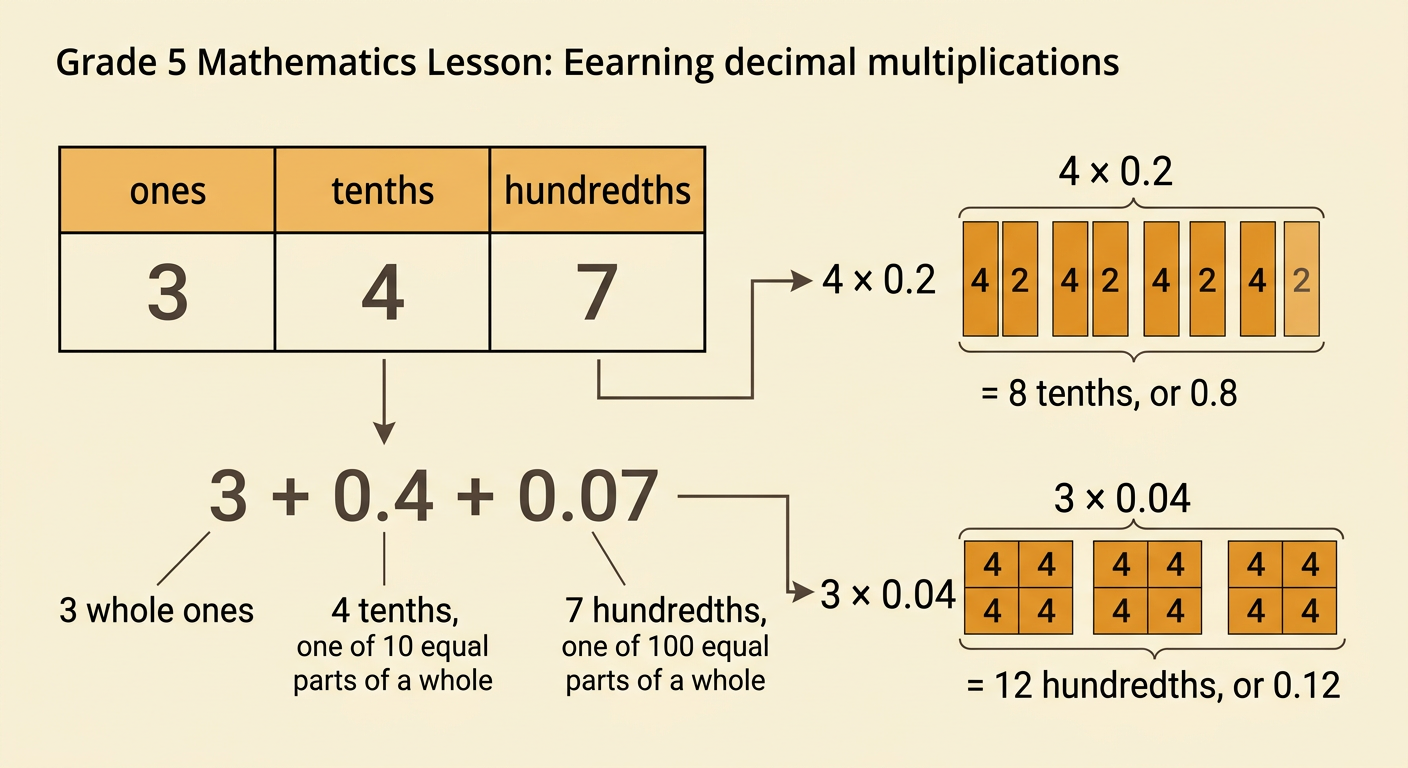
The value of a digit depends on its place. In 3.47, the 3 means 3 ones, the 4 means 4 tenths, and the 7 means 7 hundredths. A tenth is one of 10 equal parts of a whole. A hundredth is one of 100 equal parts. Therefore, 3.47 can be written as 3 + 0.4 + 0.07. Place value helps us understand multiplication. For example, 4 × 0.2 means 4 groups of 2 tenths. That equals 8 tenths, or 0.8. Similarly, 3 × 0.04 means 3 groups of 4 hundredths. That equals 12 hundredths, or 0.12. Always identify the value of each digit before multiplying decimals.
Model Decimal Multiplication
A hundred grid can model multiplication of two decimals. Consider 0.6 × 0.4. On a 10-by-10 grid, shade 6 tenths of the width in one direction. Then shade 4 tenths of the height in another direction. The overlapping region is 6 rows by 4 columns, or 24 small squares. Because the whole grid contains 100 small squares, each small square represents one hundredth. The overlap represents 24 hundredths, so 0.6 × 0.4 = 0.24. The model also shows why the answer is less than either factor. Taking 0.4 of 0.6 means taking only part of 0.6, not making it larger.

Connect Models to Written Methods
A written method records the same place-value reasoning shown by a model. To find 1.4 × 0.3, first multiply 14 × 3 to get 42. This whole-number calculation uses 14 tenths and 3 tenths. A tenth multiplied by a tenth equals a hundredth, so the product is 42 hundredths, or 0.42. In the written method, there is one decimal place in 1.4 and one decimal place in 0.3. The product therefore has two decimal places. Write 42 as 0.42. Counting decimal places is useful, but it works because of place value. The digits in the factors represent tenths, and tenths multiplied by tenths produce hundredths.

Practice Multiplying Decimals
Use whole-number multiplication, then place the decimal by reasoning about place value. Find 2.4 × 1.3. First calculate 24 × 13. Multiply 24 × 3 to get 72, and multiply 24 × 10 to get 240. Add the partial products: 72 + 240 = 312. The factors 2.4 and 1.3 each have one decimal place, so the product has two decimal places: 3.12. Try another example: 0.25 × 0.4. Calculate 25 × 4 = 100. There are three decimal places in the factors altogether, so write 0.100, which equals 0.1. Zeros at the end of a decimal do not change its value. Use place value, not just a memorized rule, to explain every decimal placement.

Explain and Check Products
After multiplying, explain why the product is reasonable. For 3.2 × 0.6, calculate 32 × 6 = 192. Because 3.2 has one decimal place and 0.6 has one decimal place, the product is 1.92. Check with an estimate: 3.2 is close to 3, and 3 × 0.6 = 1.8. The exact product, 1.92, is close to 1.8. Also, multiplying by 0.6 means taking a little more than half of 3.2, so the answer must be less than 3.2. An answer of 19.2 would be far too large. A strong explanation names the place values, shows the calculation, and uses estimation or a model to confirm that the decimal point is correctly placed.
