Multiplying Fractions Using Area Models
Students use overlapping shaded regions in area models to explain and calculate the product of two fractions.
Illustrations are auto-generated and may be placeholders. They can be refreshed to match the narration.
Review Fraction Models
A fraction describes equal parts of one whole. In an area model, the denominator tells how many equal parts the whole is divided into, and the numerator tells how many of those parts are shaded. For example, divide a rectangle into 4 equal columns. Shade 3 columns. The shaded area represents 3/4 because 3 of the 4 equal parts are shaded. Equal-sized parts are important. If the parts are not equal, the model does not represent a fraction correctly. You can also divide the same rectangle into more equal pieces without changing the shaded amount. If each fourth is split in half, the rectangle has 8 equal parts, and 6 are shaded. This shows that 3/4 and 6/8 are equivalent fractions.

Model Overlapping Fractions
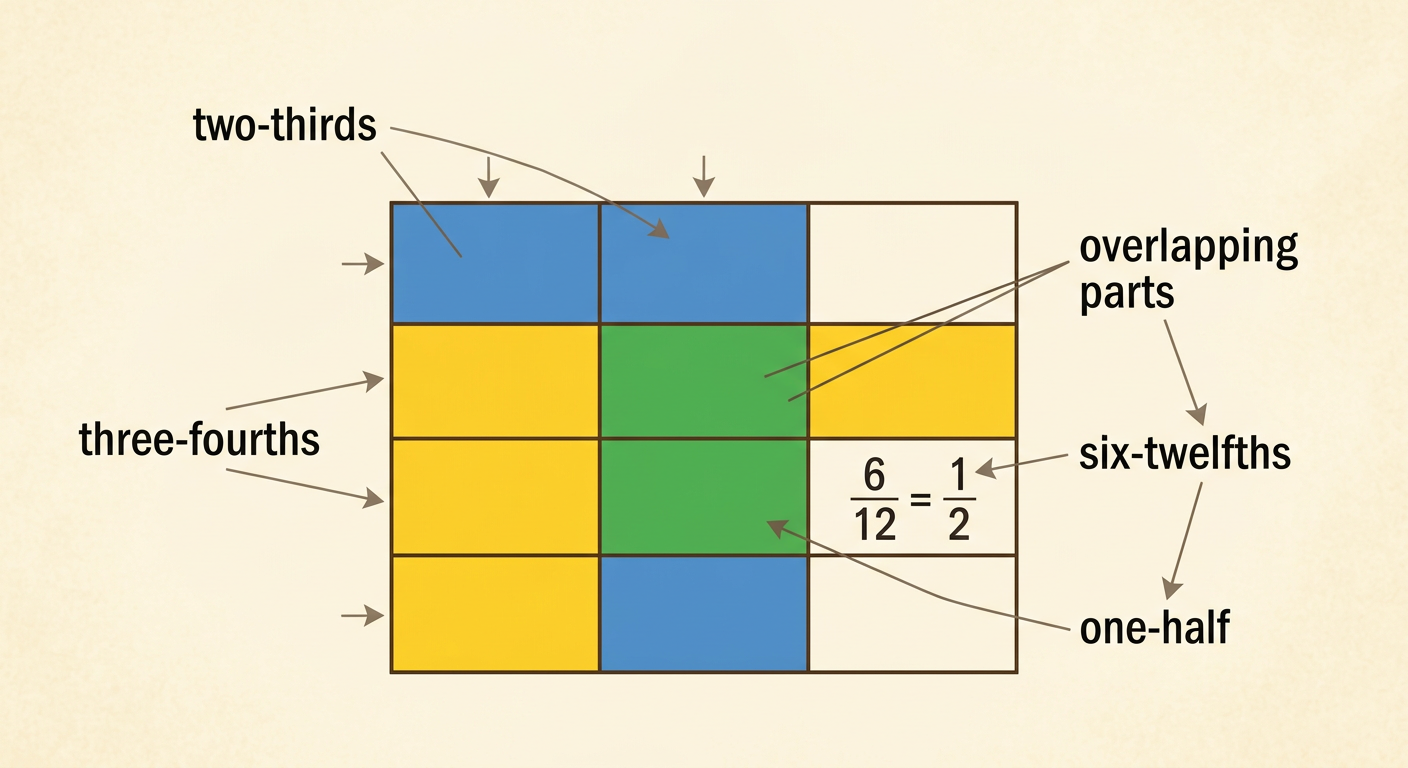
To multiply fractions with an area model, show one fraction in one direction and the other fraction in a different direction. Suppose you want to find 2/3 × 3/4. Divide a rectangle into 3 equal columns and shade 2 columns blue to represent 2/3. Then divide the same rectangle into 4 equal rows and shade 3 rows yellow to represent 3/4. The model now has 12 equal small rectangles because 3 × 4 = 12. Count the parts where the blue and yellow shading overlap. There are 6 overlapping parts, so the product is 6/12, or 1/2. The overlap represents the part that is both 2/3 of the width and 3/4 of the height.
Connect Models to Equations
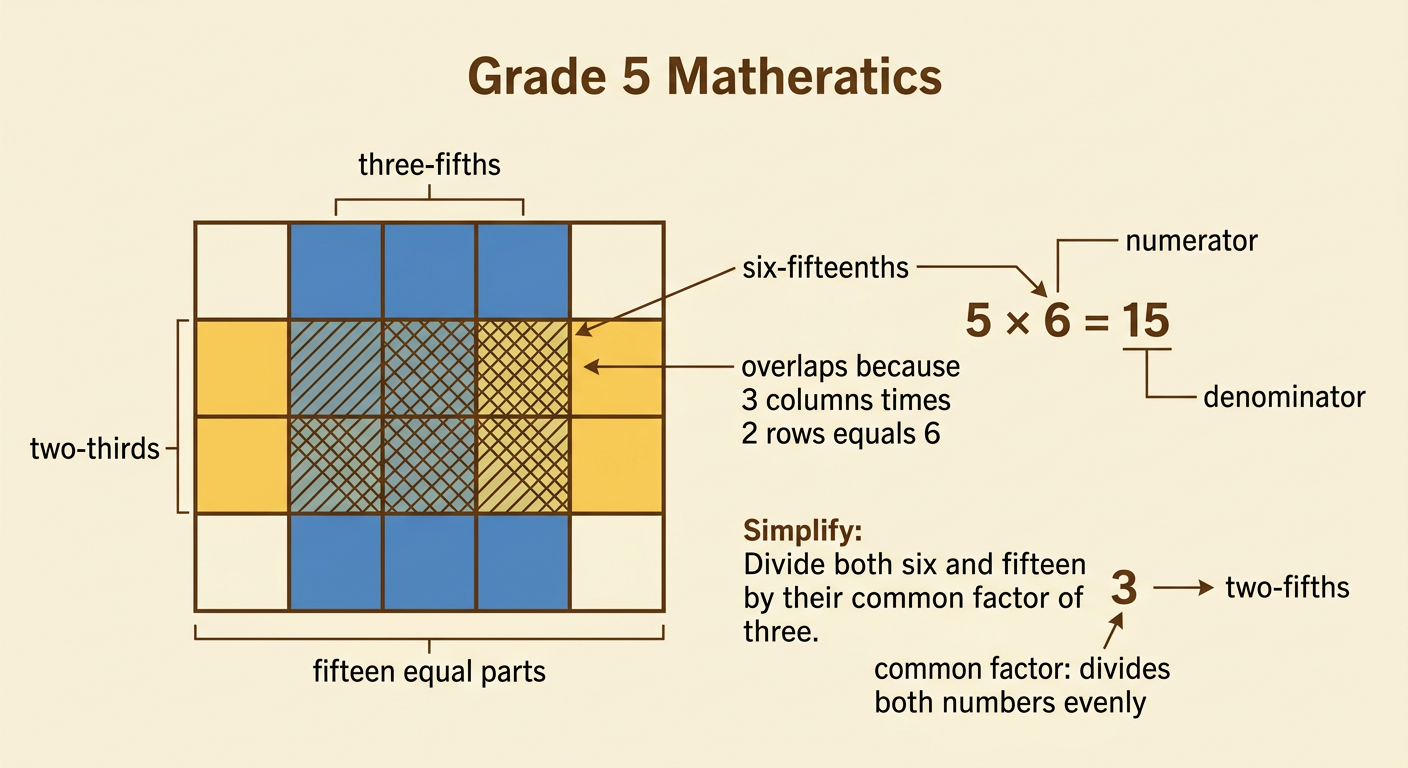
The parts of an area model connect directly to the multiplication equation. Find 3/5 × 2/3 by dividing a rectangle into 5 equal columns and 3 equal rows. This creates 5 × 3, or 15, equal parts. Shade 3 of the 5 columns in one direction and 2 of the 3 rows in the other direction. The overlapping region contains 3 × 2, or 6, parts. Therefore, 3/5 × 2/3 = 6/15. This matches the rule for multiplying fractions: multiply the numerators to count the overlapping parts, and multiply the denominators to count all equal parts. Simplify 6/15 by dividing both numbers by 3. The product is 2/5. The equation records exactly what the model shows.
Practice Multiplying Fractions
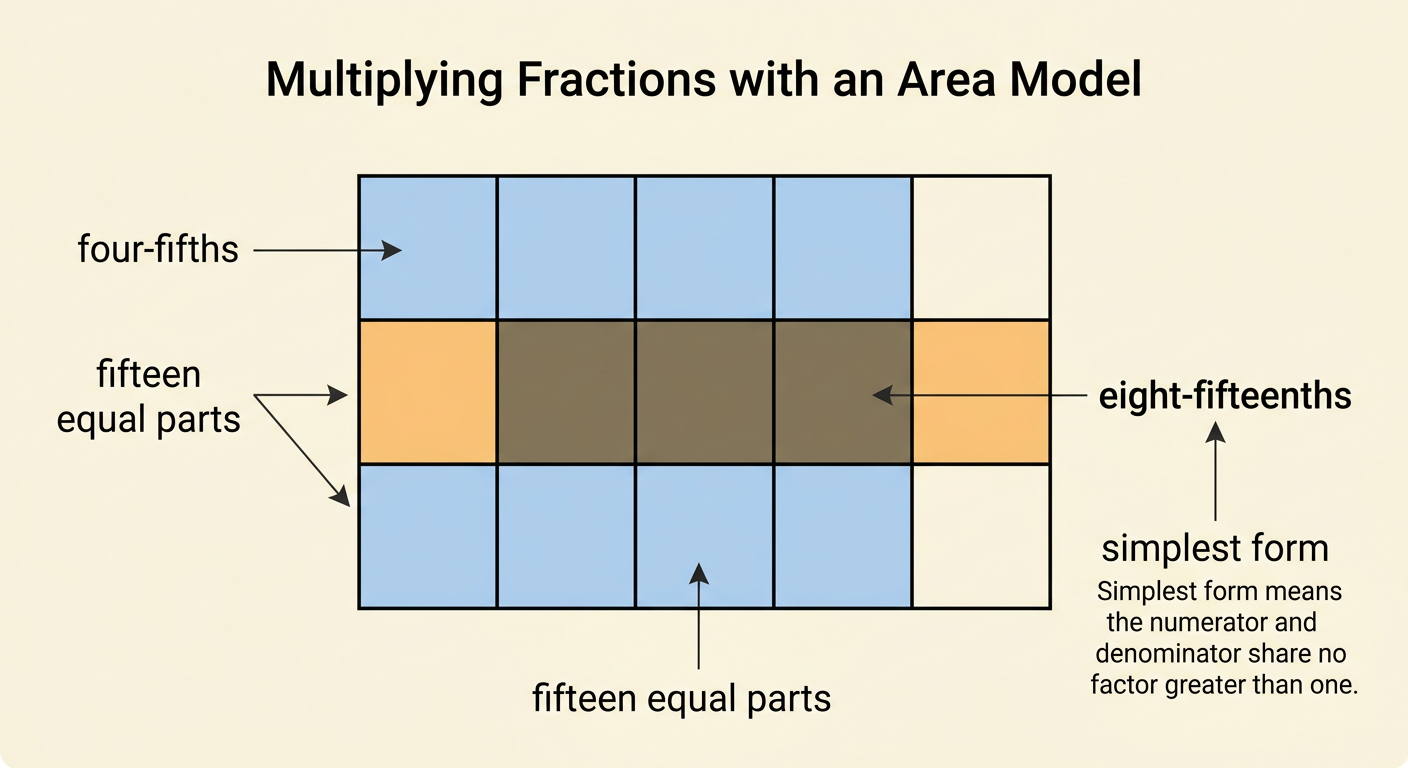
Use an area model to find 4/5 × 2/3. First, draw one rectangle and divide it into 5 equal columns. Shade 4 columns to represent 4/5. Next, divide the rectangle into 3 equal rows and shade 2 rows in a different direction. The grid has 15 equal parts because 5 × 3 = 15. Count the overlapping parts: 4 columns in 2 shaded rows make 8 overlapping parts. Therefore, 4/5 × 2/3 = 8/15. The fraction is already in simplest form because 8 and 15 have no common factor greater than 1. Try predicting the numerator and denominator before counting. Then use the overlap to confirm your calculation and make sure each part of the grid is equal in size.
Explain and Check Products
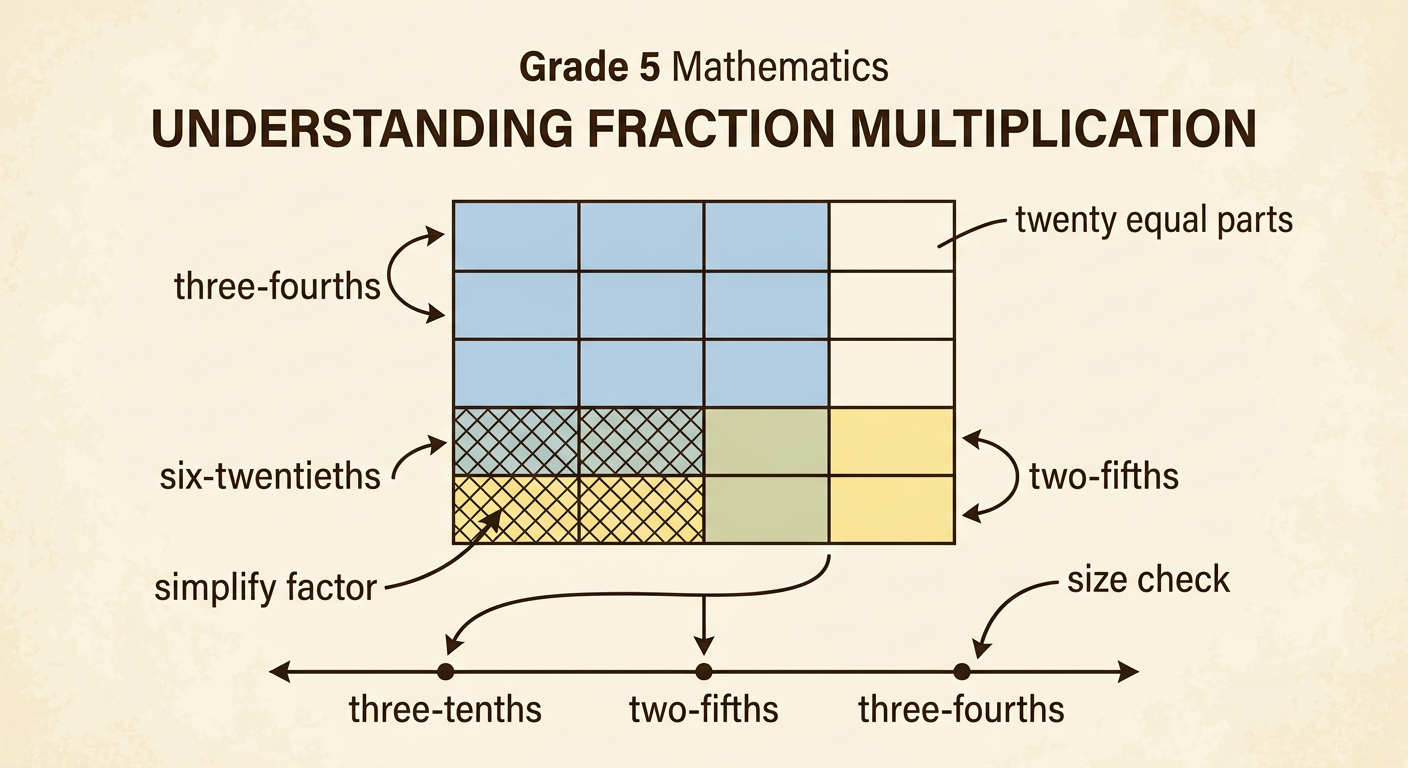
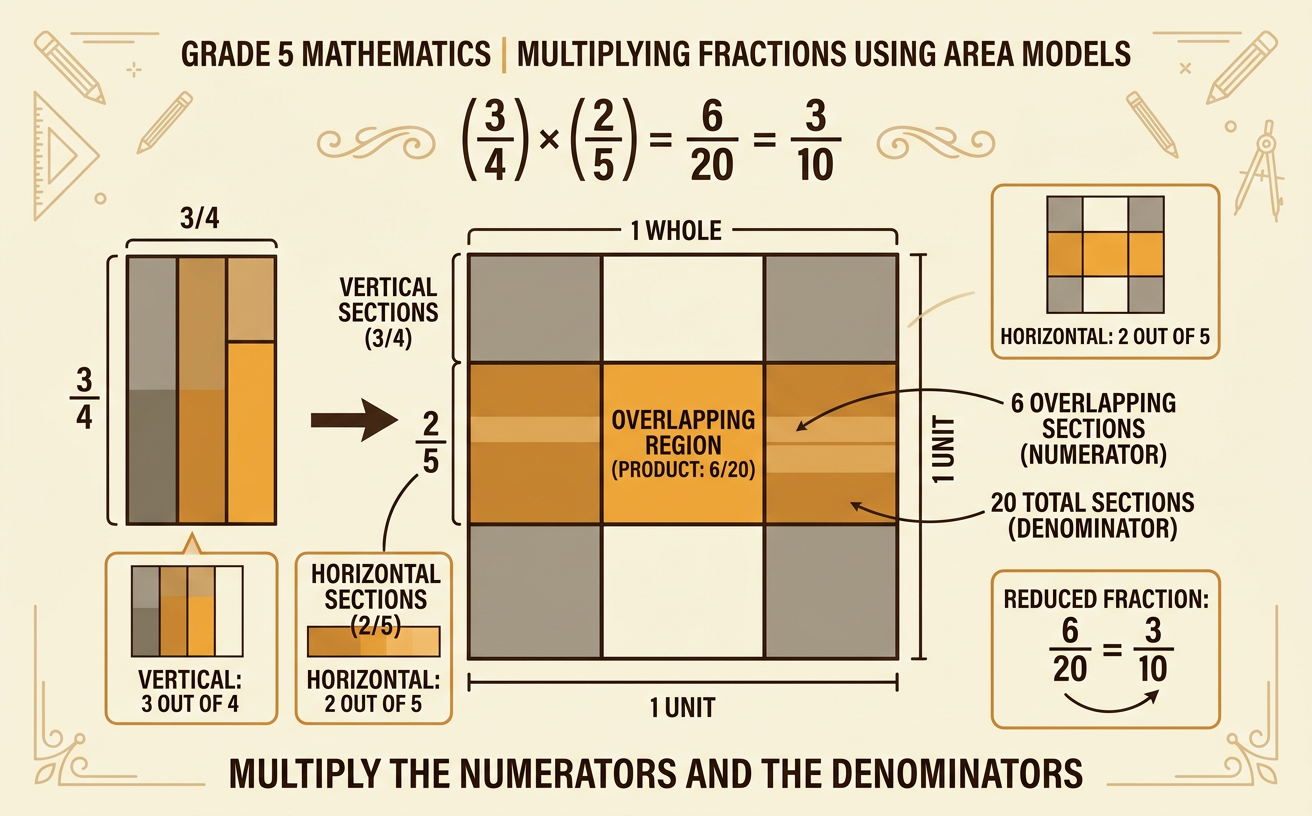
A complete solution should explain what the overlap means and check whether the answer is reasonable. For example, find 3/4 × 2/5. A 4-column by 5-row model has 20 equal parts. Shading 3 columns and 2 rows creates 6 overlapping parts, so 3/4 × 2/5 = 6/20 = 3/10. You can explain that 3/10 of the whole is both inside the shaded 3/4 region and inside the shaded 2/5 region. To check, notice that both factors are less than 1. Multiplying by a fraction less than 1 makes the other factor smaller, so the product should be less than both 3/4 and 2/5. Since 3/10 is less than each factor, the answer is reasonable. The model, equation, simplification, and size check all agree.