
Multiplying Multi-Digit Whole Numbers Using the Standard Algorithm
Students use place value, partial products, and the standard algorithm to accurately multiply multi-digit whole numbers.

Illustrations are auto-generated and may be placeholders. They can be refreshed to match the narration.
Place Value Review
A digit’s value depends on its place. In 3,482, the 3 represents 3,000, the 4 represents 400, the 8 represents 80, and the 2 represents 2. Place value helps us multiply because each digit can be multiplied according to its value. For example, to find 3,482 times 6, think of the number as 3,000 + 400 + 80 + 2. The products are 18,000, 2,400, 480, and 12. Adding them gives 20,892. The standard algorithm records these same place-value calculations in a shorter form. Always line up numbers by place so that ones are under ones, tens are under tens, and hundreds are under hundreds.

Modeling Partial Products
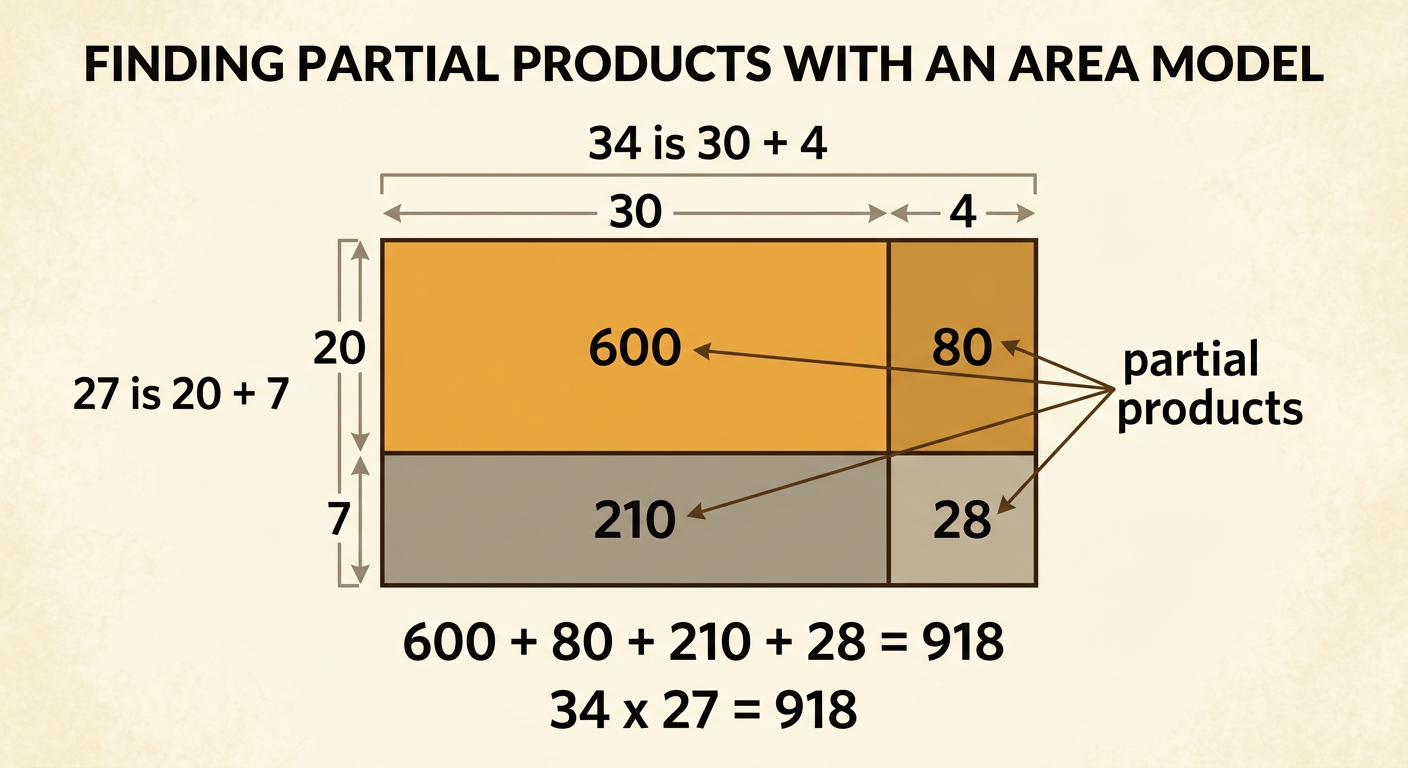
Partial products break a multiplication problem into smaller, easier products. Consider 34 times 27. Decompose 34 into 30 + 4 and 27 into 20 + 7. An area model creates four rectangles. Multiply 30 times 20 to get 600, 4 times 20 to get 80, 30 times 7 to get 210, and 4 times 7 to get 28. Then add all four partial products: 600 + 80 + 210 + 28 = 918. Therefore, 34 times 27 equals 918. The model shows why every part of one factor must be multiplied by every part of the other factor. It also makes the value of each digit visible.
Connecting Models to the Standard Algorithm
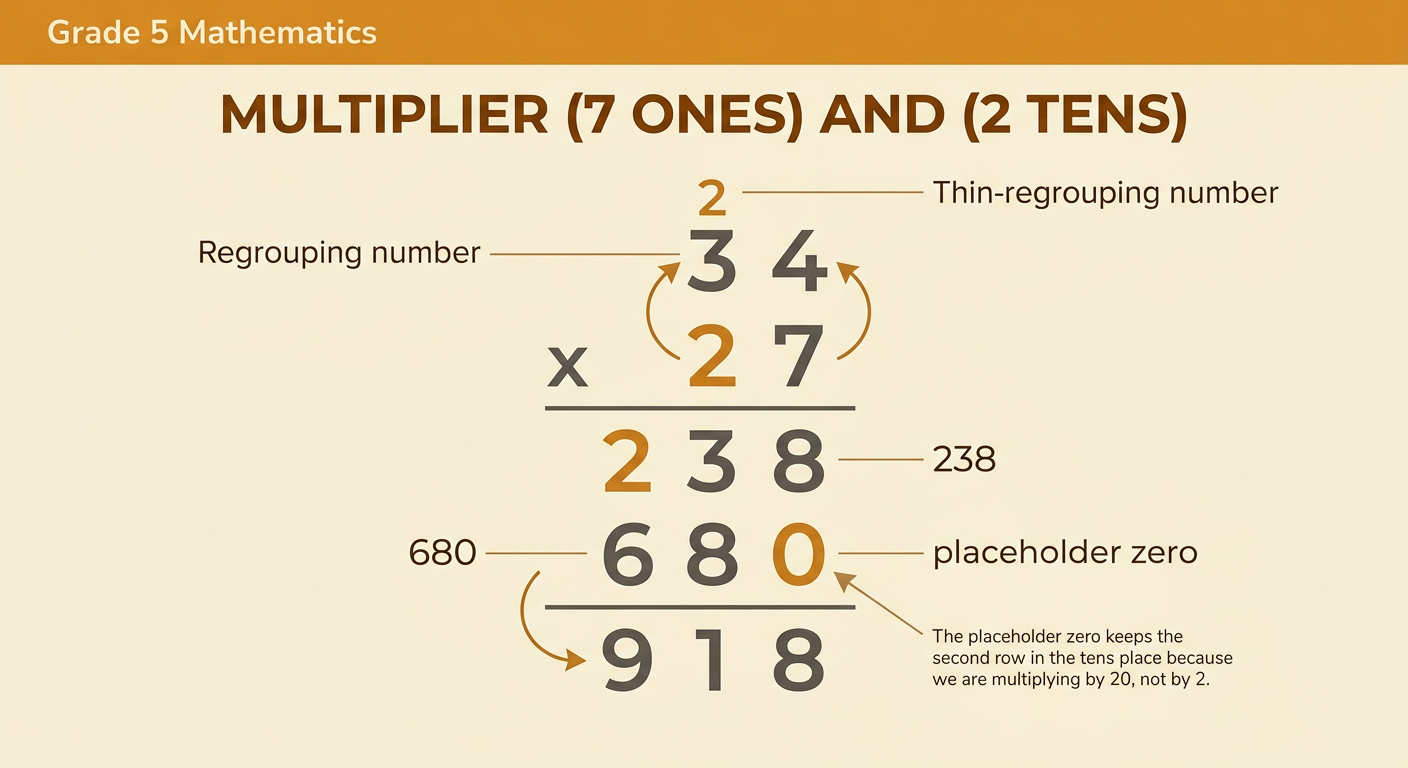
The standard algorithm organizes the same partial products shown in an area model. For 34 times 27, write 34 above 27 and align the ones digits. First multiply 34 by the 7 ones. Seven times 4 is 28, so write 8 and regroup 2 tens. Seven times 3 tens is 21 tens, plus 2 tens, which gives 23 tens. The first partial product is 238. Next multiply 34 by the 2 tens in 27. Because 2 tens means 20, place a zero in the ones place. The second partial product is 680. Add 238 and 680 to get 918. The zero keeps the tens partial product in its correct place.
Guided Multiplication Practice
Let us multiply 326 by 24 using the standard algorithm. Begin with the 4 ones. Four times 6 is 24; write 4 and regroup 2. Four times 2 is 8, plus 2 is 10; write 0 and regroup 1. Four times 3 is 12, plus 1 is 13. The first partial product is 1,304. Next multiply by the 2 tens, which means 20. Place a zero in the ones place. Two times 6 is 12, two times 2 is 4, and two times 3 is 6, giving 6,520. Add 1,304 and 6,520. The product is 7,824. Check that all digits and regrouped numbers are recorded carefully.

Independent Practice and Error Check
Solve 408 times 36 independently, and then check your work. First multiply 408 by 6 to get 2,448. Next multiply 408 by 3 tens, or 30, to get 12,240. Add the aligned partial products to find 14,688. A common error is writing 1,224 for the second row without shifting it one place left. That incorrectly treats the 3 in 36 as 3 ones instead of 3 tens. Use estimation to check the final answer. Since 408 is close to 400, 400 times 36 is 14,400. The exact answer, 14,688, is close to the estimate, so it is reasonable. Check multiplication, regrouping, alignment, and addition whenever you find an error.

Exit Ticket
Use the standard algorithm to solve 217 times 43. Align the factors by place value. Multiply 217 by the 3 ones to get 651. Then multiply 217 by the 4 tens, or 40. Place a zero in the ones place and calculate 8,680. Add the two partial products: 651 + 8,680 = 9,331. Before submitting your answer, estimate to decide whether it is reasonable. Rounding 217 to 200 and 43 to 40 gives 200 times 40, or 8,000. The exact product, 9,331, is reasonably close. On your ticket, show both partial products, the final sum, and your estimate. Circle the digit that acts as the placeholder in the tens partial product.
