Mummification and the Egyptian Afterlife
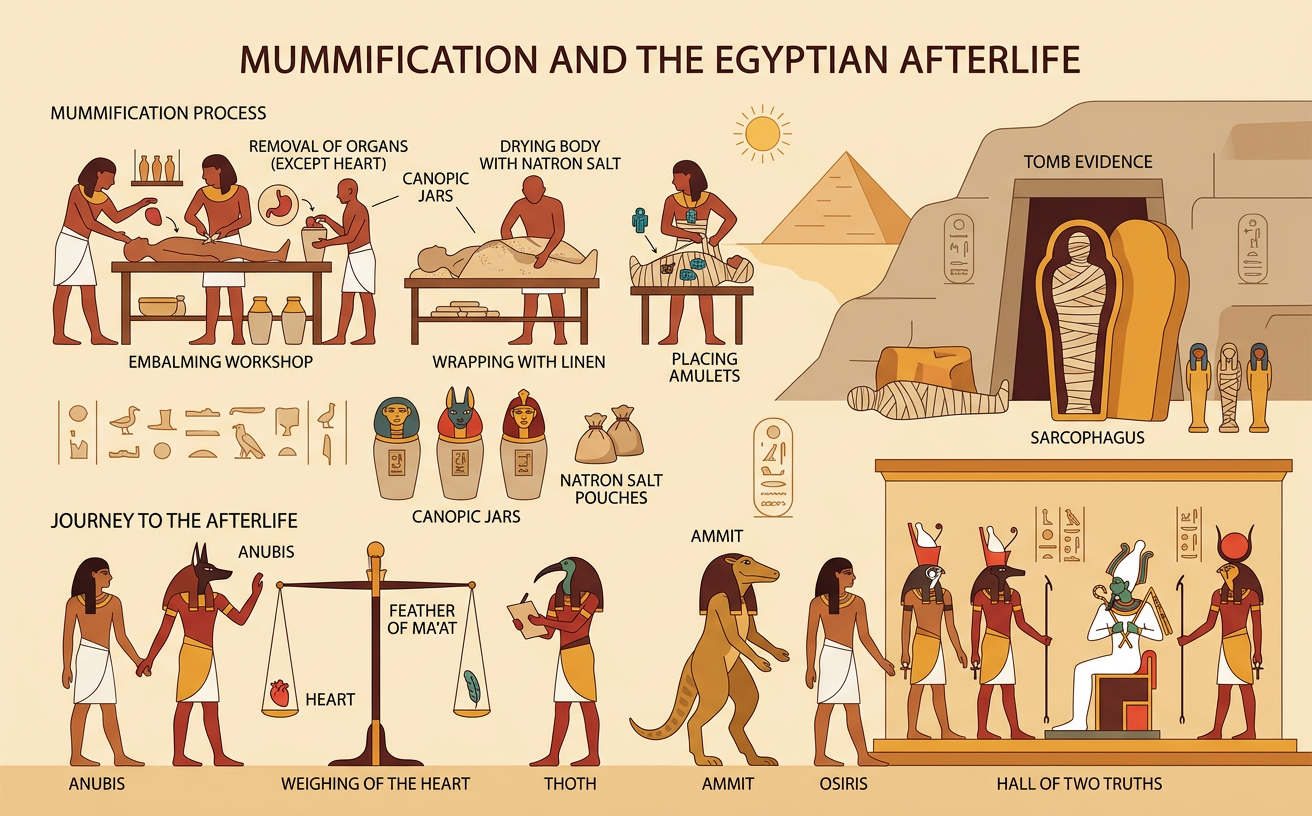
Students examine tomb evidence and the mummification process to explain how religious beliefs, social status, and knowledge of the human body shaped ancient Egyptian burial practices.
Illustrations are auto-generated and may be placeholders. They can be refreshed to match the narration.
Beliefs About Death and the Afterlife
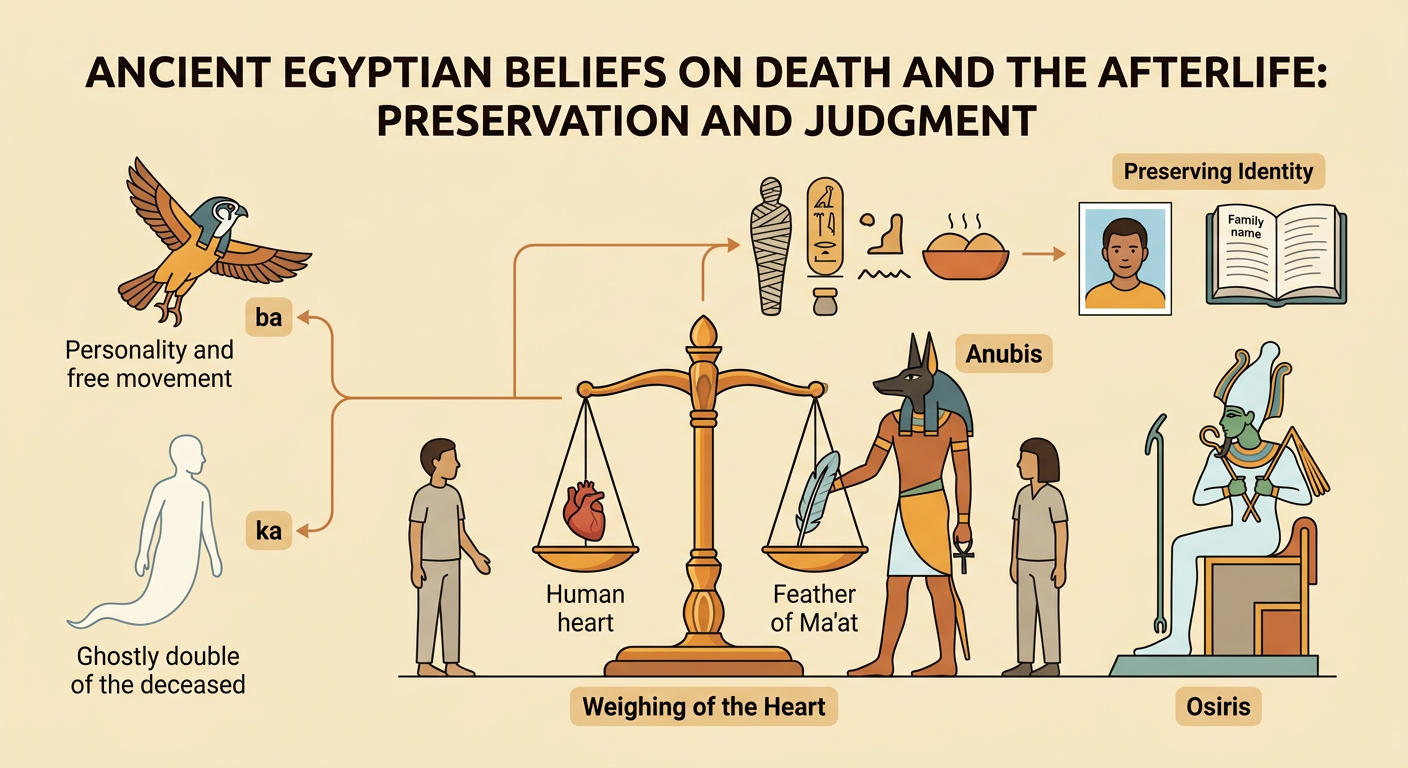
Ancient Egyptians believed that death could lead to another existence if a person’s body and identity were protected. They described parts of a person, including the ka, a life force, and the ba, a mobile aspect of personality. Burial rituals, preserved bodies, names, images, food offerings, and prayers helped these parts continue after death. Egyptians also believed the dead faced judgment before Osiris, ruler of the underworld. In the Weighing of the Heart ceremony, the heart was compared with the feather of Ma’at, which represented truth and order. For example, scenes in the Book of the Dead show Anubis operating the balance while other gods observe. Such evidence suggests that moral behavior, religious rituals, and proper burial were connected in Egyptian ideas about the afterlife.
Steps in the Mummification Process
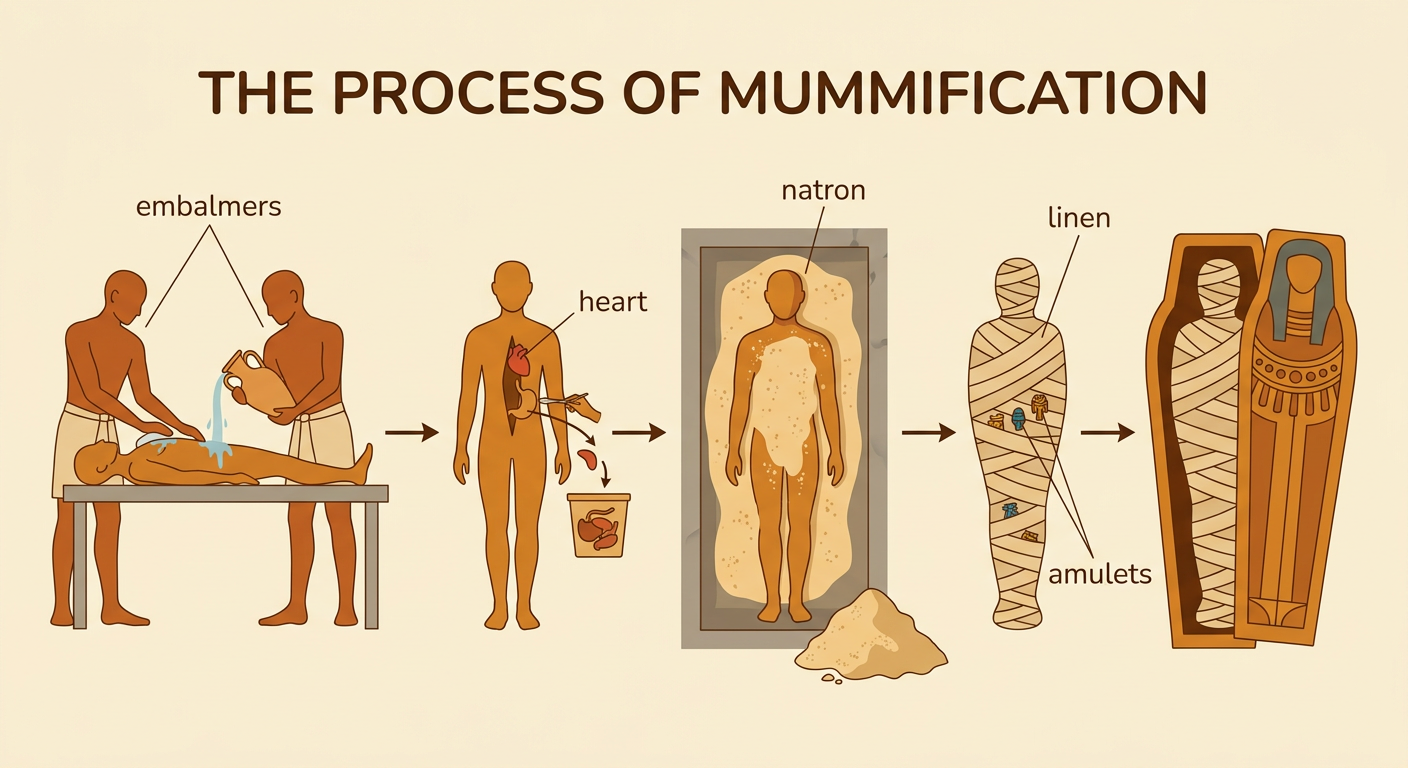
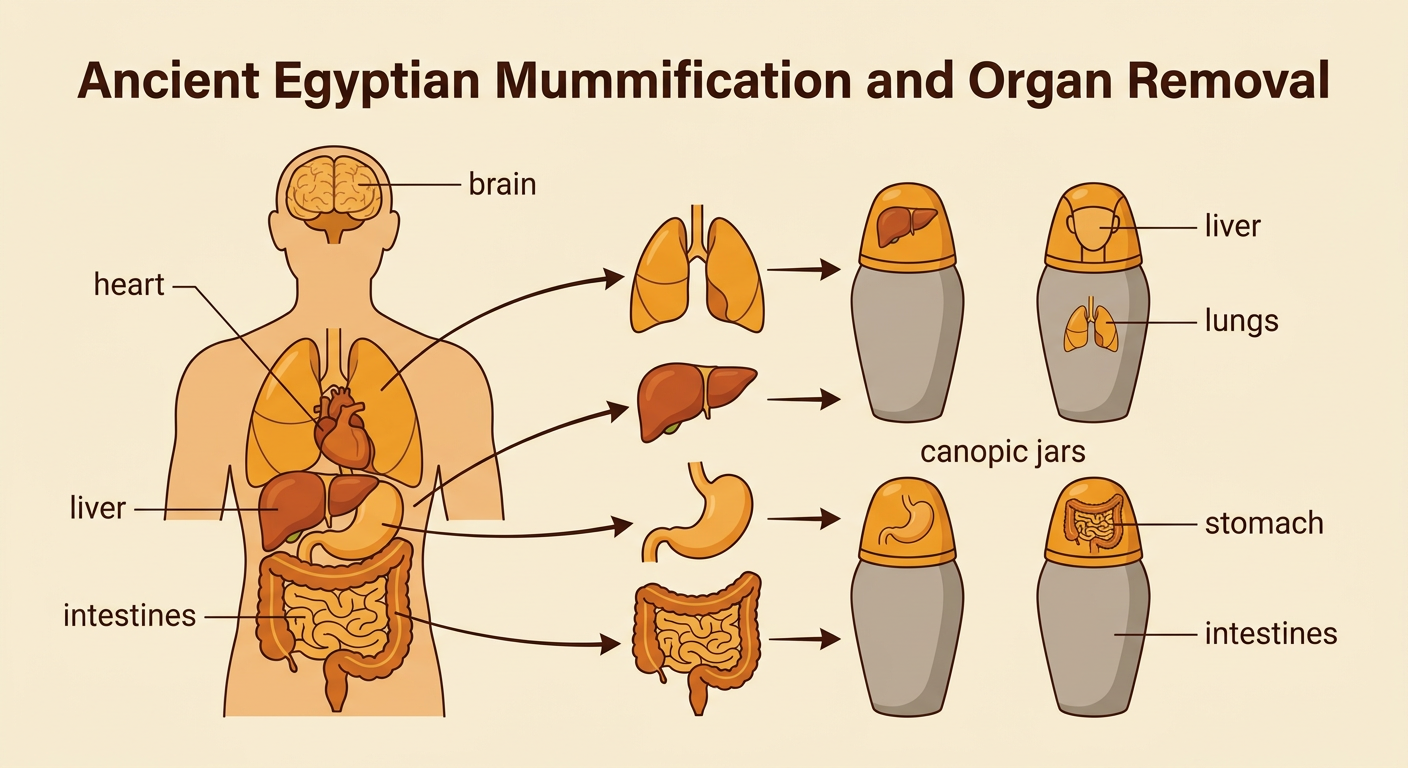
Mummification slowed decomposition so the body could remain recognizable for burial and the afterlife. Methods varied by period and by what a family could afford. In an elaborate process, embalmers washed the body and often removed the brain through the nose. They made an incision to remove several internal organs, but usually left the heart because Egyptians considered it important for identity and judgment. The organs and body were dried with natron, a naturally occurring salt mixture. After about 40 days of drying, embalmers treated the body with oils or resins, packed it to restore its shape, and wrapped it in layers of linen. Amulets could be placed among the wrappings for protection. The complete funerary preparation often lasted about 70 days and ended with rituals before burial.
Organs and the Human Body
The human body is a system of interacting subsystems. The digestive system breaks down food, the respiratory system exchanges gases, the circulatory system moves materials through the body, and the nervous system carries signals. Ancient Egyptian embalmers repeatedly handled bodies, so they gained practical knowledge about the location and appearance of organs. However, their explanations of organ functions were not the same as modern scientific explanations. They often treated the heart as the center of thought and character, while the brain was commonly discarded during elite mummification. The liver, lungs, stomach, and intestines were removed because moist tissues decomposed quickly. In many periods, these organs were dried and placed in canopic jars associated with the four sons of Horus. This practice shows both anatomical observation and religious belief shaping burial decisions.
Tombs, Artifacts, and Social Status
Tombs and burial objects reveal differences in wealth, occupation, and social position. Powerful rulers and wealthy officials could afford decorated tombs, multiple coffins, skilled embalmers, jewelry, furniture, food, and religious texts. People with fewer resources might receive simpler mummification or be buried in shallow graves with only a few objects. Egypt’s dry desert could naturally preserve some bodies even without expensive embalming. Tutankhamun’s tomb, for example, contained a gold burial mask, nested coffins, chariots, clothing, food, and many other objects. This evidence shows that the young king had access to royal labor and materials, not that every Egyptian burial was equally rich. Tomb paintings can also show occupations and valued activities, but they often present an idealized afterlife. Historians therefore compare tomb art with human remains, inscriptions, architecture, and everyday objects.

Drawing Conclusions from Evidence
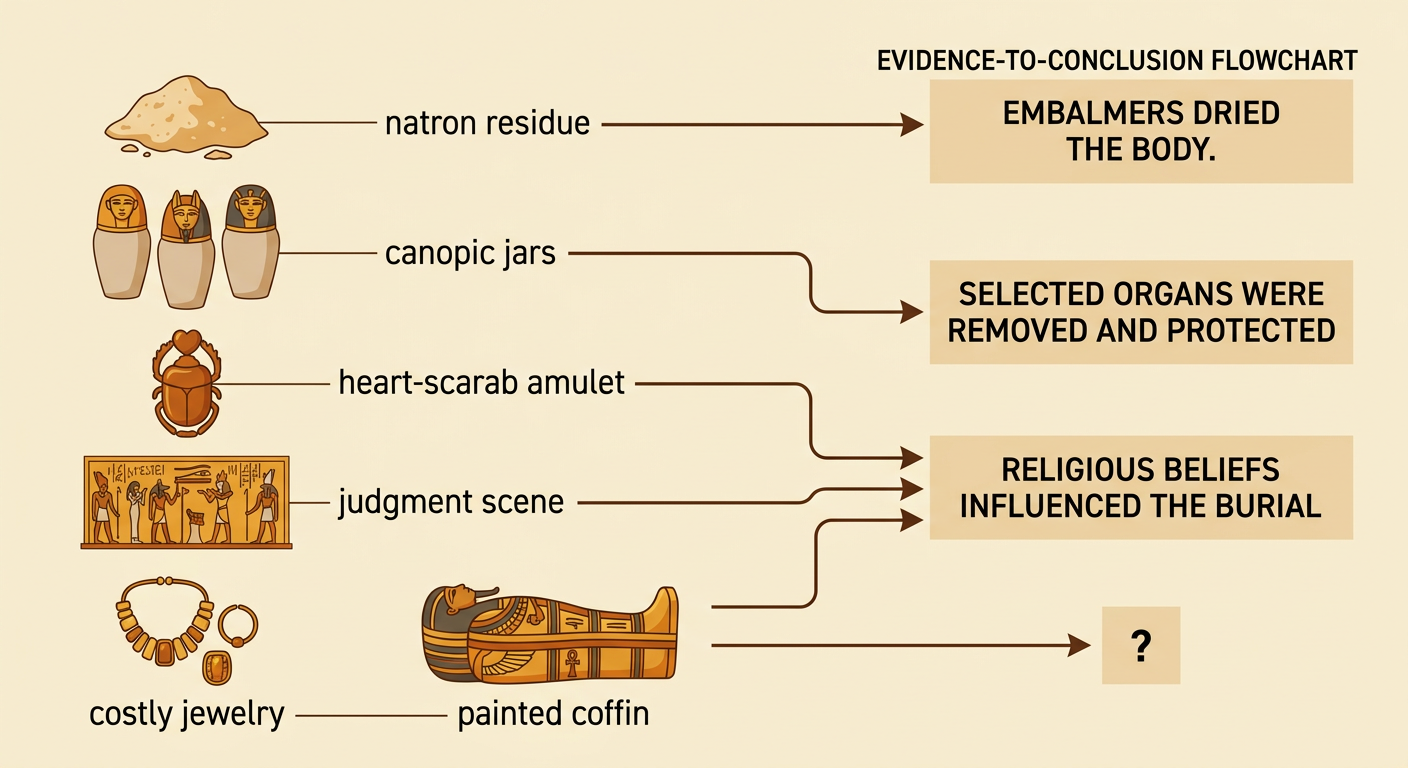
Historians build conclusions by connecting claims to specific evidence and considering who created each source. Imagine that a tomb contains a wrapped body, natron residue, canopic jars, a heart-scarab amulet, and a painted judgment scene. The residue and preserved tissues support the claim that embalmers used drying techniques. The jars support the claim that selected organs were removed and protected. The amulet and judgment scene support the claim that religious beliefs influenced the burial. If the tomb also contains costly jewelry and a finely painted coffin, those objects may indicate high social status. However, one tomb cannot represent every Egyptian or every time period. Researchers must compare dates, inscriptions, burial locations, and other tombs. Strong conclusions clearly identify the evidence, explain how it supports the claim, and acknowledge what the evidence cannot prove.