
Mystery Creature Families: Trait Detectives
Students investigate playful fictional creature families, identify shared and different observable traits, graph their findings, and arrange parents and offspring in generational order.
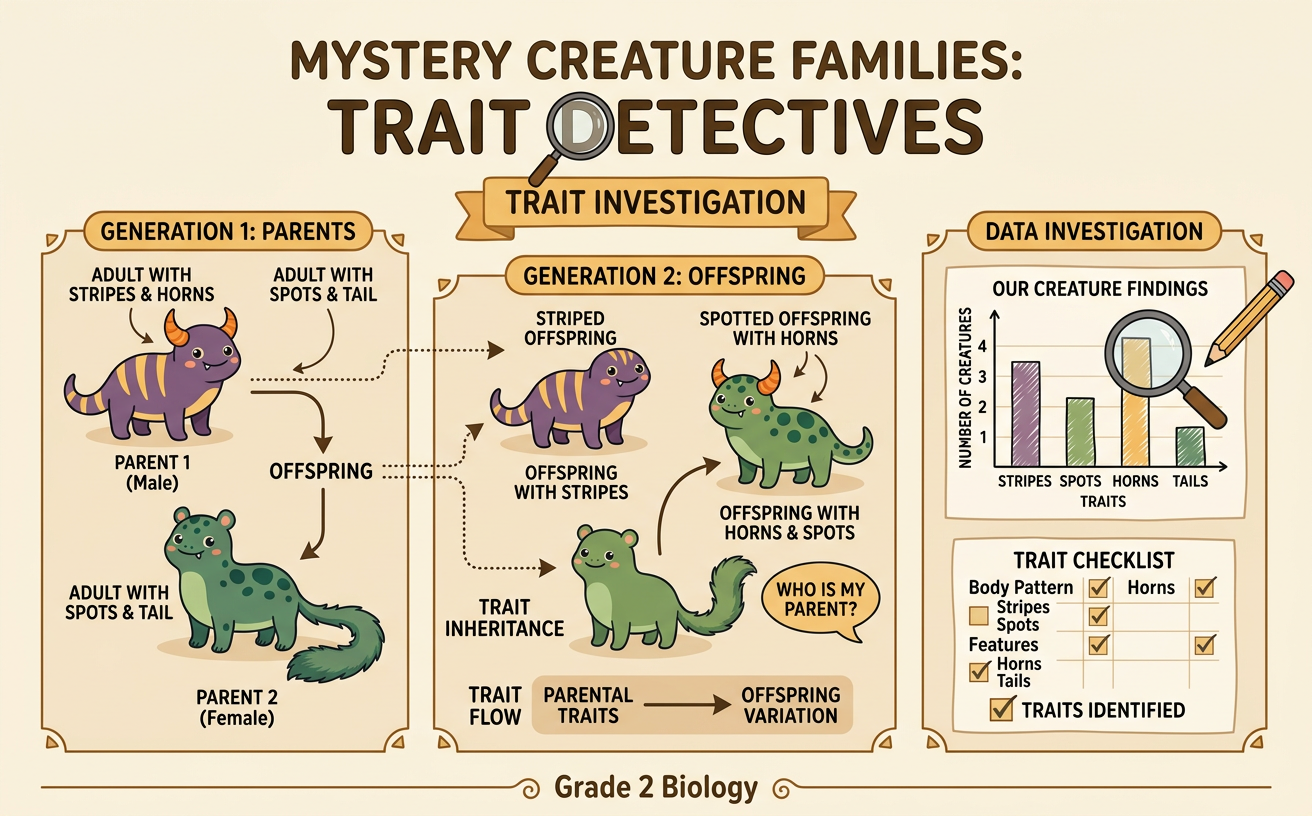
Illustrations are auto-generated and may be placeholders. They can be refreshed to match the narration.
Meet the Mystery Creatures
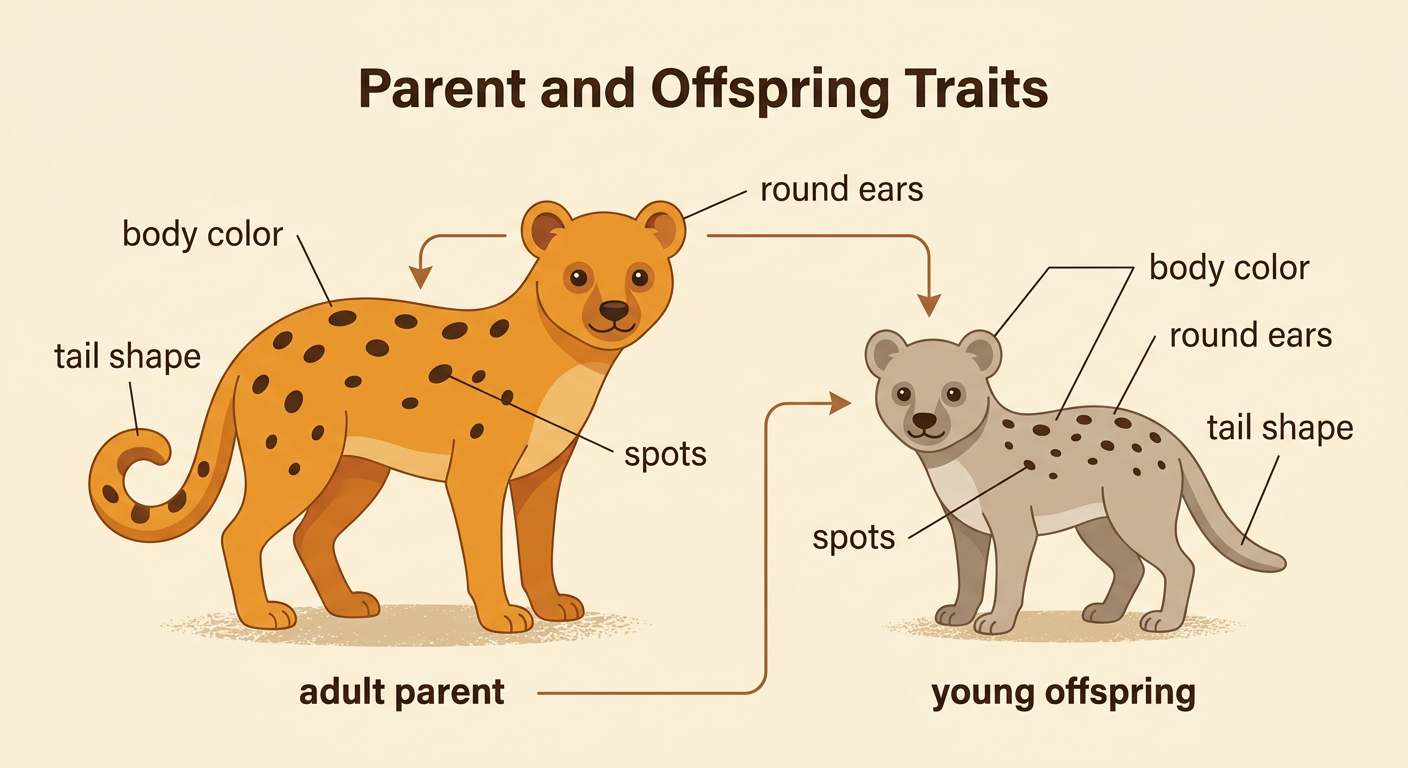
Today you are a trait detective. You will study fictional creatures called Glimmers. A trait is a feature you can observe, such as body color, number of spots, tail shape, or ear shape. Each creature card shows an adult parent or a young offspring. For example, one Glimmer family has a purple parent with round ears, four spots, and a curled tail. Its offspring is also purple and has round ears, but it has only two spots and a straight tail. The young creature is like its parent, but it is not exactly the same. Look closely at every card, describe only what you can see, and listen as classmates share observations. Fictional Glimmers help us practice noticing patterns that also occur in real animal families.
Spot the Parent-Offspring Traits
Study one parent and its offspring from head to tail. Name one trait at a time so your group can compare carefully. Begin with ear shape, then check body color, spots, and tail shape. Suppose the parent has pointed ears, green skin, three spots, and a long tail. Its offspring has pointed ears, yellow skin, three spots, and a short tail. Record pointed ears and three spots as shared traits. Record body color and tail length as different traits. Do not guess about a feature that is hidden or missing from the picture. Use a complete observation sentence, such as, “Both creatures have three spots, but their tails are different lengths.” Taking turns, asking questions, and building on a partner’s idea help the team gather dependable evidence.
Sort Similarities and Differences
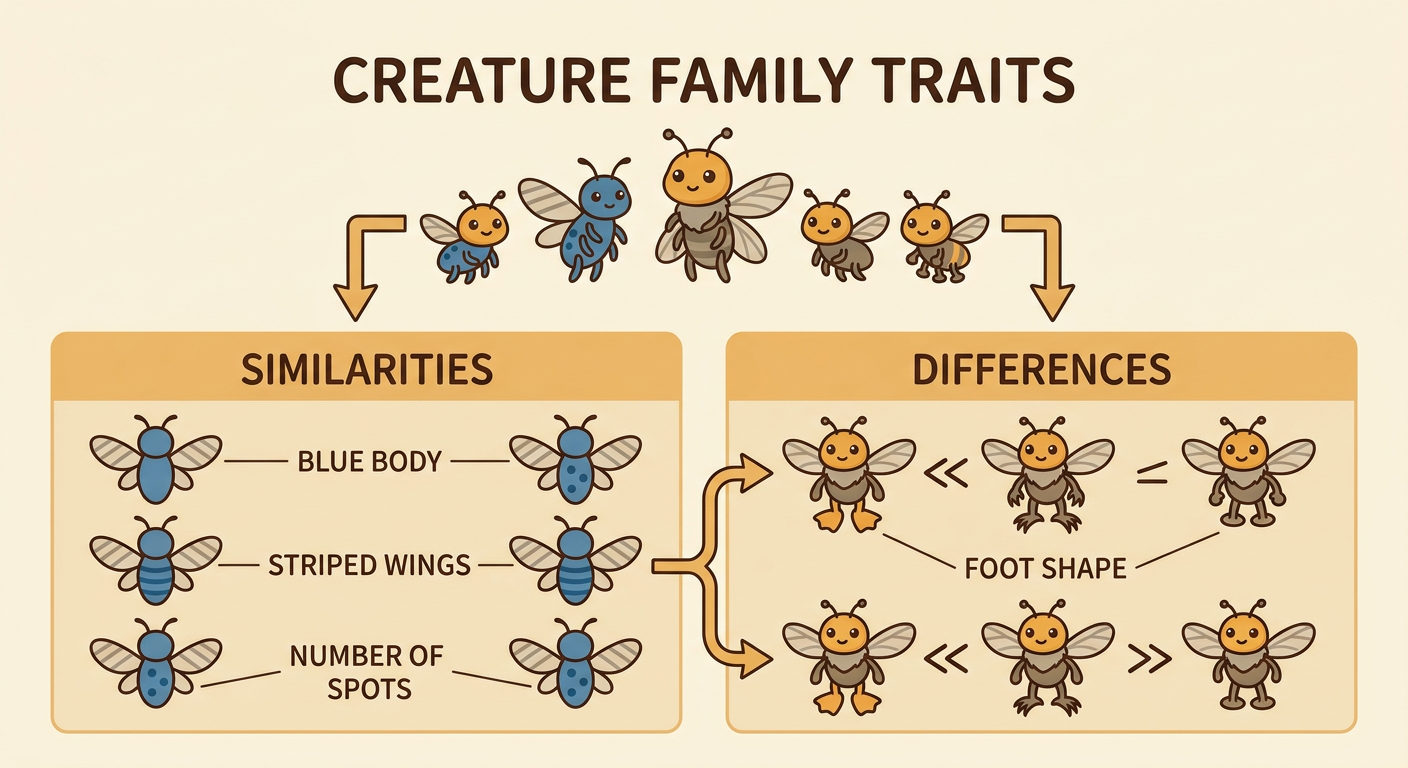
Now sort your observations into two groups: similarities and differences. A similarity is a trait that both the parent and offspring have. A difference is a trait that is not the same. For example, imagine a parent and offspring that both have blue bodies and striped wings. The parent has square feet and five spots, while the offspring has round feet and two spots. Place blue body and striped wings in the shared-traits group. Place foot shape and number of spots in the different-traits group. Check each choice with a partner and explain why it belongs there. Remember that “five spots” and “two spots” are observations about the same kind of trait: number of spots. Sorting the evidence shows that young creatures can resemble their parents without being exact copies.
Graph the Creature Traits
A graph can show how often a trait appears in a group. Count the offspring with each tail shape: curled, straight, pointed, or fluffy. These are four categories. Suppose you observe ten offspring. Four have curled tails, three have straight tails, two have pointed tails, and one has a fluffy tail. Make a bar graph with tail-shape categories along the horizontal axis and number of offspring on the vertical axis. Start the number scale at zero and use equal steps of one. Draw each bar to the correct height. The curled bar reaches 4, while the fluffy bar reaches 1. Then compare the bars. Which trait is most common? Which is least common? The graph organizes your observations so the pattern is easy to see and discuss.
Build a Generation Timeline
A generation is a group in a family that comes before or after another group. Arrange the creature cards in chronological order, which means from earlier to later. Begin with the grandparent generation, place the parent generation next, and put the offspring generation last. Draw arrows to show time moving forward. For example, Grandparent Glow may have a star-shaped mark. Her adult offspring, Parent Beam, also has a star-shaped mark. Beam’s young offspring, Spark, has the mark too, although it is smaller. The timeline does not show that all three creatures lived at exactly the same time. It shows the order of generations in the family. After arranging the cards, retell the sequence using the words first, next, and last. Check that every arrow points toward the younger generation.
Share the Evidence
Finish the investigation by sharing a claim about one creature family. A claim is an answer supported by evidence. You might say, “The offspring is like its parent, but not exactly like its parent.” Then give visible evidence: “Both have round ears and orange bodies. The parent has six spots, but the offspring has four.” Point to the creature cards, sorting chart, or graph as you speak. Take turns so every group member can contribute. Listen without interrupting, ask a helpful question, and connect your idea to what another student said. A classmate might ask, “Which trait was most common on your graph?” You can answer, “Curled tails were most common because the curled-tail bar shows four offspring.” Clear claims and accurate evidence help others understand how your group reached its conclusion.