Levels of Ecological Hierarchy
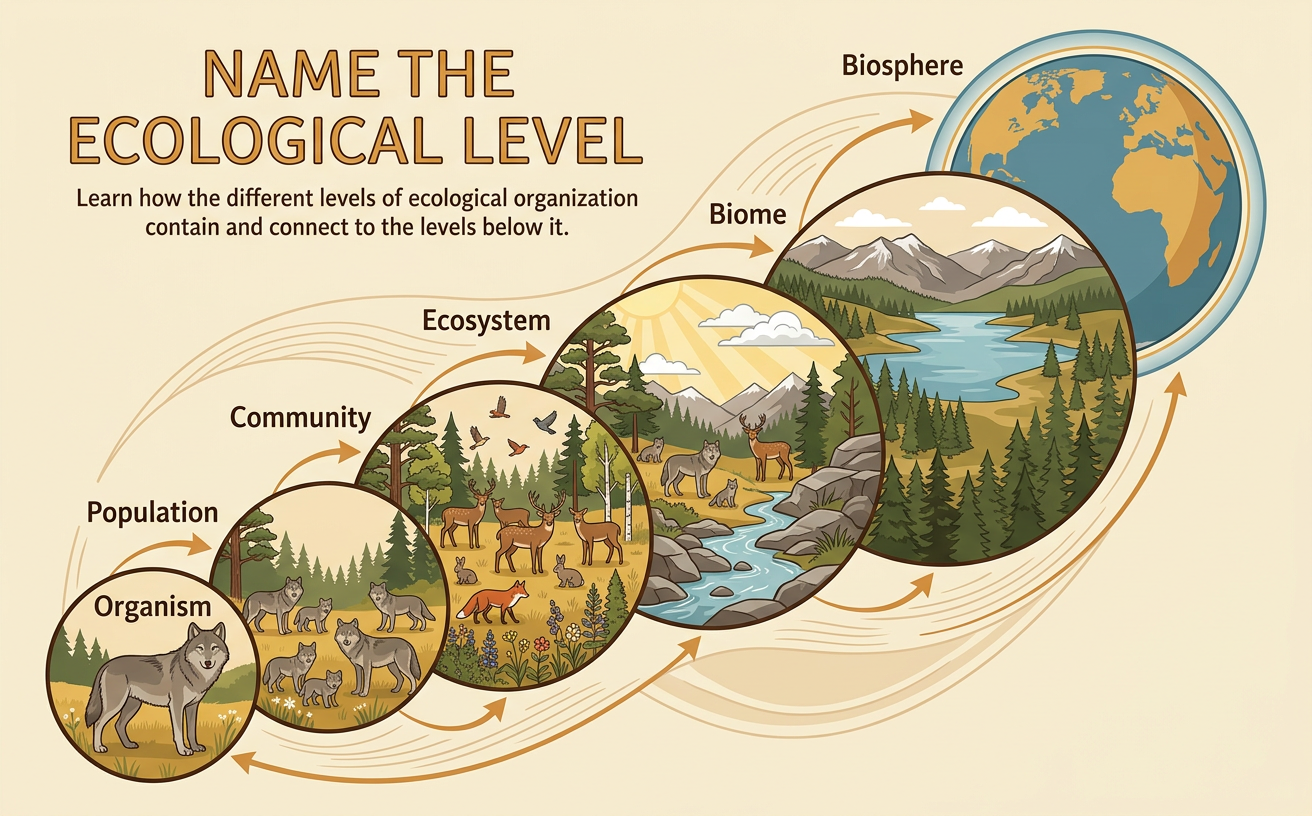
Students distinguish organism, population, community, ecosystem, biome, and biosphere by examining how each level contains and connects to the levels below it.
Illustrations are auto-generated and may be placeholders. They can be refreshed to match the narration.
One Living Thing: Organism
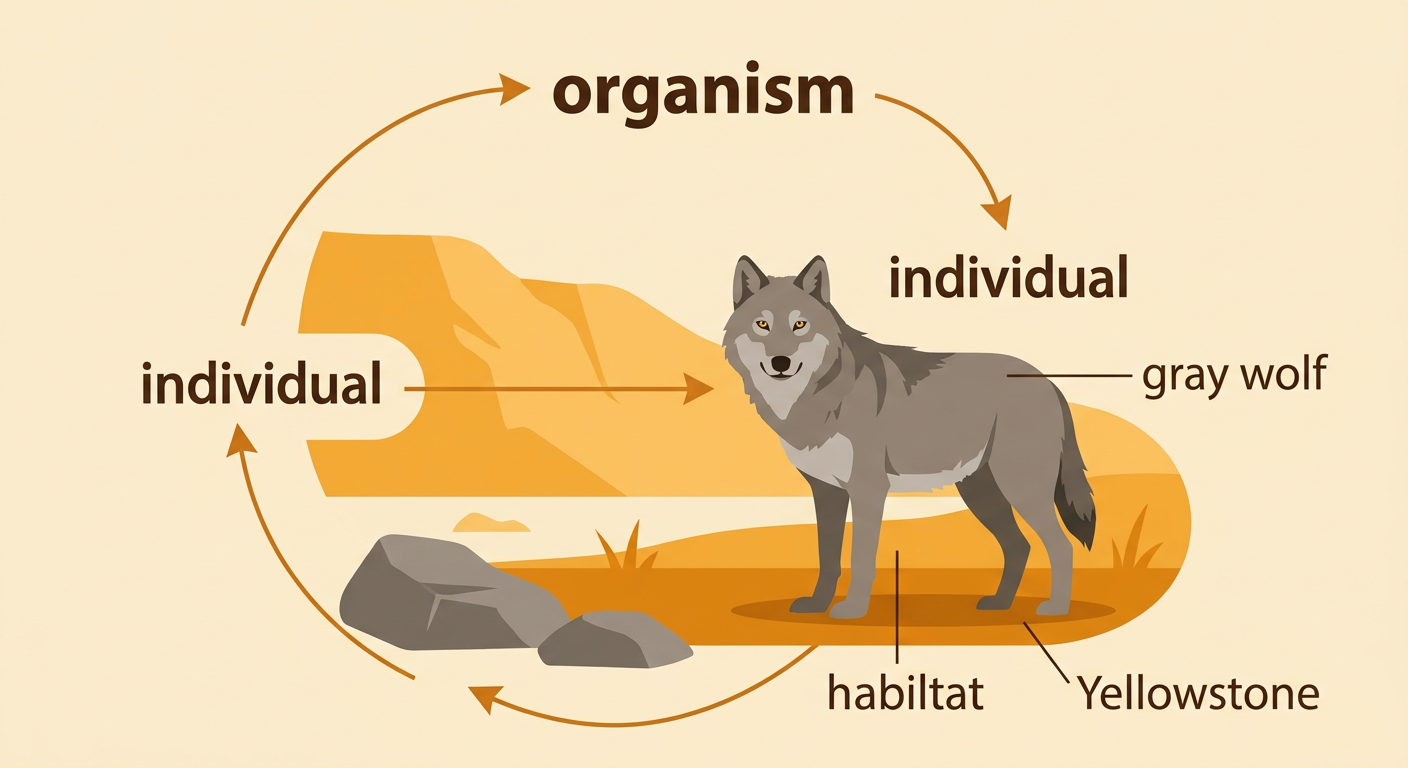
An organism is one individual living thing. It may be a plant, animal, fungus, protist, or microorganism. One gray wolf in Yellowstone National Park is an organism. The wolf takes in food, uses energy, grows, responds to its surroundings, and reproduces. It also interacts with other organisms by hunting elk, competing with other wolves, and sometimes carrying ticks. An organism is the smallest ecological level in this lesson. Scientists identify an organism before studying larger patterns. They may observe where it lives, what it eats, and how it survives. The word individual is an important clue: if a description names just one living thing, the ecological level is organism. One wolf is an organism, but all gray wolves living in the same area form a population.
One Species Together: Population
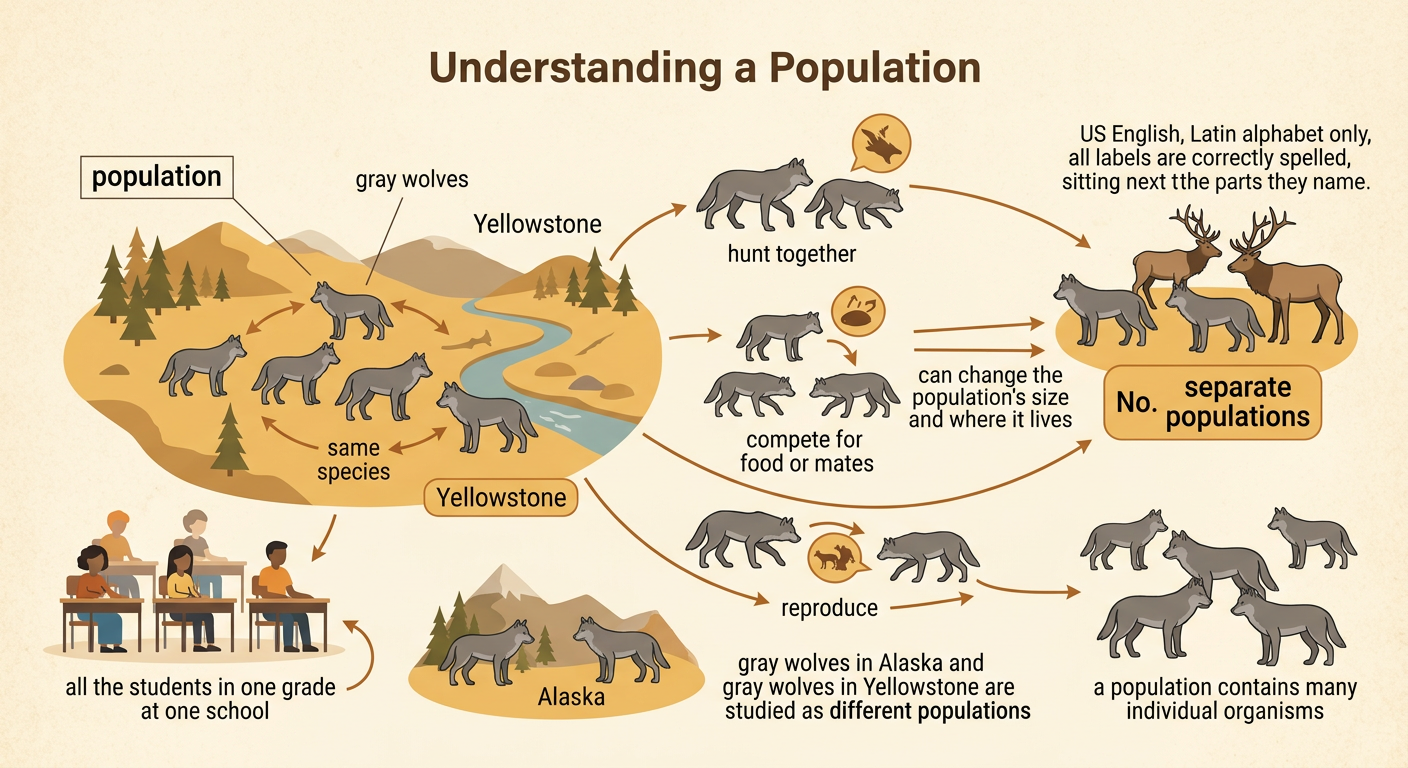
A population is all the organisms of the same species living in the same area at the same time. For example, all the gray wolves living in Yellowstone National Park form a population. The wolves may hunt together, compete for food or mates, and reproduce. These interactions can affect the population's size and location. A population includes many organisms, so it contains the ecological level below it: individual organisms. However, a group is not automatically a population. Wolves and elk together do not form one population because they belong to different species. Location also matters. Gray wolves in Yellowstone and gray wolves in Alaska are usually studied as separate populations. On a map, scientists can mark the range of a population and look for patterns in where its members gather, migrate, or find resources.
Populations Together: Community
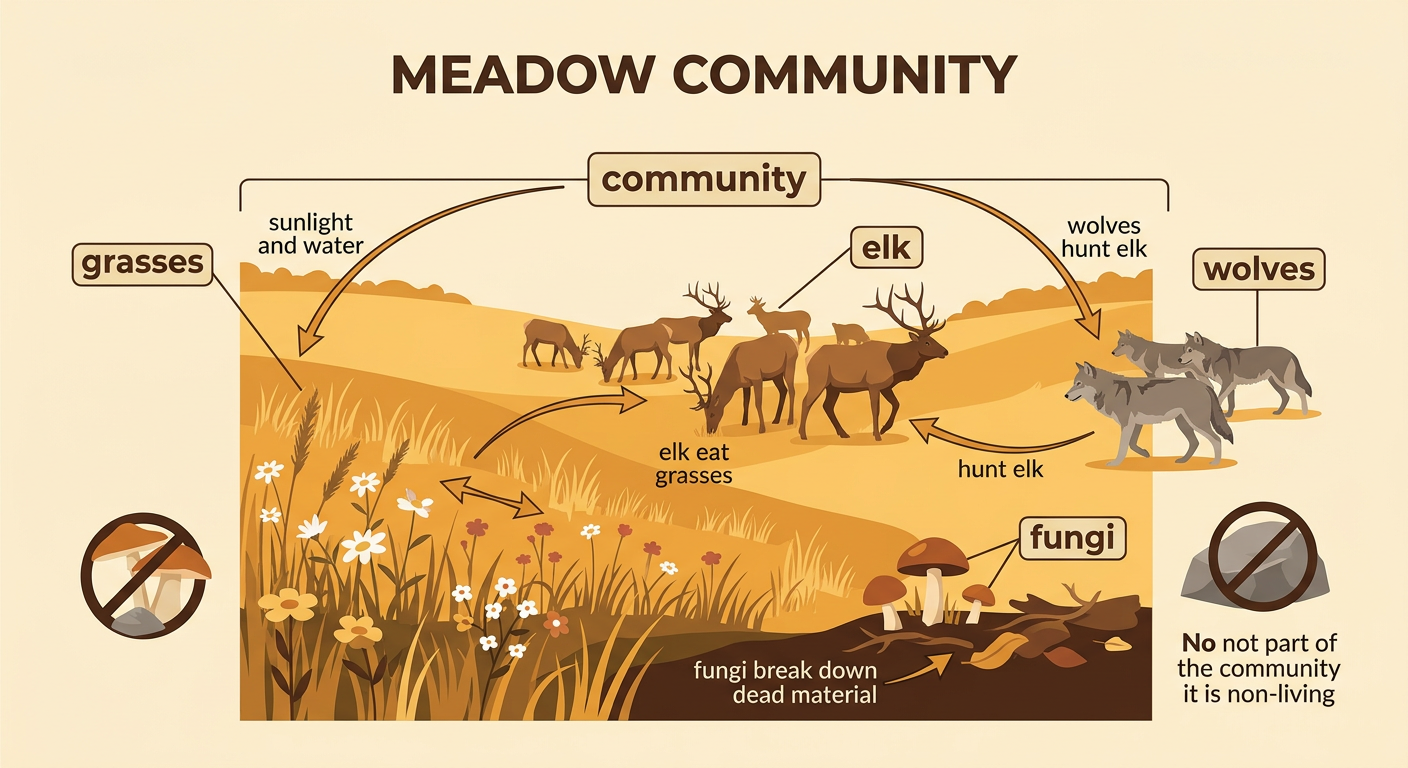
A community consists of all the populations of different species living and interacting in one area. A Yellowstone meadow community might include populations of grasses, wildflowers, elk, wolves, hawks, mice, fungi, and bacteria. Each species forms its own population, and those populations together form the community. Interactions connect them. Elk eat grasses, wolves hunt elk, hawks catch mice, and fungi break down dead material. Competition also occurs when organisms need the same limited resource. For example, grasses and wildflowers may compete for sunlight, water, and space. A community includes only living things. Rocks, air, water, and sunlight affect the community, but they are not members of it. If a description mentions several species in one place but does not include nonliving parts as components, the ecological level is usually community.
Living and Nonliving Parts: Ecosystem
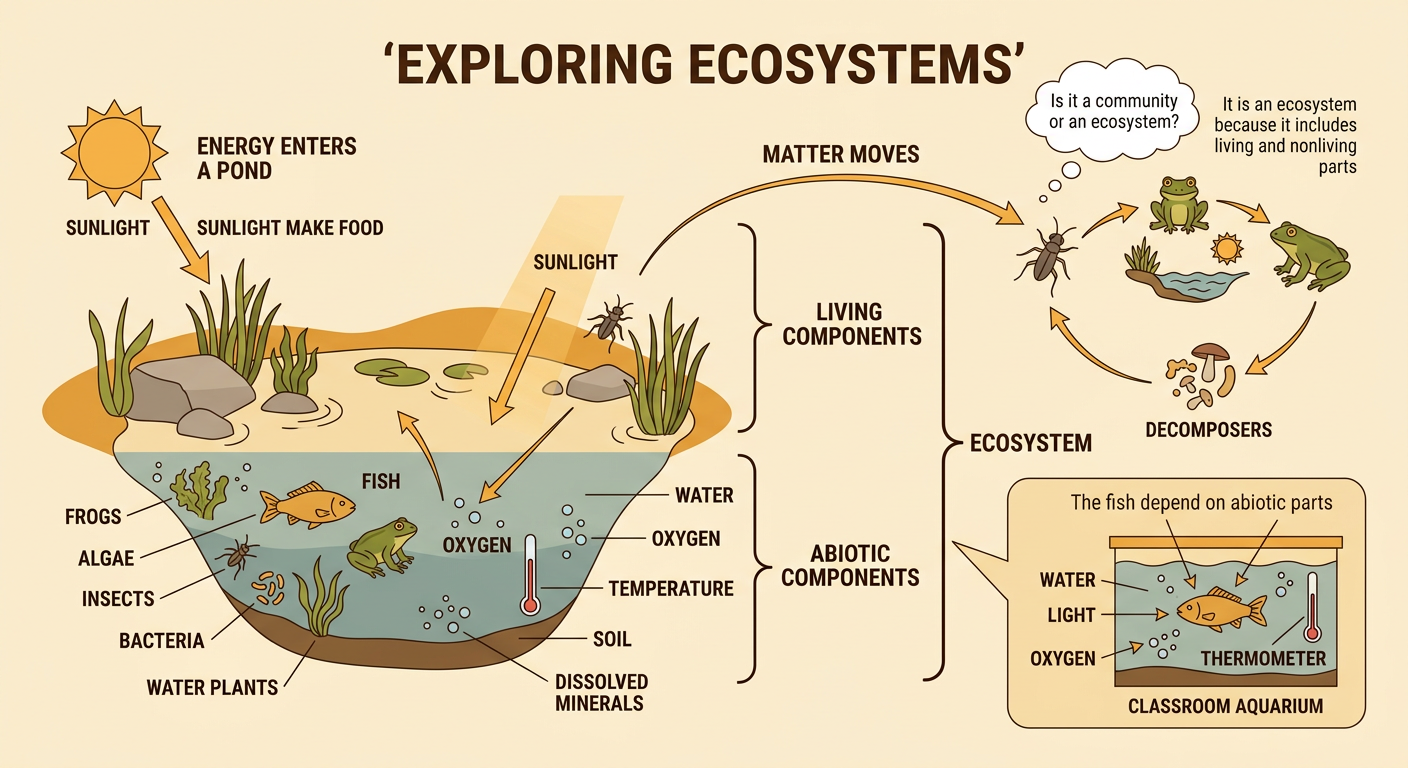
An ecosystem includes a community of living organisms and the nonliving parts of the environment with which they interact. In a pond ecosystem, fish, frogs, algae, insects, bacteria, and water plants are living components. Water, sunlight, oxygen, temperature, soil, and dissolved minerals are nonliving, or abiotic, components. Energy from sunlight enters the ecosystem when algae and plants make food. Matter moves when an insect eats a plant, a frog eats the insect, and decomposers return nutrients to the water and soil. An ecosystem therefore contains organisms, populations, and communities while adding their physical environment. Its boundary depends on the question being studied. A small pond can be treated as one ecosystem, while a connected group of ponds may be studied as a larger ecosystem. The key clue is interaction between living and nonliving components.
From Biome to Biosphere
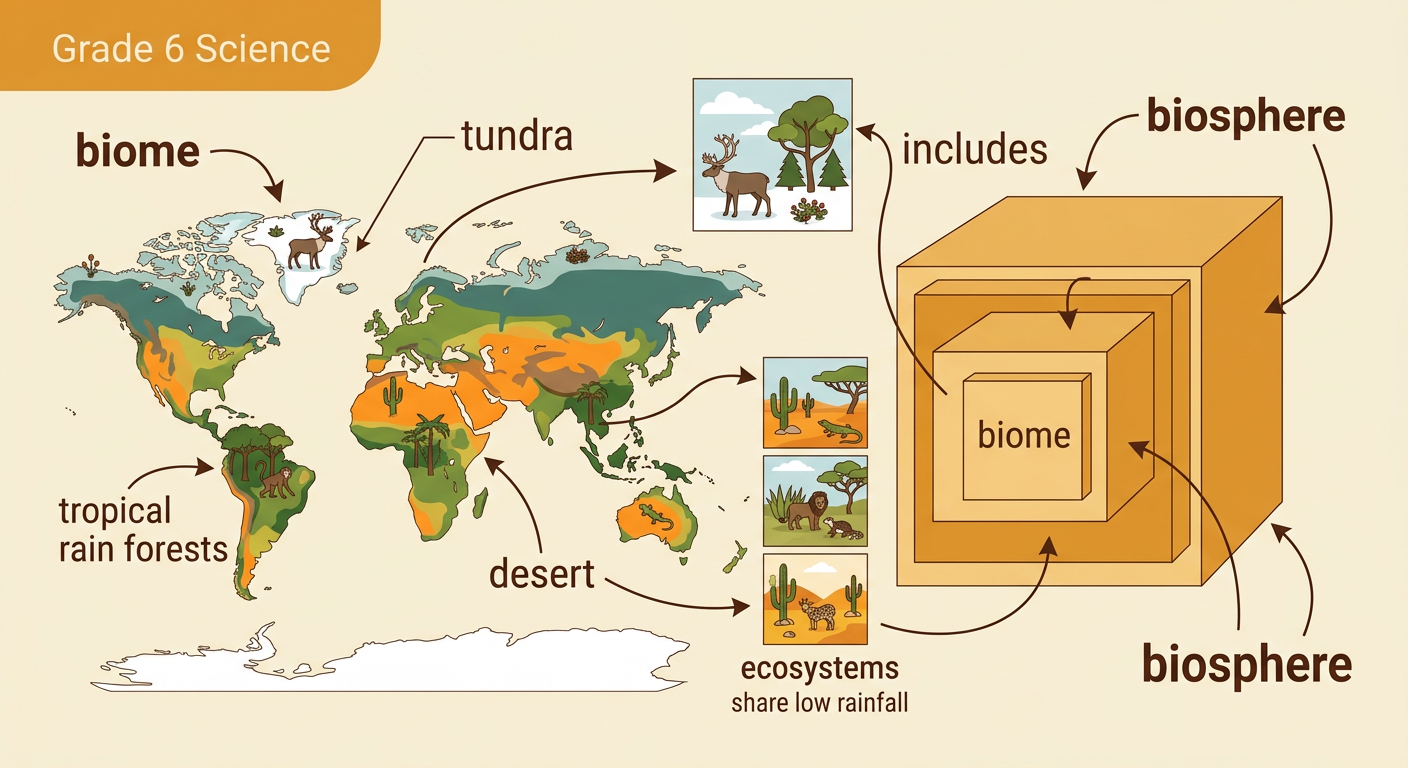
A biome is a large region defined mainly by its climate and typical plant and animal communities. Examples include desert, tundra, tropical rain forest, temperate forest, grassland, and aquatic biomes. A desert biome contains many ecosystems that share low rainfall, although their species may differ by location. Climate patterns help explain where biomes occur. For example, tundra is common at high northern latitudes, while tropical rain forests occur near the equator. The biosphere is the broadest ecological level. It includes every biome and every place on Earth where life exists: land, water, and the lower atmosphere. The levels are nested. Organisms form populations; populations form communities; communities interact with nonliving surroundings in ecosystems; related ecosystems make up biomes; and all biomes together form the biosphere. Maps help scientists compare these environmental patterns across Earth.
Identify the Ecological Level
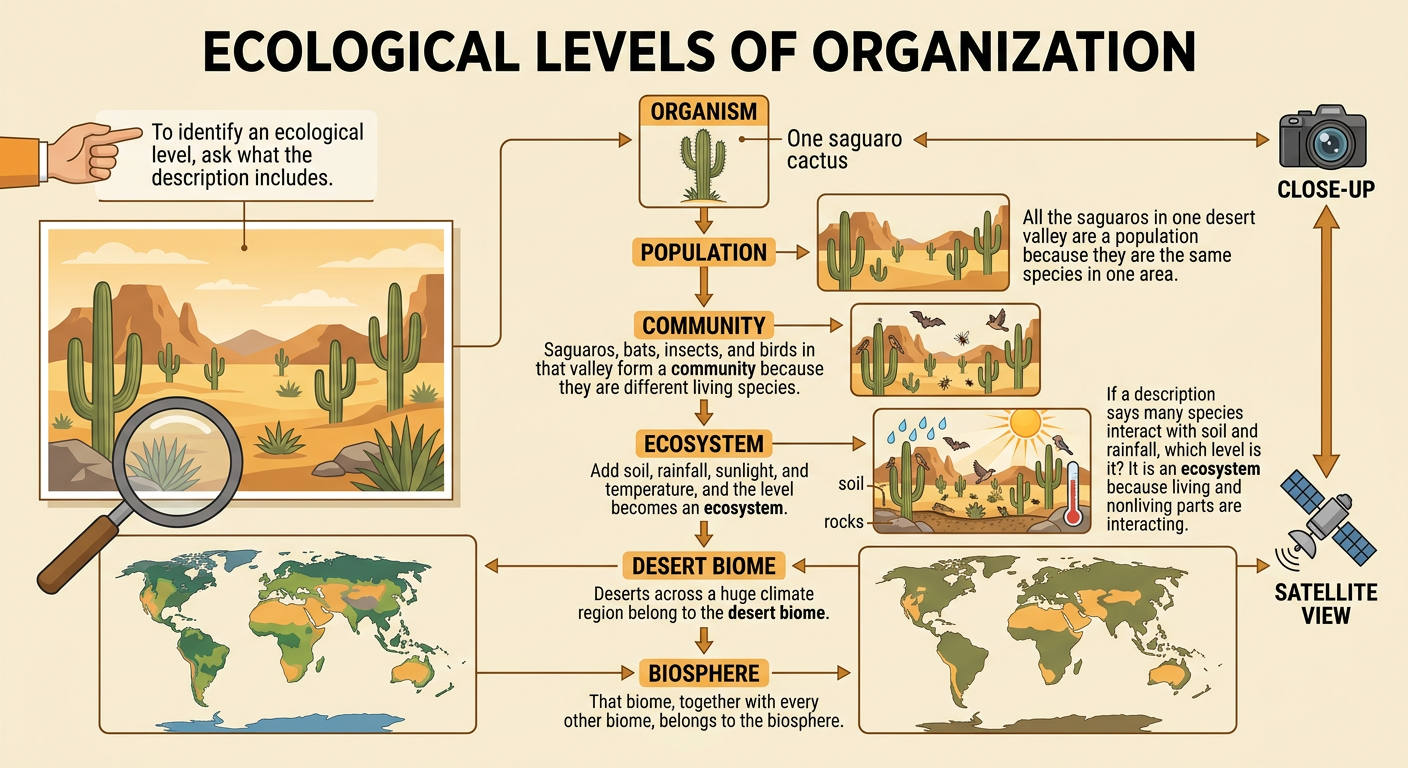
To identify an ecological level, ask what the description includes. One living individual is an organism. Members of one species in one area form a population. Several populations of different species form a community. When living organisms and nonliving conditions interact, the level is an ecosystem. A large climate region containing many similar ecosystems is a biome. All regions of Earth that support life make up the biosphere. Consider these examples: one saguaro cactus is an organism; all saguaros in one desert valley are a population; saguaros, bats, insects, and birds in that valley form a community; those organisms plus soil, rainfall, sunlight, and temperature form an ecosystem. Deserts across large geographic regions belong to the desert biome. Every desert biome, along with all other biomes, belongs to the biosphere. Look for clues about number, species, area, and nonliving parts.