Naming and Organizing Life: Taxonomic Ranks
Students use shared characteristics and scientific naming conventions to place organisms in nested taxonomic groups, interpret binomial names, and explain why classifications can change when new evidence emerges.
Illustrations are auto-generated and may be placeholders. They can be refreshed to match the narration.
Why Scientists Classify Organisms
Earth contains millions of kinds of organisms, so scientists classify them to organize information and communicate clearly. Classification places organisms into groups based on shared characteristics and evidence of common ancestry. For example, bats and eagles both have wings, but bats have hair, produce milk, and share a mammalian skeleton. These traits place bats with mammals rather than birds. Scientists compare many features because one similar feature may have evolved independently. Classification also helps researchers make predictions. If an unfamiliar animal is classified as a mammal, scientists can predict that it has a backbone and that its young drink milk. Taxonomic groups are not a ladder from “simple” to “advanced.” Instead, they are nested groups that represent patterns of similarity, difference, and evolutionary relationship.

Taxonomic Ranks from Broad to Specific
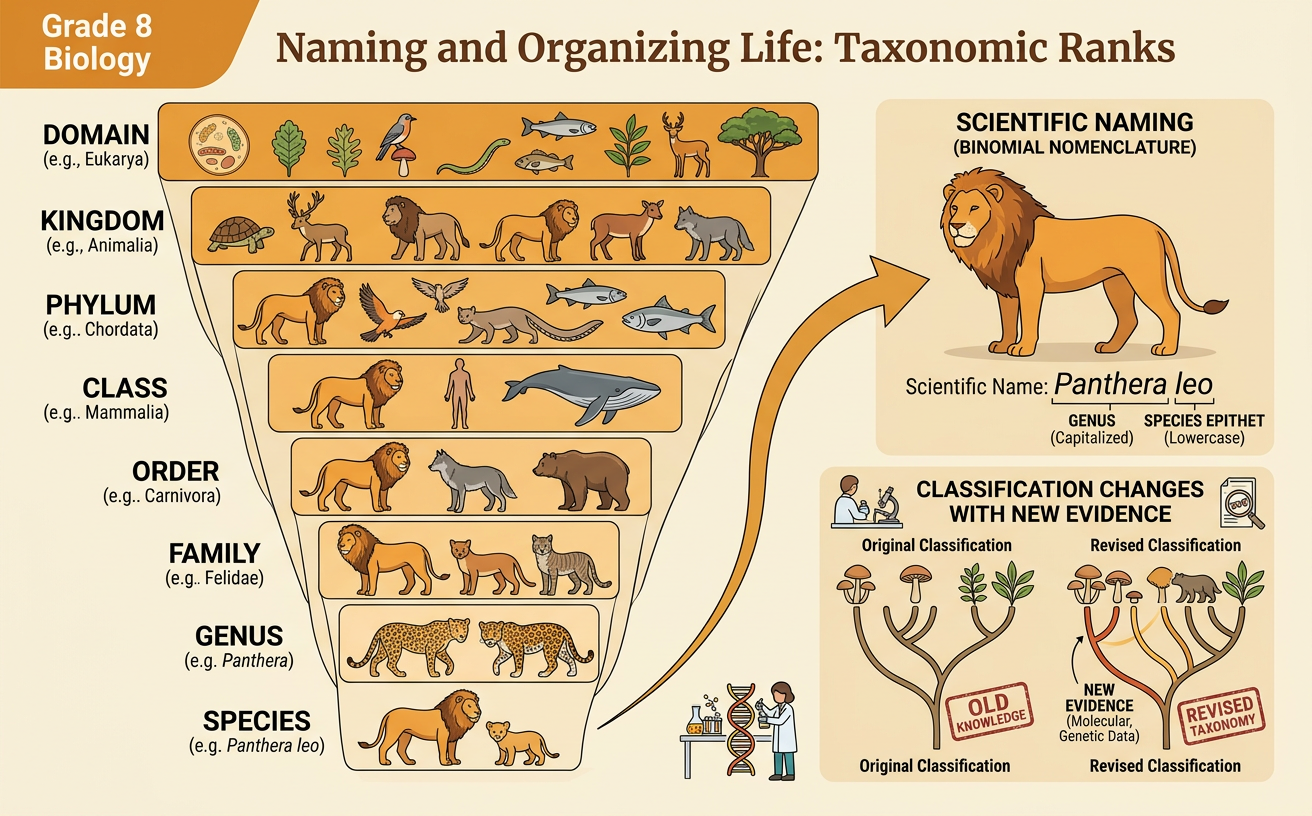
Taxonomy uses ranks that move from very broad groups to increasingly specific groups. The main ranks are domain, kingdom, phylum, class, order, family, genus, and species. Each lower rank is nested inside the rank above it. A gray wolf belongs to Domain Eukarya, Kingdom Animalia, Phylum Chordata, Class Mammalia, Order Carnivora, Family Canidae, Genus Canis, and Species Canis lupus. Domain Eukarya contains an enormous variety of organisms whose cells have nuclei. Species Canis lupus contains only gray wolves. Moving downward through the ranks decreases the number and variety of organisms while increasing the number of characteristics they share. The ranks provide a useful organizational system, although scientists also use evolutionary trees to show relationships more precisely.

Genus, Species, and Binomial Nomenclature
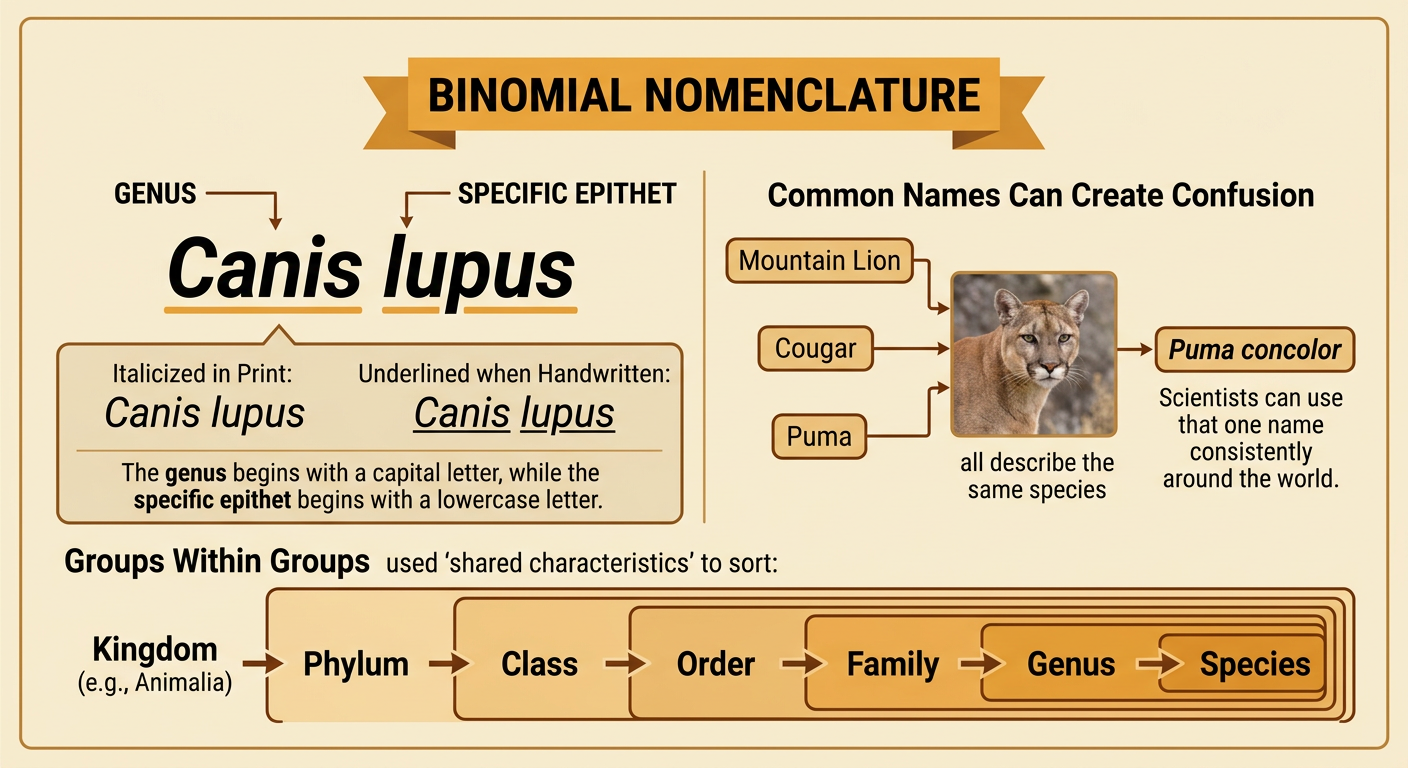
Every scientifically named species receives a two-part name through binomial nomenclature. The first word is the genus, a group of closely related species. The second word is the specific epithet, which identifies the species within that genus. Together, the two words form the species name. In Canis lupus, Canis is the genus and lupus is the specific epithet. The genus begins with a capital letter, while the specific epithet begins with a lowercase letter. In printed text, both words are italicized; when handwritten, each word is underlined separately. Scientific names reduce confusion caused by common names. For example, “mountain lion,” “cougar,” and “puma” all refer to Puma concolor. Scientists worldwide can use the same binomial name even when they speak different languages.
Sorting Organisms into Nested Groups
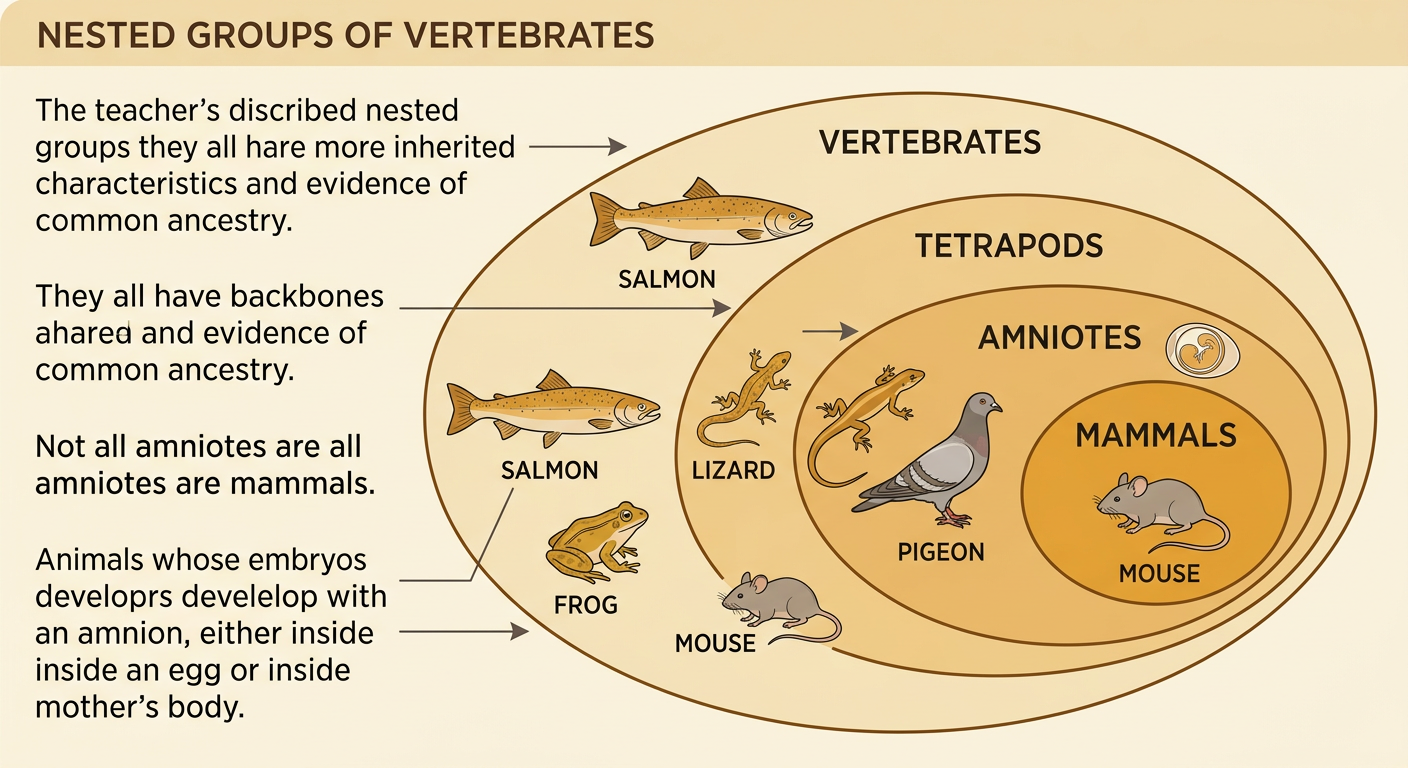
Nested groups can be represented as sets inside larger sets. Begin with a broad shared characteristic, then add characteristics that define smaller groups. Consider a salmon, frog, lizard, pigeon, and mouse. All are vertebrates because they have backbones. The frog, lizard, pigeon, and mouse are tetrapods because their ancestry includes four-limbed vertebrates. The lizard, pigeon, and mouse are amniotes because their embryos develop with an amnion, whether inside an egg or the mother’s body. The mouse is also a mammal because it has hair and produces milk. At each step, the group becomes smaller and its members share more inherited characteristics. This organization uses logical set reasoning: all mammals in the example are amniotes, but not all amniotes are mammals. Shared derived traits can also provide evidence of common ancestry.
How New Evidence Revises Classification
Classification systems are scientific models, so they can change when stronger evidence becomes available. Early classifications relied mainly on visible structures and ways of life. Modern scientists also compare fossils, embryonic development, proteins, and DNA sequences. Whales provide an example. Their streamlined bodies and aquatic lives resemble fish, but lungs, milk production, warm-blooded bodies, and skeletal features identify them as mammals. Fossil discoveries and DNA evidence later showed that whales belong within the even-toed ungulate lineage and that hippopotamuses are their closest living relatives. This evidence refined the placement of whales without changing the conclusion that they are mammals. Taxonomy therefore shows both change and continuity: group placements and evolutionary trees may be revised, while useful practices such as binomial naming and comparison of shared traits continue. Revisions are a strength of science because explanations improve as evidence grows.

Taxonomy Exit Check
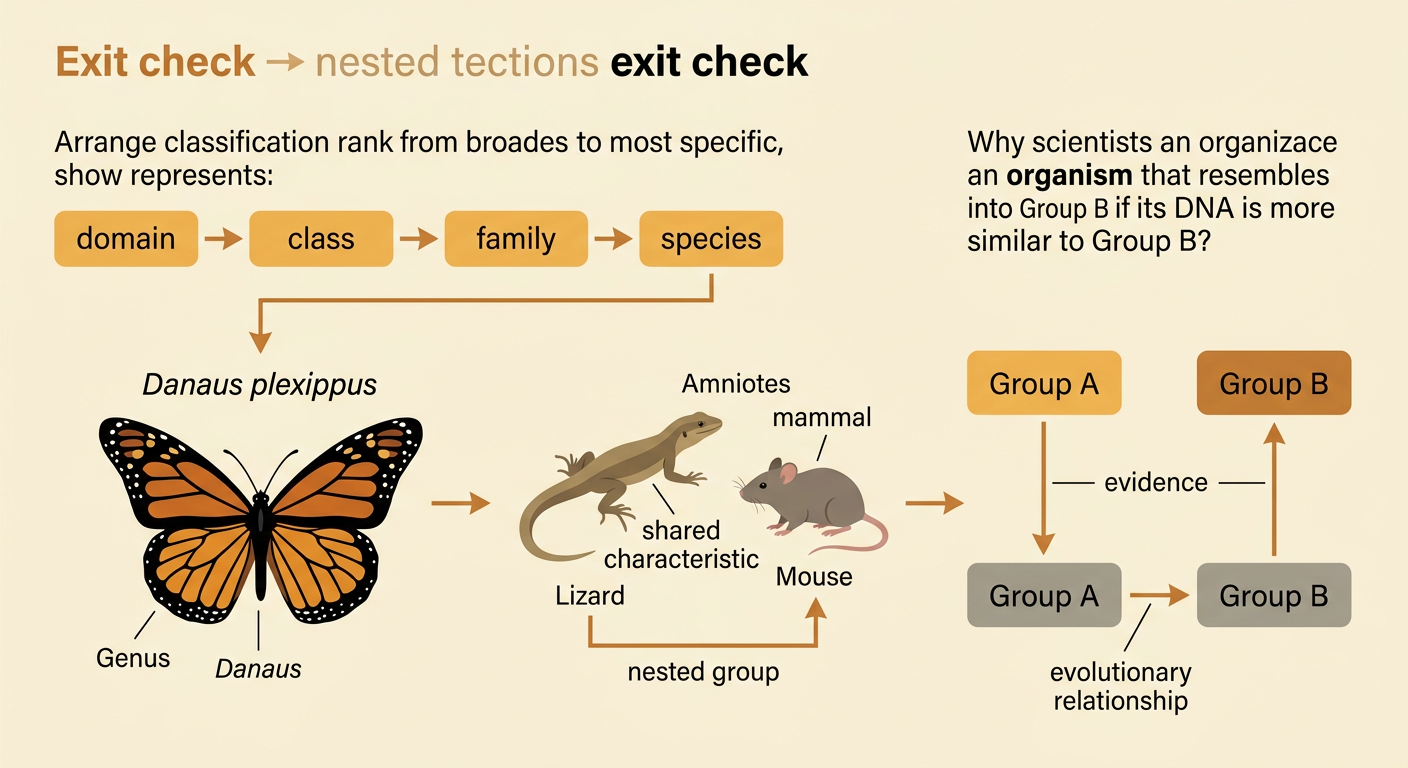
Use these questions to check your understanding. Place domain, family, class, and species from broadest to most specific; the correct order is domain, class, family, species. In the name Danaus plexippus, identify Danaus as the genus and plexippus as the specific epithet. Explain why both a lizard and a mouse can belong to the amniote group even though only the mouse is a mammal. Then consider a newly studied organism whose DNA is more similar to Group B than Group A, despite its outward resemblance to Group A. The DNA may support moving it to Group B because molecular similarities can provide evidence of closer common ancestry. A strong explanation uses the terms shared characteristic, nested group, evidence, and evolutionary relationship, while recognizing that conclusions may change if new evidence appears.