Natural Selection in a Changing Environment
Students analyze peppered moth population data to explain how heritable variation, environmental change, and differential survival can shift trait frequencies over time.
Illustrations are auto-generated and may be placeholders. They can be refreshed to match the narration.
Peppered Moths and Industrial Change
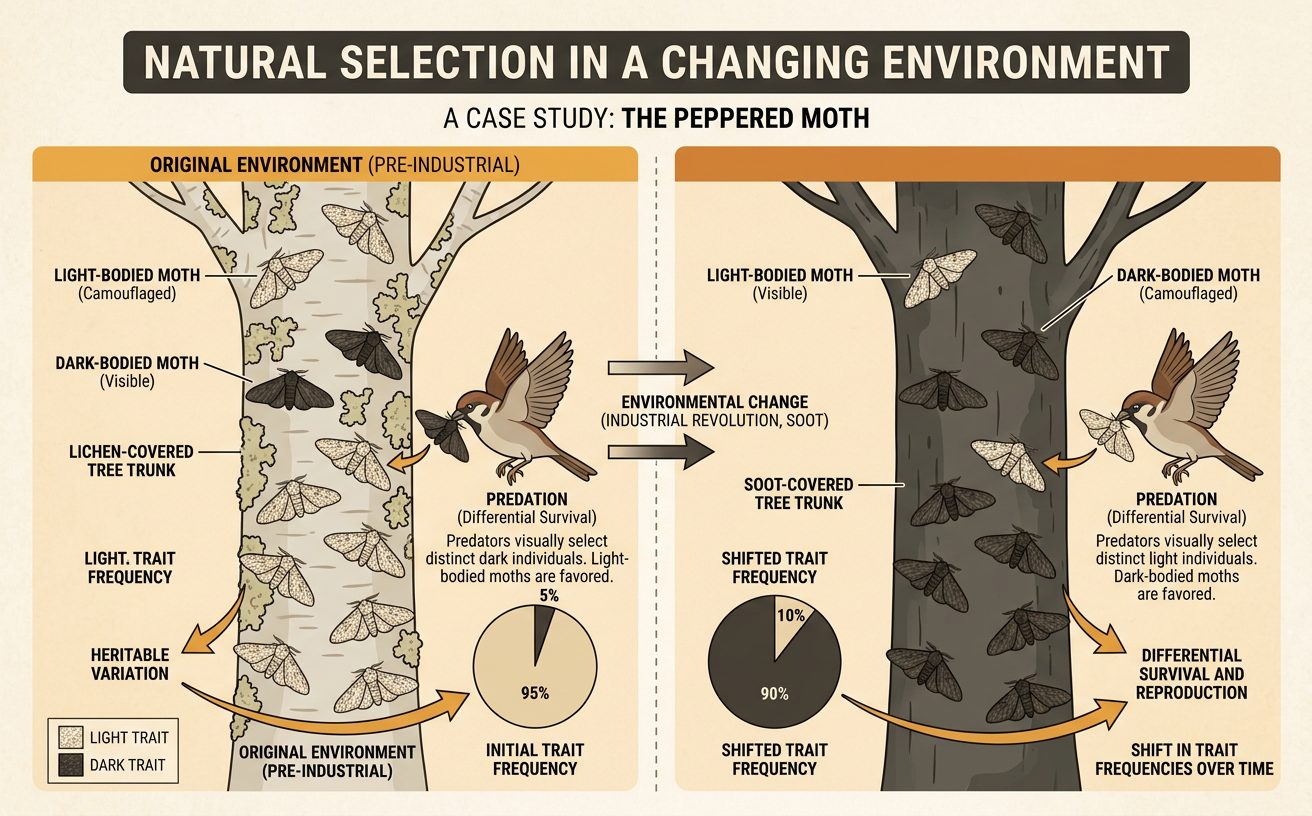
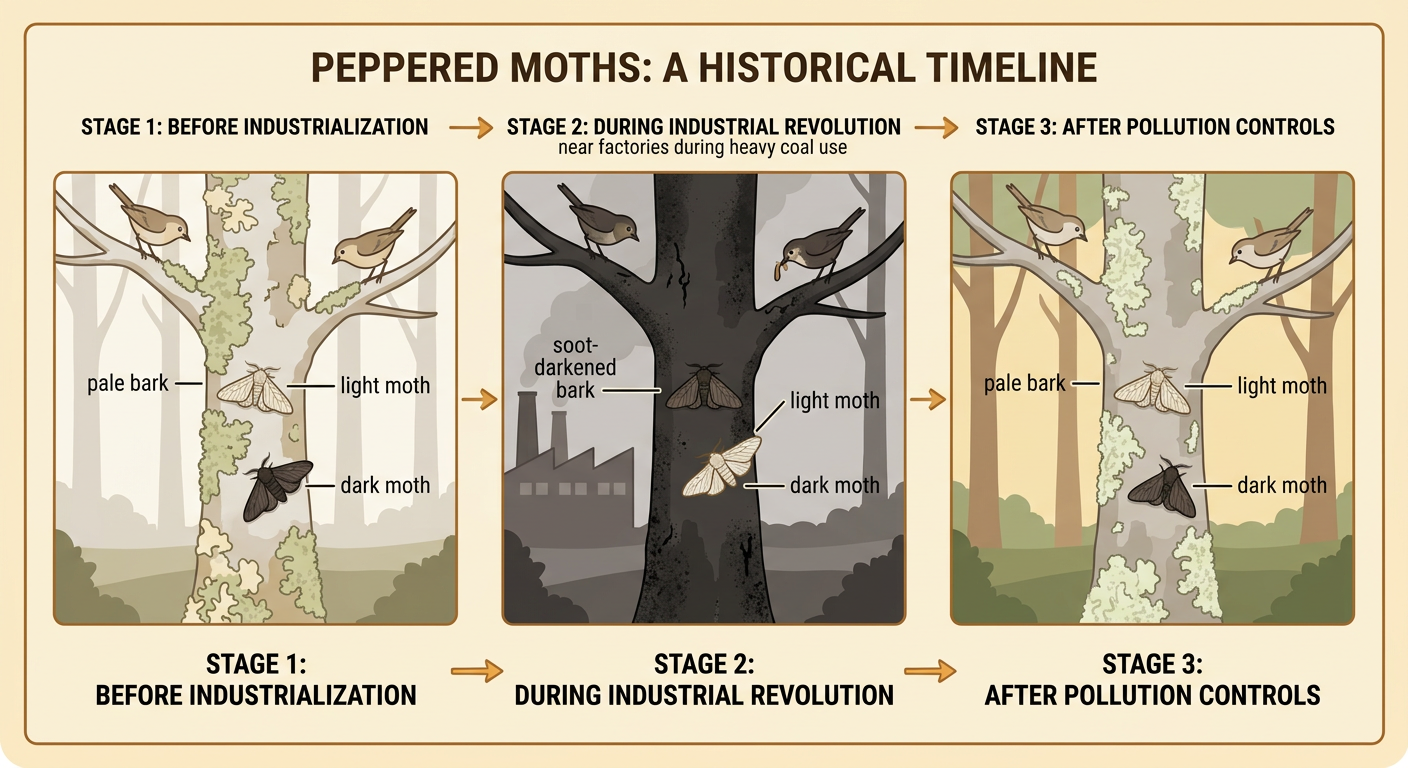
Peppered moths in Britain occur in light and dark forms. Before widespread industrialization, many trees had pale, lichen-covered bark, where light moths were often better camouflaged from birds. During the Industrial Revolution, coal smoke and sulfur pollution darkened surfaces and reduced many lichens near industrial centers. In these changed habitats, dark moths were less visible against darker backgrounds and often survived bird predation at higher rates. For example, the dark form became much more common around heavily polluted cities such as Manchester. Later, clean-air laws reduced soot pollution, lichens recovered in many places, and the frequency of dark moths declined. This history shows that industrialization had connected effects on air quality, ecosystems, and moth populations. The environment did not create dark moths because they were needed; it changed which existing heritable traits provided an advantage.
Sources of Heritable Variation
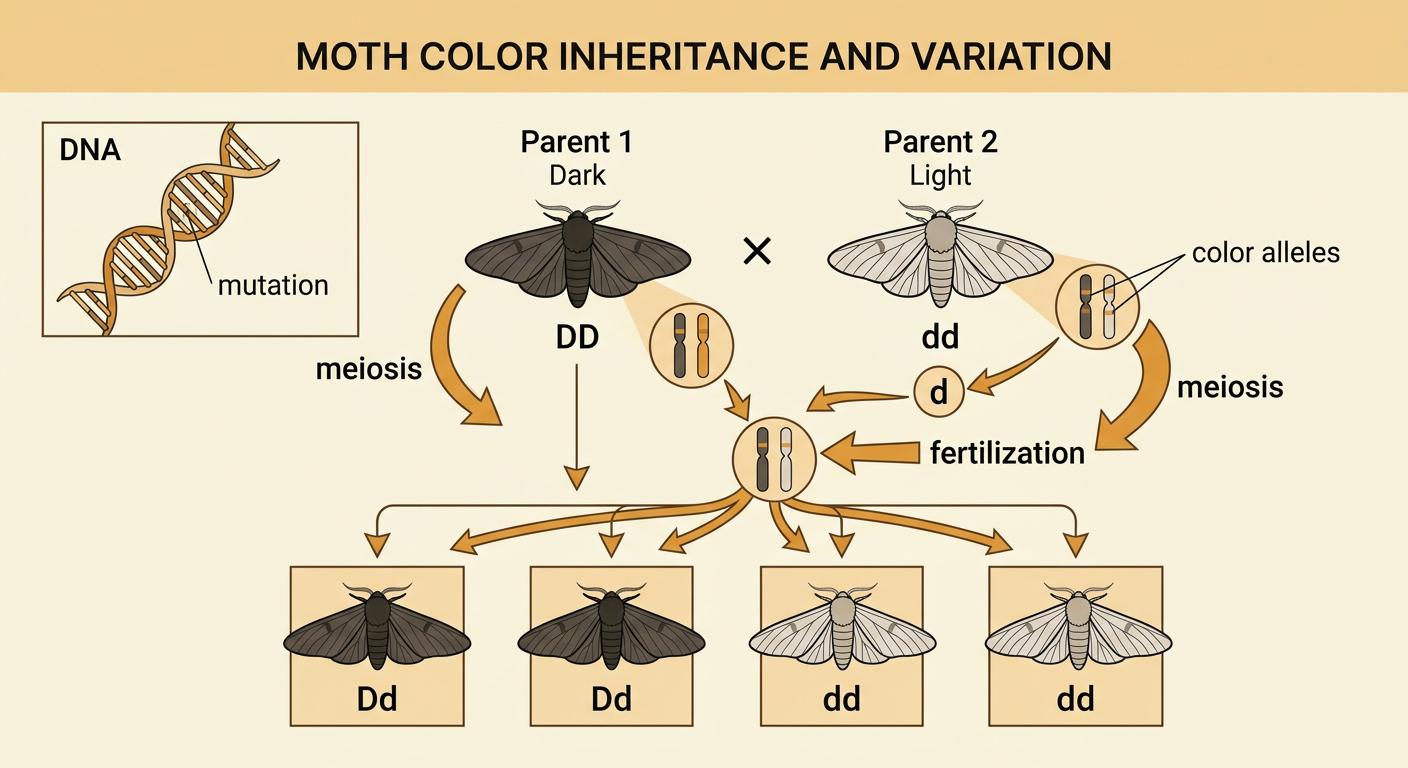
Natural selection can occur only when individuals differ in traits and some of those differences are heritable. In peppered moths, genetic differences influence whether an adult has a light, speckled appearance or a dark, melanic appearance. New genetic variation ultimately begins with mutations, which are changes in DNA. During sexual reproduction, meiosis and fertilization reshuffle existing alleles into new combinations. If a color-related allele is passed from parents to offspring, moth color can respond to selection across generations. An individual moth does not change its inherited color to match a tree during its lifetime. Instead, populations already contain variation, and individuals with advantageous inherited traits may leave more offspring. For example, a dark moth that survives long enough to reproduce can pass color alleles to its offspring, increasing the representation of those alleles in the next generation.
Reading Population Data
Population data can reveal changes that are not obvious from a single observation. Suppose researchers sample 200 moths near an industrial city in 1900 and find 160 dark moths and 40 light moths. The dark phenotype frequency is 160 divided by 200, or 0.80, which is 80 percent. In 2000, after decades of cleaner air, a sample of 200 moths contains 50 dark moths and 150 light moths, so the dark frequency is 25 percent. A line graph can display year on the horizontal axis and phenotype frequency on the vertical axis. Students should examine trends, sample sizes, and uncertainty rather than relying on one data point. They should also distinguish correlation from causation: a decline in dark moths alongside declining pollution supports a relationship, but experiments and observations of survival provide additional evidence for the mechanism.

How Selection Shifts Trait Frequencies
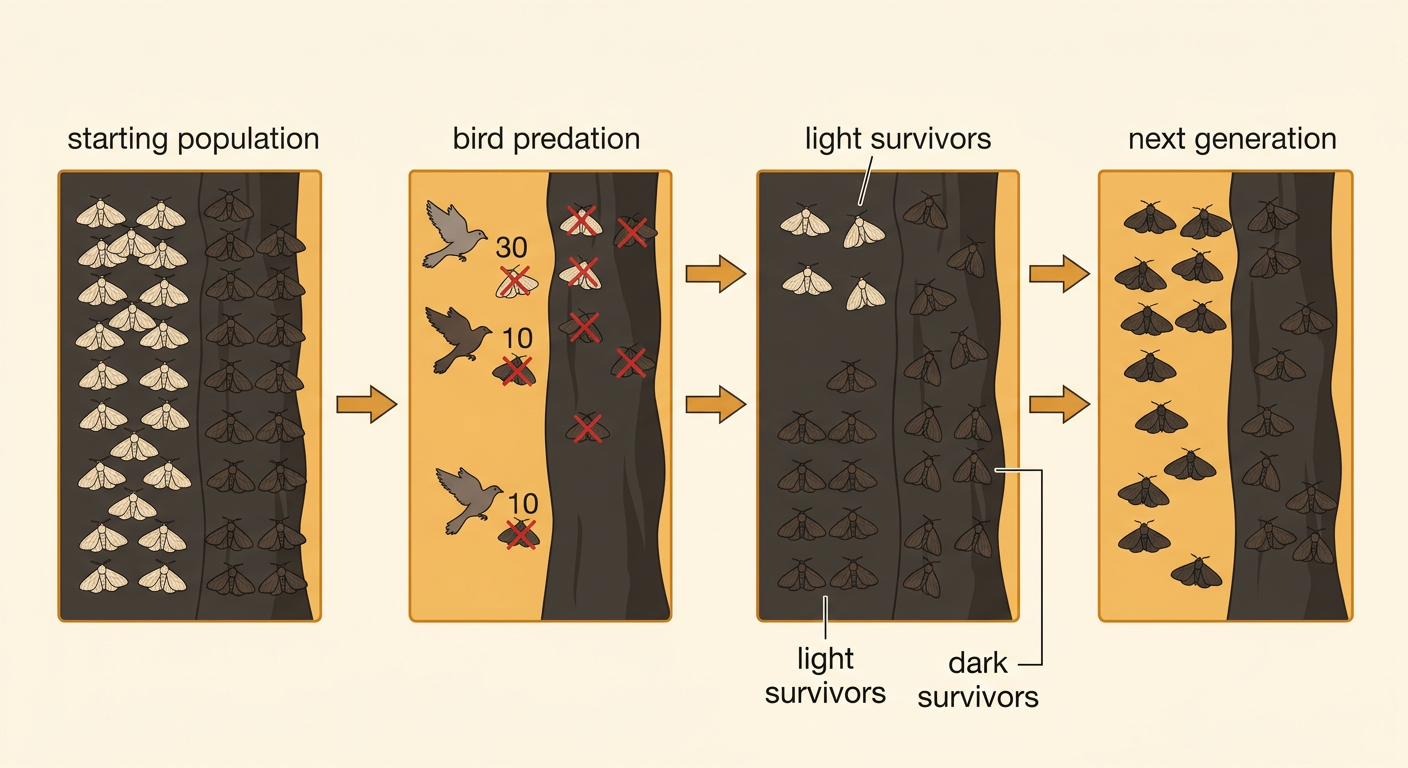
Natural selection changes populations through differences in survival and reproduction. Imagine a population containing 50 light moths and 50 dark moths. In a soot-darkened habitat, birds might detect and eat 30 light moths but only 10 dark moths. That leaves 20 light survivors and 40 dark survivors. If survivors reproduce at similar rates, dark moths contribute a larger share of the alleles in the next generation. Over many generations, the dark trait can become more frequent. If pollution later declines and pale lichens return, the direction of selection may reverse because light moths gain better camouflage. Selection acts on individual moths, but evolution is measured as a change in trait or allele frequencies in the population. The favored trait is therefore not universally superior; its advantage depends on the current environment and the selective pressures operating there.
Constructing an Evidence-Based Explanation
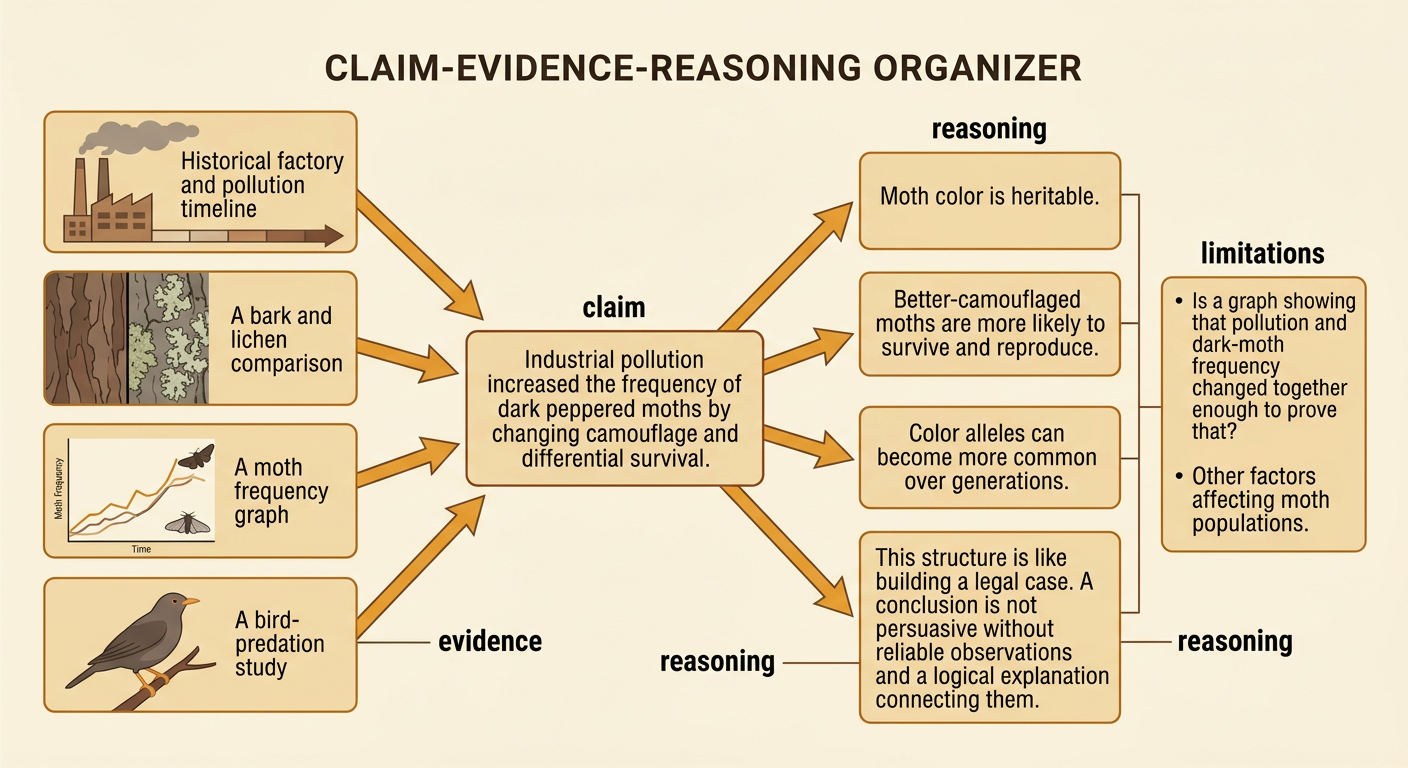
A strong scientific explanation connects a claim, relevant evidence, and reasoning. A claim might state that industrial pollution increased the frequency of dark peppered moths by changing camouflage and differential survival. Evidence could include historical records of coal use and soot, photographs or descriptions of bark and lichen conditions, moth frequency graphs, and field experiments measuring bird predation or moth survival. The reasoning should explain that color variation is heritable and that better-camouflaged moths are more likely to survive, reproduce, and pass color alleles to offspring. Students should also evaluate limitations. For example, a graph showing that pollution and dark-moth frequency changed together does not alone prove that soot caused the evolutionary shift. Evidence from multiple formats and sources strengthens the explanation. Other influences, including migration, local habitat differences, and sampling methods, should be considered when judging the conclusion.