
Natural Selection in Action: Antibiotic Resistance
Students analyze bacterial survival data to explain how antibiotic use can drive natural selection and inform public health decisions.
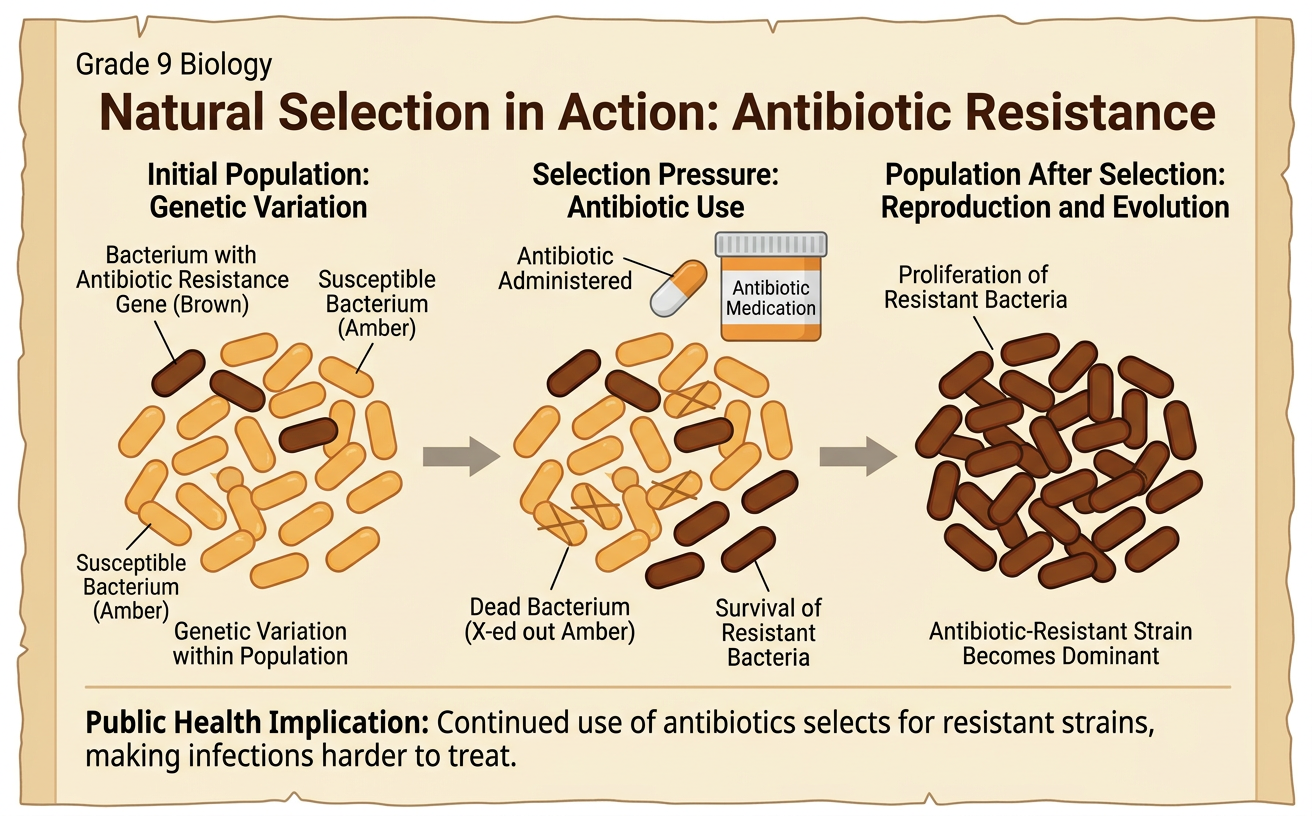
Illustrations are auto-generated and may be placeholders. They can be refreshed to match the narration.
Variation in Bacterial Populations
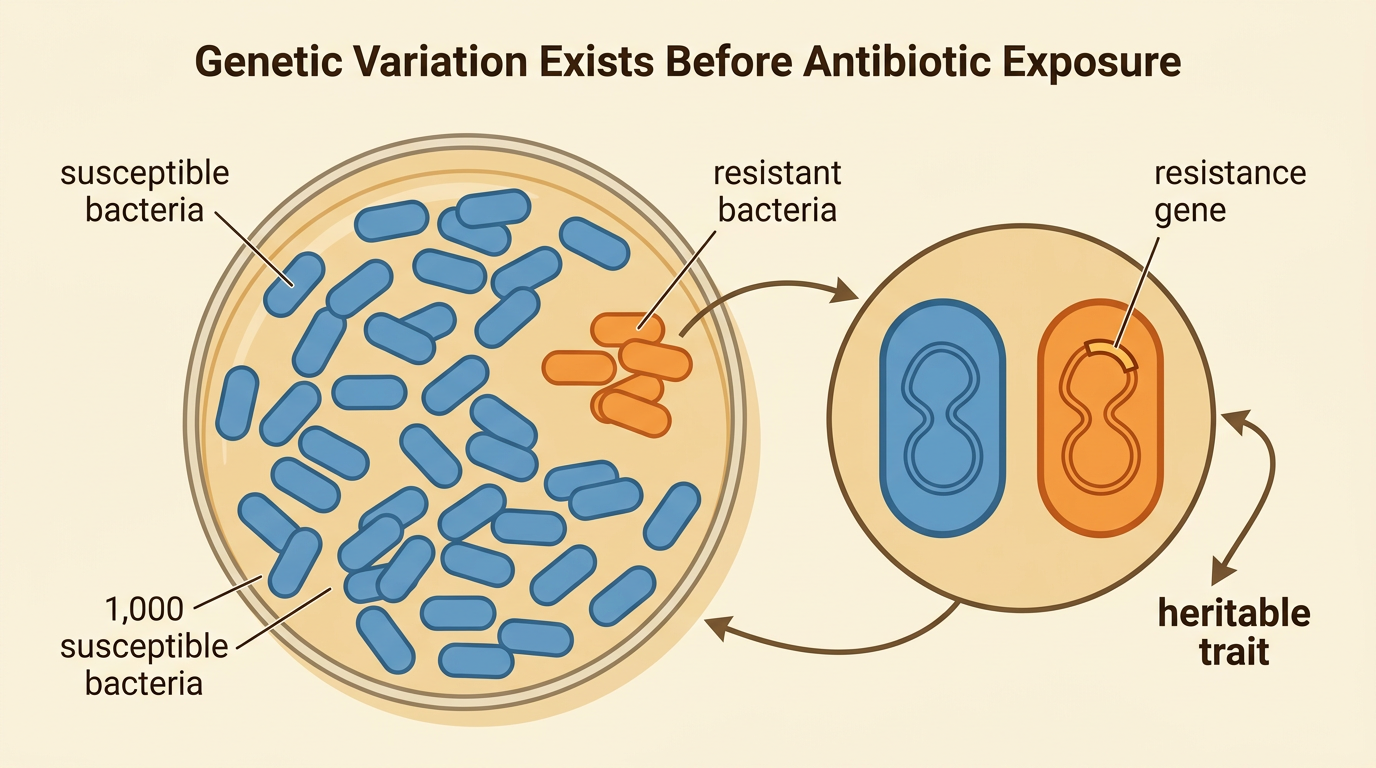
A bacterial population contains variation, meaning that its members are not genetically identical. Random mutations and gene transfer can give some bacteria traits that affect antibiotic resistance. This variation exists before an antibiotic is used; the drug does not cause bacteria to develop the resistance they need. For example, imagine a population of 1,000 bacteria in which 10 already carry a resistance gene. The other 990 are susceptible to a particular antibiotic. Without the antibiotic, both types may reproduce. If the environment changes, however, the resistance trait may affect which bacteria survive and leave descendants. Because bacteria reproduce quickly and pass genetic information to offspring, even a rare heritable trait can become more common over many generations.
How Antibiotics Create Selection Pressure
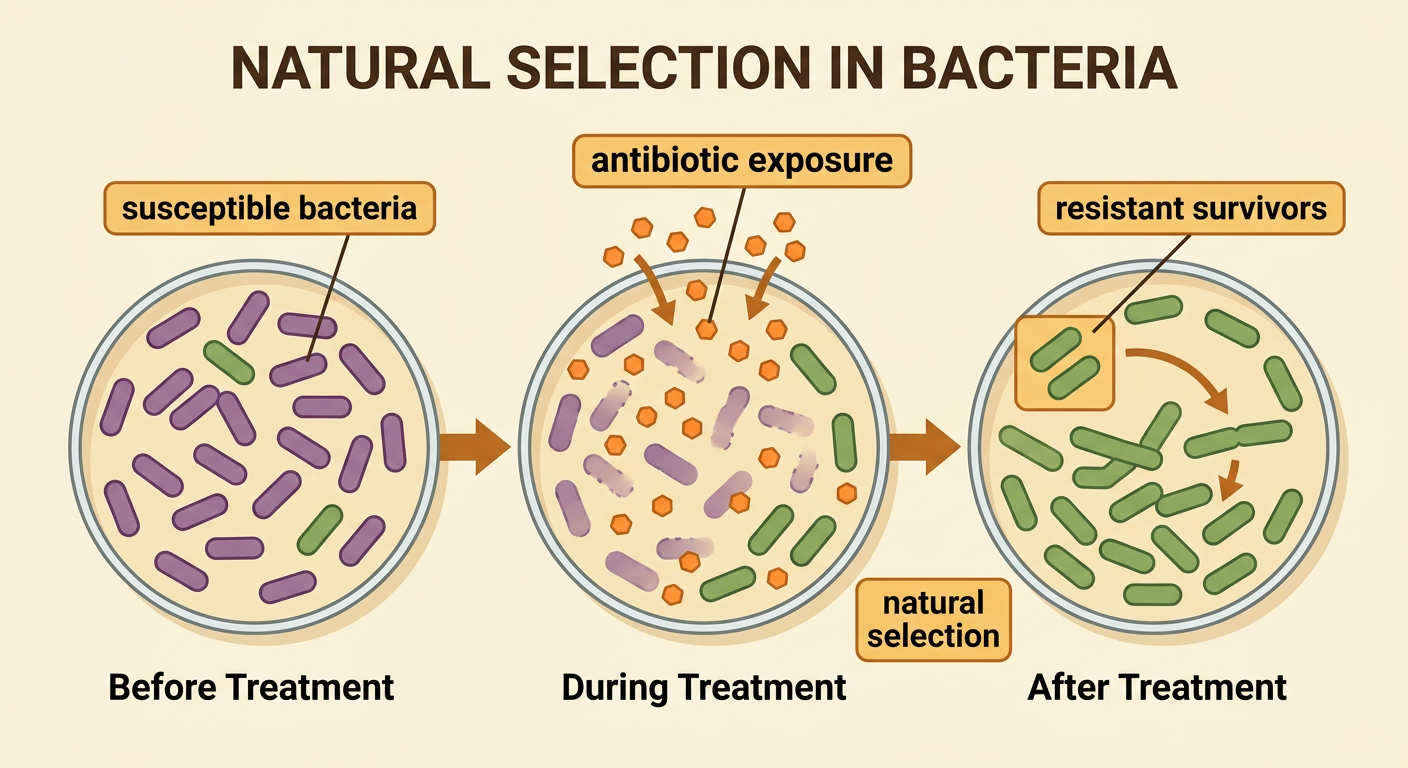
An antibiotic creates selection pressure by changing which bacteria are most likely to survive and reproduce. When a population is exposed to an effective antibiotic, susceptible bacteria die or stop growing. Bacteria with a resistance trait are more likely to survive. These survivors reproduce and pass resistance genes to descendants, so resistance becomes more common in the next generation. For example, if an antibiotic kills 990 susceptible bacteria but 10 resistant bacteria survive, the survivors can multiply into a large population. The individual bacteria did not adapt because they tried to survive. Instead, the population changed because bacteria with an existing heritable advantage produced more descendants. Repeated or unnecessary antibiotic exposure can increase this selection pressure and speed the rise of resistant populations.
Analyzing Resistance Data
Scientists can graph two quantitative variables to look for patterns in resistance. Consider a controlled experiment measuring the percentage of resistant bacteria after repeated rounds of antibiotic exposure. At rounds 0, 1, 2, 3, and 4, the exposed population is 5%, 18%, 42%, 71%, and 88% resistant. A population not exposed to the antibiotic remains near 5% to 7% resistant. On a line graph, exposure round is the independent variable on the horizontal axis, and percent resistant is the dependent variable on the vertical axis. The strong upward trend supports the conclusion that repeated exposure is associated with increasing resistance. However, the graph alone does not identify the resistance gene or prove exactly how it arose. Replication and controlled conditions strengthen the scientific conclusion.

Explaining Population Change
An evidence-based explanation connects a claim, data, and scientific reasoning. A useful claim is that repeated antibiotic exposure caused the bacterial population to become adapted to an antibiotic-rich environment. The evidence is that resistance increased from 5% before exposure to 88% after four exposure rounds, while the control stayed near its starting level. The reasoning is that resistant bacteria survived at higher rates and produced more descendants than susceptible bacteria. Over generations, the resistance trait increased in frequency. Adaptation describes this population-level change; it does not mean that individual susceptible bacteria intentionally changed. If resistance carries an energy cost, its frequency might later decrease when the antibiotic is removed. If there is little cost, or if resistance genes spread between bacteria, the trait may remain common.

Antibiotic Stewardship and Public Health
Antibiotic stewardship means using antibiotics only when they are needed and choosing the correct drug, dose, and treatment length. These decisions can reduce unnecessary selection pressure while still treating bacterial infections. Antibiotics do not treat viral illnesses such as influenza, so prescribing them for those illnesses provides no benefit and can promote resistance. Public institutions also influence resistance. For example, a hospital committee might track local resistance data, update prescribing guidelines, require laboratory testing, and review antibiotic use. Public health agencies can collect reports, educate communities, and regulate some uses of antibiotics in agriculture. People can support or challenge these policies through public comments, professional organizations, advocacy groups, and elected representatives. Effective policy should consider scientific evidence, patient safety, access to treatment, costs, and effects on different communities.
