
Natural Selection in Peppered Moths
Students analyze peppered moth data to explain how environmental changes can make certain inherited traits more advantageous over generations.

Illustrations are auto-generated and may be placeholders. They can be refreshed to match the narration.
Meet the Peppered Moths
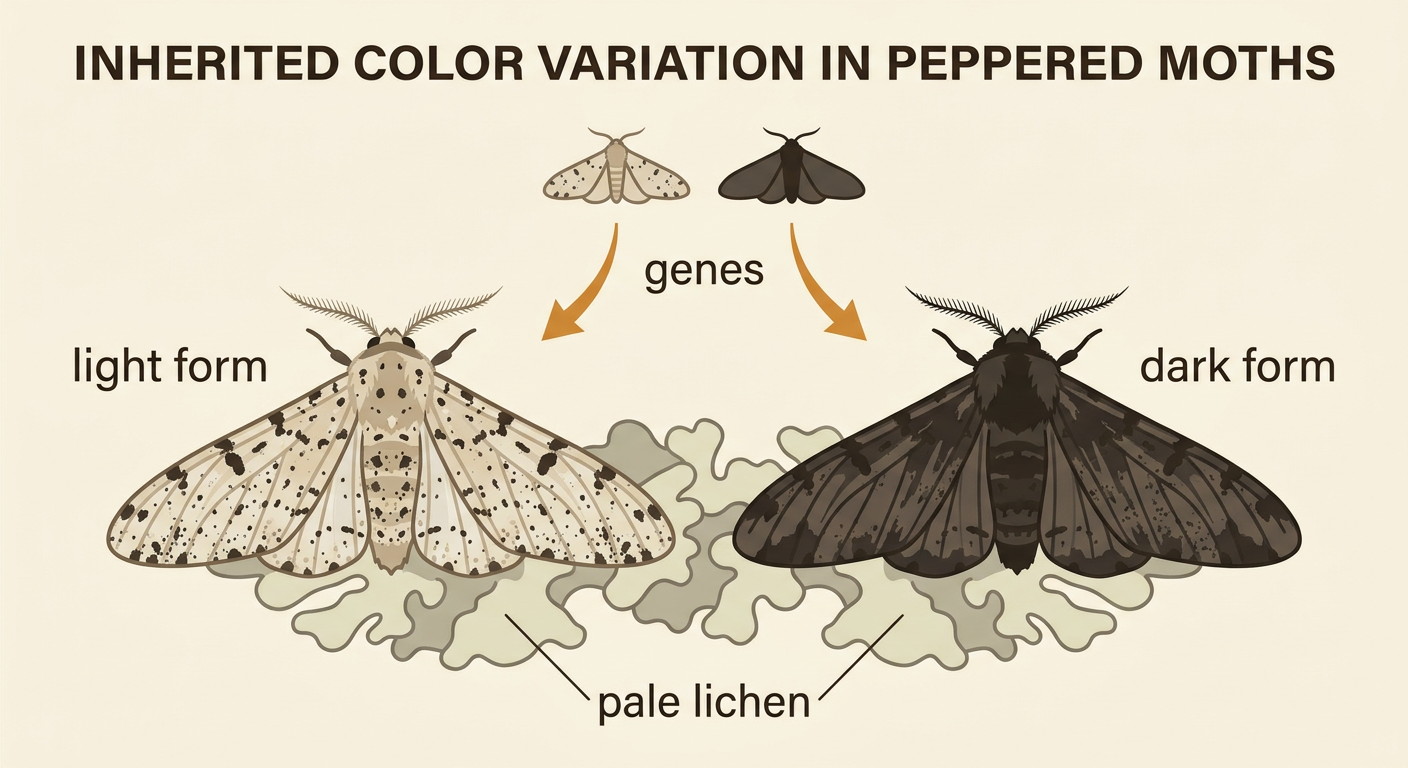
Peppered moths are a species of night-flying insect found in Britain and other places. Within one population, moths can have different inherited color patterns. The common light form has pale wings with dark speckles, while a dark form has much more dark pigment. These forms are members of the same species, not different kinds of moths. A moth receives genes from its parents that help determine its coloring. It cannot choose or change its inherited color to match a tree. During the day, peppered moths rest on tree surfaces and other sheltered places, where birds may find them. For example, a light moth and a dark moth may rest against the same pale, lichen-covered background. The light moth is usually harder for a bird to see because its coloring blends with the surface.
Environmental Change and Camouflage
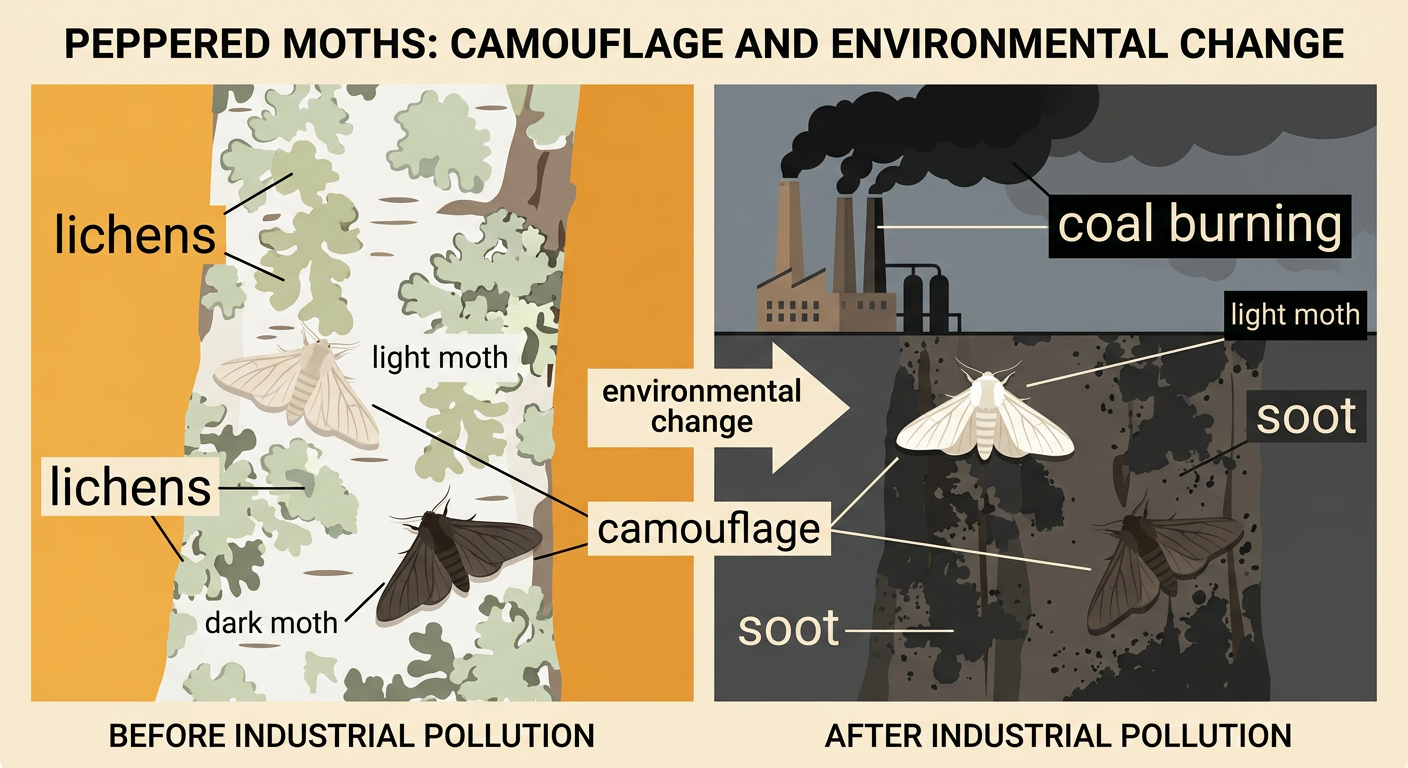
Camouflage helps an organism blend with its surroundings, making it less likely to be noticed by a predator. Before widespread industrial pollution in parts of Britain, many tree surfaces were pale and covered with lichens. Light peppered moths were often better camouflaged there. During the Industrial Revolution, factories and homes burned large amounts of coal. Soot darkened many surfaces, and air pollution damaged lichens. These changes created darker resting backgrounds in polluted areas. On those backgrounds, dark moths were often less visible to hunting birds than light moths. For example, a bird searching a soot-darkened tree might quickly notice a pale moth but overlook a dark one. The environment did not cause individual moths to change color. Instead, it changed which existing inherited color variation provided better camouflage and a greater chance of survival.
Analyze Survival Data
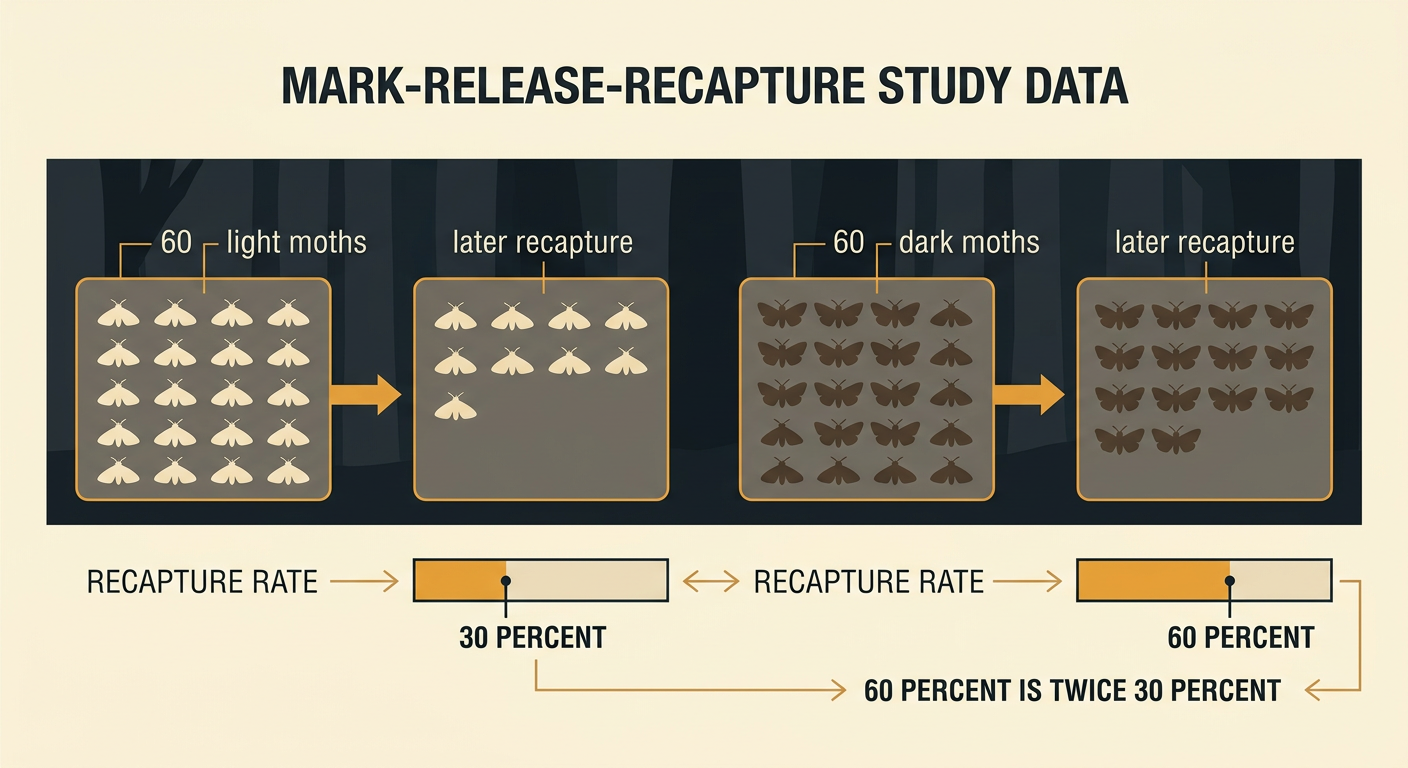
Scientists can test survival differences with observations and mark-release-recapture studies. In a sample investigation in a dark woodland, suppose researchers release 60 light moths and 60 dark moths. Later, they recapture 18 light moths and 36 dark moths. The light moth recapture rate is 18 out of 60, or 30 percent. The dark moth recapture rate is 36 out of 60, or 60 percent. This specific evidence shows that dark moths were twice as likely to be recaptured in that environment. Recapture is used as an estimate of survival, so scientists repeat trials and consider other possible influences. Observations of birds attacking more visible moths strengthen the camouflage explanation. A fair comparison uses equal starting groups, the same location, and the same amount of time. Results from pale, lichen-rich woodlands may show the opposite pattern.
Explain Natural Selection
Natural selection occurs when inherited variations affect survival and reproduction in a particular environment. A peppered moth population already contains light and dark forms. In a dark woodland, dark moths may be harder for birds to detect. Because more dark moths are likely to survive, more may reproduce and pass genes for dark coloring to their offspring. Over many generations, the dark form can become more common in that population. For example, if 40 of every 100 moths are dark at first, stronger survival and reproduction by dark moths could increase that number in later generations. Individual light moths do not turn dark, and moths do not become dark because they need to. The population changes because individuals with an advantageous inherited variation leave more offspring. If the environment becomes pale again, the light form may have the advantage instead.

Connect Causes and Effects
The historical pattern of peppered moth colors resulted from several connected causes and effects. During the Industrial Revolution, growing cities, factories, and coal burning increased air pollution. Soot darkened tree surfaces, while other pollutants reduced lichens. These environmental effects changed camouflage conditions. Birds then removed more visible moths, so dark moths often survived and reproduced more successfully in polluted areas. Over generations, the dark form became more common in many of those populations. Later, clean-air laws, cleaner fuels, and reduced soot allowed many surfaces to become lighter and lichens to recover. In several areas, the light form increased again. For example, moth records from a polluted city and a cleaner rural area could show different color frequencies during the same decade. Scientists connect historical records, pollution measurements, experiments, and moth counts while also considering migration, local habitats, weather, and other influences.
