
Natural Selection: Why Helpful Traits Become More Common
Students analyze a changing population to explain how inherited variations can affect survival, reproduction, and the frequency of traits over generations.
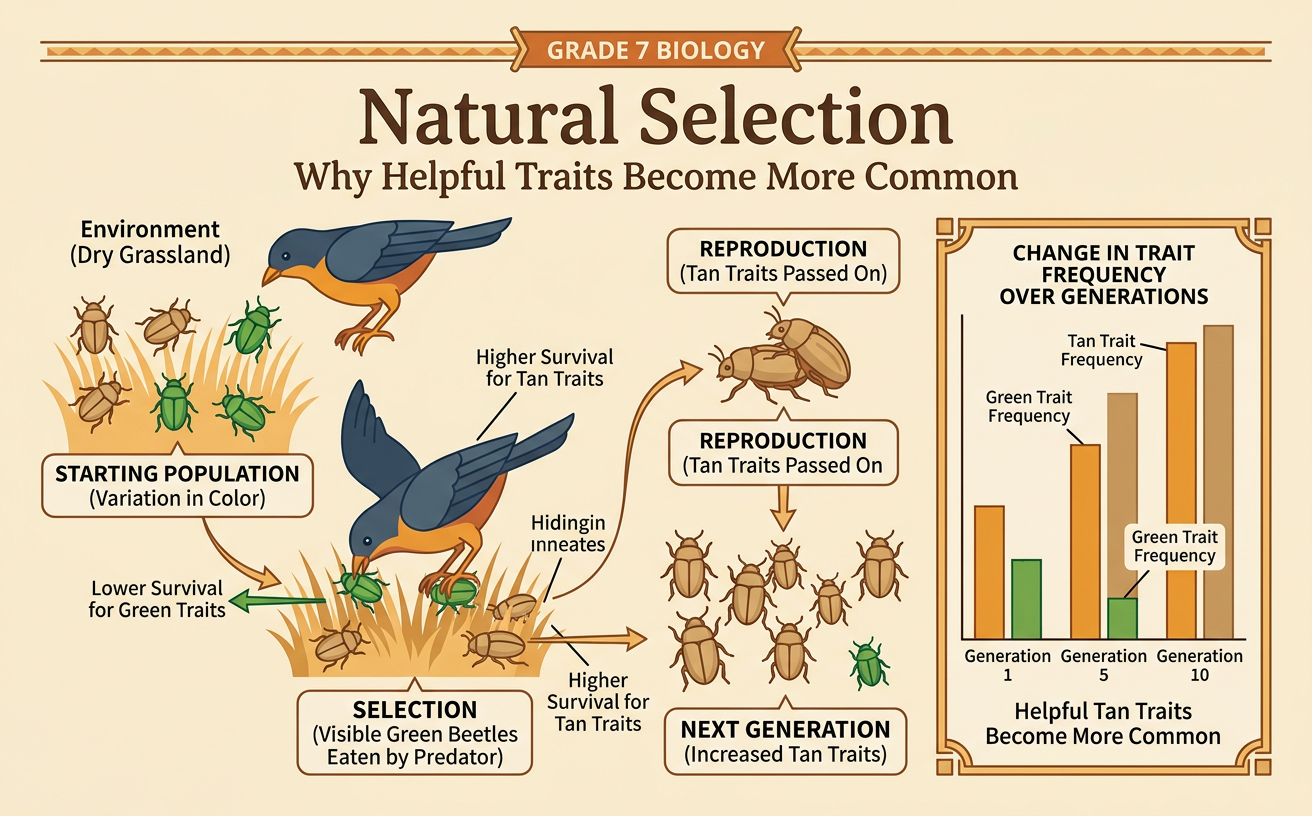
Illustrations are auto-generated and may be placeholders. They can be refreshed to match the narration.
Variation Within a Population
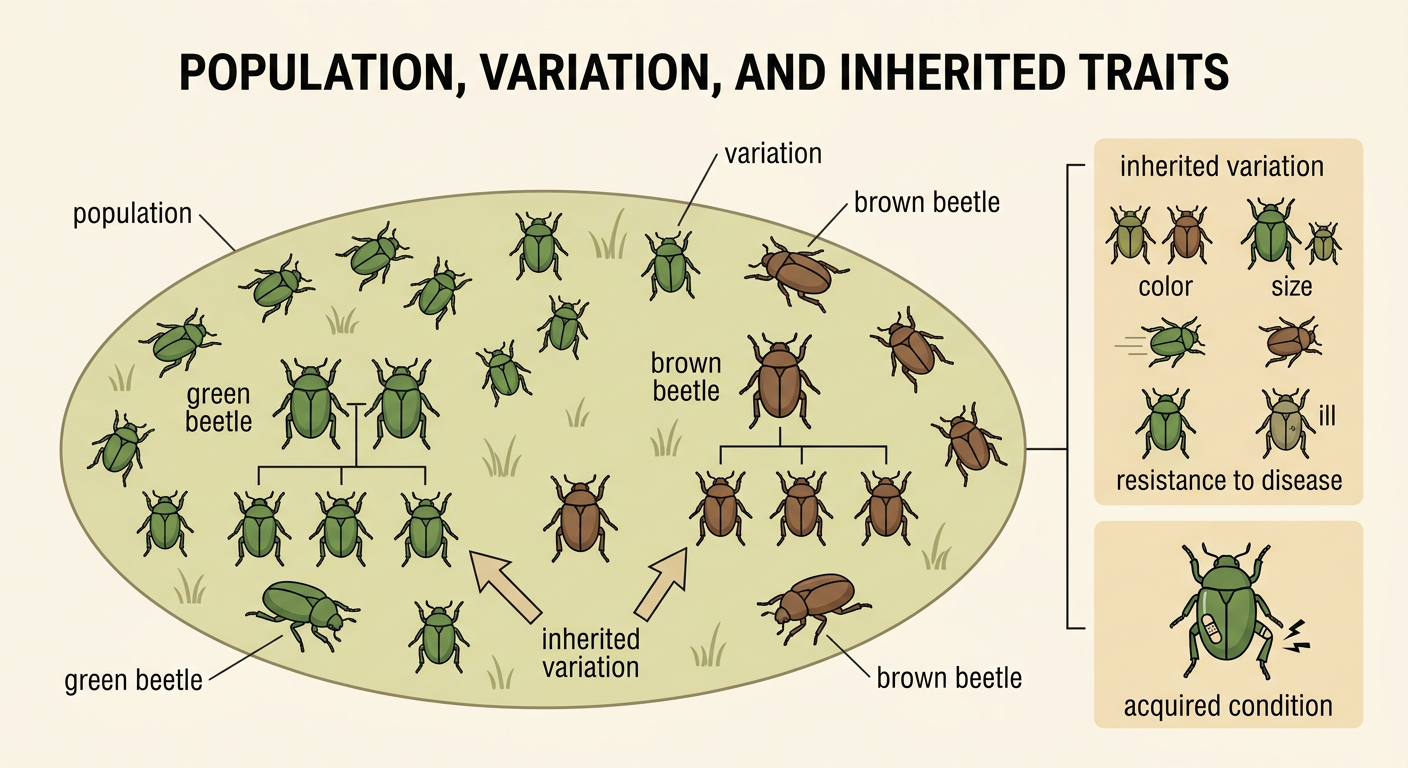
A population is a group of the same species living in the same area. Individuals in a population are not identical. They may vary in color, size, speed, or resistance to disease. Some variations are inherited, meaning they can be passed from parents to offspring through genes. For example, a beetle population might include green beetles and brown beetles because of inherited differences in body color. Variation does not appear because an organism needs it, and not every difference affects survival. A broken leg is an acquired condition, so it is not an inherited variation. Natural selection can change a population only when individuals have inherited variations and some of those variations affect their chances of surviving and reproducing in a particular environment.
Environmental Selection Pressures
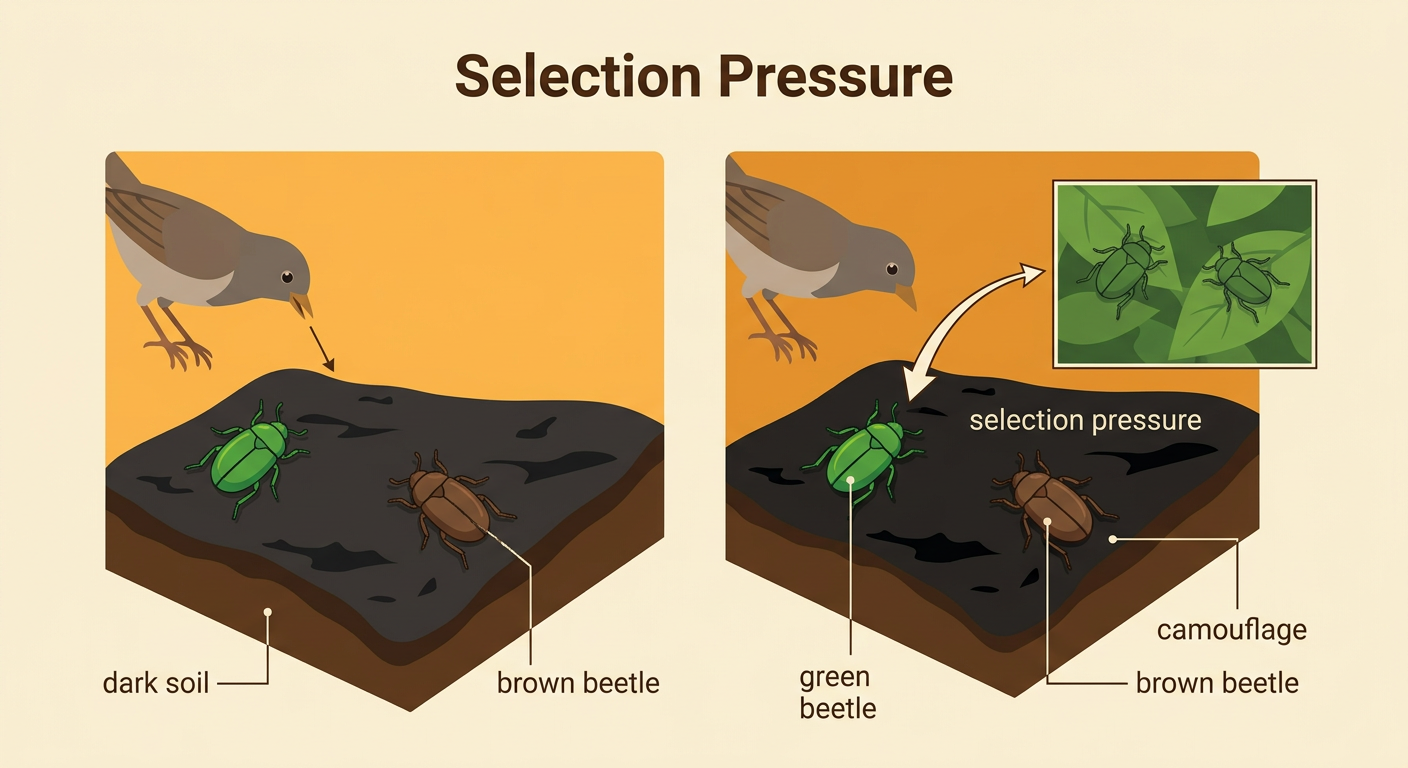
A selection pressure is an environmental factor that affects an organism’s probability of surviving or reproducing. Predators, temperature, drought, disease, food availability, and competition can all act as selection pressures. Imagine green and brown beetles living on dark brown soil after a wildfire removes much of the grass. Birds may notice green beetles more easily against the dark ground, while brown beetles are better camouflaged. The environment does not decide which trait is best, and individual beetles do not change color because they want to hide. Instead, an inherited color that already exists may be helpful under these specific conditions. If green plants grow back, the advantage could change. Therefore, whether a trait is helpful depends on the environment in which the population lives.
Survival and Reproduction
Natural selection involves both survival and reproduction. A helpful inherited trait can increase an individual’s probability of living long enough to reproduce, finding a mate, or producing more surviving offspring. It does not guarantee success. For example, suppose some rabbits inherit thicker fur than others in a very cold habitat. Thick-furred rabbits may be more likely to stay warm, survive the winter, and have young in spring. Because offspring often inherit genes from their parents, many young rabbits may also have thick fur. Thin-furred rabbits do not disappear immediately, and some may still survive and reproduce. However, if thick-furred rabbits consistently leave more offspring, the genes related to thicker fur can become more common. The population changes over generations; individual rabbits do not evolve during their lifetimes.

Tracking Traits Across Generations
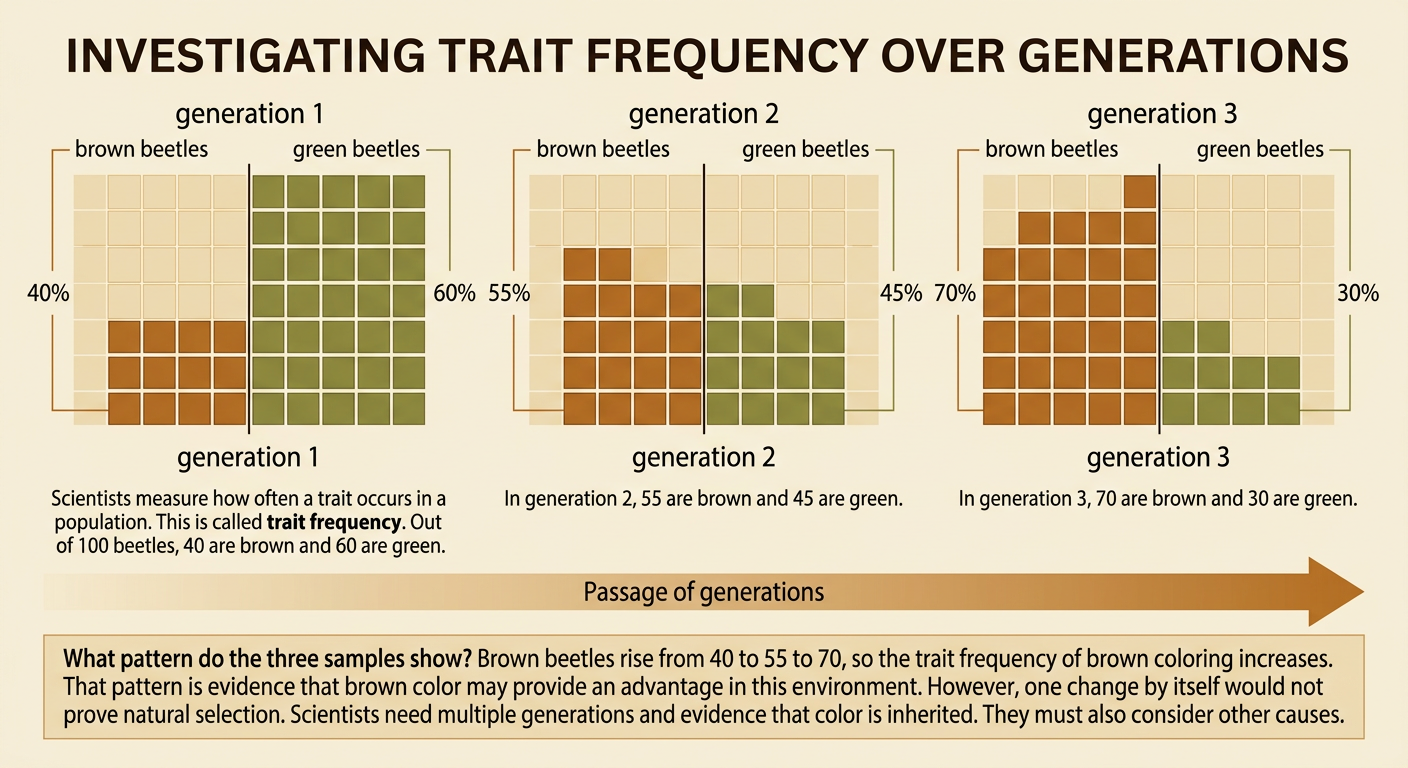
Scientists track natural selection by measuring how often traits occur in each generation. This is called trait frequency. Consider samples of 100 beetles from the same population after the ground becomes darker. In generation 1, 40 beetles are brown and 60 are green. Brown beetles are less visible to birds and, on average, produce more surviving offspring. In generation 2, a new sample contains 55 brown and 45 green beetles. In generation 3, 70 are brown and 30 are green. The rising frequency of brown beetles is evidence that the brown-color variation may provide an advantage in that environment. However, one change is not enough to prove natural selection. Scientists should examine multiple generations, confirm that color is inherited, and consider other causes, such as migration or chance.
Evidence-Based Natural Selection Explanation
A strong natural selection explanation includes a claim, evidence, and reasoning. A claim might state that brown coloring became more common because it improved camouflage on dark soil. Evidence could include beetle counts from several generations, observations of bird attacks, and a scientific text showing that body color is inherited. The reasoning connects the evidence to the claim: brown beetles were less likely to be eaten, so more survived and reproduced, passing the brown-color variation to offspring. Evidence from multiple sources strengthens the explanation, but each source has limitations. Counts may cover only a small area, observations may be brief, and a text about another beetle population may not match local conditions. A careful conclusion acknowledges these limits and avoids saying that beetles changed because they tried or needed to adapt.
