
Nature-Inspired Tools: Learning from Plant and Animal Parts
Students observe how external plant and animal parts meet survival needs, then draw and explain a simple tool inspired by one of those parts.
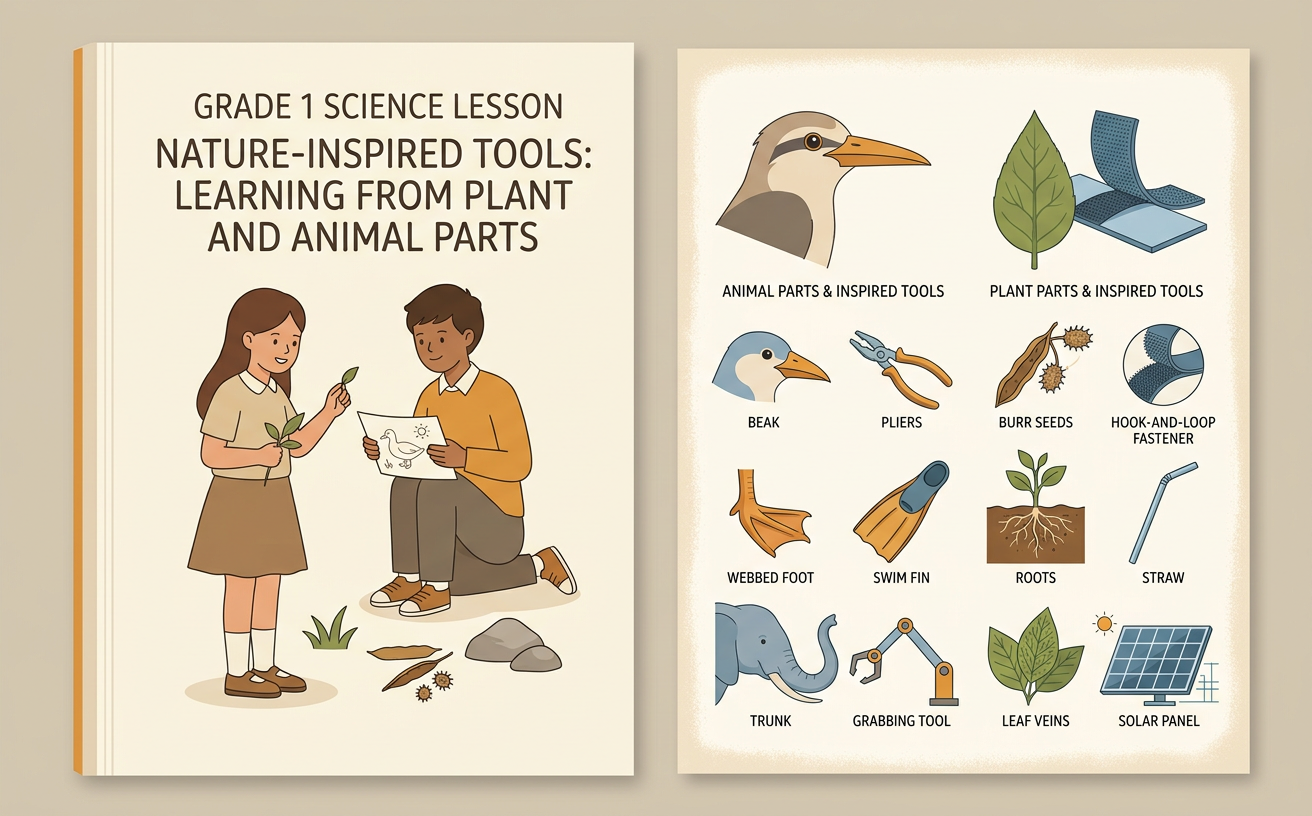
Illustrations are auto-generated and may be placeholders. They can be refreshed to match the narration.
Notice Useful Plant and Animal Parts
Plants and animals have outside parts that help them live. Look closely at each part’s shape, texture, and movement. A duck has webbed feet that push against water as it swims. A bird’s beak can pick up food. A cactus has sharp spines that help protect it from hungry animals. A burdock plant makes seed cases called burrs. Tiny hooks on a burr catch on animal fur, helping the seeds travel to new places. When you observe a part, describe only what you notice before deciding what it does. You might say, “The burr has many small, curved hooks.” Share your observation with a partner. Listen carefully, take turns speaking, and ask a question about something your partner noticed.

Connect Each Part to a Need
Living things have needs, such as finding food, getting water, moving, and staying safe. An external part can help meet one or more of these needs. A bird uses its beak to collect or eat food. A fish uses fins to steer and move through water. Tree roots take in water and help hold the tree in the ground. Thorns on some plants can discourage animals from eating them. Match each part to the need it helps meet. Then explain your thinking with a complete sentence: “A fish’s fins help it move through water.” Remember that the shape matters. A wide duck foot pushes water, while a sharp claw can hold food or grip a surface. Compare your ideas with a classmate and revise a match if new evidence changes your thinking.

Observe the Habitat
A habitat is the place where a plant or animal lives. The features of a place affect which parts are useful there. Consider a freshwater marsh. It has shallow water, soft mud, wet soil, reeds, insects, fish, and other small animals. A heron’s long legs let it stand and walk in shallow water while keeping much of its body dry. Its long, pointed beak helps it catch food. Reeds have roots that hold them in wet soil. Describe the marsh using what you can see: “The marsh has shallow water and tall plants.” Then connect the place to a useful part: “Long legs help the heron move through the shallow water.” Talk with classmates about how the same part might be less useful in a very different place, such as a dry, rocky desert.

Design a Nature-Inspired Tool
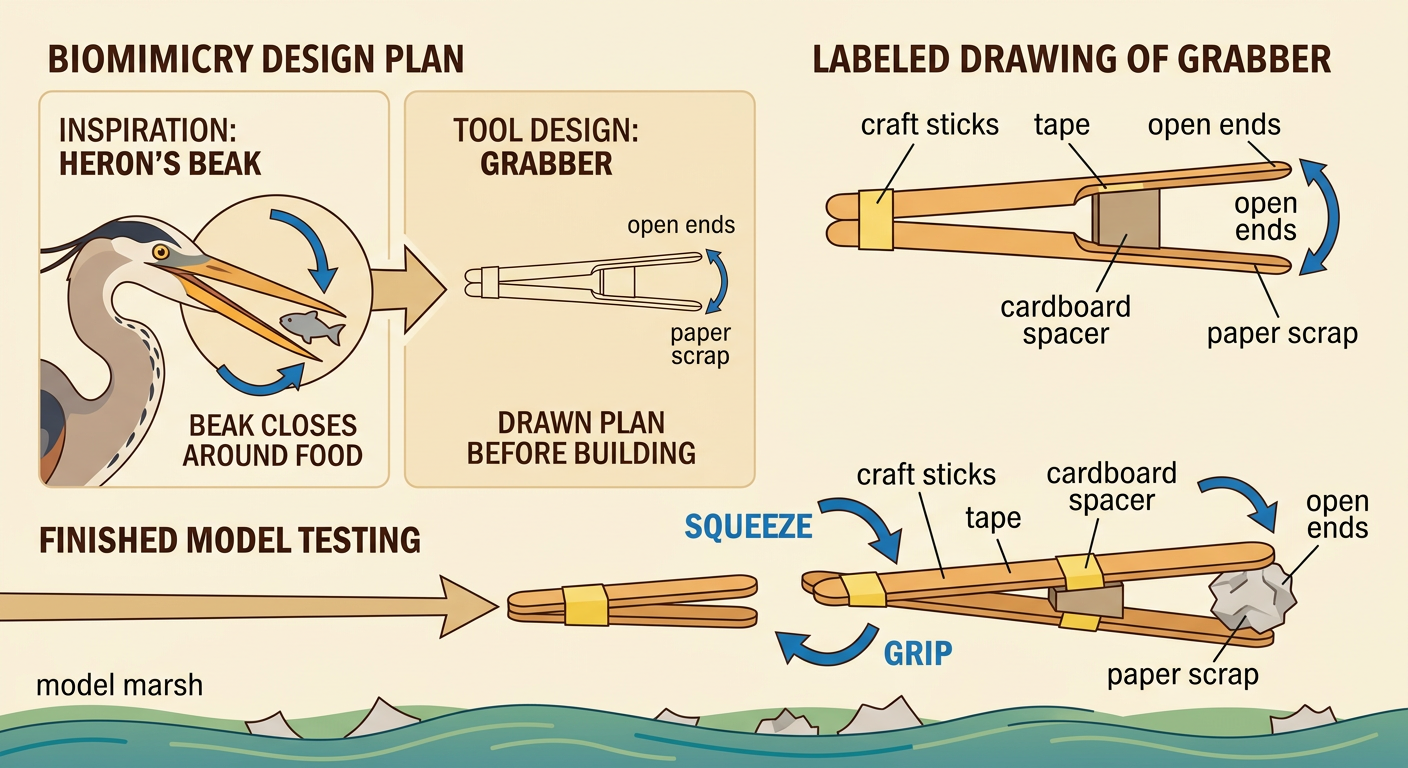
People can copy a useful idea from nature to solve a problem. Suppose small pieces of paper litter are scattered in a model marsh, and you do not want to touch them with your hands. Design a simple grabber inspired by a heron’s beak. Place two craft sticks together and safely join one end with tape and a small cardboard spacer. Press the open ends toward each other to grip a paper scrap. First, draw your plan. Label the part inspired by the beak, list the materials, and show how the tool will move. Then build and test it with an adult’s help. Does it pick up the paper? If the ends do not meet, move the tape or change the spacer. Improving a design after a test is part of solving a problem.
Share and Explain the Design
Share your nature-inspired tool with a partner or small group. Hold up your drawing or model and name the human problem it solves. Identify the plant or animal part that inspired you. Explain how your tool copies the part’s shape or movement. You might say, “My grabber is inspired by a heron’s beak. Its two ends close around paper, just as the beak closes around food.” Show what happened during your test and describe one change you made or would make. Listeners should face the speaker, wait for their turn, and ask a helpful question, such as, “Why did you make the ends long?” The designer can answer using evidence from the test. Finish by naming the habitat and one feature of that place that makes the natural part useful.
