
Nature’s Nested Groups: Classifying Life in an Ecosystem
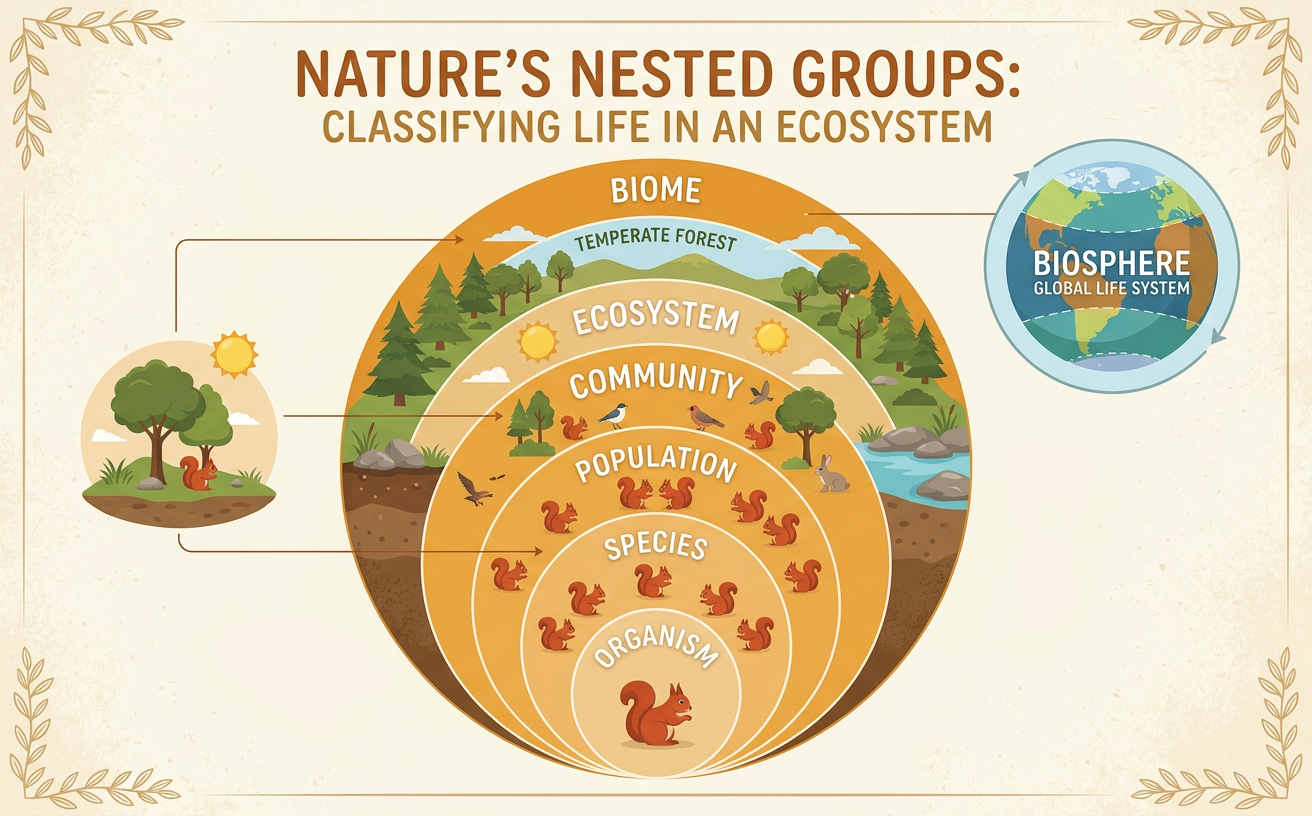
Students define and distinguish organism, species, population, community, ecosystem, biome, and biosphere by placing each level within a nested ecological hierarchy.
Illustrations are auto-generated and may be placeholders. They can be refreshed to match the narration.
One Living Thing: Organism
An organism is one individual living thing. Every organism carries out life processes, such as using energy, growing, responding to its surroundings, and reproducing during its life cycle. A single white-tailed deer in a forest is an organism. One oak tree, one mushroom, and one bacterium are also organisms, even though they differ greatly in size and structure. An organism interacts with both living and nonliving parts of its surroundings. For example, the deer eats plants, drinks water, breathes air, and may be hunted by a wolf. In the ecological hierarchy, an organism is the smallest level. Each organism belongs to a species and may also be part of a population living in a particular place.
Defining a Species
A species is a group of organisms that share important inherited traits and can usually reproduce with one another to produce fertile offspring. For example, all white-tailed deer belong to the species Odocoileus virginianus, even when they live in different forests. A mule deer belongs to a different species because it has different inherited characteristics and a separate reproductive group. Members of one species are not always found in the same place, so a species is not the same as a population. Scientists identify species by studying body structures, behavior, reproduction, and DNA. The idea can be harder to apply to fossils or organisms that reproduce without mates, so scientists compare several kinds of evidence when classifying life.
Same Species, Same Place: Population
A population includes all organisms of the same species living in the same area at the same time. Ten white-tailed deer living in one forest form a deer population. White-tailed deer in a distant forest belong to the same species, but they are part of a different population because they live in another place. Members of a population may compete for food, water, shelter, or mates. They may also cooperate, warn one another about danger, and reproduce. Population size can change when organisms are born, die, enter the area, or leave it. Both species and location matter: a forest containing deer, squirrels, and oak trees does not form one population because those organisms belong to different species.
Populations Together: Community
A community is all the populations of different species living and interacting in the same area. In a forest community, populations of oak trees, deer, squirrels, fungi, insects, and wolves live together. Their interactions create recognizable patterns. Deer eat plants, wolves hunt deer, bees pollinate flowers, and fungi break down dead material. Some interactions help both species, while others involve competition or feeding. A community includes only living things; sunlight, soil, water, air, and temperature are not part of the community. Community boundaries depend on the area being studied. A scientist might investigate the community in one rotting log, one pond, or an entire forest. Each community contains multiple populations, and each population contains organisms of one species.
Living and Nonliving Parts: Ecosystem
An ecosystem includes a community of living organisms and the nonliving parts of the environment with which they interact. A pond ecosystem includes fish, frogs, algae, insects, and bacteria, along with water, sunlight, oxygen, rocks, soil, and temperature. Energy enters when algae and other producers capture sunlight. Animals obtain energy by eating plants or other animals, while decomposers break down dead matter and return nutrients to the environment. Nonliving conditions affect which organisms can survive. For example, a decrease in pond water or oxygen may reduce some fish populations. Unlike a community, an ecosystem includes both biotic factors, which are living or were once living, and abiotic factors, which are nonliving physical and chemical parts of the environment.
Larger Levels: Biome and Biosphere
A biome is a large region defined by broad patterns of climate and by characteristic plant and animal communities. Examples include desert, tundra, tropical rain forest, grassland, and temperate forest. A temperate forest biome contains many separate ecosystems, but they share seasonal temperatures, moderate precipitation, and trees that are suited to those conditions. Similar biomes can occur on different continents. The biosphere is the broadest ecological level: it includes every part of Earth where life exists and therefore contains all biomes and ecosystems. The levels form a nested hierarchy: organism, species, population, community, ecosystem, biome, and biosphere. Moving outward adds more individuals, species, places, and environmental connections. Climate connects distant places by shaping the kinds of ecosystems and organisms that can occur there.