Needs, Wants, and Scarcity
Students distinguish needs from wants and use a limited budget to explain choices made when resources are scarce.
Illustrations are auto-generated and may be placeholders. They can be refreshed to match the narration.
Needs and Wants
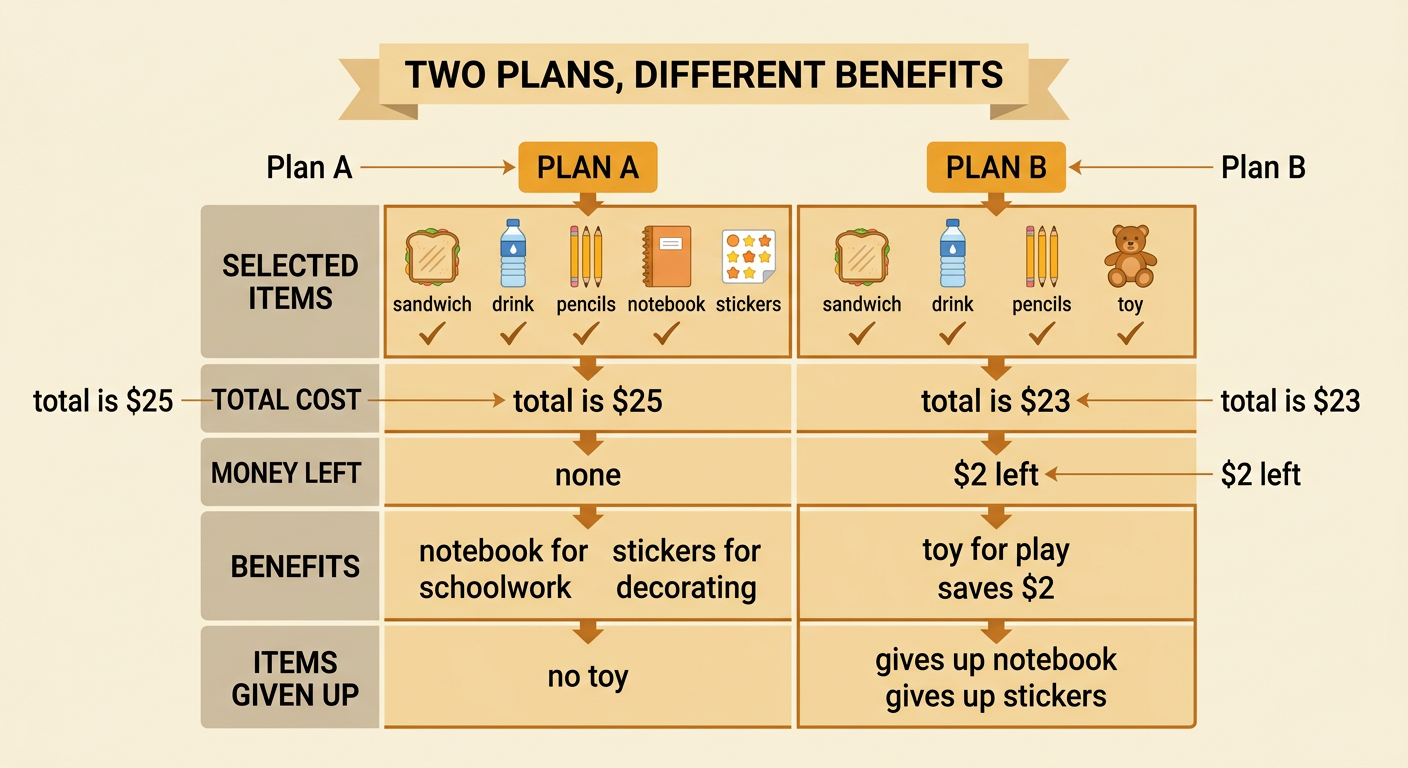
People use goods and services every day. A need is something a person must have to stay healthy, safe, and able to live, such as food, clean water, shelter, basic clothing, and medical care. A want is something a person would enjoy but can live without, such as a video game or fancy sneakers. The same item can fit different categories depending on the situation. A warm coat is a need for a child walking to school in freezing weather, while a second coat in a favorite color may be a want. Ask, “What could happen if the person did not have this?” If health or safety would be harmed, the item is probably a need. If life would still be safe and healthy, it is probably a want.

What Scarcity Means
Scarcity means there are not enough resources to satisfy every need and want at the same time. Resources include money, time, materials, land, and workers. Scarcity does not always mean that nothing is available. It means the amount available is limited compared with what people would like to use. Imagine a class has six apples for eight students. The apples are scarce because two more apples would be needed for everyone to receive one. The class must make a choice, such as cutting the apples into smaller shares or choosing another snack. Money can also be scarce. If a family has $30 for groceries, it cannot buy every item in the store. Scarcity makes people set priorities, compare options, and decide how to use resources.

Choices Have Costs
Every choice has benefits and costs. A benefit is something helpful or enjoyable that a choice provides. A cost is what a person gives up or uses, including money, time, or another option. The best alternative not chosen is called the opportunity cost. Suppose Maya has $10. She can buy a $6 notebook and a $4 pack of pencils because $6 + $4 = $10. If she instead buys a $9 game, she has $1 left because $10 − $9 = $1. The game brings fun, but Maya gives up the notebook and pencils. The school supplies may help her complete classwork. Neither choice is automatically right; the better choice depends on her goal. Comparing benefits and costs helps Maya explain why she chose one option over another.

The Limited-Budget Challenge
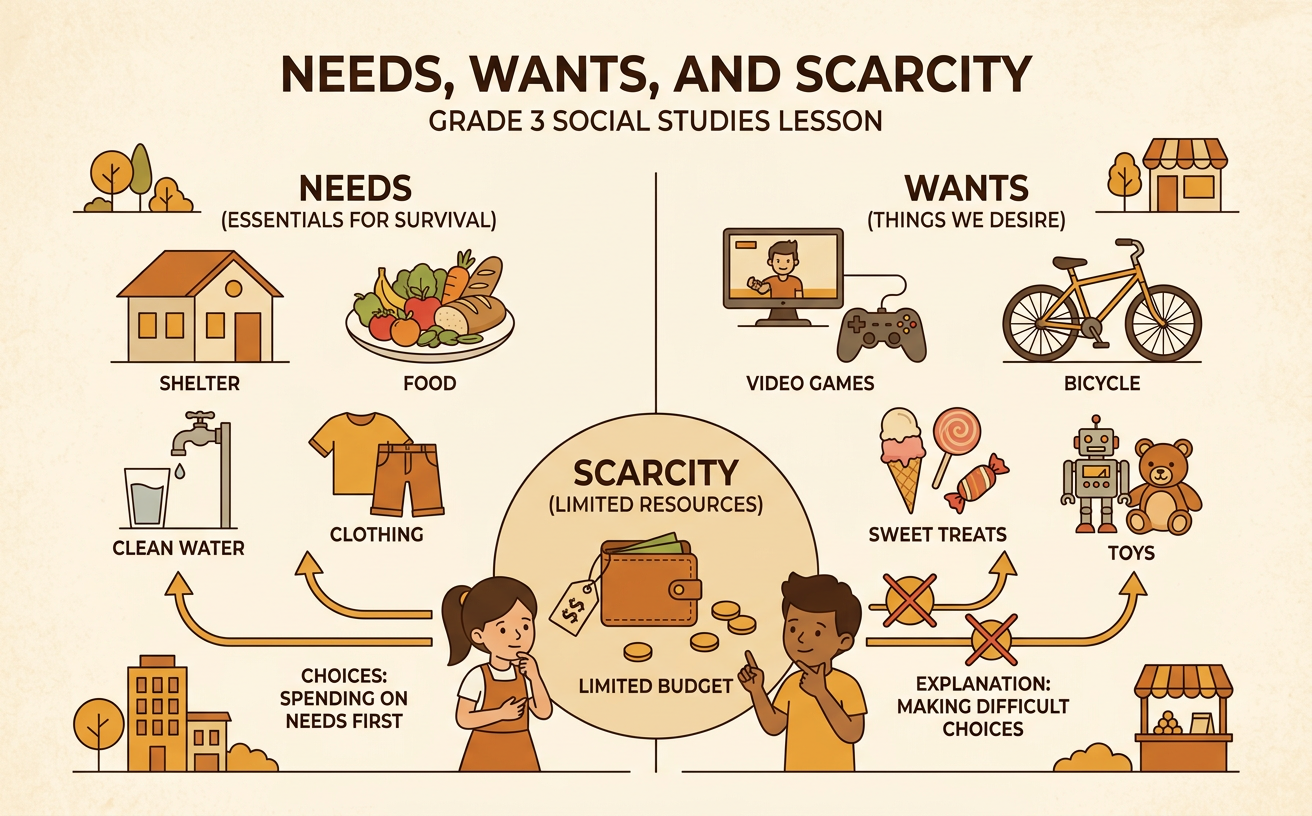
Imagine you must pack supplies for one school day with a budget of $25. The criteria for success are to include food, a drink, and a writing tool. These are the required results. The constraint is that the total cost cannot be more than $25. Available items are a sandwich for $7, a water bottle for $5, pencils for $3, a notebook for $6, a toy for $8, and stickers for $4. Start with the required items: $7 + $5 + $3 = $15. Subtract to find the money left: $25 − $15 = $10. You could add the notebook and stickers because $6 + $4 = $10. You could choose the toy instead and have $2 left. Check every plan against both the criteria and the cost constraint before deciding.
Explain and Compare Choices
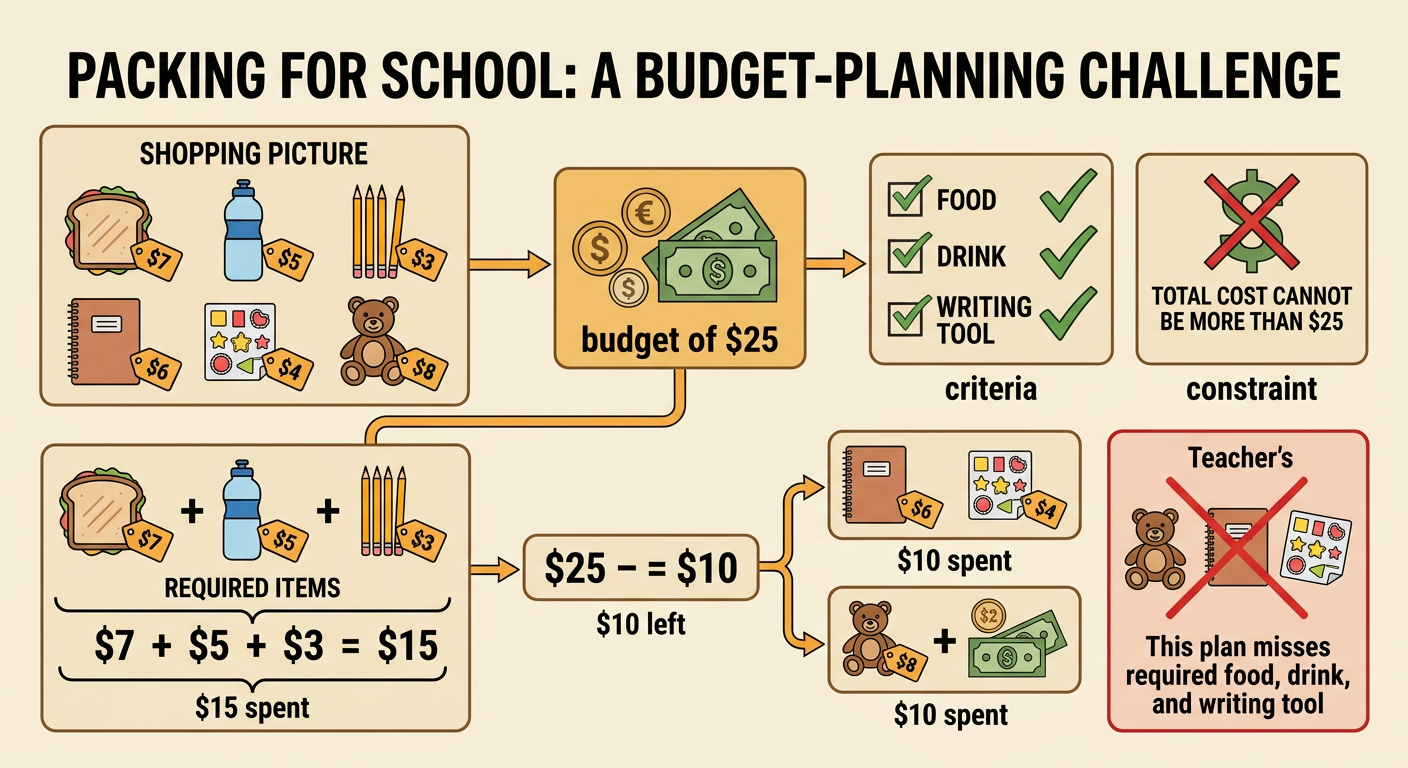
Two plans can both meet the rules but provide different benefits. Plan A includes a sandwich, water bottle, pencils, notebook, and stickers. Its total is $7 + $5 + $3 + $6 + $4 = $25. Plan B includes a sandwich, water bottle, pencils, and toy. Its total is $7 + $5 + $3 + $8 = $23, leaving $2. Both plans meet the food, drink, and writing-tool criteria and stay within budget. Plan A offers a notebook for schoolwork and stickers for decorating, but no toy. Plan B offers a toy and saves $2, but gives up the notebook and stickers. To explain a choice, name the goal, use price evidence, and state what is gained and given up. For example, “I choose Plan A because it uses all $25 and gives me more school supplies.”