
Net Force, Mass, and Acceleration
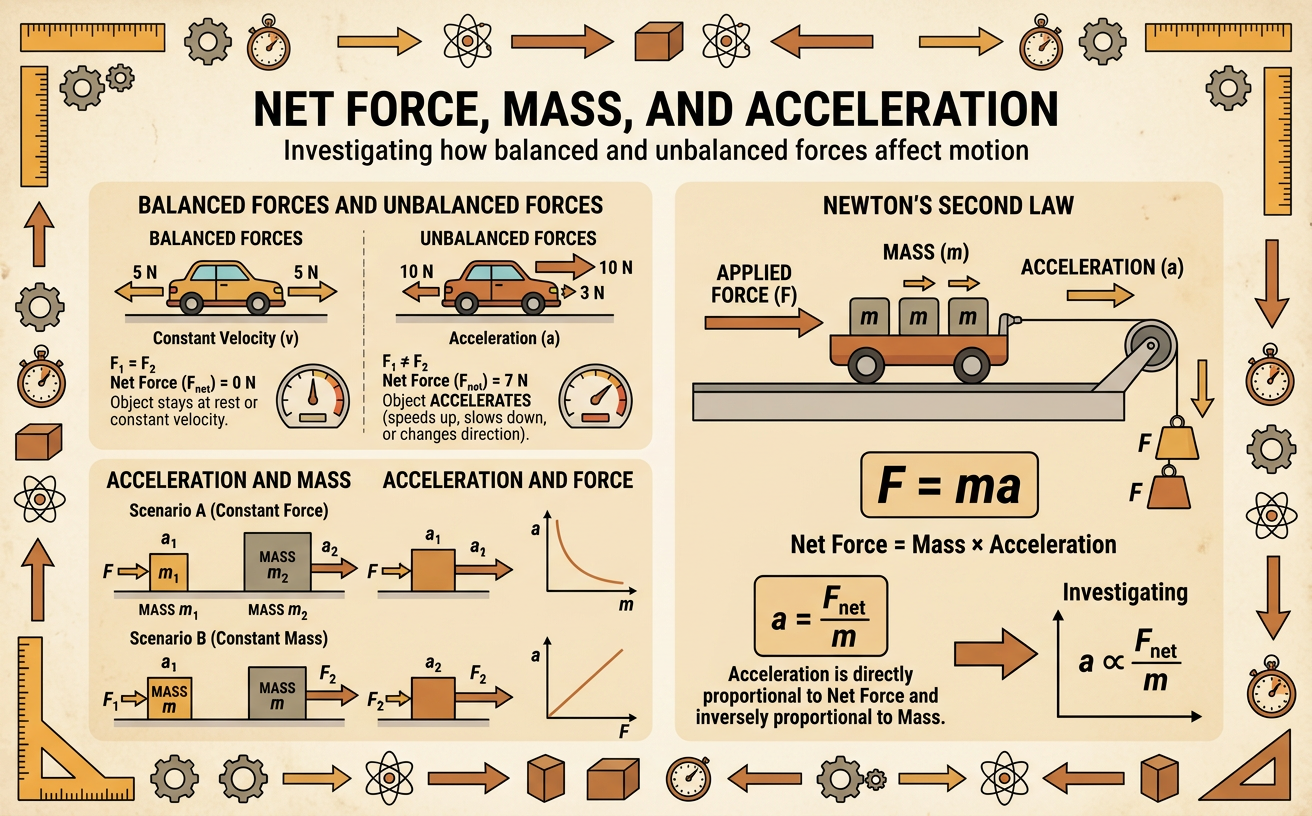
Students investigate how balanced and unbalanced forces affect motion and how acceleration depends on net force and mass.
Illustrations are auto-generated and may be placeholders. They can be refreshed to match the narration.
Forces as Pushes and Pulls
A force is a push or pull that acts on an object. Forces can change an object’s speed, direction, or shape. A force has both a size and a direction, so it is often represented by an arrow. A longer arrow represents a greater force, and the arrowhead shows the direction. Contact forces occur when objects touch, such as when a student pushes a box or friction resists its motion. Noncontact forces act across a distance. For example, gravity pulls the box toward Earth even though Earth’s center does not touch the box. Forces are measured in newtons, abbreviated N. When a student pushes a box with 20 N to the right, the push is one force acting on the box, while friction may act in the opposite direction.
Balanced and Unbalanced Forces
Forces are balanced when they cancel one another and the net force is zero. Balanced forces do not change an object’s motion. An object at rest remains at rest, while a moving object continues at a constant speed in a straight line. For example, if two students pull a rope in opposite directions with 50 N each, the rope does not accelerate. Forces are unbalanced when their combined effect is not zero. Unbalanced forces cause acceleration, which means a change in speed, direction, or both. If one student pulls the rope with 70 N and the other pulls with 50 N, the forces are unbalanced. The rope accelerates toward the 70 N pull because there is a 20 N net force in that direction.
Finding Net Force
Net force is the sum of all forces acting on an object. Forces in the same direction are added. Forces in opposite directions are subtracted, and the net force points toward the greater force. Suppose two people push a cart to the right with forces of 30 N and 20 N. If friction pushes left with 10 N, the net force is 30 N + 20 N − 10 N = 40 N to the right. A useful method is to choose one direction as positive and the opposite direction as negative. Right may be positive, so left is negative. Forces acting vertically must also be considered. On a level floor, the upward normal force may balance the downward gravitational force, leaving only the horizontal forces to affect the cart’s horizontal motion.
Mass and Acceleration
Acceleration depends on both net force and mass. Newton’s second law expresses this relationship as acceleration equals net force divided by mass, or a = Fnet ÷ m. With the same mass, a greater net force produces greater acceleration. With the same net force, a greater mass produces less acceleration. For example, a 12 N net force acting on a 3 kg cart produces an acceleration of 4 m/s². If the same 12 N net force acts on a 6 kg cart, the acceleration is only 2 m/s². The heavier cart has more inertia, meaning it resists changes in motion more strongly. Mass is measured in kilograms, force in newtons, and acceleration in meters per second squared. Direction also matters: acceleration points in the same direction as the net force.
Force-Motion Investigation
To investigate force, mass, and acceleration, use a cart, a level track, a force source, and a motion sensor. First, keep the cart’s mass constant and test several pulling forces. Measure the cart’s acceleration for each force and repeat every trial at least three times. Next, keep the pulling force constant and add equal masses to the cart. Again, measure acceleration and repeat the trials. Keep the same cart, track, starting position, and measurement method so the tests are fair. Record force, total mass, and average acceleration in a data table. Then graph acceleration on the vertical axis. For the first test, place net force on the horizontal axis; for the second, place mass on the horizontal axis. Evidence should show that acceleration increases with net force but decreases as mass increases.