
Networks, the Internet, and Protocols
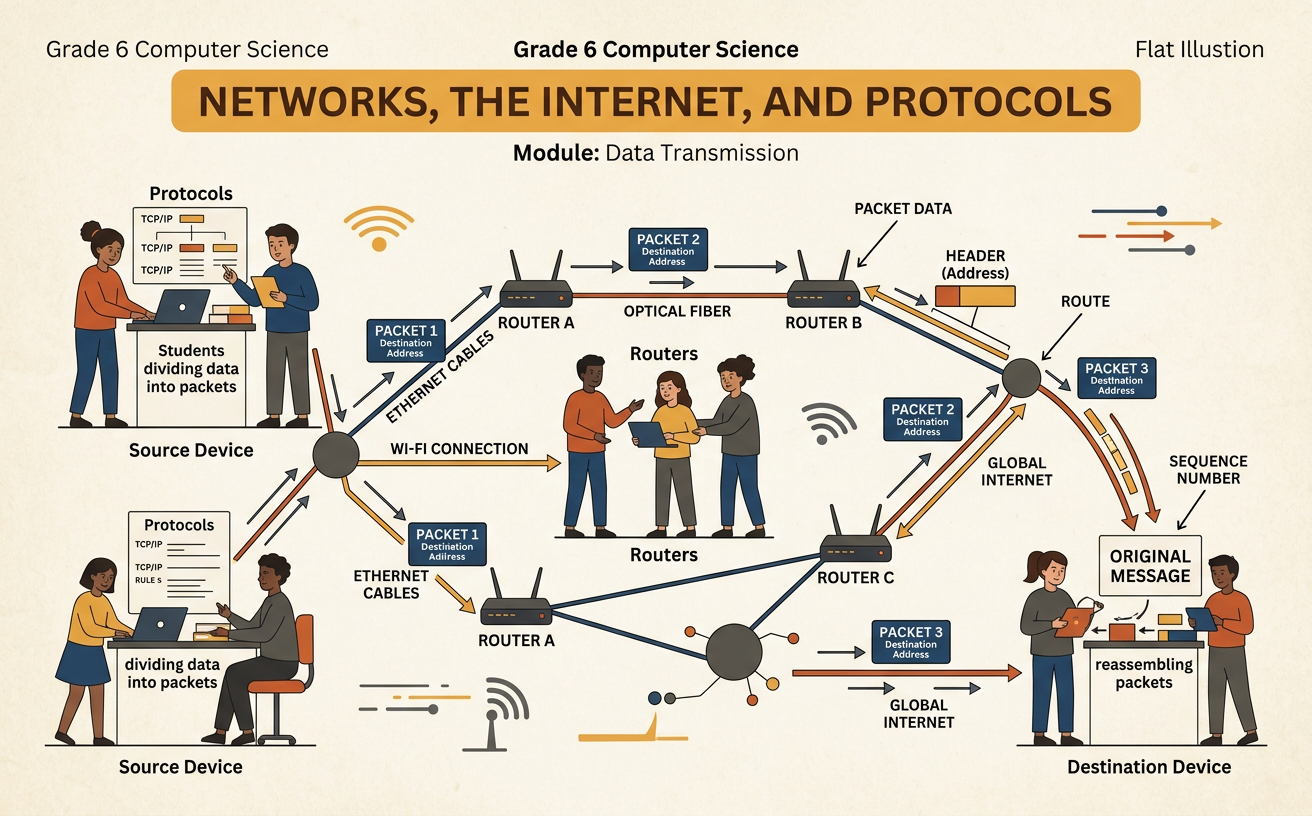
Students model how data is divided into packets, addressed, transmitted through networks, and reassembled at its destination.
Illustrations are auto-generated and may be placeholders. They can be refreshed to match the narration.
Network Components
A computer network is a group of connected devices that exchange data. End devices, such as laptops, phones, printers, and servers, create or receive data. A switch connects devices within the same local network and forwards data toward the correct device. A router connects different networks and chooses where data should travel next. A wireless access point lets devices join a network using radio signals. A modem may connect a home or school network to an internet service provider. For example, when a student opens a school website, the laptop sends data through a wireless access point to a router. The router passes the data through the internet to the server that stores the website. Each component has a specific role in moving the request and response.
Addresses and Routes
Devices need addresses so networks know where to deliver data. An Internet Protocol address, or IP address, identifies a device’s network connection. A data packet includes a source IP address and a destination IP address, much like a letter includes return and delivery addresses. Routers examine the destination address and use routing information to choose the packet’s next step, called a hop. Different packets from one message may take different routes because connections can be busy, unavailable, or faster than others. For example, a packet traveling from an Indiana school to a server in another state might pass through several routers. Each router chooses only the next hop rather than planning the entire trip. The destination address stays with the packet so every router can continue guiding it toward the correct network.
Data Packets
Networks usually divide a large message or file into smaller units called packets. Each packet carries part of the data plus control information in a header. The header can include source and destination addresses, a sequence number, and other information needed for delivery. Breaking data into packets allows many devices to share network connections instead of one large message occupying a connection for a long time. Packets may travel along different routes and may arrive out of order. When a reliable transport protocol such as TCP is used, the receiving device checks the packets, requests missing data when necessary, and uses sequence information to reassemble the original message. For example, a photograph can be split into four packets that arrive in the order 1, 3, 2, 4 but are placed back into the order 1, 2, 3, 4.
Communication Protocols
A protocol is an agreed-upon set of rules for communication. Devices made by different companies can exchange data because they follow the same protocols. Each protocol has a particular role. Internet Protocol, or IP, provides addressing and supports routing packets between networks. Transmission Control Protocol, or TCP, provides reliable, ordered delivery by tracking data and helping recover missing parts. Hypertext Transfer Protocol, or HTTP, defines how web clients request resources and how web servers respond. Secure websites use HTTPS, which protects the exchanged information through encryption and authentication. For example, when a student selects a webpage link, HTTP or HTTPS describes the request, TCP can manage reliable delivery, and IP helps route the packets. Protocols work together in layers, with each layer handling part of the communication process.
Model a Transmission
To model a transmission, write a short message and divide it into numbered packet cards. On each card, record the source address, destination address, sequence number, and one part of the message. Assign students to act as the source device, routers, and destination device. Give each router two possible next hops and a simple routing table that tells where to forward packets. Send the packet cards one at a time, allowing some to follow different routes or arrive out of order. The destination student sorts the cards by sequence number and rebuilds the message. To model a missing packet, remove one card and have the destination request it again, as a reliable protocol may do. Afterward, compare the model with a real network: cards represent packets, students represent devices, and forwarding rules represent protocols and routing decisions.