
New Objects from the Same Pieces
Students observe how a set of small solid pieces can be taken apart and rearranged to create different objects while the pieces retain their properties.

Illustrations are auto-generated and may be placeholders. They can be refreshed to match the narration.
Observe the Building Pieces
Look closely at a small set of solid building pieces before you use them. Notice each piece’s color, shape, size, and texture. These features are called properties. For example, your set might have four red square blocks, two blue rectangle blocks, and two yellow triangle blocks. You can touch the pieces to find out whether they feel smooth or rough. You can also compare their sizes. Count the pieces and record what you observe. You have a limited number of pieces, so you may not be able to build every object you imagine. You will need to choose how to use them. Careful observations will help you recognize the same pieces after an object is taken apart and changed.
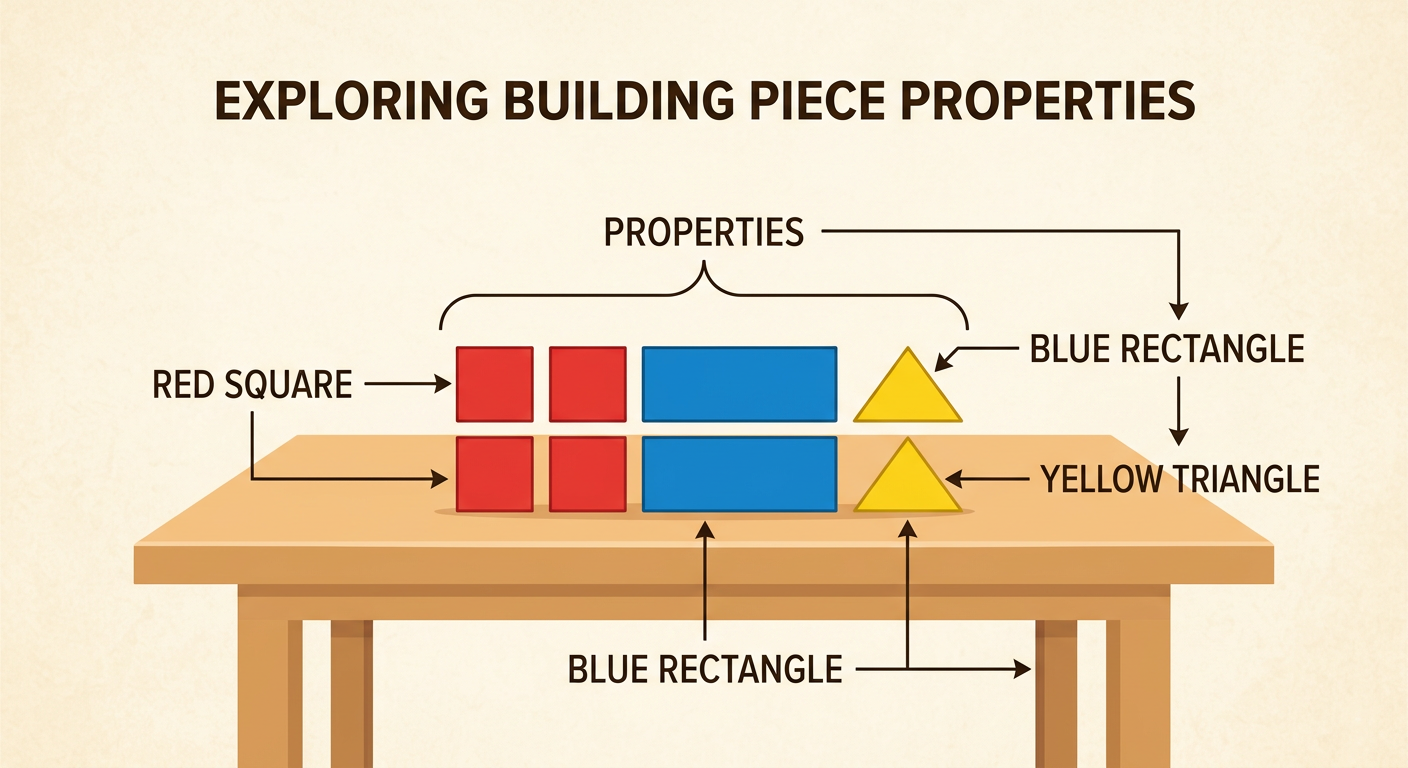
Build an Object
Use the set of pieces to build one object. Think about how the shapes can fit together. For example, you could make a small house with red square blocks for the walls, a yellow triangle block for the roof, and a blue rectangle block for the door. The pieces touch and connect, but each piece keeps its own color, shape, size, and texture. The yellow triangle does not stop being a triangle when it becomes part of the roof. Because your supply is limited, using a piece in one place means it is not available for another place. You must make choices. Count the pieces in your finished object, and explain why you placed them where you did.

Take It Apart
Now carefully disassemble, or take apart, the object. Separate every piece and place the pieces on the table. Do not cut, break, melt, or change them. If you take apart the block house, the red wall blocks, yellow roof block, and blue door block become separate pieces again. Count them and compare the number with your starting count. You should still have the same total number if no pieces were lost. Look at their properties, too. A red square block from the wall is still red, square, solid, and smooth. Taking apart the object changes how the pieces are arranged, but it does not change what the pieces are. This observation is evidence you can use later.

Create Something New
Rearrange the same pieces to create a different object. You might turn the pieces from the house into a toy boat. Place a long blue rectangle block at the bottom for the boat’s base. Stack red square blocks above it, and use a yellow triangle block as a sail. No new pieces are added, and none are thrown away. The object looks different because the positions and jobs of the pieces have changed. You may need to choose between ideas because the set is limited. For example, if there is only one yellow triangle available for the sail, you cannot use that same piece as a flag at the same time. Explain your choices and how you solved the building problem.

Compare the Pieces
Compare the pieces in the first object with the pieces in the new object. Match each piece by its properties. For example, the yellow triangle that was the house roof may now be the boat sail. Its job and location changed, but its yellow color, triangle shape, size, and smooth texture stayed the same. The red blocks may have changed from walls into part of the boat. Ask: Which things changed, and which stayed the same? The whole object’s form and purpose changed. The properties of each building piece did not. This comparison provides evidence that solid pieces can be taken apart and reused. Reusing the pieces also helps us make another object without needing more materials.

Record Evidence
Record what you did so another person can understand your evidence. Draw the first object and the new object. Write the number and kinds of pieces used in each one. Then complete a statement such as: “I know the house and boat used the same pieces because both objects had four red squares, two blue rectangles, and two yellow triangles.” Add what changed and what stayed the same. You might write, “The arrangement and object changed, but the pieces kept their colors, shapes, sizes, and textures.” Include one choice you made because the pieces were limited, such as using the only yellow triangle for a sail instead of a flag. Your drawings, counts, observations, and sentences work together as evidence.
