Newton’s First Law: Inertia, Net Force, and Motion
Students use force diagrams and everyday examples to explain how balanced forces preserve an object’s state of motion while an unbalanced net force changes it.
Illustrations are auto-generated and may be placeholders. They can be refreshed to match the narration.
Motion Without a Net Force
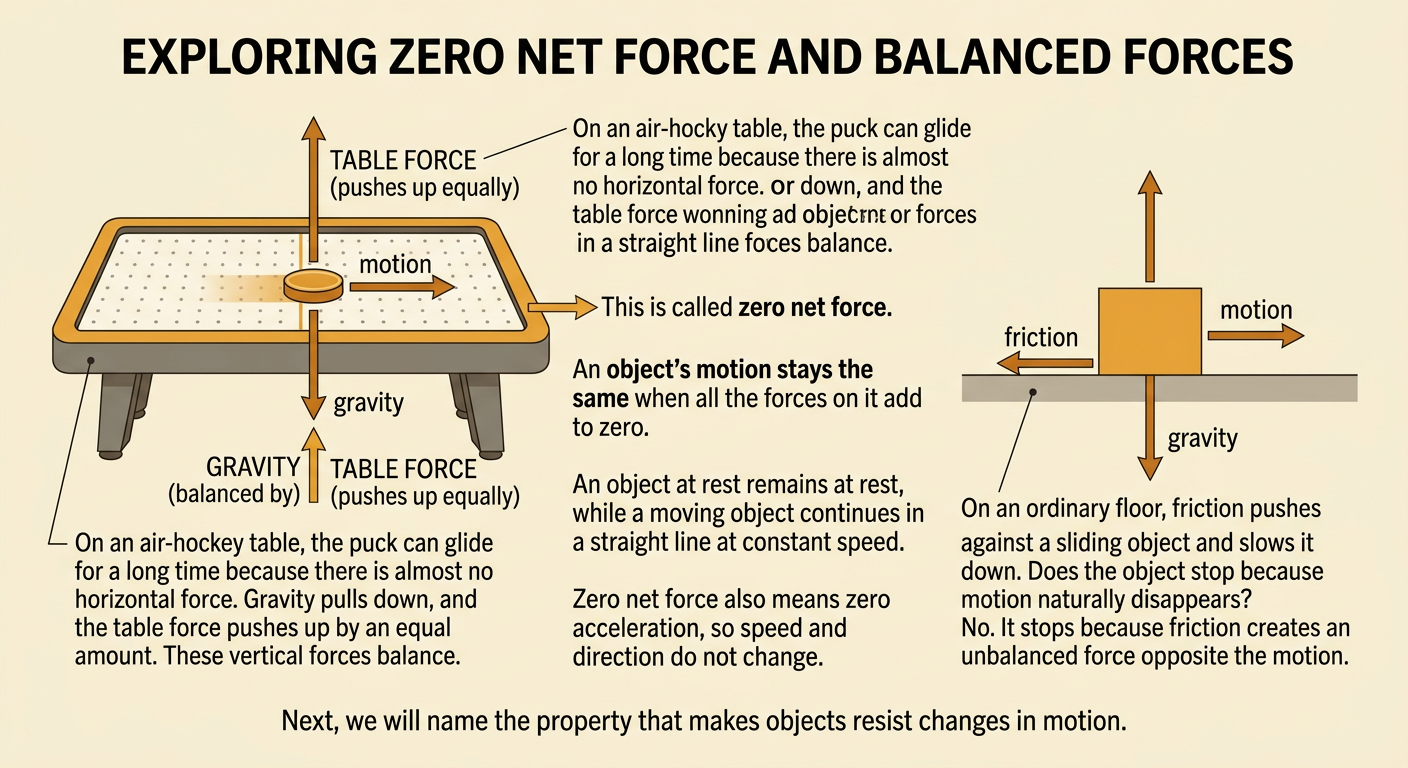
An object does not need a continuous net force to keep moving. If the forces on an object add to zero, its motion remains unchanged. An object at rest stays at rest, and a moving object continues in a straight line at constant speed. Imagine an air-hockey puck gliding across a nearly frictionless table. Gravity pulls downward while the table pushes upward with an equal force. With almost no horizontal force, the puck keeps moving at nearly constant velocity. On an ordinary floor, friction slows a sliding object because friction creates a net force opposite its motion. The object stops because of that unbalanced force, not because motion naturally disappears. A zero net force means zero acceleration, so neither the speed nor the direction changes.
Inertia and Newton’s First Law
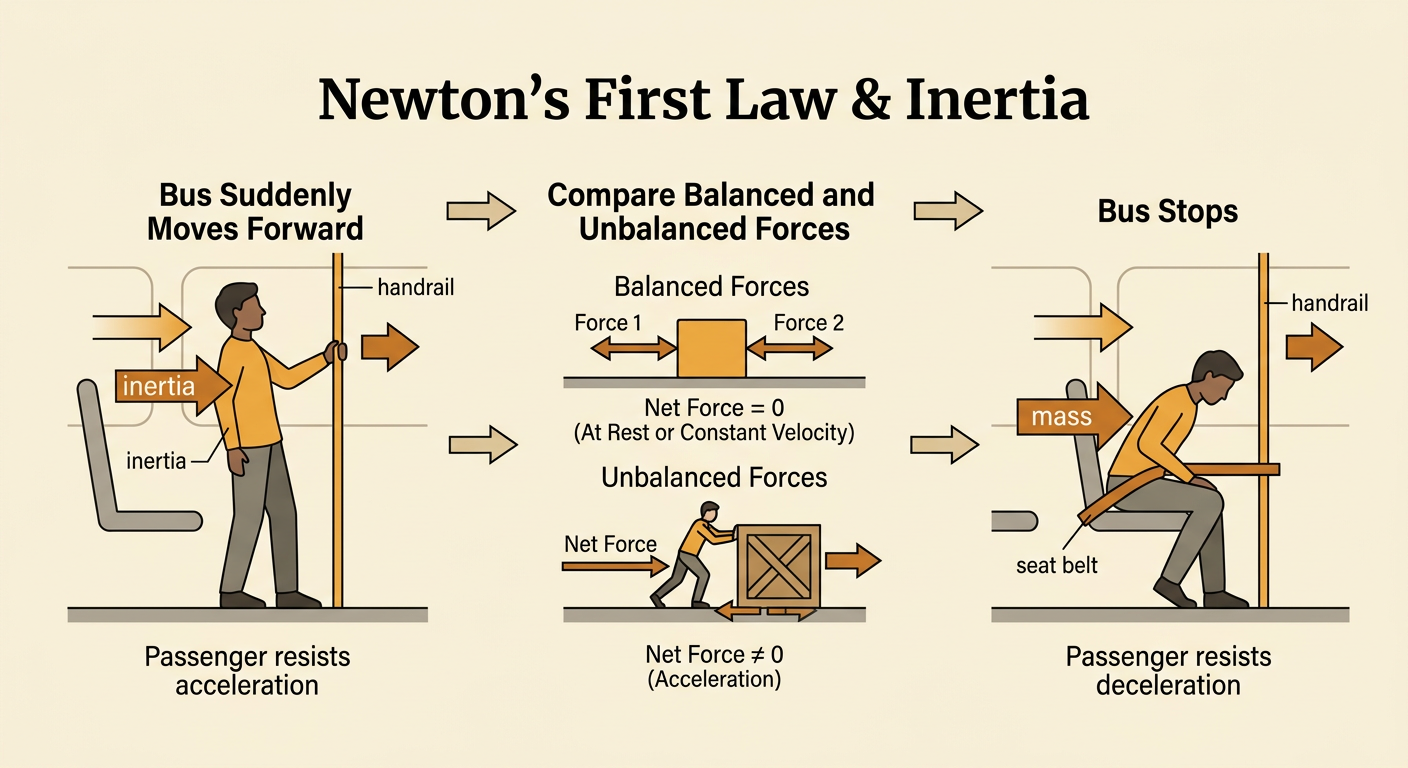
Newton’s First Law states that an object remains at rest or moves with constant velocity unless acted on by a nonzero net force. The tendency to resist a change in motion is called inertia. Mass is a measure of inertia: an object with greater mass is harder to start, stop, or turn than an object with less mass. When a bus suddenly moves forward, a standing passenger may seem to fall backward. The passenger’s body is actually tending to remain at rest while the bus moves forward beneath it. When the bus stops suddenly, the passenger’s body tends to keep moving forward. A handrail or seat belt provides the force needed to change the passenger’s motion. Inertia is not a force; it is a property of matter related to mass.
Balanced and Unbalanced Forces
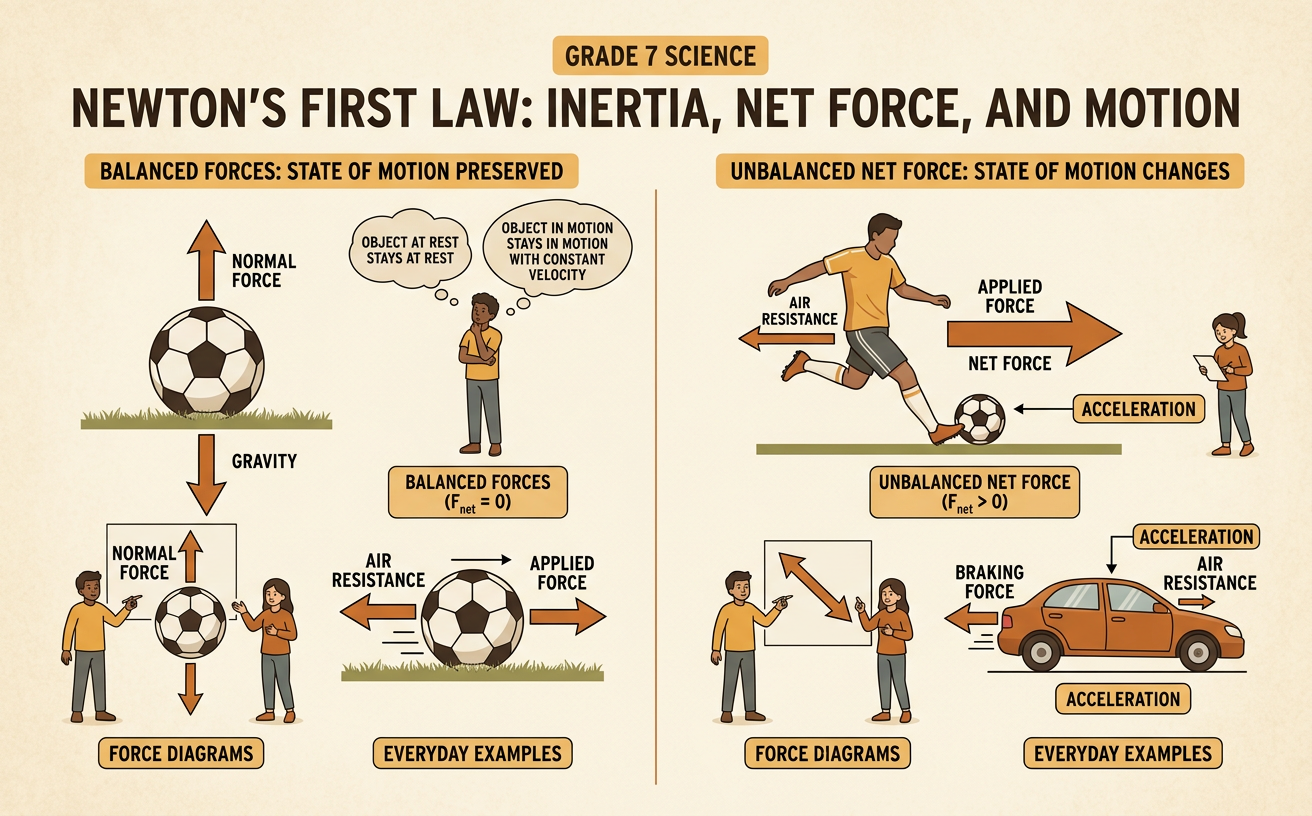
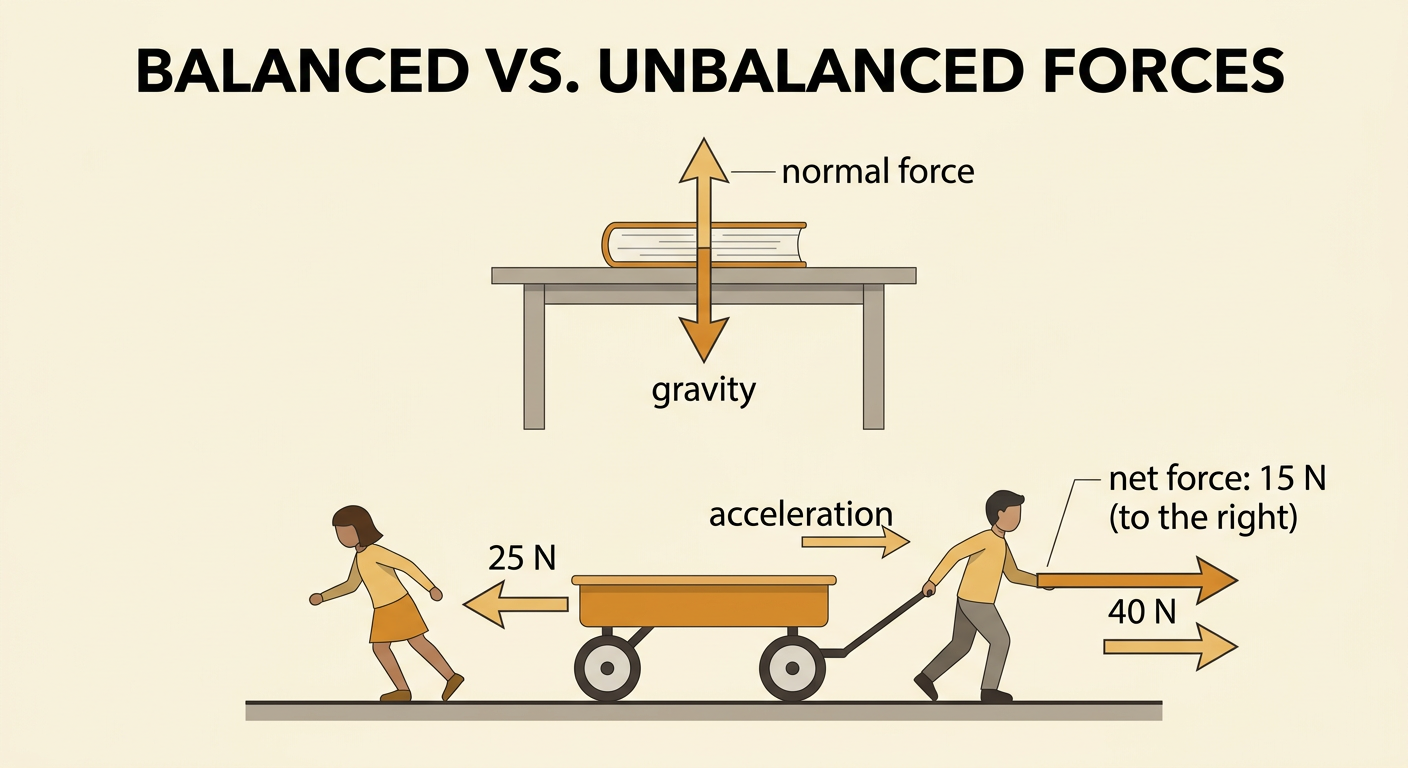
Forces are balanced when their vector sum, or net force, is zero. Balanced forces do not change an object’s velocity. A book resting on a table has two main forces: gravity pulls downward, and the table’s normal force pushes upward. These equal, opposite forces produce a net force of zero, so the book remains at rest. Forces are unbalanced when they add to a nonzero net force. Suppose two students pull a wagon in opposite directions. One pulls right with 40 newtons, and the other pulls left with 25 newtons. The net force is 15 newtons to the right, so the wagon accelerates right. The direction of acceleration matches the direction of the net force. Balanced forces can act on moving objects as well as resting objects; they preserve constant velocity.
Calculating One-Dimensional Net Force
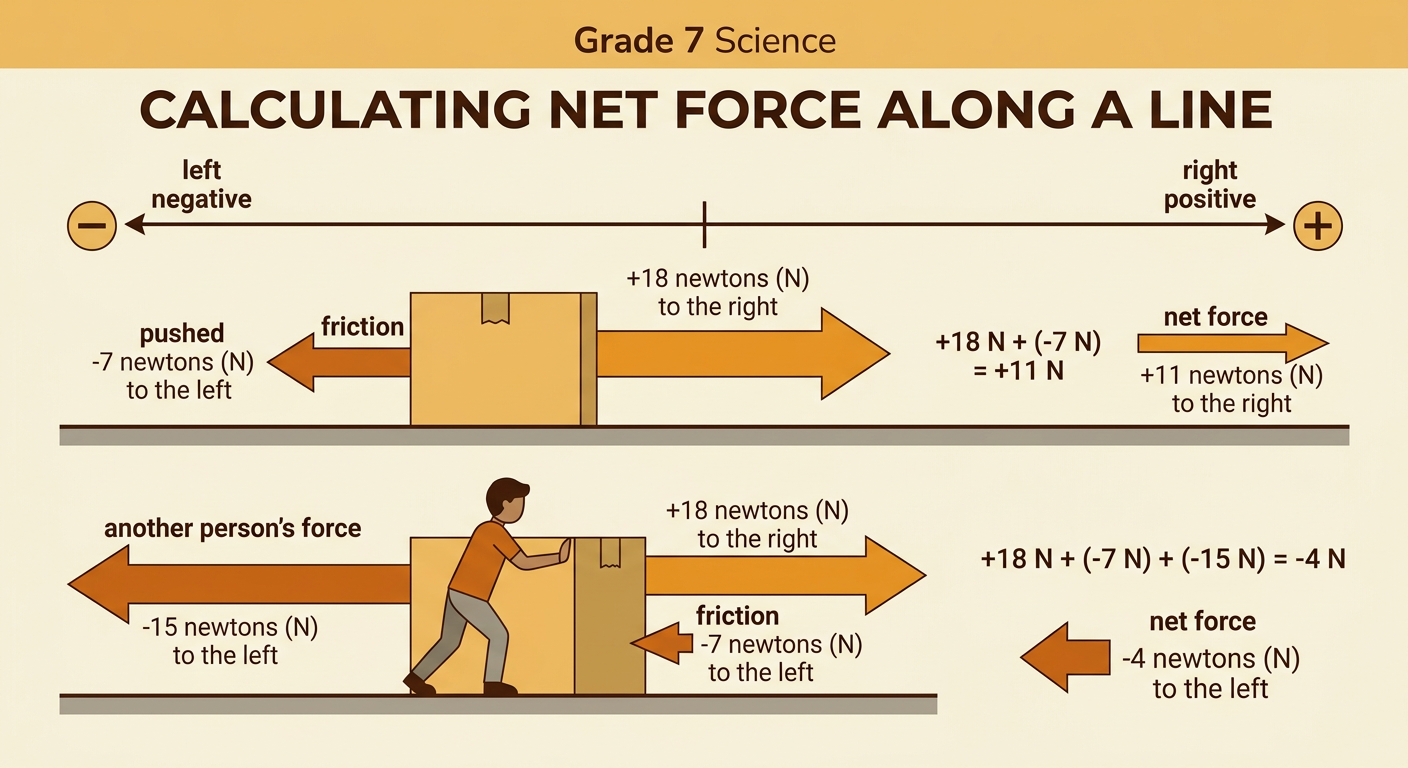
To calculate net force along one line, first choose a positive direction. For example, let right be positive and left be negative. Then represent every force with a signed number and add them. If a box is pushed with +18 N to the right while friction acts with -7 N to the left, the net force is +18 N + (-7 N) = +11 N. The positive result means the net force points right. If another person adds a -15 N leftward force, the new sum is +18 N + (-7 N) + (-15 N) = -4 N. The negative result means the net force points left. A result of 0 N means the forces are balanced. Always include units and interpret the sign using the direction chosen at the start.
Drawing Force Diagrams
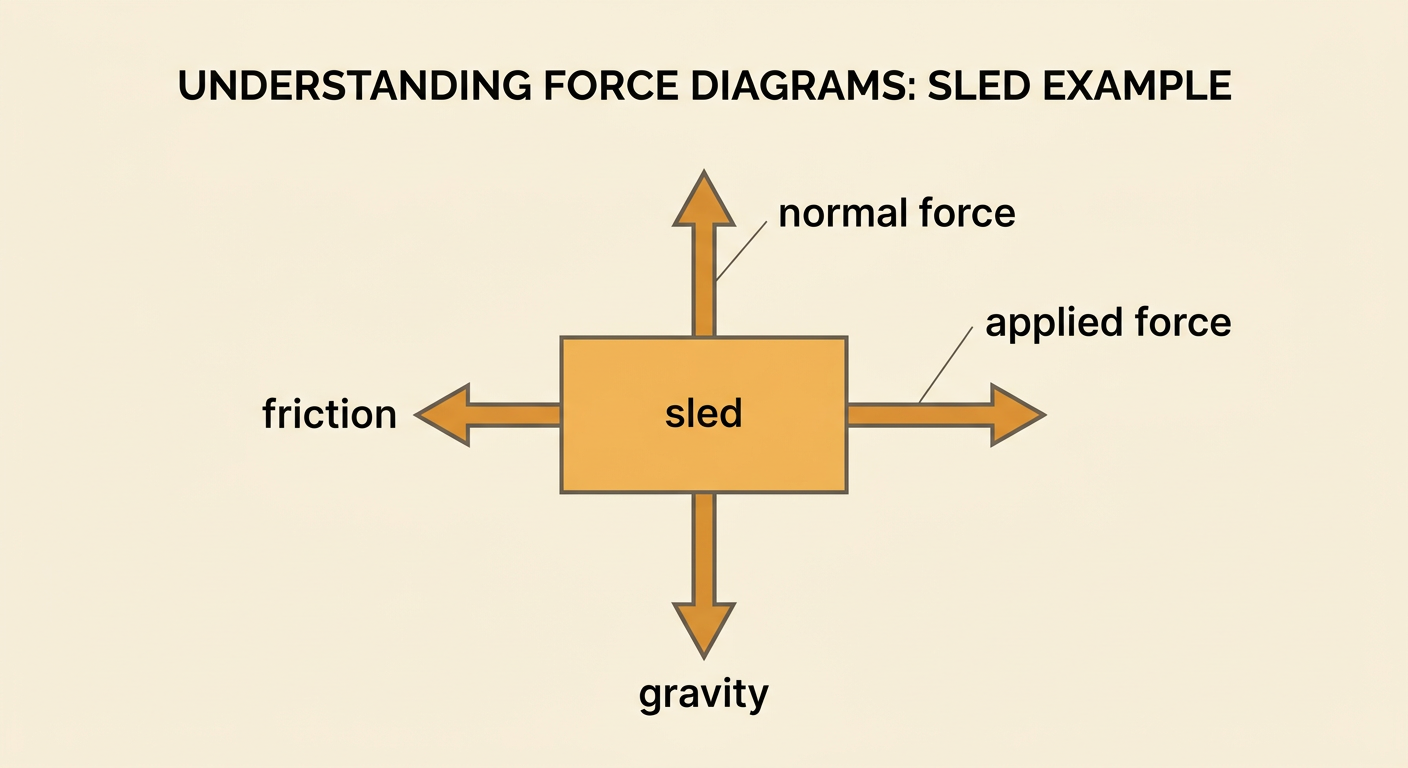
A force diagram, also called a free-body diagram, represents all external forces acting on one object. Draw the object as a simple box or dot, then draw a labeled arrow for each force beginning at the object. The arrow points in the force’s direction, and its length represents the force’s relative magnitude. For a sled pulled to the right across level snow, gravity points down, the normal force points up, the applied force points right, and friction points left. If the rightward arrow is longer than the friction arrow, the sled has a net force to the right. Include only forces acting on the chosen object, not forces that the object exerts on something else. Do not draw velocity as a force. After drawing, compare opposite arrows to determine the net force.
Explaining Changes in Everyday Motion
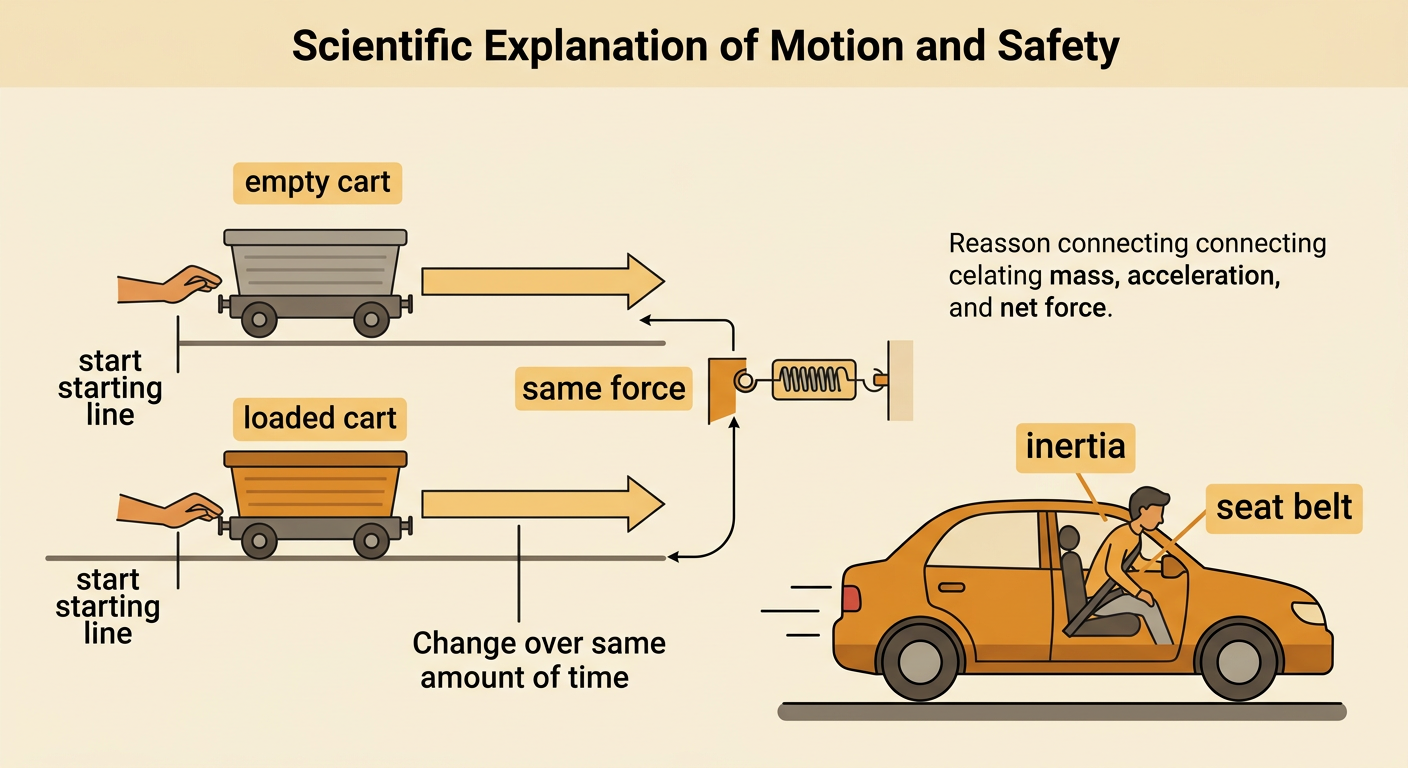
A strong scientific explanation links a claim to evidence and reasoning. Consider a loaded shopping cart and an empty cart pushed with the same force. In an investigation, students could mark a starting line, use the same spring scale reading for each push, measure each cart’s change in speed over the same time, and repeat several trials. The empty cart should show a greater change in motion because it has less mass, while the loaded cart’s greater inertia makes its acceleration smaller. The evidence would be the measured speed changes and average results. The reasoning is that motion changes depend on both net force and mass. Everyday safety devices follow the same principle. During a sudden stop, a passenger continues forward because of inertia, and a seat belt supplies the unbalanced force that slows the passenger with the vehicle.