
Newton’s Laws and Force Analysis
Students construct free-body diagrams and apply Newton’s three laws to predict how net force affects an object’s motion.
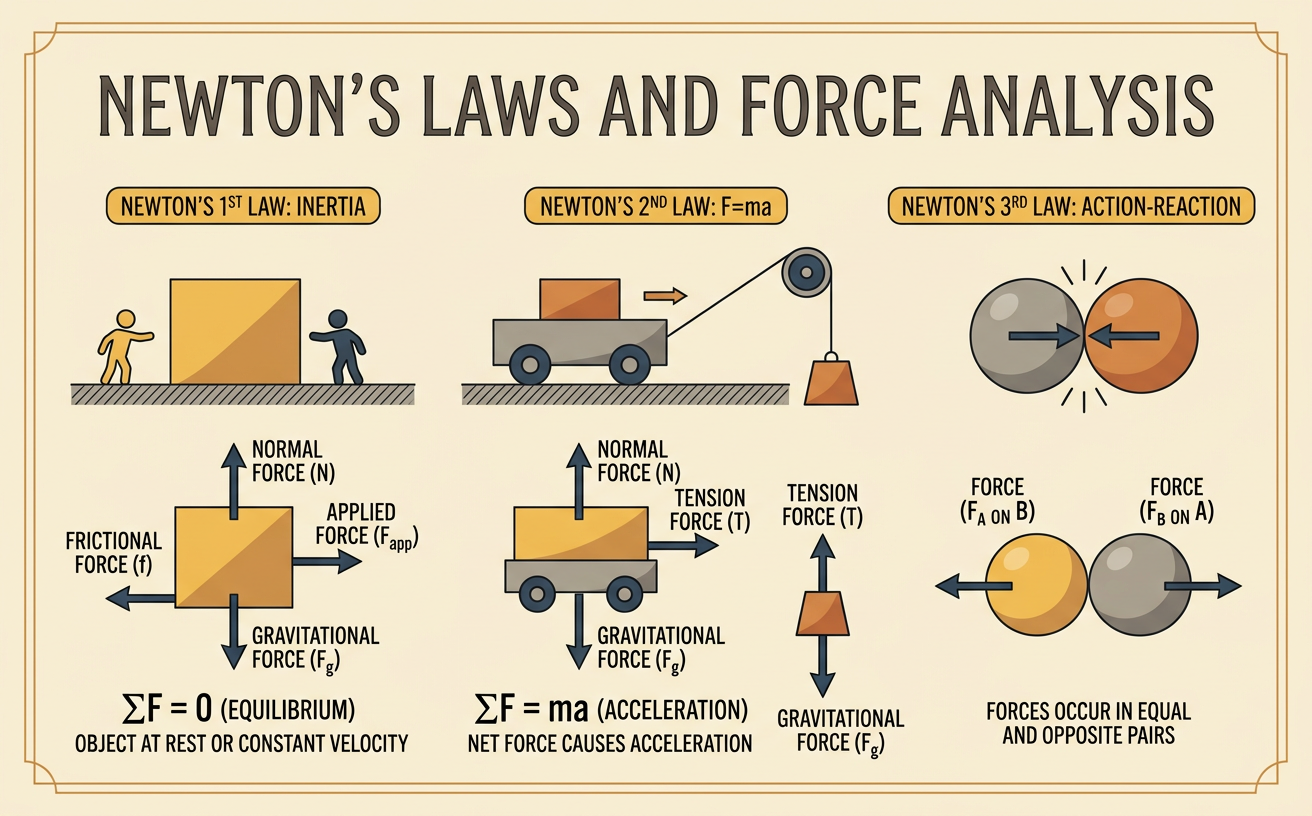
Illustrations are auto-generated and may be placeholders. They can be refreshed to match the narration.
Identifying Forces
A force is a push or pull caused by an interaction between objects. Begin force analysis by choosing the object of interest, then identify every external force acting on it. Contact forces include the normal force from a surface, friction, tension from a rope, and applied pushes or pulls. Noncontact forces include gravity and electric or magnetic forces. For example, consider a book resting on a level table. Earth pulls the book downward with gravitational force, while the table pushes upward with a normal force. If these forces have equal magnitude, the net force is zero. Avoid listing motion, velocity, or acceleration as forces. Also, do not include forces that the book exerts on other objects when analyzing forces on the book.
Free-Body Diagrams
A free-body diagram isolates one object and represents each external force with a labeled arrow. Draw the object as a dot or simple box, place each arrow’s tail on the object, and point the arrow in the direction of the force. Arrow length should indicate relative force magnitude. Choose coordinate axes that simplify the situation, then resolve angled forces into components when needed. Suppose a crate is pulled to the right across a rough floor at constant velocity. The diagram includes weight downward, normal force upward, tension to the right, and kinetic friction to the left. Because the velocity is constant, acceleration is zero, so the horizontal forces balance and the vertical forces balance. Internal forces and forces exerted by the crate on other objects do not belong in this diagram.
Newton’s First Law
Newton’s first law states that an object remains at rest or moves with constant velocity unless a nonzero net external force acts on it. This tendency to resist changes in velocity is inertia. Mass measures inertia: an object with greater mass requires a greater force to produce the same change in motion. Balanced forces produce zero net force, so they do not cause acceleration. For example, a hockey puck sliding across nearly frictionless ice continues in a straight line at nearly constant speed after the stick is no longer touching it. It does not need a continuing forward force to keep moving. If friction acts opposite the motion, however, the forces become unbalanced, the puck accelerates opposite its velocity, and its speed decreases. A change in direction also counts as acceleration.
Newton’s Second Law
Newton’s second law relates net force, mass, and acceleration: the vector sum of the external forces equals mass times acceleration, ΣF = ma. Acceleration points in the same direction as the net force, not necessarily in the direction of velocity. To apply the law, choose axes, add force components along each axis, and solve a separate equation for each direction. Consider a 10 kg cart pulled right with 50 N while friction acts left with 20 N. The horizontal net force is 50 N − 20 N = 30 N to the right. Therefore, a = ΣF/m = 30 N/10 kg = 3.0 m/s² to the right. The upward normal force and downward weight balance, so vertical acceleration is zero.
Action-Reaction Pairs
Newton’s third law states that whenever object A exerts a force on object B, object B simultaneously exerts an equal-magnitude force in the opposite direction on object A. These forces are the same type of interaction, but they act on different objects, so they do not cancel on one free-body diagram. When a swimmer pushes water backward, the water pushes the swimmer forward with an equal force. The swimmer may accelerate because the forward force from the water can be unbalanced on the swimmer. Meanwhile, the backward force acts on the water. To identify a third-law pair, name both objects and reverse their order: force of the swimmer on the water and force of the water on the swimmer. Weight and normal force are not a third-law pair because both act on the same object.