
Newton’s Second Law and Vehicle Safety
Students analyze force, mass, and acceleration data to explain how Newton’s second law informs vehicle safety designs and policies.

Illustrations are auto-generated and may be placeholders. They can be refreshed to match the narration.
Forces During a Collision
A moving vehicle changes velocity rapidly during a collision, so it experiences a large acceleration opposite its motion. Newton’s second law connects this acceleration to the net force on the vehicle and its occupants. Forces in the same direction add, while forces in opposite directions subtract to produce the net force. For example, suppose a car traveling east strikes a rigid barrier and stops. The barrier pushes west on the car, causing westward acceleration. An unrestrained passenger continues moving east because of inertia until another force, such as the dashboard, stops the passenger. A seat belt instead applies a stopping force earlier and across stronger parts of the body. Collision forces occur in pairs: the car pushes on the barrier, and the barrier pushes back on the car with an equal force in the opposite direction.

The Force-Mass-Acceleration Relationship
Newton’s second law is written as Fnet = ma, where Fnet is net force in newtons, m is mass in kilograms, and a is acceleration in meters per second squared. Acceleration increases when net force increases, but it decreases when mass increases if force stays constant. For example, a 1,000-kilogram car acted on by a net force of 5,000 newtons accelerates at 5 meters per second squared because a = Fnet ÷ m. If the same force acts on a 2,000-kilogram vehicle, its acceleration is only 2.5 meters per second squared. Direction matters: if the force points opposite the vehicle’s motion, acceleration is negative relative to that motion, and the vehicle slows down. The equation describes the net force, not every individual force acting on the vehicle.

Analyzing Vehicle Test Data
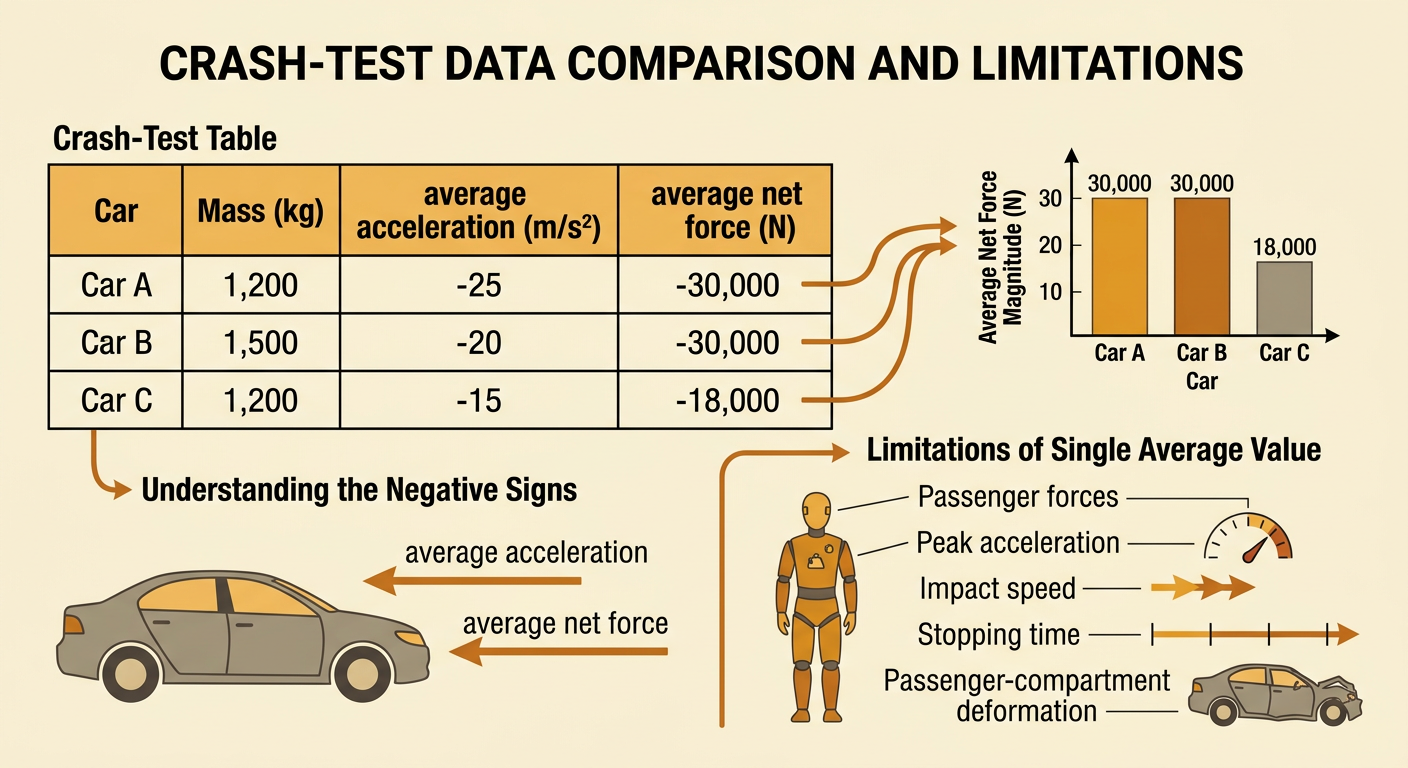
Crash-test data can be organized in a table and checked with Fnet = ma. Consider three barrier tests. Car A has a mass of 1,200 kilograms and an average acceleration of −25 meters per second squared, so its average net force is −30,000 newtons. Car B has a mass of 1,500 kilograms and an acceleration of −20 meters per second squared, also producing −30,000 newtons. Car C has a mass of 1,200 kilograms and an acceleration of −15 meters per second squared, producing −18,000 newtons. The negative signs show that the acceleration and force point opposite the chosen positive direction of motion. Car C has the smallest average force magnitude, but that result alone does not prove it is safest. Students must also examine passenger forces, peak acceleration, impact speed, stopping time, and passenger-compartment deformation.
Modeling Newton’s Second Law
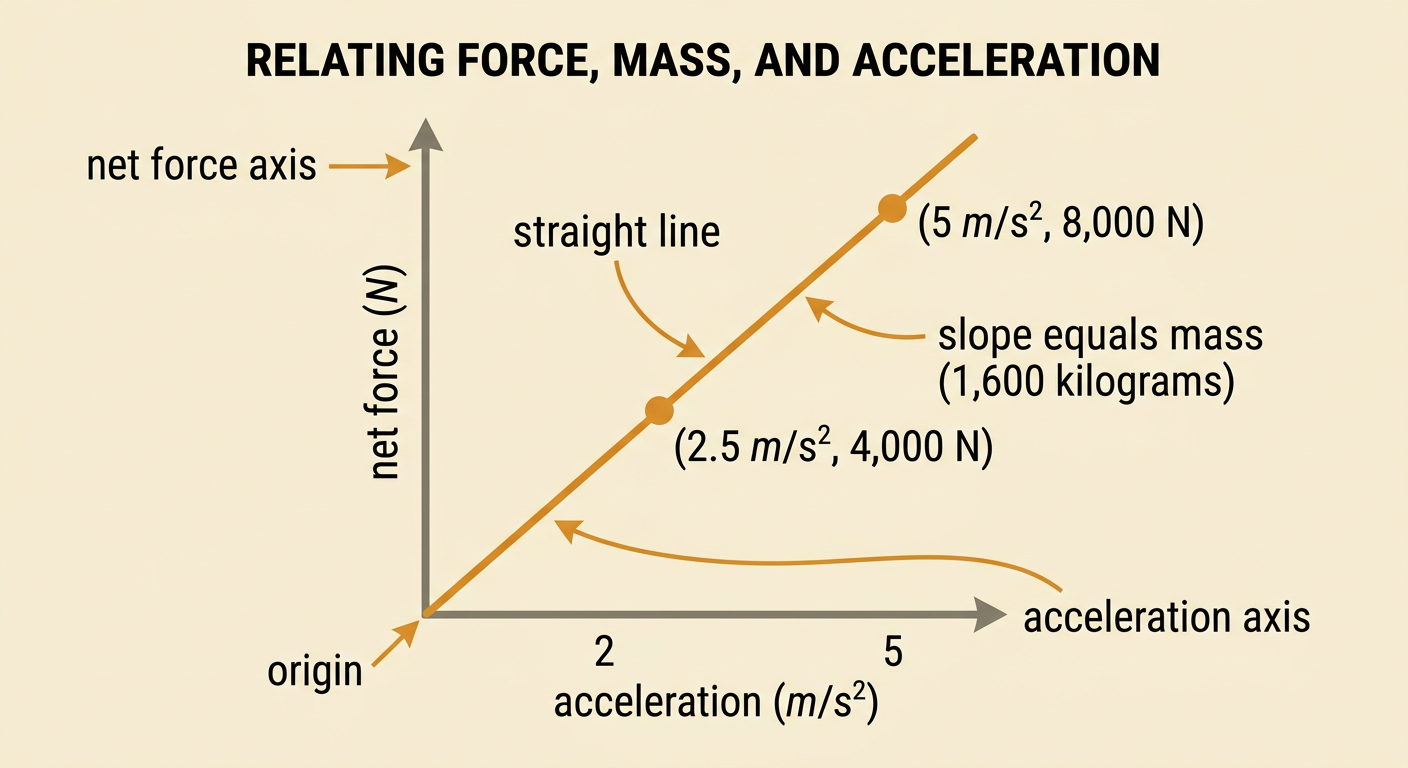
A scientific model can express one relationship with words, an equation, a table, and a graph. Start with Fnet = ma. Solving for acceleration gives a = Fnet ÷ m, and solving for mass gives m = Fnet ÷ a. For a 1,600-kilogram vehicle, a net force of 8,000 newtons produces an acceleration of 5 meters per second squared. If mass remains constant, a graph of net force versus acceleration is a straight line through the origin. Its slope equals the mass because Fnet ÷ a = m. For the 1,600-kilogram vehicle, points such as 4,000 newtons at 2.5 meters per second squared and 8,000 newtons at 5 meters per second squared lie on the same line. Real crash data may vary because force changes during impact and measurements contain uncertainty.
Evaluating Safety Design Features
Vehicle safety features reduce injury by controlling how forces act on occupants. Crumple zones deform during impact, increasing the time over which the vehicle’s velocity changes. A longer stopping time produces a smaller average acceleration magnitude and therefore a smaller average force on an occupant of fixed mass. For example, a 70-kilogram passenger slowing from 15 meters per second to rest in 0.05 second has an average acceleration magnitude of 300 meters per second squared and an average net-force magnitude of about 21,000 newtons. If restraints and controlled deformation extend the stopping time to 0.15 second, the values fall to 100 meters per second squared and about 7,000 newtons. Seat belts also spread force across the chest and pelvis, while airbags cushion the head and chest. Airbags supplement seat belts; they do not replace them.

Making an Evidence-Based Safety Recommendation
A strong safety recommendation includes a claim, relevant evidence, reasoning, and a response to a counterclaim. One claim could be that new vehicles should be required to meet minimum occupant-acceleration limits in standardized crash tests while using seat belts, airbags, and controlled crumple zones. Evidence from a test might show that increasing a passenger’s stopping time from 0.05 second to 0.15 second reduces the average force on a 70-kilogram passenger from about 21,000 newtons to 7,000 newtons. Newton’s second law supports the reasoning because lower acceleration produces lower net force for the same mass. A counterclaim may state that stronger, more complex designs increase vehicle cost or mass. The response should acknowledge this tradeoff while comparing it with injury reduction, repair data, and equitable access. The final recommendation should identify evidence limits and propose additional testing at several speeds and collision angles.
