
Newton's Third Law and Collisions
Students analyze action-reaction force pairs and apply Newton's third law to reduce damage during a collision.
Illustrations are auto-generated and may be placeholders. They can be refreshed to match the narration.
Action-Reaction Force Pairs
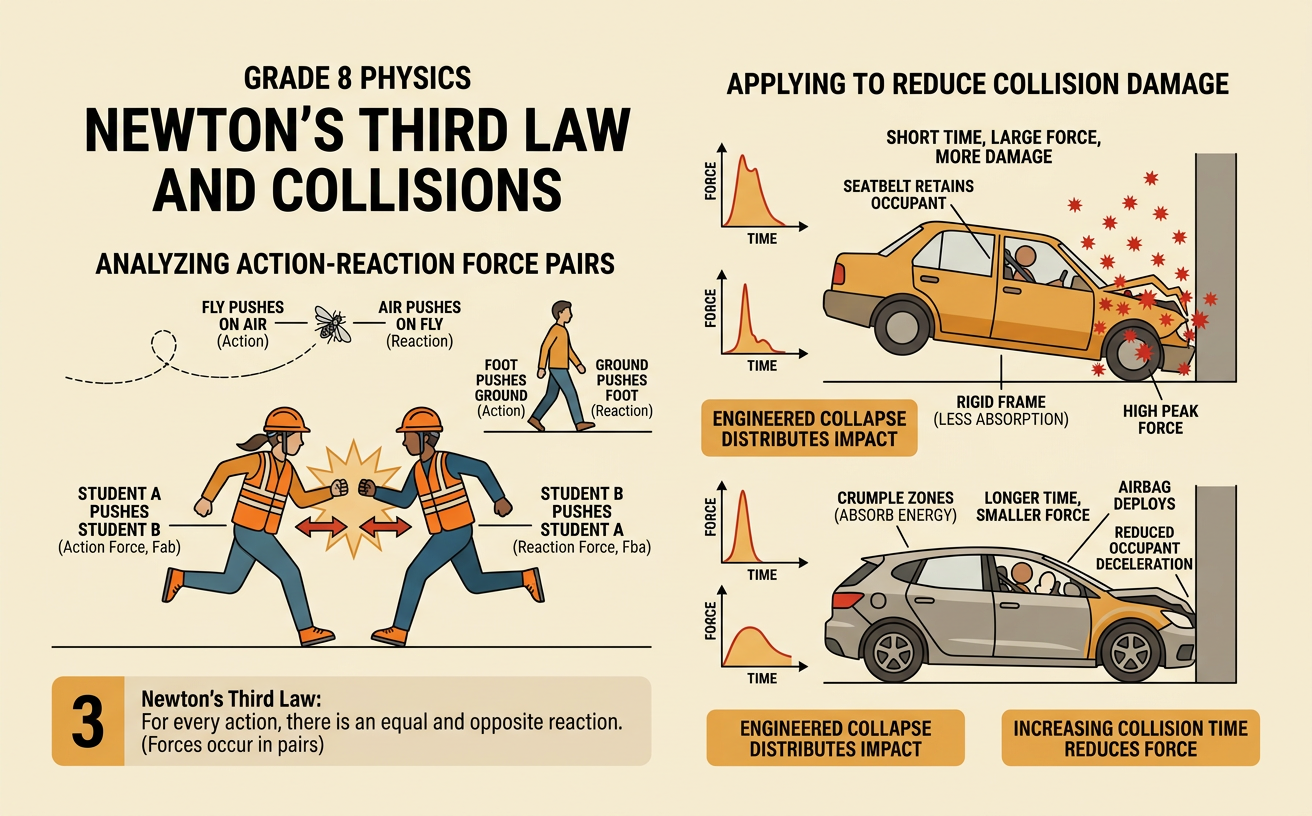
Newton’s third law states that when one object exerts a force on a second object, the second object exerts an equal-strength force in the opposite direction on the first object. These two forces form an action-reaction pair. They occur at the same time and act on different objects, so they do not cancel each other. For example, when a skateboarder pushes backward on the ground, the ground pushes forward on the skateboarder with an equal force. The forward force can accelerate the skateboarder. To identify a force pair, name both interacting objects and reverse their roles: the force of object A on object B pairs with the force of object B on object A. The words action and reaction do not mean that one force happens before the other.
Forces During Collisions
A collision occurs when two objects touch and exert forces on each other over a short time. During the contact, each object may compress, bend, slow down, speed up, stop, or change direction. According to Newton’s third law, the force of the first object on the second is equal in strength and opposite in direction to the force of the second object on the first. Imagine two identical carts rolling toward each other. When their spring bumpers touch, the left cart pushes the right cart to the right, while the right cart pushes the left cart to the left. The force arrows should be equal in length because the interaction forces are equal. The forces increase during compression and decrease as the carts separate, but they remain an equal and opposite pair at every instant.
Equal Forces and Different Effects
Equal interaction forces do not always produce equal changes in motion. An object’s acceleration depends on both the net force and its mass. For the same force, an object with less mass has a greater acceleration than an object with more mass. Consider a loaded shopping cart colliding with an empty cart. During contact, each cart pushes on the other with an equal and opposite force. However, the empty cart has less mass, so its velocity changes more quickly. The loaded cart has more inertia and undergoes less acceleration from the same-sized force. This does not violate Newton’s third law because the law compares the two forces, not the resulting accelerations or changes in velocity. When analyzing a collision, keep force, mass, and acceleration separate and identify which force acts on which object.
Collision Safety Features
Collision safety features reduce injury by controlling how quickly people and objects stop. A sudden stop produces a large acceleration, which can lead to a large force on a passenger. Crumple zones bend in a controlled way, increasing the time and distance over which a vehicle stops. Seat belts stretch slightly and spread force across stronger parts of the body. Air bags inflate to cushion the passenger, increase stopping time, and distribute force over a larger area. For example, when a car strikes a barrier, the barrier and car exert equal and opposite forces on each other. The front of the car crumples while the passenger continues moving forward because of inertia. The seat belt and air bag then exert forces that slow the passenger more gradually, reducing the risk of serious injury.
Design Challenge
Design a protective front end for a small cart carrying a raw egg as its passenger. The cart must roll down the same ramp and collide with a fixed wall without cracking the egg. Begin by identifying the interacting objects and predicting the equal and opposite forces during impact. Then choose materials, such as folded cardboard, foam, straws, or rubber bands, that can compress or bend. Your design should increase the cart’s stopping time, keep the egg secured, and prevent hard surfaces from striking it. Test one design at a time under the same conditions. Record whether the egg cracks, the amount of visible compression, and the cart’s motion after impact. Use the evidence to revise the design. A successful solution meets the safety goal while following limits on size, materials, and cost.