
Notice First: Building Questions from Scientific Observations
Students make precise qualitative and quantitative observations, distinguish observations from inferences, and identify patterns or anomalies that can lead to focused scientific questions.
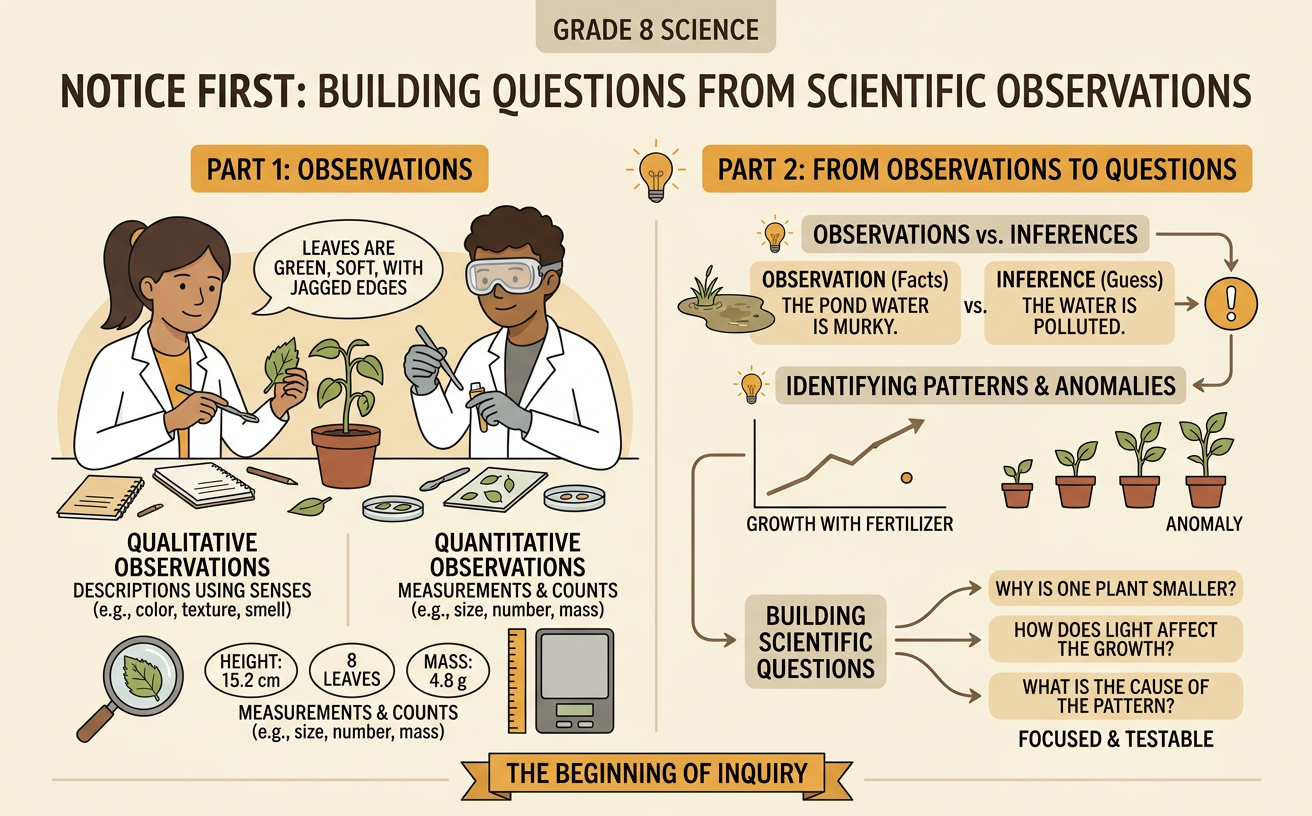
Illustrations are auto-generated and may be placeholders. They can be refreshed to match the narration.
Observe Without Explaining
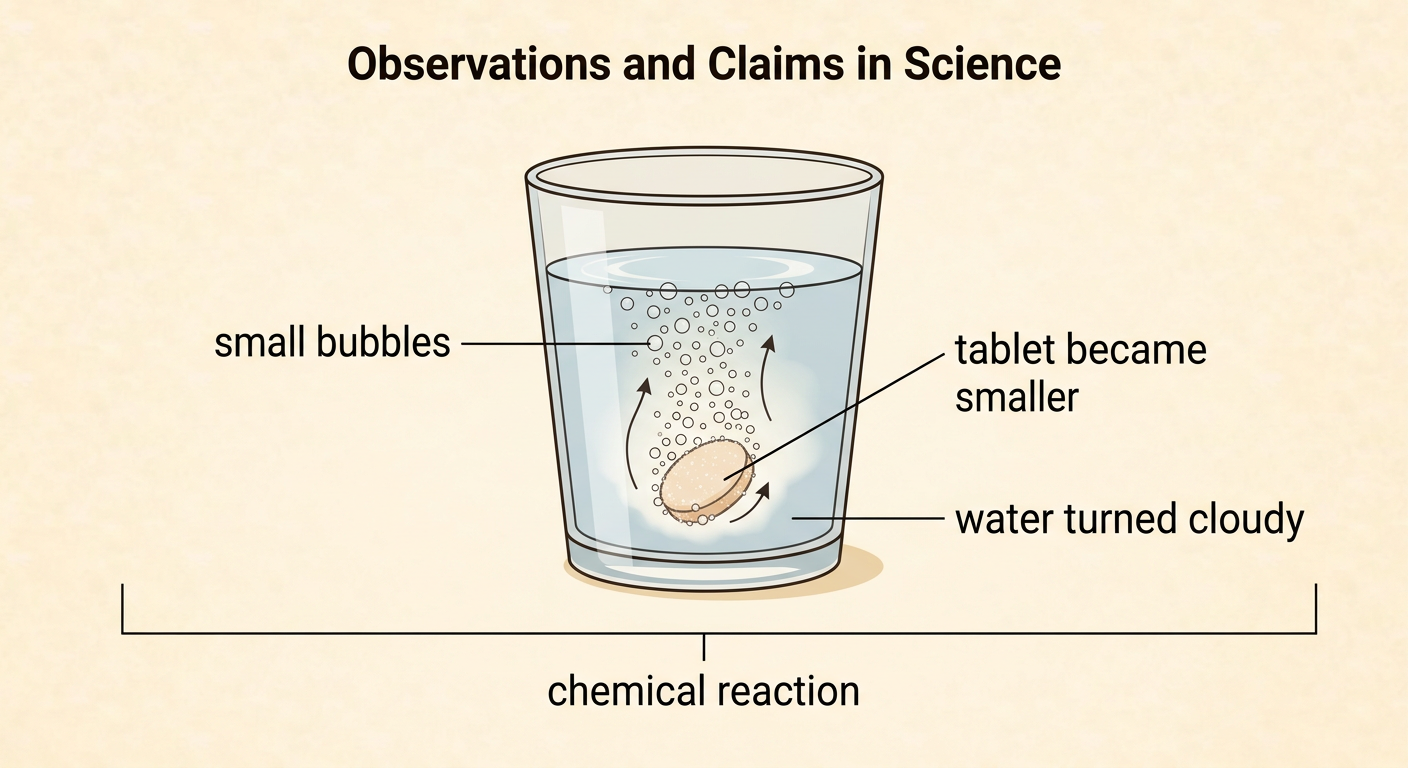
Scientific questions begin with careful noticing. During an initial observation, describe only what your senses or measuring tools can detect. Avoid explaining why something happened. Imagine placing an effervescent tablet in a clear cup of water. You might record, “Small bubbles formed on the tablet within two seconds,” “The tablet became smaller,” and “The water turned cloudy.” These statements describe visible changes. Saying, “The tablet dissolved because its chemicals reacted with water” is an explanation, not an observation. Record the setting, materials, sequence, and time so another person could recognize the same event. When observing a photograph, model, demonstration, or text, point to the exact feature or sentence that supports each statement. Careful, neutral descriptions provide dependable evidence for later inferences and questions.
Record Qualitative and Quantitative Details
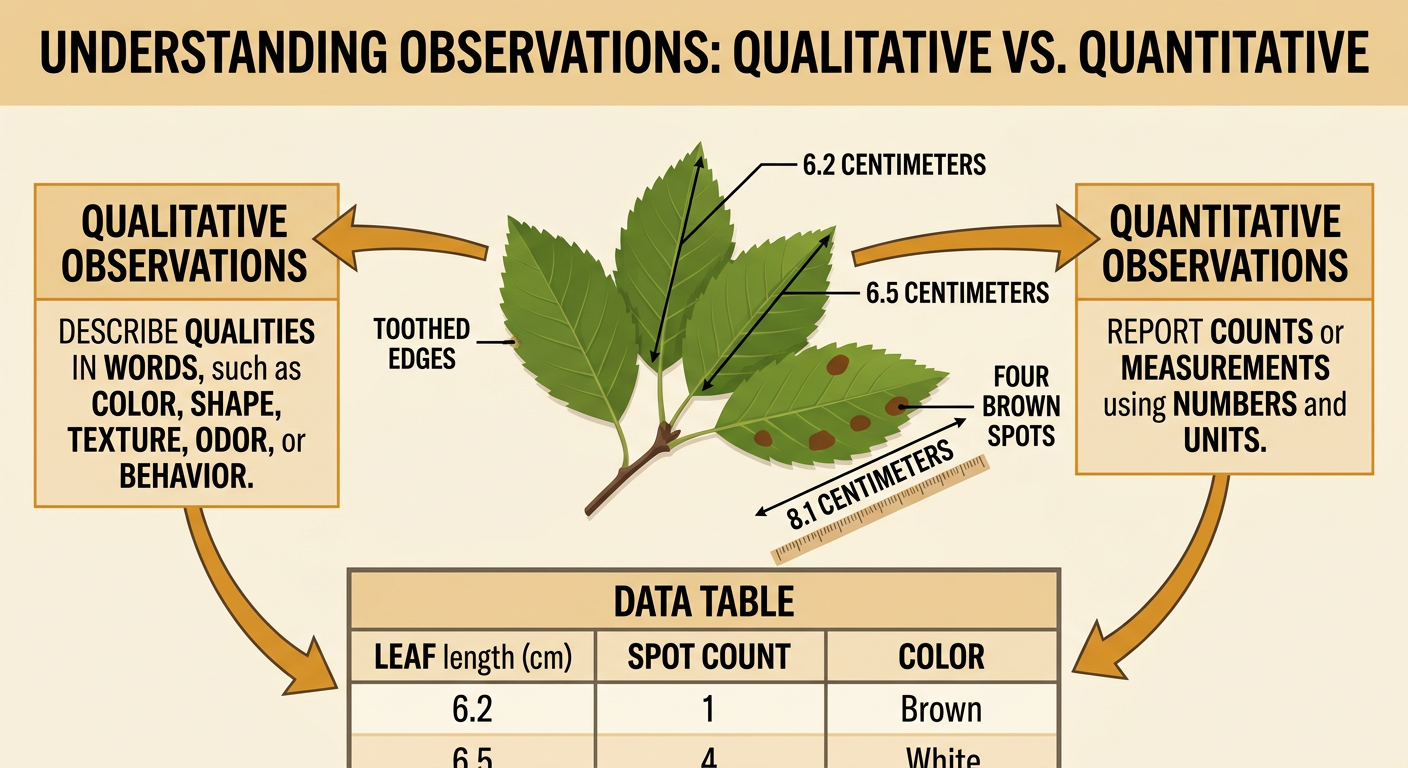
Complete observations usually include qualitative and quantitative details. Qualitative observations describe qualities such as color, shape, texture, odor, or behavior. Quantitative observations use numbers and units obtained by counting or measuring. Suppose you examine three leaves from the same plant. You could record that each leaf is green with toothed edges; those are qualitative details. You could also measure lengths of 6.2, 6.5, and 8.1 centimeters and count four brown spots on the longest leaf. Those are quantitative details. Use appropriate tools, standard units, and consistent procedures. Do not write “large” when a ruler can provide a measurement. A well-organized data table helps others compare observations and identify variation. Include units in every table heading so the meaning of each number is clear.
Separate Observation from Inference
An observation reports evidence gathered directly, while an inference is a reasonable interpretation of that evidence. Consider a cold metal can sitting on a table. After five minutes, droplets appear on its outside surface. “Clear droplets cover the lower half of the can” is an observation. “Water vapor in the air cooled and condensed on the can” is an inference because it explains how the droplets formed. Inferences are useful, but they should not be presented as facts observed directly. Different inferences may fit the same evidence. Someone might initially infer that the can is leaking, so an additional observation—such as checking whether the liquid level inside changed—would help evaluate that idea. Keep observations and inferences in separate notebook columns. Then connect every inference to the specific evidence that supports it.

Notice Patterns, Changes, and Anomalies
Scientists compare observations to find patterns, changes, and anomalies. A pattern is a repeated relationship or trend. A change is a difference across time or conditions. An anomaly is a result that does not fit the general pattern. Suppose water is heated gently and its temperature is measured every minute. The readings are 20, 26, 32, 38, 31, and 50 degrees Celsius. Most values rise by about six degrees per minute, but the 31-degree reading breaks the trend. Do not erase it simply because it looks unusual. First, check the recorded time, thermometer position, and procedure. The anomaly might result from a measurement problem, or it might reveal an unexpected event worth investigating. Tables and graphs make trends easier to see. Describe the evidence precisely, such as, “The temperature decreased by 7 degrees between minutes 3 and 4.”
Identify What Is Still Unknown
After recording evidence, separate what is known from what remains unknown. Suppose a classroom aquarium becomes cloudy two days after extra fish food is added. Observations show reduced water clarity, uneaten food on the bottom, and no change in water temperature. These details do not reveal which organisms or processes caused the cloudiness. Unknowns might include the number of bacteria, the concentration of dissolved oxygen, or whether the food increased algae growth. List these gaps before choosing a question. Then determine which sources could help: water-quality measurements can provide direct data, microscope observations can reveal microorganisms, and reliable scientific texts can explain possible processes. Cite the exact measurement, image feature, or sentence used as evidence. Comparing sources and viewpoints, such as an aquarist’s practical experience and a biologist’s research, can also expose assumptions and guide further investigation.
Turn Evidence-Based Wonderings into Questions
A strong scientific question grows from evidence and focuses on something that can be investigated. Begin with an observation, identify the unknown, and narrow a broad wondering into a measurable question. For example, students observe that twelve pill bugs gather beneath a dark card while three remain in an uncovered, lit area. “Why do pill bugs like darkness?” assumes a preference and is too broad. A more focused question is, “How does light exposure affect the number of pill bugs found in each side of a two-chamber container after ten minutes?” This question identifies a condition to change, a result to count, and a time period. It can be answered by collecting repeated measurements. Avoid questions that already contain an explanation. Before investigating, check that the question is clear, safe, ethical, and answerable with available tools and evidence.