
Nuclear Chemistry and Radioactive Change
Students model radioactive decay, fission, and fusion while comparing changes in nuclear composition and associated energy release.
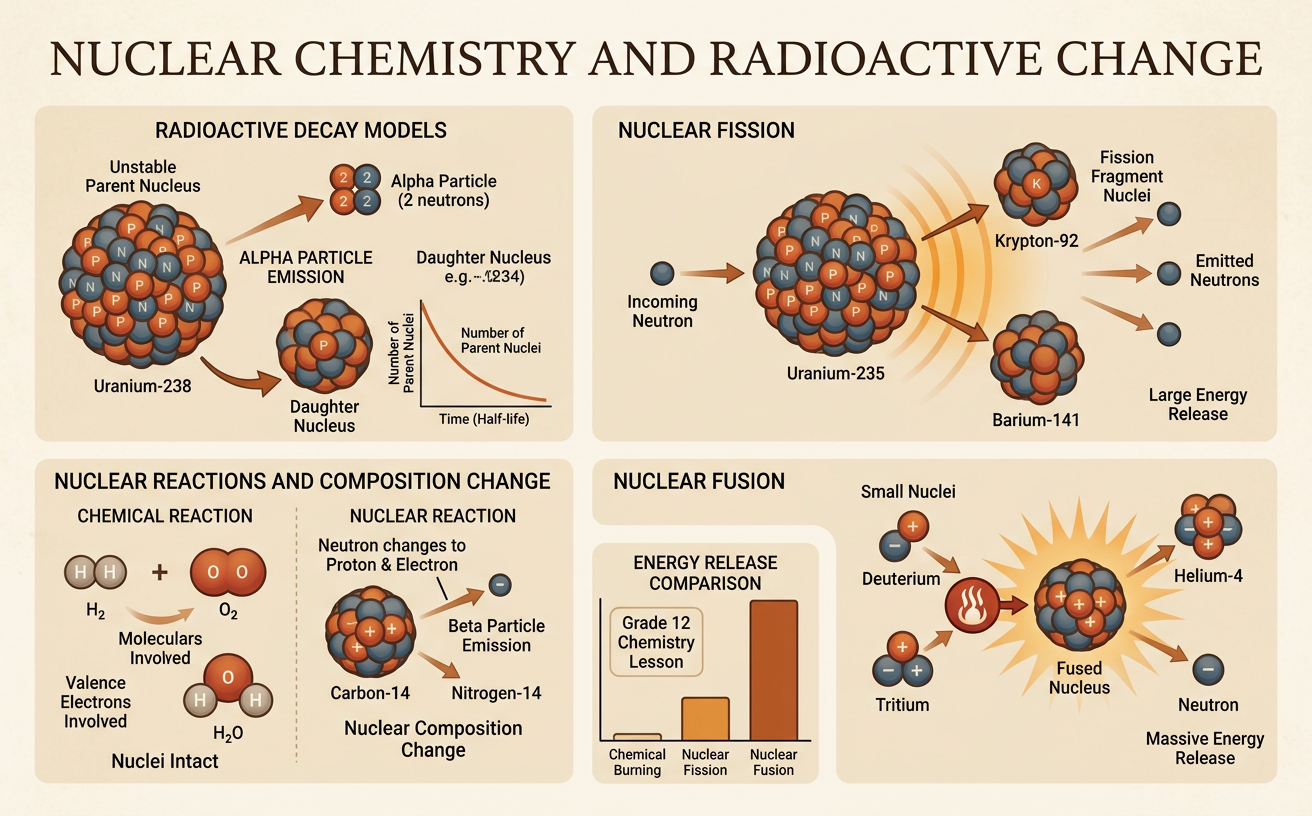
Illustrations are auto-generated and may be placeholders. They can be refreshed to match the narration.
Nuclear Stability
An atomic nucleus contains positively charged protons and neutral neutrons. Protons repel one another electrically, while the short-range strong nuclear force attracts nearby protons and neutrons. A nucleus is stable when these effects produce a sufficiently large binding energy. Light stable nuclei usually have similar numbers of protons and neutrons, but heavier stable nuclei need proportionally more neutrons to separate the protons. Carbon-12, with six protons and six neutrons, is stable. Carbon-14 has six protons and eight neutrons and is unstable, so it undergoes radioactive decay. The total mass of a bound nucleus is slightly less than the combined masses of its separate nucleons. This mass defect corresponds to nuclear binding energy according to E = mc². When an unstable nucleus changes into a more stable arrangement, some energy is released as radiation or particle motion.
Alpha, Beta, and Gamma Radiation
Radioactive decay changes an unstable nucleus while conserving total nucleon number, electric charge, and energy. During alpha decay, the nucleus emits an alpha particle containing two protons and two neutrons. Its mass number decreases by four, and its atomic number decreases by two; for example, uranium-238 becomes thorium-234. During beta-minus decay, a neutron changes into a proton while an electron and an antineutrino are emitted. The mass number stays constant, but the atomic number increases by one; carbon-14 therefore becomes nitrogen-14. Gamma decay releases a high-energy photon from an excited nucleus. Gamma emission changes neither the mass number nor the atomic number. Alpha radiation has low penetration, beta radiation has moderate penetration, and gamma radiation is highly penetrating. Paper stops most alpha particles, aluminum stops many beta particles, and thick lead or concrete reduces gamma intensity.
Half-Life Calculations
Half-life is the time required for half the radioactive nuclei in a sample to decay. Individual decay events are unpredictable, but a large sample follows a regular exponential pattern. The amount remaining can be modeled by N = N₀(1/2)^(t/t₁/₂), where N₀ is the initial amount, t is elapsed time, and t₁/₂ is the half-life. Suppose an 80-gram sample has a half-life of 8 days. After 8 days, 40 grams remain; after 16 days, 20 grams remain; and after 24 days, 10 grams remain. Three half-lives have passed, so the same result is 80(1/2)³ = 10 grams. The amount never suddenly reaches zero in the mathematical model. Activity, or decays per second, also decreases by half during each half-life.
Nuclear Fission
Nuclear fission occurs when a heavy nucleus splits into two smaller nuclei. In a common model, uranium-235 absorbs a neutron and briefly forms unstable uranium-236. It can split into barium-141, krypton-92, and three neutrons: uranium-235 plus one neutron produces barium-141, krypton-92, three neutrons, and energy. The mass numbers balance because 235 + 1 = 141 + 92 + 3, and the atomic numbers balance because 92 = 56 + 36. The products have slightly less mass than the reactants, and the mass difference appears as about 200 million electron volts of energy per fission. Released neutrons can strike other uranium-235 nuclei, producing a chain reaction. In a nuclear reactor, control rods absorb excess neutrons so the reaction proceeds at a controlled rate, while coolant transfers thermal energy for electricity generation.
Nuclear Fusion and Energy
Nuclear fusion joins light nuclei to form a heavier nucleus. Because positively charged nuclei repel one another, fusion requires extremely high temperature and pressure so nuclei collide with enough energy to approach within range of the strong nuclear force. A useful example is the fusion of deuterium and tritium, two hydrogen isotopes. Deuterium has one proton and one neutron, while tritium has one proton and two neutrons. They combine to form helium-4 and a free neutron, releasing 17.6 million electron volts of energy. The products have slightly less mass than the reactants, and the missing mass is converted to energy according to E = mc². Fusion powers the Sun, where a sequence of reactions ultimately combines hydrogen nuclei into helium. Fusion releases more energy per unit mass than chemical reactions and produces no carbon dioxide during operation, but sustained, controlled fusion remains technologically difficult.