Nuclear Chemistry: Radioactive Decay and Half-Life
Students use nuclear equations and mathematical models to explain radioactive decay, calculate half-life, and evaluate applications of radioactive isotopes.

Illustrations are auto-generated and may be placeholders. They can be refreshed to match the narration.
Isotopes and Nuclear Stability
Atoms of the same element always have the same number of protons, but they may have different numbers of neutrons. These forms are called isotopes. An isotope is written with its mass number, the total number of protons and neutrons, above its atomic number, the number of protons. Carbon-12 and carbon-14 both contain 6 protons, but carbon-12 has 6 neutrons while carbon-14 has 8. Nuclear stability depends partly on the balance between attractive nuclear forces and repulsion among positively charged protons. Some neutron-to-proton combinations are unstable. An unstable nucleus is radioactive and changes spontaneously by emitting particles or electromagnetic energy. Carbon-12 is stable, whereas carbon-14 undergoes radioactive decay. Decay changes the nucleus but is not caused by ordinary changes in temperature, pressure, or chemical bonding.

Alpha, Beta, and Gamma Decay
Radioactive nuclei can decay in several ways. In alpha decay, the nucleus releases an alpha particle containing 2 protons and 2 neutrons. Its mass number decreases by 4, and its atomic number decreases by 2. For example, uranium-238 becomes thorium-234. In beta-minus decay, a neutron changes into a proton while an electron and an antineutrino are emitted. The mass number stays constant, but the atomic number increases by 1; carbon-14 therefore becomes nitrogen-14. In gamma decay, an excited nucleus releases a high-energy photon. Its mass number and atomic number do not change. Alpha particles penetrate the least and can be stopped by paper. Beta particles penetrate farther and can be reduced by thin metal. Gamma rays are highly penetrating and require dense shielding, such as thick lead or concrete.

Balancing Nuclear Equations
A nuclear equation must conserve both mass number and electric charge. Add the mass numbers on each side and confirm that the totals match; then do the same with atomic numbers. Consider alpha decay: uranium-238 becomes thorium-234 plus helium-4. The mass numbers balance because 238 equals 234 plus 4. The atomic numbers also balance because 92 equals 90 plus 2. The emitted helium-4 nucleus is the alpha particle. For beta-minus decay, carbon-14 becomes nitrogen-14 plus an electron. The mass numbers are 14 equals 14 plus 0, and the atomic numbers are 6 equals 7 plus negative 1. The element may change because its atomic number changes. Balancing does not mean counting ordinary atoms or molecules; it tracks particles and charge during a change inside the nucleus.

Half-Life as Exponential Decay
Half-life is the time required for half of the radioactive nuclei in a sample to decay. Because each nucleus has a constant probability of decaying, equal time intervals reduce the remaining amount by the same factor rather than the same difference. This makes radioactive decay exponential. The model is N = N₀(1/2)^(t/T), where N₀ is the initial amount, t is elapsed time, and T is the half-life. Suppose an isotope has a half-life of 6 hours and begins with 80 milligrams. After 6 hours, 40 milligrams remain; after 12 hours, 20 milligrams remain; and after 18 hours, 10 milligrams remain. A table, equation, and curved graph can represent the same pattern. The sample approaches zero but does not reach zero in the ideal mathematical model.

Medical and Energy Applications
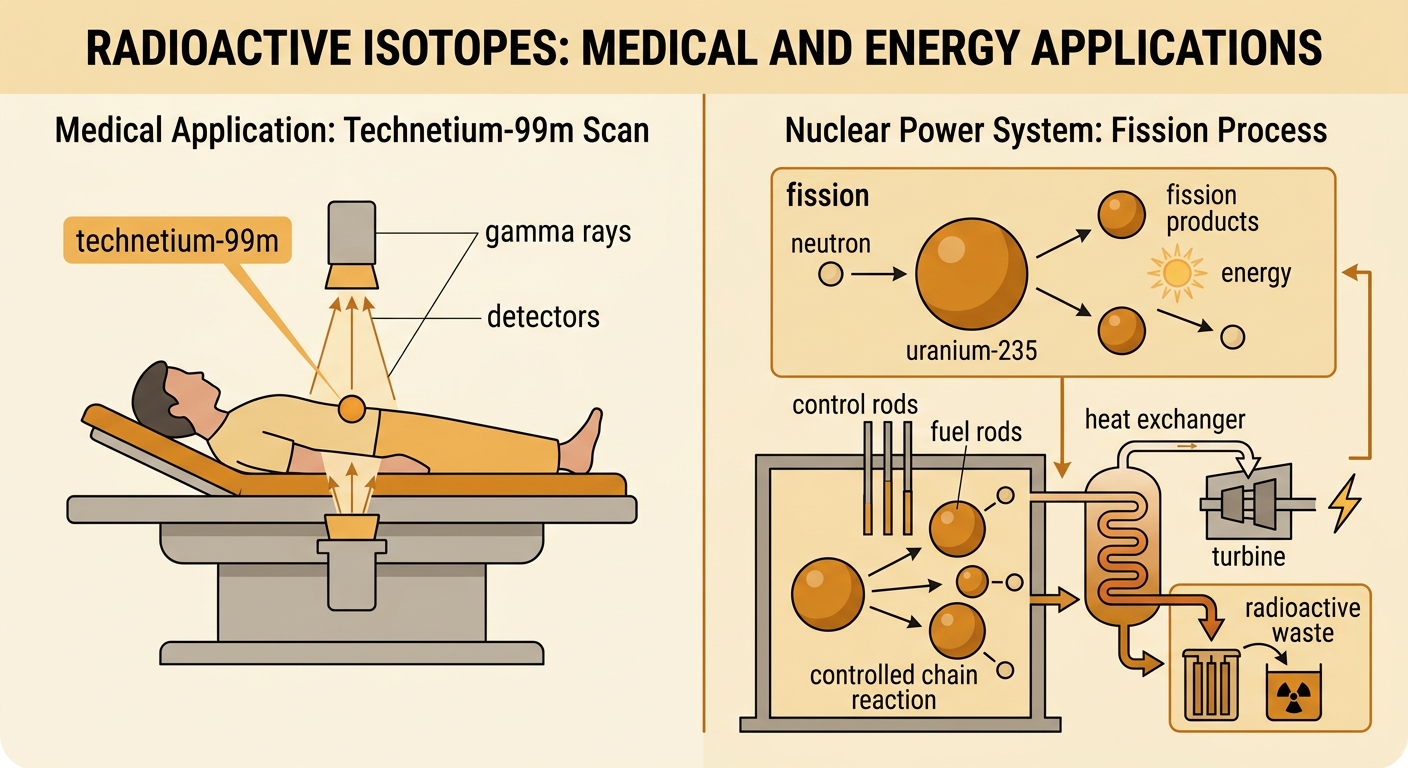
Radioactive isotopes are useful when their radiation, half-life, and chemical behavior match a specific purpose. In medical imaging, technetium-99m emits gamma rays that detectors outside the body can measure. Its approximately 6-hour half-life is long enough for an examination but short enough to limit prolonged exposure. In some treatments, carefully directed radiation damages cancer cells while shielding reduces exposure to healthy tissue. Nuclear power uses fission rather than ordinary radioactive decay as its main energy-producing process. When a uranium-235 nucleus absorbs a neutron, it can split into smaller nuclei, release additional neutrons, and release energy. Controlled chain reactions heat water, which can produce steam and generate electricity. These applications offer major benefits, but they also require secure isotope handling, radiation monitoring, reactor controls, and plans for storing radioactive waste.
Evidence-Based Risk and Policy Decisions
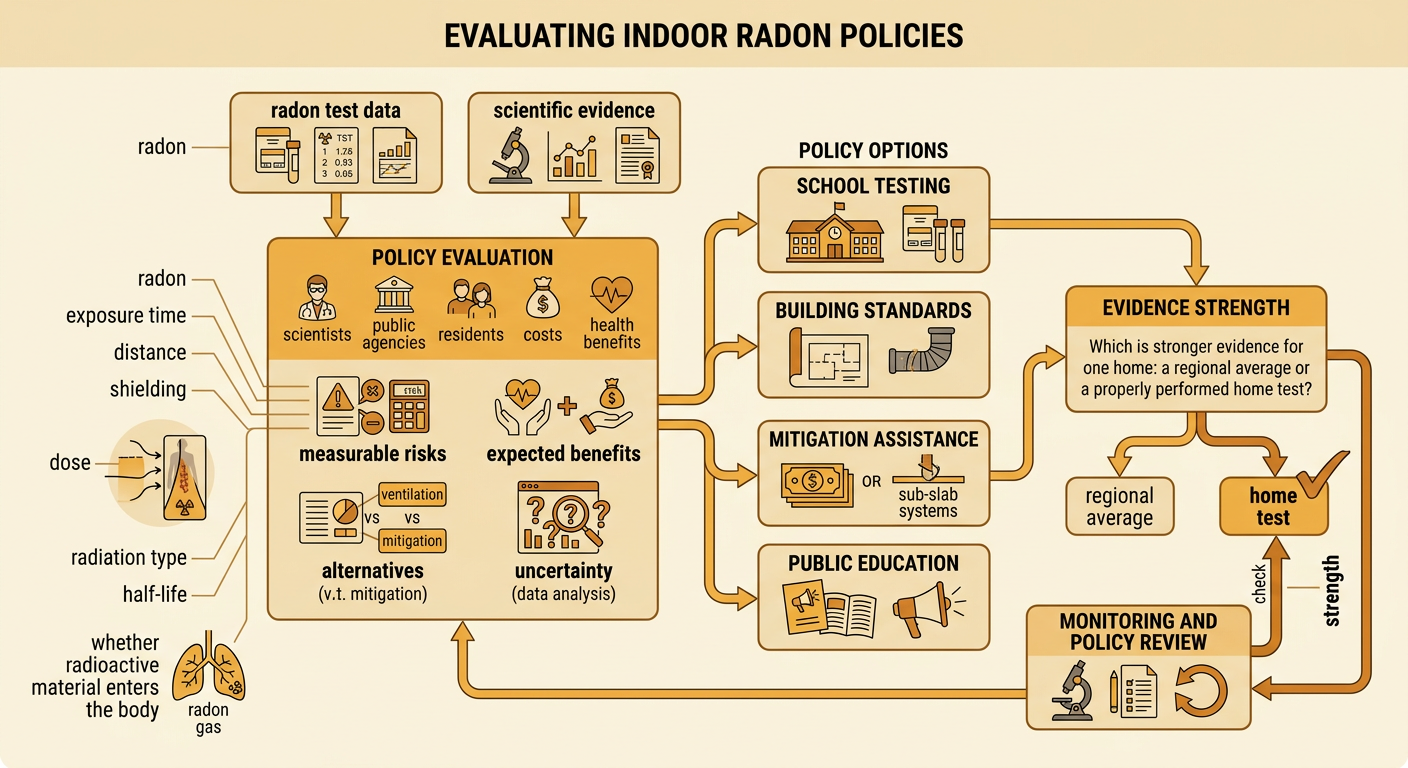
Decisions about radioactive materials should compare measurable risks, expected benefits, alternatives, and uncertainty. Relevant evidence includes radiation type, dose, exposure time, distance, shielding, half-life, and whether a material can enter the body. For example, a community considering rules for indoor radon can examine home test results, local geology, health studies, mitigation costs, and the effectiveness of ventilation or sub-slab systems. Radon is a radioactive gas produced naturally in the uranium decay series, and long-term exposure increases lung cancer risk. Policymakers might require testing in schools, establish construction standards, fund mitigation for qualifying households, or provide public information. Scientists supply measurements and explain uncertainty, while elected officials and agencies set and enforce policy. Citizens and affected groups can evaluate evidence and consequences. A strong policy identifies who benefits, who bears costs, and how results will be monitored and revised.