
Nuclear Energy Policy: Balancing Climate, Cost, and Risk
Students analyze scientific data, economic evidence, and competing civic arguments to recommend whether nuclear power should play a larger role in United States energy policy.
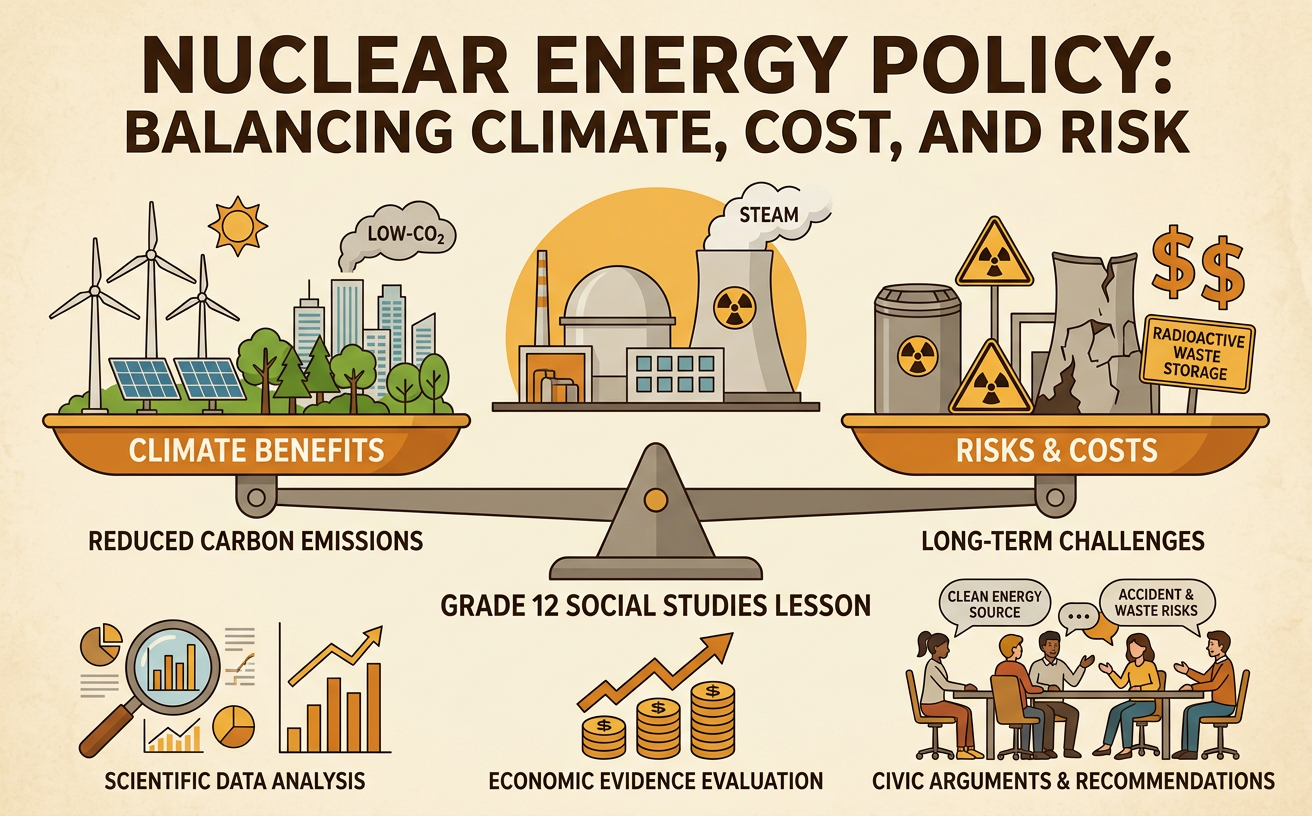
Illustrations are auto-generated and may be placeholders. They can be refreshed to match the narration.
The U.S. Energy Policy Debate
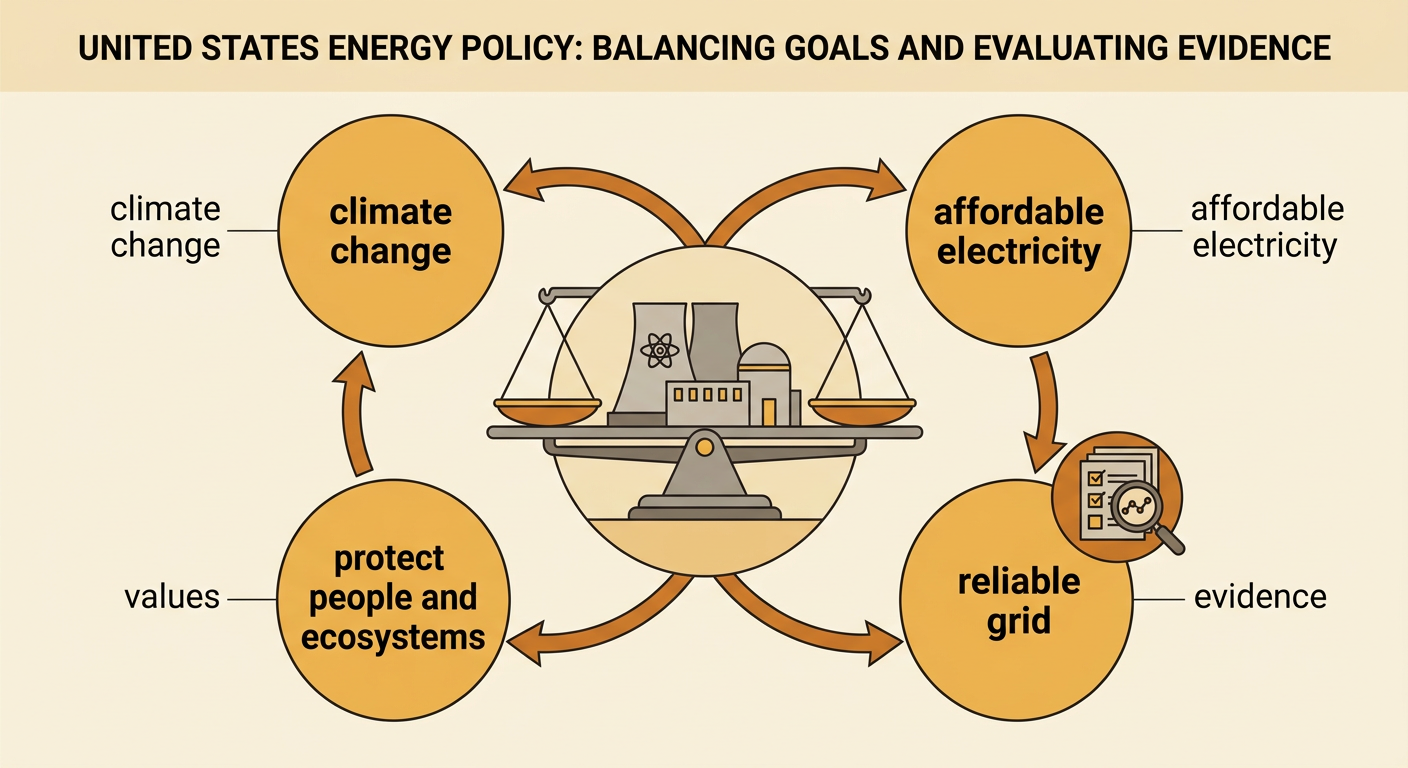
United States energy policy must pursue several goals at once: limiting climate change, keeping electricity affordable, maintaining a reliable grid, and protecting communities and ecosystems. Nuclear plants generate electricity without direct carbon dioxide emissions during operation and currently provide a substantial share of U.S. electricity. However, new reactors can require large investments, long construction periods, and difficult decisions about safety and radioactive waste. Policy choices occur at federal, state, and local levels. For example, officials considering whether to extend an existing plant’s operating license might compare its safety record and maintenance costs with the likely replacement power. If the plant closes and natural gas replaces it, emissions could rise; if wind, solar, storage, and transmission replace it, costs and land use may change. Students should distinguish evidence about these effects from claims expressing political values or preferences.
Comparing Emissions, Costs, and Reliability
Energy sources should be compared with consistent measurements. Life-cycle emissions include construction, fuel production, operation, and decommissioning, not only emissions at the power plant. Published estimates commonly place nuclear and wind among low-emission sources, while natural gas and coal have much higher life-cycle emissions. Cost comparisons should identify whether they concern an existing plant or a new facility because new nuclear construction is generally much more expensive than operating a safe, paid-off reactor. Reliability can be examined through capacity factor, the percentage of maximum possible electricity actually generated over time. U.S. nuclear plants have recently averaged capacity factors above 90 percent, although a high capacity factor does not measure how quickly a plant adjusts its output. For example, students can plot plant age against annual maintenance cost, fit a linear or nonlinear function, and use the model cautiously to estimate future costs.

Assessing Safety and Waste Risks
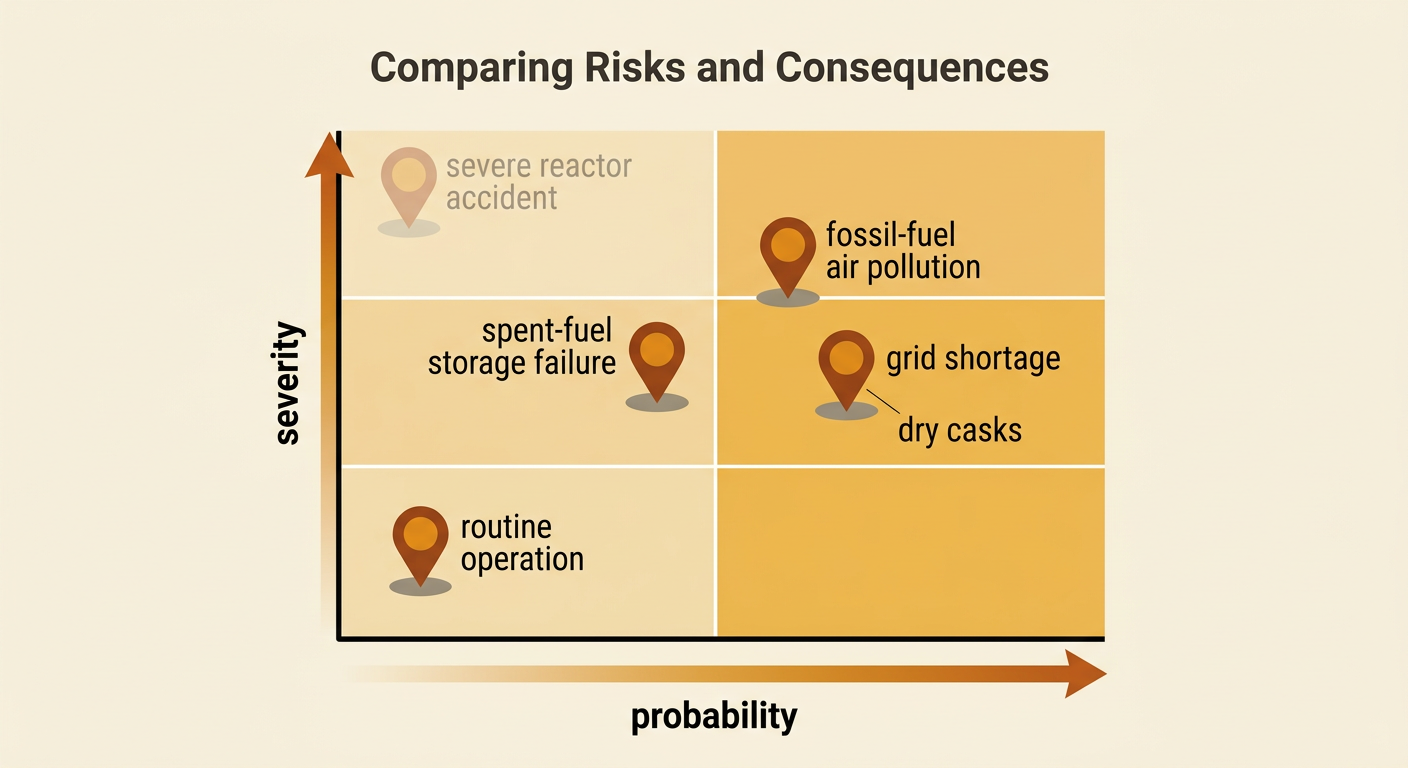
Risk assessment considers both the probability of an event and the severity of its consequences. Nuclear accidents are rare, but a severe accident can cause evacuation, cleanup costs, public fear, and long-term restrictions on land use. Reactor designs, independent regulation, backup cooling, and emergency plans reduce risk, but no technology is risk-free. Nuclear generation also produces spent fuel that remains highly radioactive and requires secure isolation. Most U.S. spent fuel is stored at reactor sites in pools and then in dry casks because the country has not opened a permanent disposal repository. These risks should be compared with harms from alternatives, including air pollution from fossil fuels, mining impacts, dam failures, and land or material demands. For example, closing a nuclear plant may remove one local hazard but unintentionally increase regional air pollution if fossil-fuel generation fills the gap.
Stakeholders and Competing Civic Values
Energy policy affects groups differently, so civic analysis must identify stakeholders, evidence, values, and power. Utility companies may emphasize dependable generation and financial stability. Workers and host communities may value jobs, tax revenue, and a safe workplace. Ratepayers may prioritize affordable bills, while climate organizations may focus on rapid emissions reductions. Tribal nations and communities near mines, plants, waste routes, or proposed storage sites may raise concerns about consent, environmental justice, and long-term stewardship. Renewable-energy developers may argue that investment should favor wind, solar, transmission, and storage instead of reactors. For example, a proposed waste facility could provide jobs to one community while placing transportation and environmental burdens on communities along shipping routes. Public hearings, consultation, transparent records, and access to technical expertise can improve participation, but decision-makers must still evaluate whose interests are represented and whose are overlooked.

Evaluating Policy Options
Policymakers can compare several options rather than treating nuclear power as a simple yes-or-no choice. Options include extending licenses for safe existing plants, subsidizing selected reactors, supporting advanced-reactor demonstrations, accelerating permanent waste disposal, building conventional reactors, or directing funds toward renewables, storage, efficiency, and transmission. A decision matrix can score each option on emissions, total cost, construction time, reliability, safety, waste, and equity. Criteria should be measurable, and assigned weights should reflect publicly explained priorities. For example, if emissions receive a weight of 0.40, affordability 0.30, reliability 0.20, and equity 0.10, each option’s rating is multiplied by the corresponding weight and then summed. Students should perform a sensitivity test by changing the weights. If the preferred option changes easily, the result depends strongly on value choices or uncertain evidence rather than demonstrating one unquestionably superior policy.

Evidence-Based Policy Recommendation
A strong policy recommendation states a clear claim, cites specific evidence, explains the reasoning, addresses counterarguments, and acknowledges uncertainty. Evidence should come from credible primary and secondary sources, such as federal generation data, regulatory safety reports, peer-reviewed life-cycle studies, utility filings, and testimony from affected communities. Students should quote or cite exact findings rather than say only that research supports their view. One defensible example is a conditional policy: preserve existing reactors that pass rigorous safety and cost reviews, invest in waste management, and require low-carbon replacement plans before closures, while limiting support for new reactors to projects with enforceable cost and schedule protections. A student might defend this approach using emissions and capacity-factor data, then address concerns about expense, accidents, and waste. The recommendation should also include measurable indicators, such as project cost, outage frequency, emissions, electricity rates, and waste milestones, plus a date for public review.
