
Nuclear Fission, Fusion, and Mass-Energy Equivalence
Students use nuclear models and E = mc² to explain how small changes in mass release energy during fission, fusion, and radioactive decay.
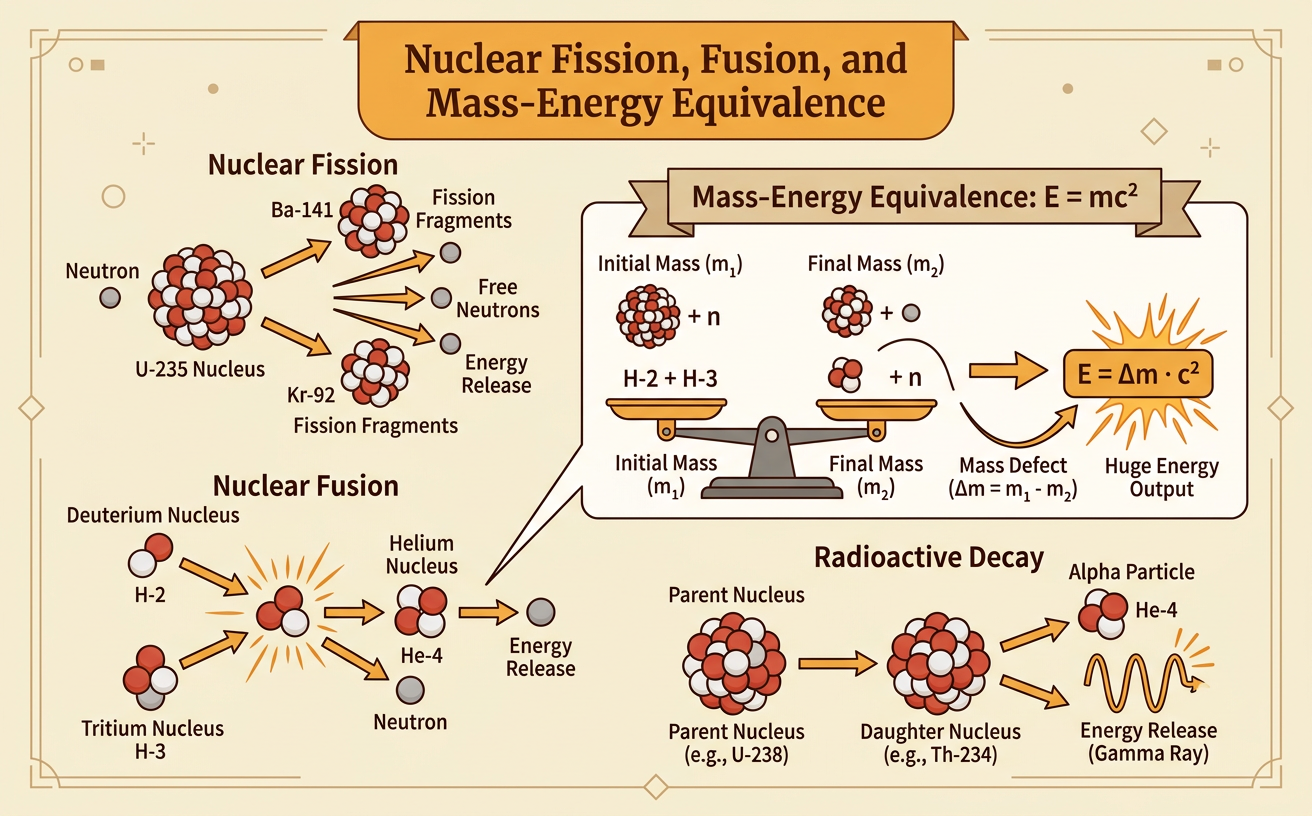
Illustrations are auto-generated and may be placeholders. They can be refreshed to match the narration.
Inside the Atomic Nucleus
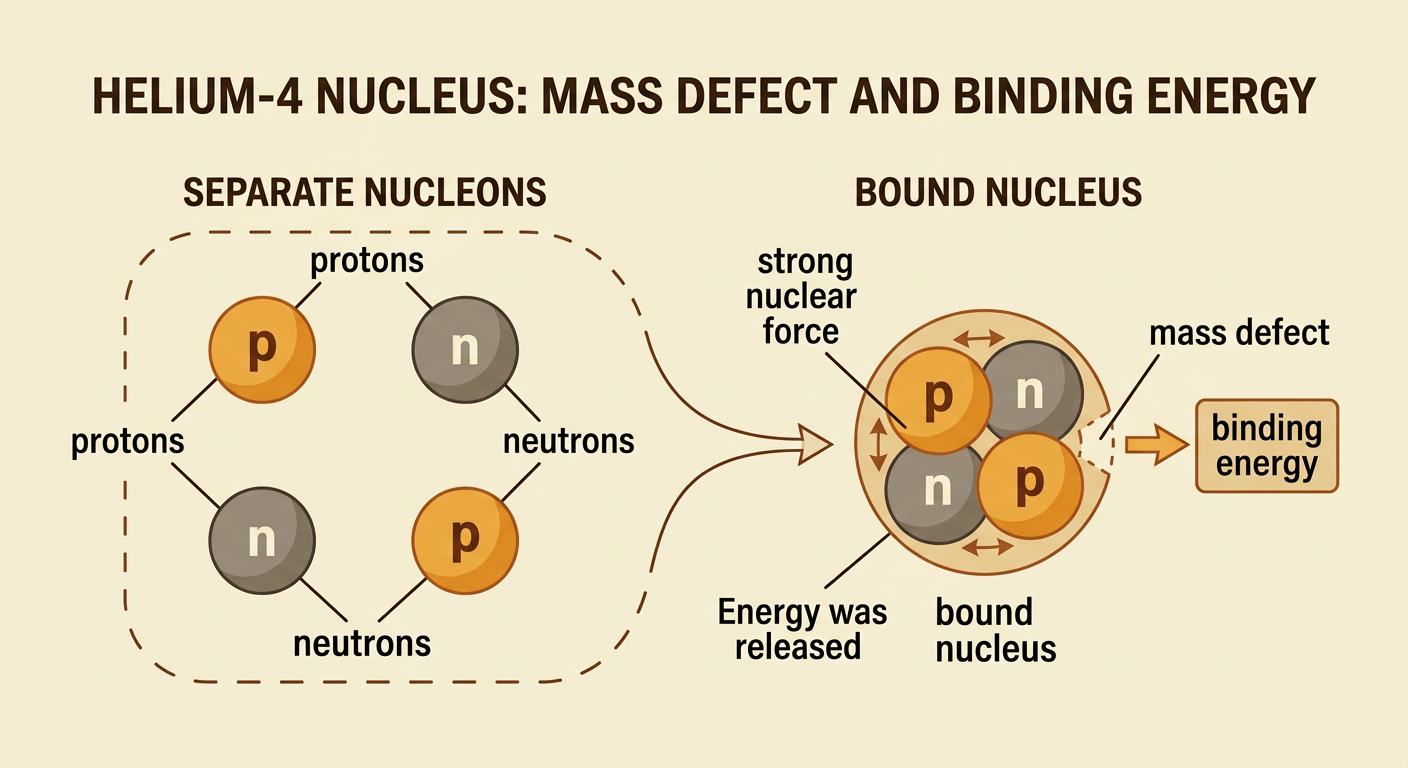
An atom has a tiny, dense nucleus made of positively charged protons and electrically neutral neutrons. Together, these particles are called nucleons. The number of protons identifies the element, while different numbers of neutrons produce isotopes of that element. The strong nuclear force attracts nearby nucleons and can overcome the electric repulsion between protons at very short distances. When nucleons bind together, the nucleus has slightly less mass than the separate particles would have. This difference is the mass defect, and it corresponds to nuclear binding energy. For example, a helium-4 nucleus contains two protons and two neutrons, but its measured mass is less than their total separate mass. A particle model helps show nuclear composition, although it cannot represent the nucleus's exact quantum behavior or scale.
Radioactive Decay and Nuclear Stability
A nucleus is stable only when its combination of protons and neutrons allows nuclear attraction to balance proton repulsion. An unstable nucleus can become more stable by radioactive decay, which changes its composition or energy. In alpha decay, the nucleus emits two protons and two neutrons, so its atomic number decreases by 2 and its mass number decreases by 4. In beta-minus decay, a neutron changes into a proton while an electron and an antineutrino are emitted. Gamma decay releases a high-energy photon but does not change the numbers of protons or neutrons. For example, uranium-238 undergoes alpha decay to form thorium-234. The products have slightly less total mass than the original nucleus, and the missing mass appears as kinetic energy and radiation. Decay is random for one nucleus but predictable for large samples through half-life.

How Nuclear Fission Works
Nuclear fission occurs when a heavy nucleus splits into two smaller nuclei. In one common model, uranium-235 absorbs a slow neutron and briefly becomes unstable uranium-236. It then splits into fission fragments, such as barium-141 and krypton-92, while releasing three neutrons and energy. The products contain the same total numbers of protons and neutrons as the reactants, but their combined mass is slightly smaller. That mass defect becomes kinetic energy, gamma radiation, and other forms of energy. Released neutrons may strike additional uranium-235 nuclei, creating a chain reaction. In a nuclear reactor, control rods absorb some neutrons so the reaction remains controlled and heat can produce steam and electricity. A particle diagram explains the sequence well, but actual fission can produce many different pairs of fragments rather than only one pair.

How Nuclear Fusion Works
Nuclear fusion joins two light nuclei to form a heavier nucleus. Because both nuclei are positively charged, they repel each other and must collide at extremely high temperature and pressure. When they get close enough, the strong nuclear force can bind them. A common example is deuterium, hydrogen with one proton and one neutron, fusing with tritium, hydrogen with one proton and two neutrons. The reaction forms helium-4, releases one neutron, and produces about 17.6 million electron volts of energy. The helium nucleus and neutron have less total mass than the original deuterium and tritium nuclei, so the mass difference becomes energy. Fusion powers the Sun, although the Sun mainly uses a different sequence called the proton-proton chain. On Earth, sustaining fusion requires confinement systems that keep extremely hot plasma dense and stable long enough for many collisions.

Calculating Energy from Mass Defect
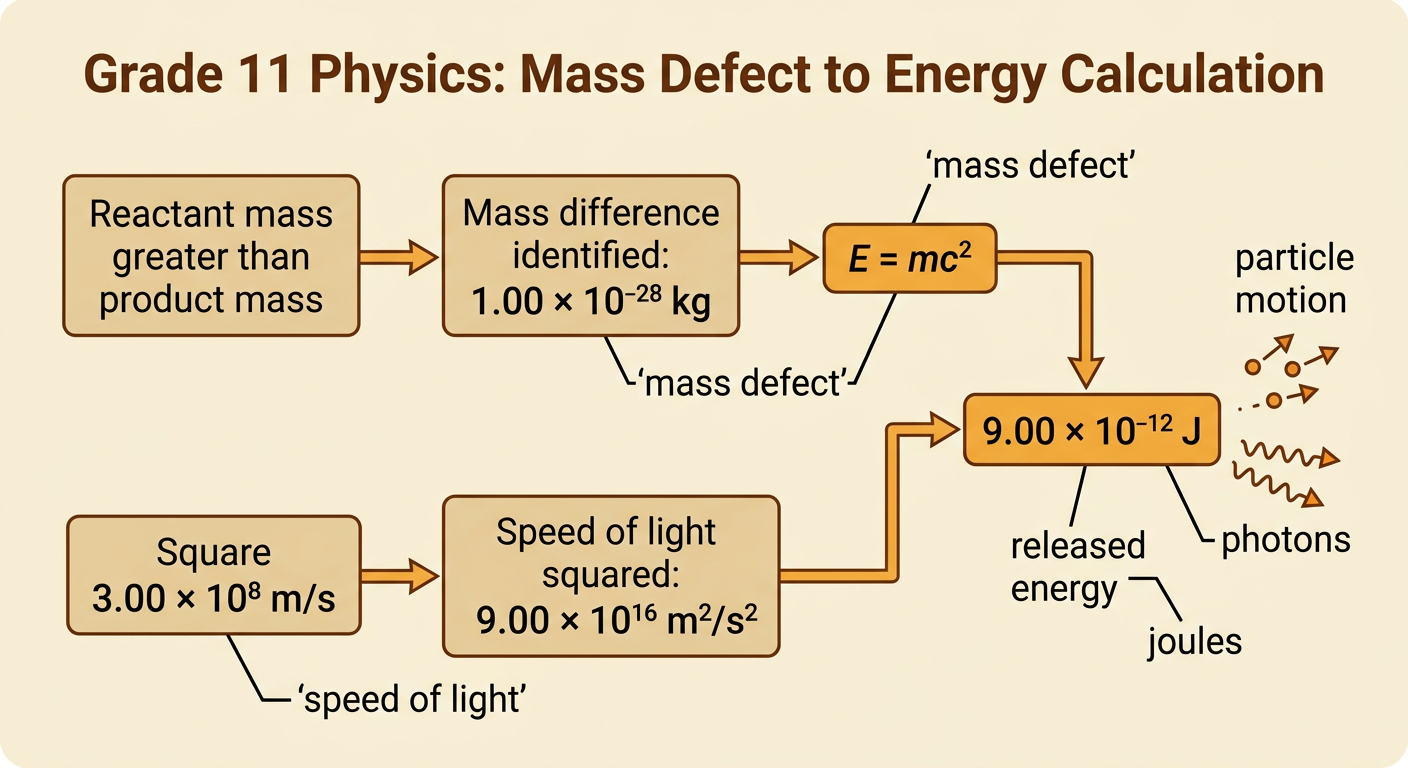
Einstein's equation E = mc² relates a change in mass to released energy. In this equation, E is energy in joules, m is the mass defect in kilograms, and c is the speed of light, approximately 3.00 × 10⁸ meters per second. Suppose a nuclear reaction's products have 1.00 × 10⁻²⁸ kilogram less mass than its reactants. The released energy is E = (1.00 × 10⁻²⁸ kg)(3.00 × 10⁸ m/s)², which equals 9.00 × 10⁻¹² joule for one reaction. This amount seems small, but a macroscopic sample can contain enormous numbers of reacting nuclei. The calculation assumes the measured mass difference is accurate and that all resulting energy forms are included. In practice, energy may appear as particle motion, photons, or energy carried away by neutrinos, so not all of it is necessarily captured for useful work.
Comparing Applications, Benefits, and Risks
Nuclear processes have different applications, benefits, and risks. Controlled fission reactors generate large amounts of electricity with low direct carbon dioxide emissions and reliable output. However, they produce long-lived radioactive waste, require costly safety systems, and can release radioactive material if multiple protections fail. Fusion could use widely available fuel and would not produce carbon dioxide during operation; it also avoids a self-sustaining fission chain reaction. Yet practical fusion power remains difficult because reactors must confine extremely hot plasma, and high-energy neutrons can damage equipment and activate materials. Radioactive decay is useful in medical imaging, cancer treatment, smoke detectors, and dating ancient materials, but radiation exposure can damage living tissue. A sound comparison should use evidence about total life-cycle emissions, cost, waste, reliability, and health effects. Conclusions remain limited because technologies, regulations, and local conditions differ.
