
Nuclear Physics: Radioactive Decay, Fission, and Fusion
Students model how radioactive decay, fission, and fusion change atomic nuclei, release energy, and influence technologies and society.

Illustrations are auto-generated and may be placeholders. They can be refreshed to match the narration.
Stable and Unstable Atomic Nuclei
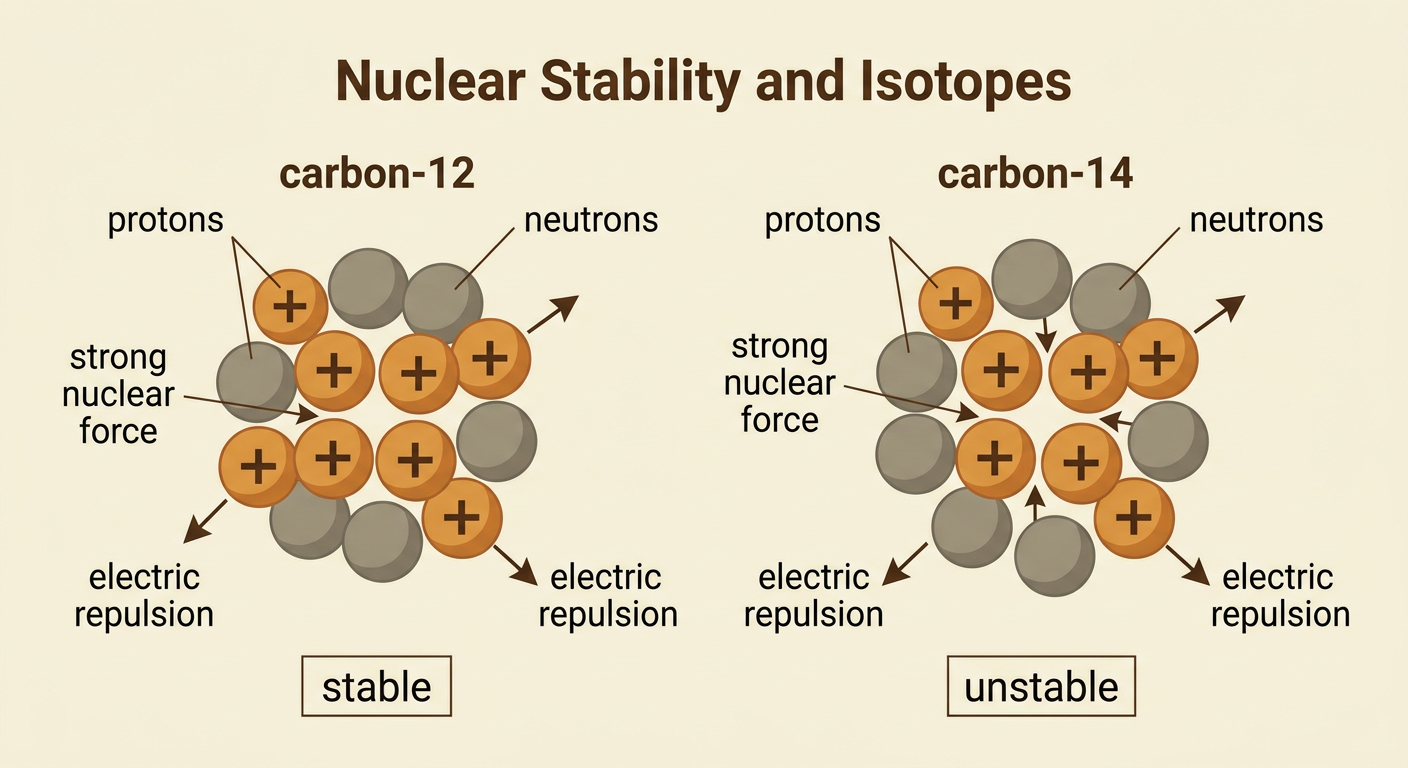
An atomic nucleus contains positively charged protons and neutral neutrons. The strong nuclear force attracts nearby nucleons, while electric repulsion pushes protons apart. A nucleus is stable when these effects and its neutron-to-proton ratio allow it to remain unchanged. An unstable nucleus has excess energy or an unfavorable combination of protons and neutrons, so it can transform through radioactive decay. Small stable nuclei often have similar numbers of protons and neutrons, while larger stable nuclei generally need more neutrons. For example, carbon-12 is stable with six protons and six neutrons. Carbon-14 has six protons and eight neutrons and is unstable. It eventually changes into nitrogen-14. Isotopes such as carbon-12 and carbon-14 are the same element because they have the same number of protons, but they differ in neutron number and stability.
Radioactive Decay and Nuclear Equations
Radioactive decay is a spontaneous change in an unstable nucleus. In alpha decay, the nucleus emits two protons and two neutrons, so its mass number decreases by four and its atomic number decreases by two. In beta-minus decay, a neutron changes into a proton while an electron and an antineutrino are emitted. Carbon-14 undergoes beta-minus decay: carbon-14 becomes nitrogen-14, an electron, and an antineutrino. The mass number remains 14, but the atomic number increases from 6 to 7. Gamma decay releases a high-energy photon without changing either number. A correct nuclear equation conserves electric charge, nucleon number, and total mass-energy. The exact time when one nucleus decays cannot be predicted, but the behavior of a large collection of identical unstable nuclei can be described statistically.

Half-Life as Exponential Change
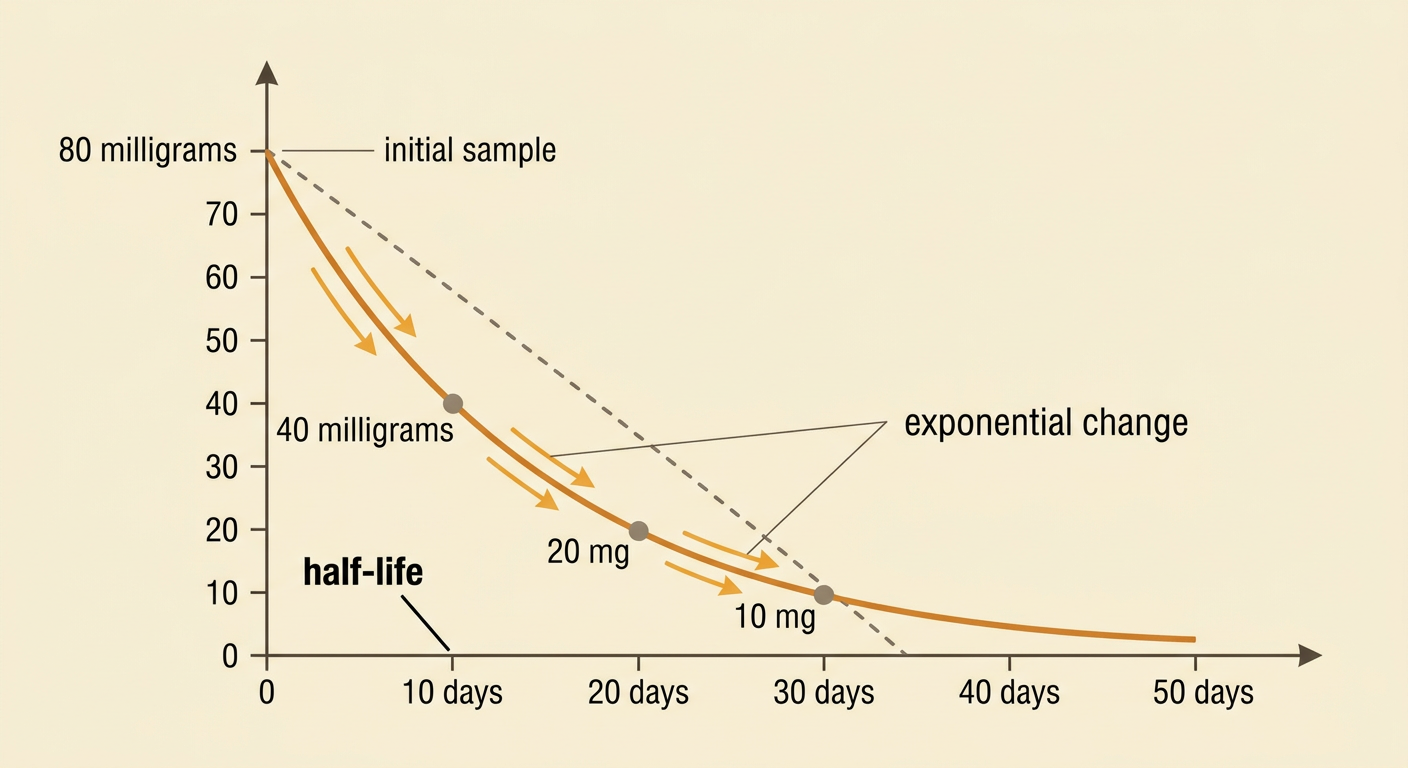
Half-life is the time required for half the radioactive nuclei in a sample to decay. After each half-life, the same fraction disappears, not the same amount. Suppose an isotope has a half-life of 10 days and a sample initially contains 80 milligrams. After 10 days, 40 milligrams remain; after 20 days, 20 milligrams remain; and after 30 days, 10 milligrams remain. This is exponential change because each value is multiplied by one-half during every equal time interval. It is not linear change, which would subtract a constant amount each interval. The model is N equals N-zero times one-half raised to the power t divided by T, where T is the half-life. Actual measurements may vary slightly because individual decays are random, but large samples closely follow the exponential pattern.
Comparing Nuclear Fission and Fusion
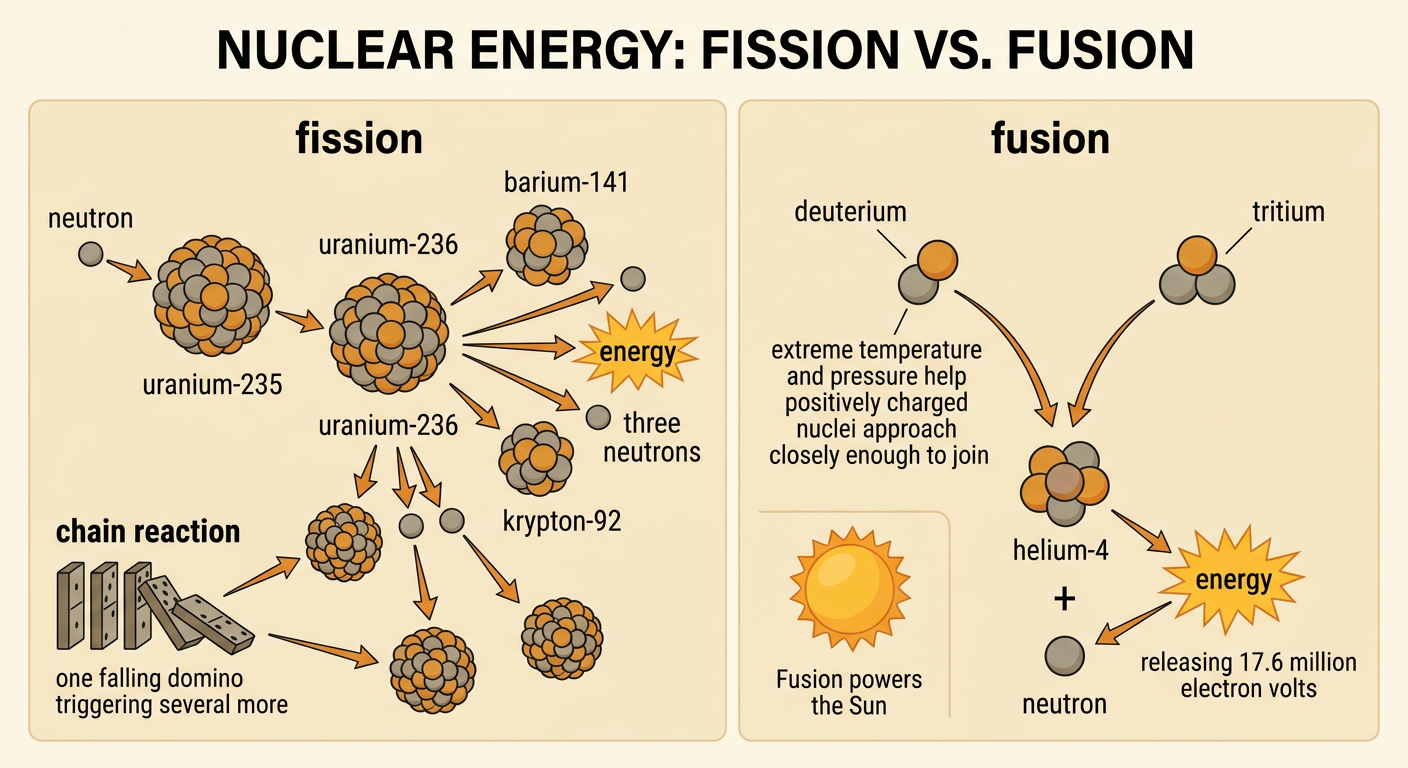
Fission splits a heavy nucleus, while fusion combines light nuclei. In one fission reaction, uranium-235 absorbs a neutron and briefly becomes unstable uranium-236. It can split into barium-141, krypton-92, and three neutrons, releasing about 200 million electron volts of energy. The released neutrons may strike other uranium nuclei and produce a chain reaction. In fusion, a deuterium nucleus and a tritium nucleus combine to form helium-4 and a neutron, releasing 17.6 million electron volts. Fusion powers the Sun, where high temperature and pressure help positively charged nuclei approach closely enough to fuse. Both processes release energy because the products have greater binding energy per nucleon. Their slightly lower total rest mass corresponds to released energy according to E equals mc squared. Total mass-energy, electric charge, and nucleon number remain conserved.
Nuclear Technologies: Benefits and Risks
Nuclear science affects energy, medicine, industry, warfare, and public policy. Nuclear power plants use controlled fission to produce heat, make steam, and generate electricity with low direct carbon dioxide emissions. However, uranium mining, high construction costs, radioactive waste, and rare but serious accidents create environmental and social risks. Radioisotopes also provide important benefits. Technetium-99m helps physicians image organs, and focused radiation can damage cancer cells. Nuclear weapons, developed during World War II through a combination of scientific discovery, military competition, government funding, and fear, caused devastating human consequences and later encouraged arms races and nonproliferation efforts. Decisions about nuclear technology therefore involve more than physics. Communities must compare evidence about health, climate, security, cost, waste storage, and fairness. Different groups may weigh the same benefits and risks differently because they have different experiences, responsibilities, and values.

Constructing a Nuclear Process Model
A useful nuclear process model identifies the starting nucleus, the interaction or decay, the products, and the energy transfer. It should represent protons and neutrons accurately and show that nucleon number and electric charge are conserved. For example, a fission model can begin with uranium-235 and an incoming neutron. It then shows an unstable uranium-236 nucleus splitting into barium-141, krypton-92, three neutrons, radiation, and kinetic energy. Counting verifies that 236 nucleons enter and 236 leave, while the total atomic number is 92 on both sides. The model should also explain that a small decrease in rest mass corresponds to released energy while total mass-energy remains conserved. Clearly state limitations: a simple drawing may not show nucleus size, three-dimensional motion, reaction probability, or every possible fission product. Labels, arrows, an equation, and a written explanation help translate the same process among visual, mathematical, and verbal forms.
