
Nuclear Reactions: Modeling Fission, Fusion, and Radioactive Decay
Students use nuclear equations and mass-energy relationships to compare fission, fusion, and radioactive decay and evaluate nuclear energy outcomes.
Illustrations are auto-generated and may be placeholders. They can be refreshed to match the narration.
Inside the Atomic Nucleus
An atomic nucleus contains positively charged protons and electrically neutral neutrons, collectively called nucleons. The element is determined by its number of protons, or atomic number. Isotopes of the same element have equal numbers of protons but different numbers of neutrons. For example, carbon-12 has 6 protons and 6 neutrons, while carbon-14 has 6 protons and 8 neutrons. The strong nuclear force attracts nearby nucleons and can overcome the electrical repulsion between protons at very short distances. Nuclear stability depends partly on the neutron-to-proton ratio and the total arrangement of nucleons. An unstable nucleus may change through radioactive decay. Models of nuclei do not show exact nucleon positions; instead, they represent composition, charge, and possible transformations.

Balancing Nuclear Equations
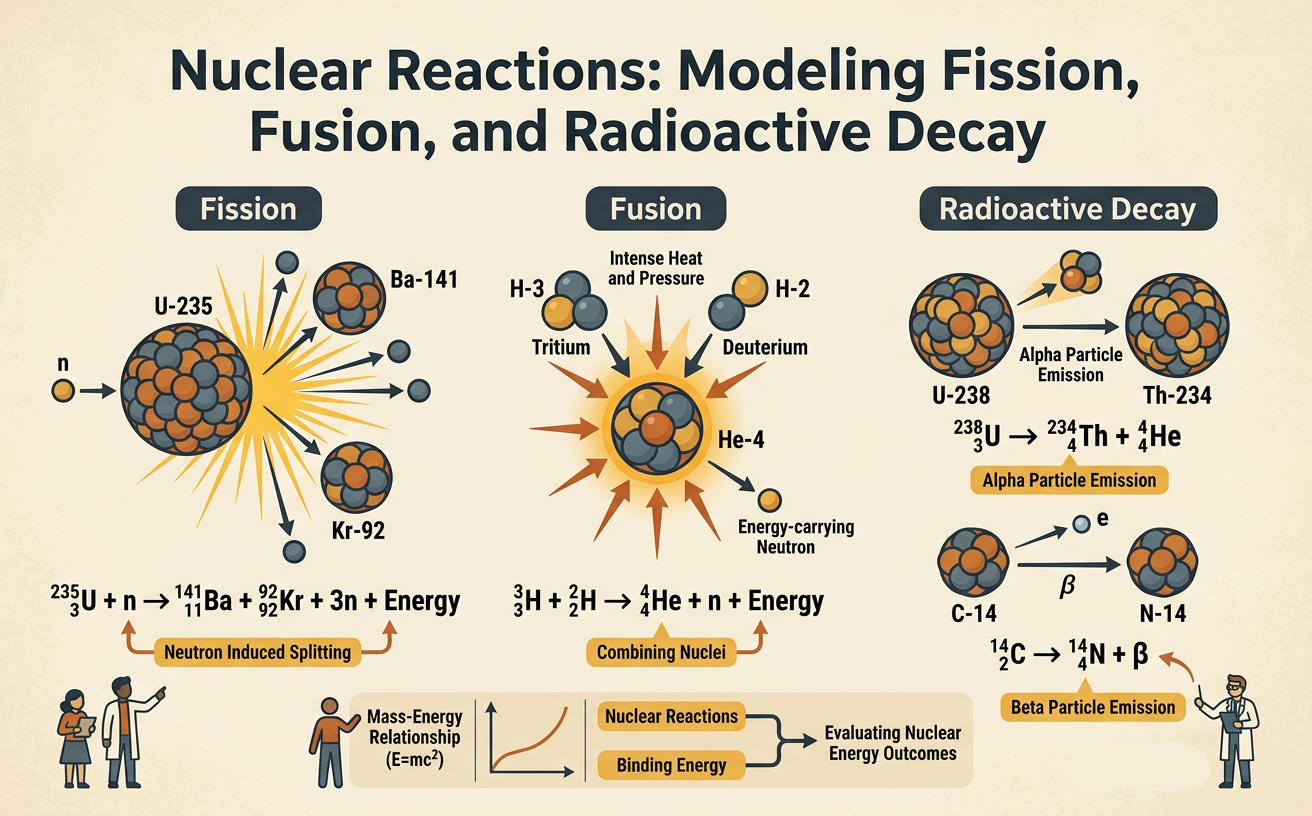
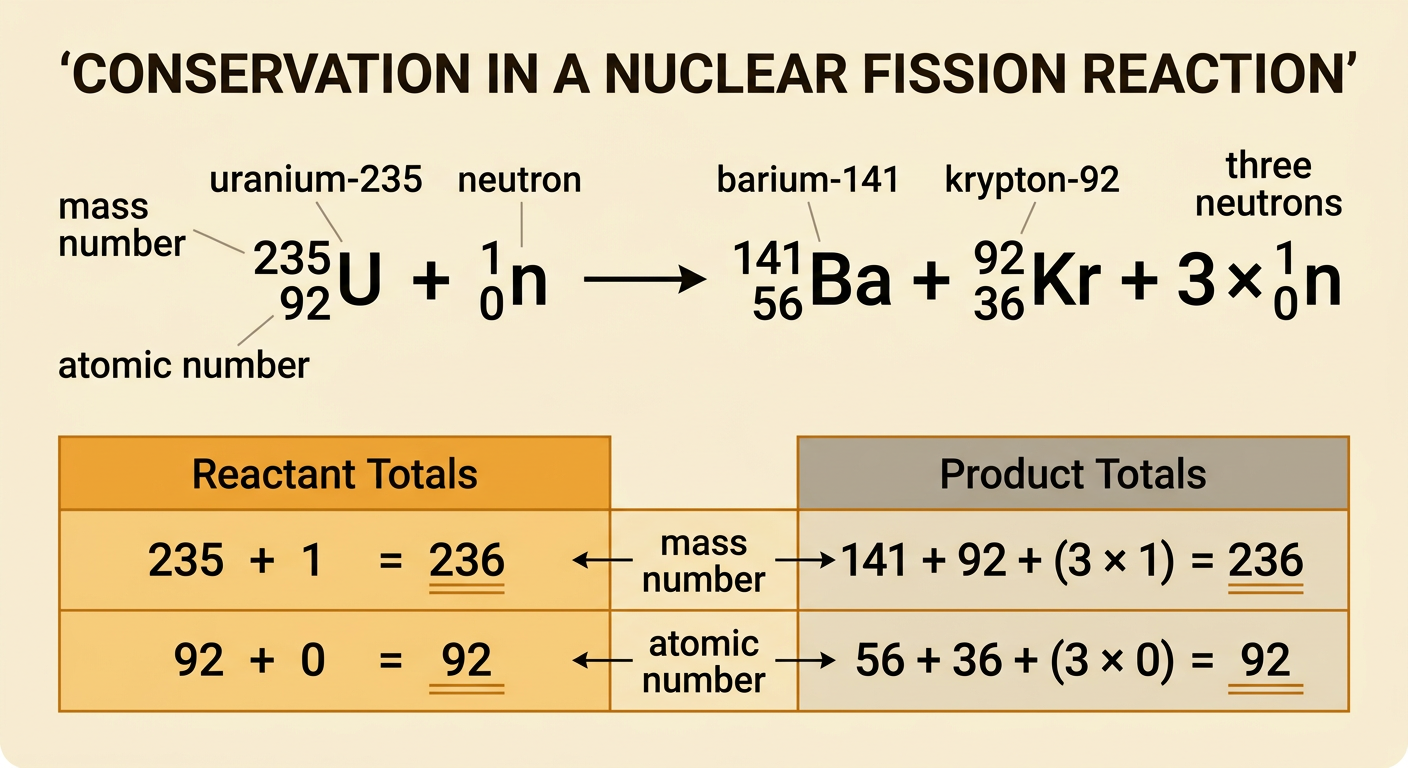
A nuclear equation must conserve total mass number and total electric charge. Mass number, written at the upper left of a nuclear symbol, counts protons and neutrons. Atomic number, written at the lower left, counts protons. In uranium-235 fission, one balanced equation is uranium-235 plus a neutron yields barium-141, krypton-92, and three neutrons. The mass numbers balance because 235 + 1 = 141 + 92 + 3, and the atomic numbers balance because 92 = 56 + 36. In alpha decay, uranium-238 yields thorium-234 and helium-4. In beta-minus decay, carbon-14 yields nitrogen-14, an electron, and an antineutrino. Checking both number totals prevents impossible nuclear models, even though a small amount of mass may be converted into energy.
Comparing Fission, Fusion, and Decay
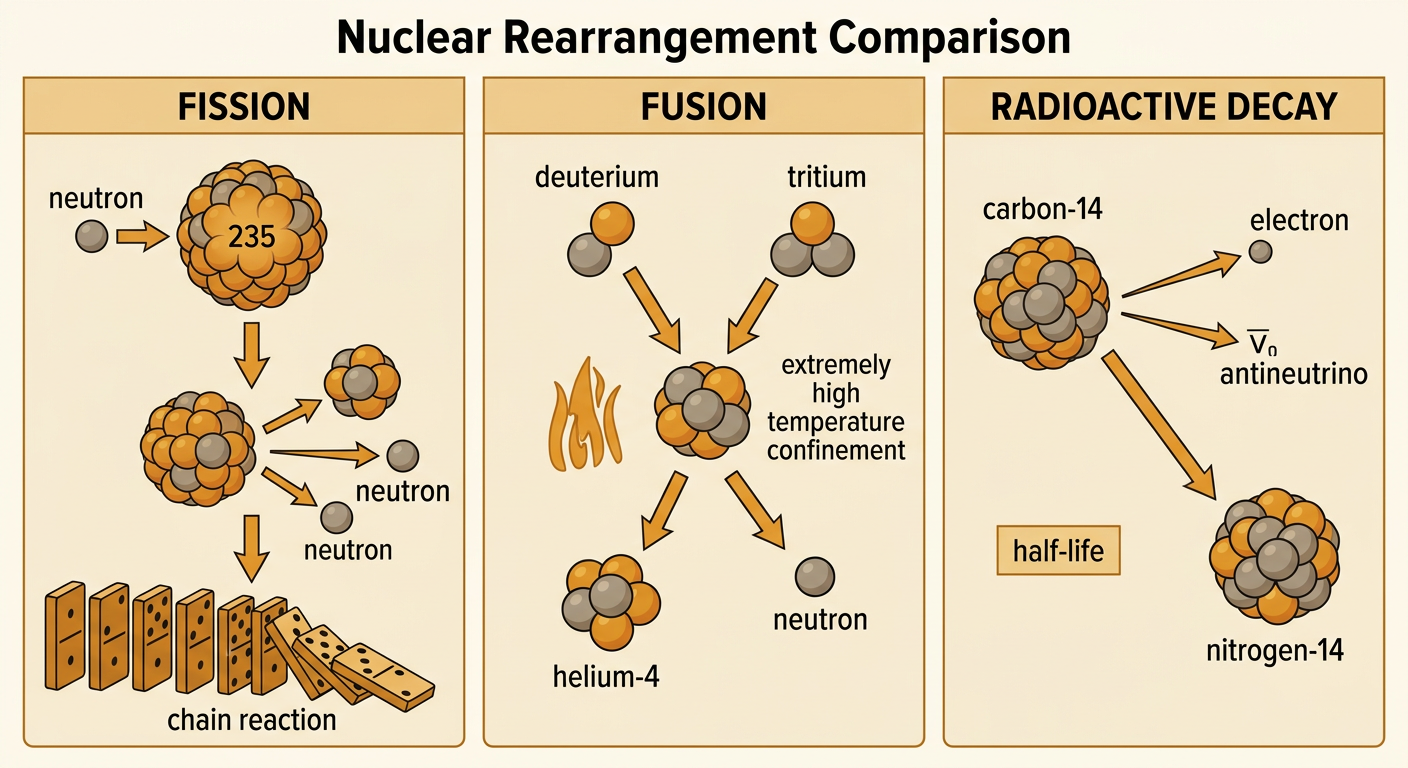
Fission splits a heavy nucleus, fusion combines light nuclei, and radioactive decay changes an unstable nucleus without an outside trigger. In a common fission model, uranium-235 absorbs a neutron and divides into smaller nuclei, additional neutrons, and roughly 200 megaelectronvolts of energy. Released neutrons can cause more fissions, creating a chain reaction. In fusion, deuterium and tritium combine to form helium-4, a neutron, and 17.6 megaelectronvolts of energy. Fusion requires extremely high temperature and confinement because positively charged nuclei repel one another. Radioactive decay is spontaneous and probabilistic. For example, carbon-14 undergoes beta-minus decay to become nitrogen-14. Its half-life describes the time required for half of a large sample to decay, not the lifetime of one specific nucleus. All three processes rearrange nuclei and release energy through changes in nuclear binding.
Connecting Mass Defect to Energy
The mass of a bound nucleus is slightly less than the combined masses of its separate protons and neutrons. This difference is the mass defect, and its energy equivalent is the nuclear binding energy. Einstein’s relationship, E = mc², connects a change in mass to released or absorbed energy. Nuclear calculations often use the conversion 1 atomic mass unit equals about 931.5 megaelectronvolts divided by c². If the products of a reaction have 0.200 atomic mass unit less mass than the reactants, the released energy is 0.200 times 931.5, or about 186 megaelectronvolts. This equals approximately 2.98 × 10⁻¹¹ joule per reaction. Although that amount seems small, a macroscopic sample contains an enormous number of nuclei. Multiplying the energy per reaction by the number of reactions explains nuclear energy’s very high energy density.

Evaluating Nuclear Energy Outcomes
Evaluating nuclear energy policy requires comparing intended benefits with unintended costs and risks. Fission power plants are designed to produce large amounts of reliable electricity with low operational carbon dioxide emissions. These outcomes may support climate and energy-security goals. However, policies must also address radioactive waste storage, uranium mining, high construction costs, accident risk, plant decommissioning, water use, and possible proliferation of nuclear materials. For example, a policy that subsidizes new reactors may reduce fossil-fuel generation, but it may also shift financial and waste-management responsibilities to future taxpayers and communities. Evidence should be compared by using consistent measures, such as emissions per kilowatt-hour, cost per megawatt-hour, accident probability, waste volume, and storage duration. A defensible recommendation identifies affected groups, explains trade-offs, considers alternatives, and proposes safeguards rather than treating nuclear power as entirely beneficial or entirely harmful.
