
Number Bases and Base Conversion
Students represent numbers in different bases, convert between bases, and perform basic operations in nondecimal systems.
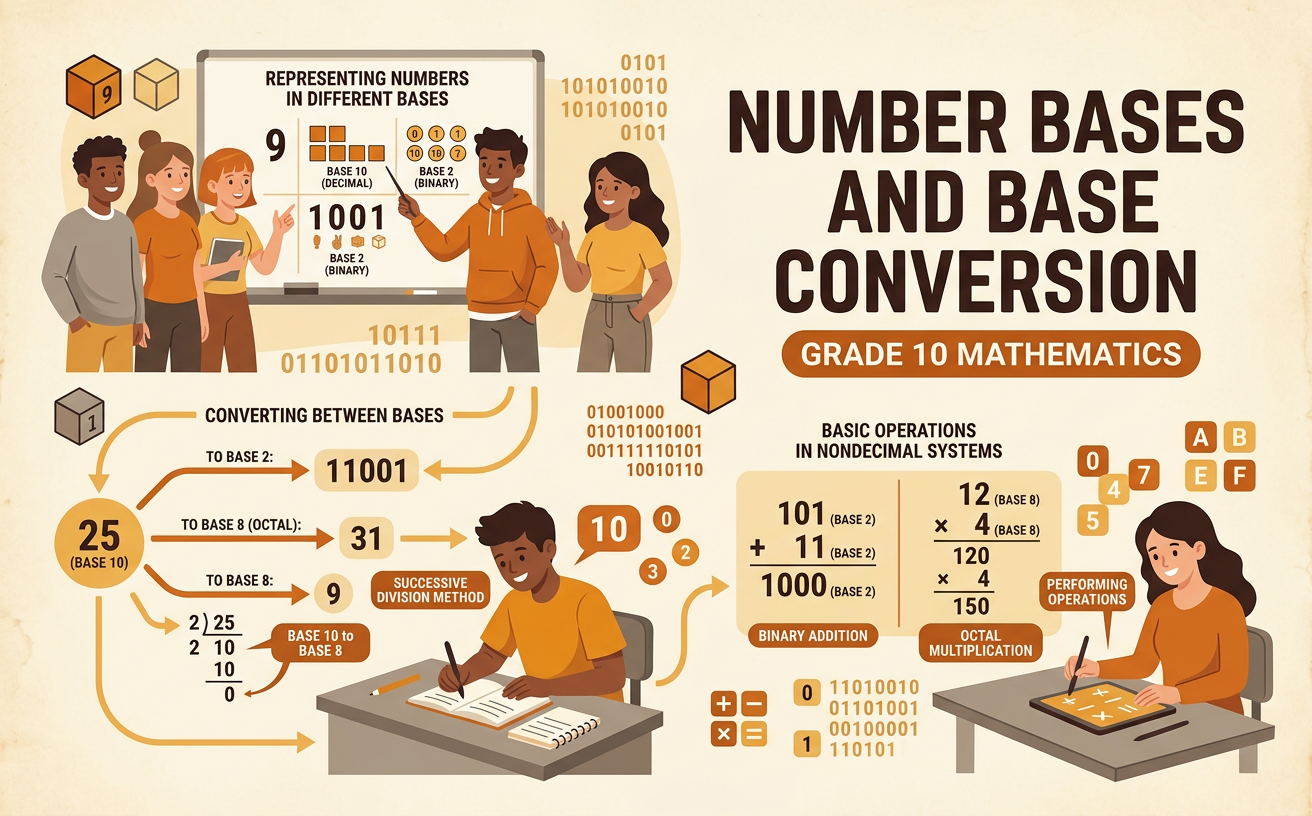
Illustrations are auto-generated and may be placeholders. They can be refreshed to match the narration.
Place Value in Different Bases
A number base tells how many digits are available and how place values grow. In base b, the allowed digits are 0 through b - 1, and each position has a value that is a power of b. From right to left, the place values are b0, b1, b2, and so on. For example, base five uses only 0, 1, 2, 3, and 4. In 324 base five, the digit 4 is in the 50 place, 2 is in the 51 place, and 3 is in the 52 place. Therefore, its expanded form is 3 × 52 + 2 × 51 + 4 × 50. A written numeral is valid only if every digit is less than its base; for example, 526 is not valid in base six because 6 is not an allowed digit.
Converting to Base Ten
To convert a numeral from another base to base ten, multiply each digit by its place value and add the products. For example, consider 231 base four. The place values are 42, 41, and 40. Expand the numeral as 2 × 42 + 3 × 41 + 1 × 40. This gives 2 × 16 + 3 × 4 + 1 × 1 = 32 + 12 + 1 = 45. Therefore, 231 base four equals 45 in base ten. The same method works for any base from two through ten. For instance, 1011 base two equals 1 × 23 + 0 × 22 + 1 × 21 + 1 × 20, which is 8 + 0 + 2 + 1 = 11 in base ten.
Converting from Base Ten
To convert a whole number from base ten to another base, repeatedly divide by the new base and record each remainder. Read the remainders from bottom to top to form the new numeral. To convert 93 base ten to base five, divide 93 by 5 to get quotient 18 and remainder 3. Then divide 18 by 5 to get quotient 3 and remainder 3. Finally, divide 3 by 5 to get quotient 0 and remainder 3. Reading the remainders upward gives 333 base five. Check the answer by expanding: 3 × 52 + 3 × 51 + 3 × 50 = 75 + 15 + 3 = 93. Every remainder must be one of the allowed digits in the target base.
Operations in Other Bases
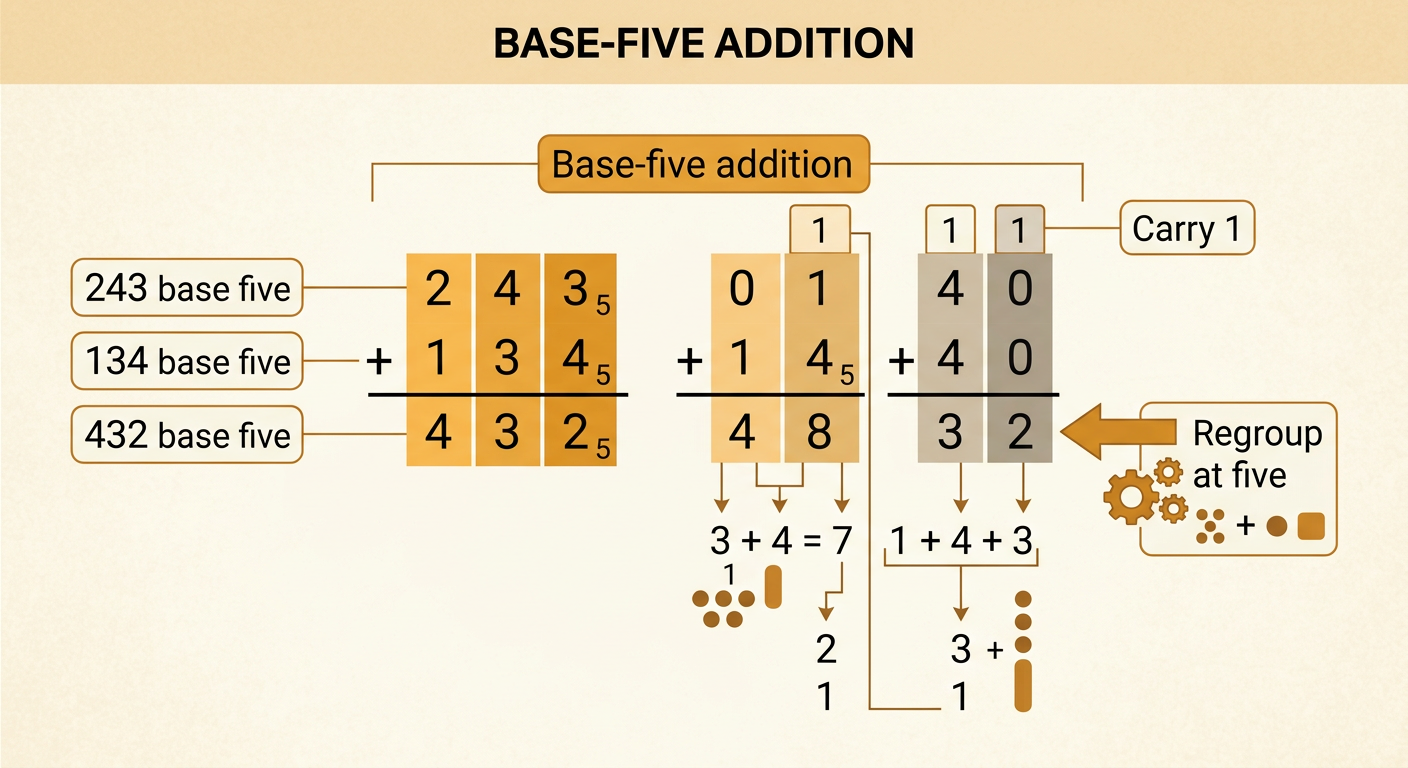
Arithmetic in another base follows the usual column methods, but regrouping occurs when a total reaches the base. In base five, add 243 base five and 134 base five. In the units column, 3 + 4 = 7 in base ten, which is 12 base five, so write 2 and carry 1. In the next column, 4 + 3 + 1 = 8, which is 13 base five, so write 3 and carry 1. In the final column, 2 + 1 + 1 = 4. The sum is 432 base five. Multiplication uses the same principle. For example, 23 base four × 2 base four equals 112 base four. Always check that no digit in the answer is equal to or greater than the base.
Application Problems
Number bases can describe grouped quantities, computer data, codes, and storage records. Suppose a school store records 132 base five boxes of chalk in the morning and receives 24 base five more boxes in the afternoon. Add the quantities in base five: 132 base five + 24 base five = 211 base five. In the units column, 2 + 4 = 6 in base ten, so write 1 and carry 1 because 6 equals 11 base five. In the next column, 3 + 2 + 1 = 6, so write 1 and carry 1. The final digit is 2. To interpret the total, convert 211 base five to base ten: 2 × 52 + 1 × 51 + 1 × 50 = 56. The store now has 56 boxes.