
Observing Carefully, Respecting People
Students distinguish objective observations from inferences and biased judgments, then apply respectful observation practices that protect privacy, fairness, and human dignity.
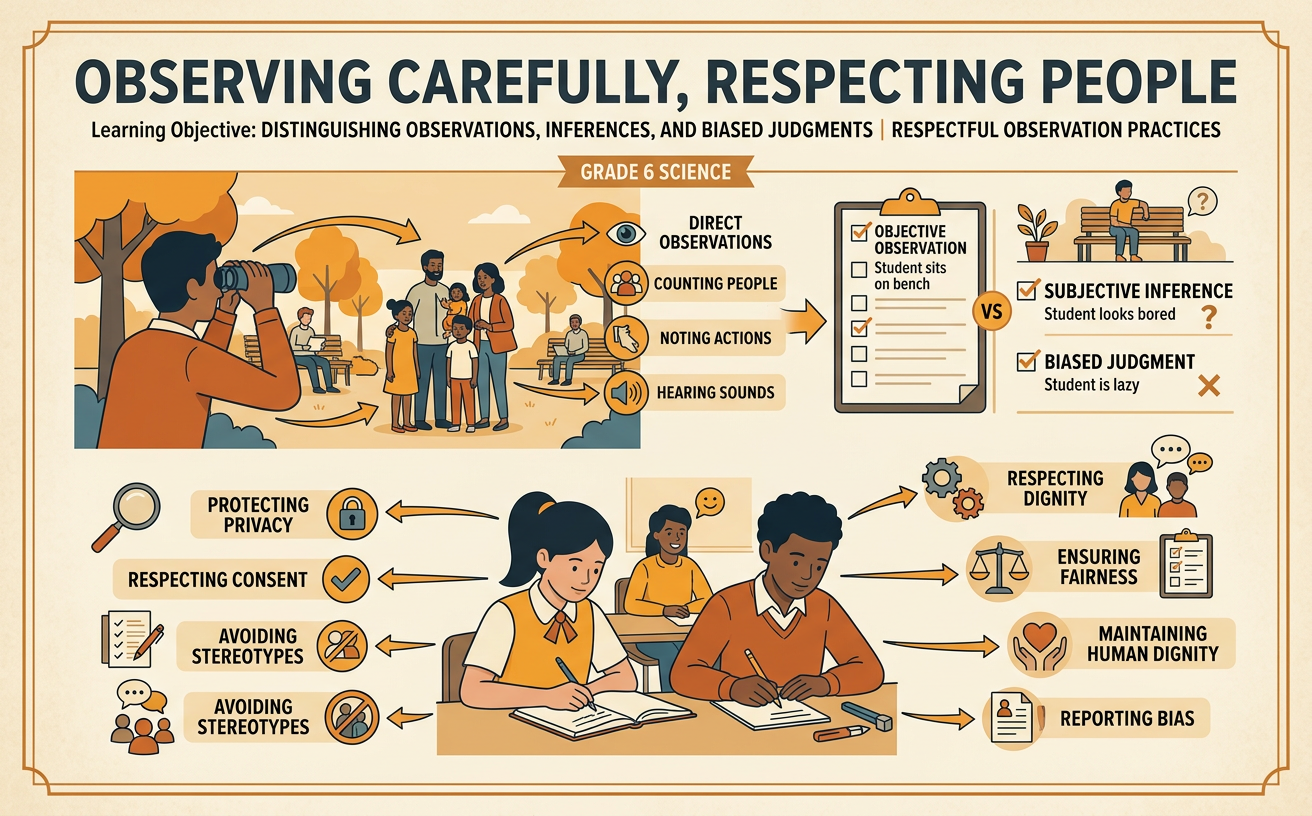
Illustrations are auto-generated and may be placeholders. They can be refreshed to match the narration.
Observation in Scientific Work
Scientific observation means gathering and recording information carefully. Scientists use senses when appropriate and tools such as rulers, timers, thermometers, and cameras. A useful observation identifies what was measured, the unit used, the time and place, and the conditions. It does not include guesses or opinions. For example, a student investigating seedlings might write, “At 9:00 a.m., Seedling A was 8.2 centimeters tall,” rather than, “Seedling A looked healthy.” Recording observations in a consistent table makes patterns easier to find and allows other people to check the evidence. When observations involve people, scientists must also choose methods that are fair and respectful. They collect only information needed to answer the question and follow rules that protect each participant.

Observation Versus Inference
An observation describes information detected directly or measured with a tool. An inference is a possible explanation based on observations and prior knowledge. Inferences can be useful, but they should not be presented as facts. Suppose a student rubs their eyes three times during a ten-minute activity. “The student rubbed their eyes three times” is an observation. “The student was tired” is an inference because eye rubbing can have several causes, such as irritation or an allergy. Additional evidence could support an inference, but it might not prove it. Scientists keep observations and inferences separate so readers can evaluate the evidence themselves. Helpful language includes “I observed” for recorded evidence and “This may suggest” for a possible interpretation.

Recognizing Bias and Assumptions
Bias is a tendency that can unfairly influence what someone notices, records, or concludes. An assumption is an idea accepted without enough evidence. Bias may come from expectations, first impressions, or knowledge of a participant’s identity. For example, an observer who expects a student wearing a team jersey to complete a movement task quickly might start the timer late or overlook a mistake. That expectation could change the data. Scientists reduce bias by using the same written procedure for everyone, measuring with tools, defining behaviors clearly, and hiding names when possible. They may also ask a second observer to record the same event and compare results. These safeguards do not guarantee perfection, but they make observations more consistent, fair, and open to checking.

Human Dignity, Privacy, and Consent
People who participate in scientific work have rights and deserve dignity. Consent means that a person receives understandable information about an activity and freely agrees to participate. Students may also need permission from a parent or guardian and approval from their school. Participation must be voluntary, and a participant should be able to stop without punishment. Privacy means controlling access to personal information. For example, in a classroom pulse-rate investigation, students should know what will happen, what data will be collected, and how the results will be used before agreeing. Records can use codes such as P01 instead of names, and reports can show group results rather than individual results. Researchers should collect only necessary data, store it securely, and never secretly record people.

Revising Observations to Be Accurate and Respectful
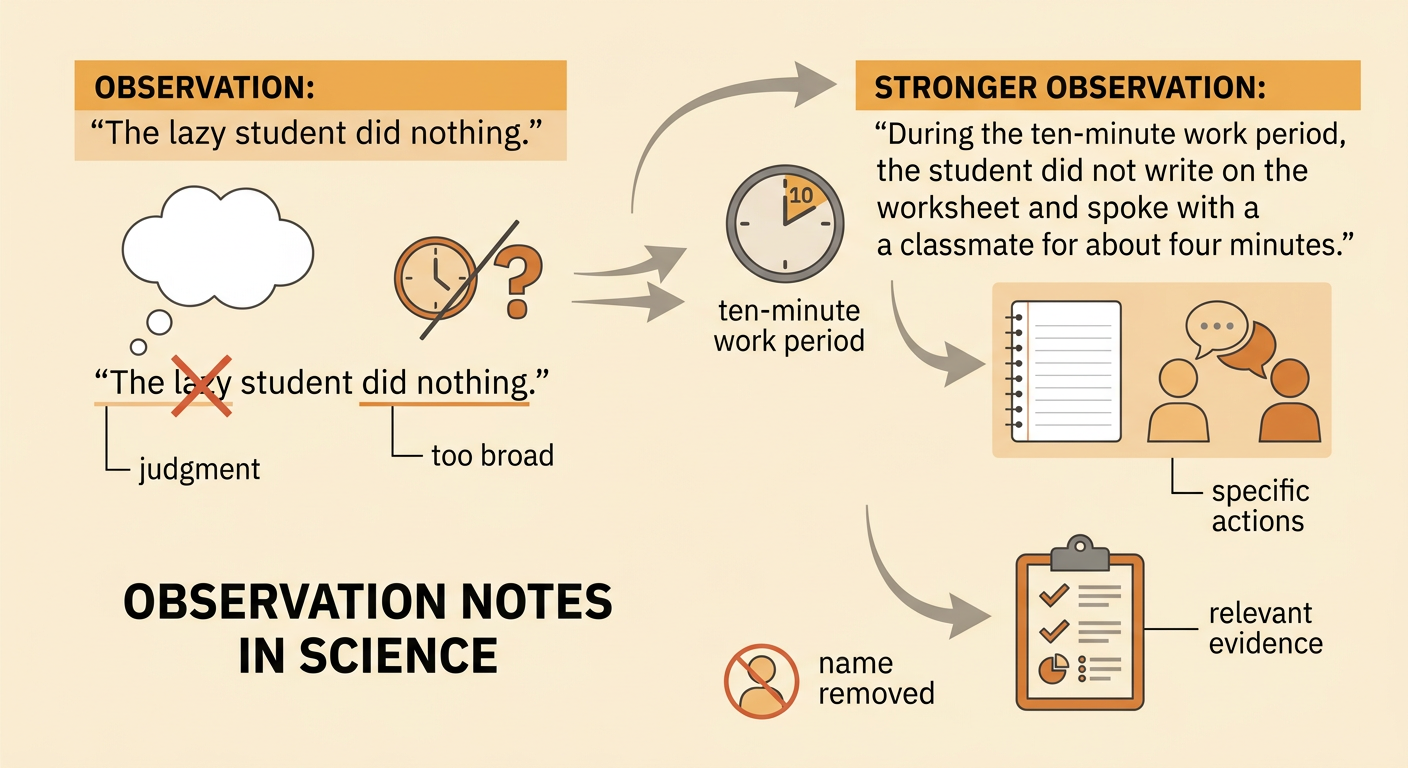
Observation notes should describe visible actions or measured results without insulting labels, unsupported explanations, or unnecessary personal details. Consider the statement, “The lazy student did nothing.” The word “lazy” is a judgment, and “did nothing” is too broad to check. A more accurate version is, “During the ten-minute work period, the student did not write on the worksheet and spoke with a classmate for about four minutes.” This revision gives a time period and records specific actions. It still should be included only if those actions are relevant to the investigation. Before sharing notes, check for precise verbs, quantities, units, and context. Remove names and unrelated details. Respectful wording does not hide results; it reports relevant evidence without reducing a person to a label.
Evidence-Based Reflection
Evidence-based reflection explains what the data support, how the evidence connects to a claim, and what remains uncertain. Imagine that six consenting students completed the same sorting task three times. Their group median completion times were 18 seconds on Attempt 1, 15 seconds on Attempt 2, and 13 seconds on Attempt 3. A supported claim is, “Completion time decreased across the three attempts for this group.” The numbers are specific evidence. A reasonable interpretation is that practice may have helped, but the data do not prove that practice was the only cause. The group was small, and other conditions might have changed. A complete reflection also checks ethics: participants were informed, names were replaced by codes, and only group results were reported. Strong conclusions are accurate, limited to the evidence, and respectful of participants.
