Ocean Acidification: Carbon Chemistry and Marine Ecosystems
Students interpret data and chemical equations to explain how atmospheric carbon dioxide lowers ocean pH and affects shell-building organisms.

Illustrations are auto-generated and may be placeholders. They can be refreshed to match the narration.
Carbon Dioxide Enters the Ocean
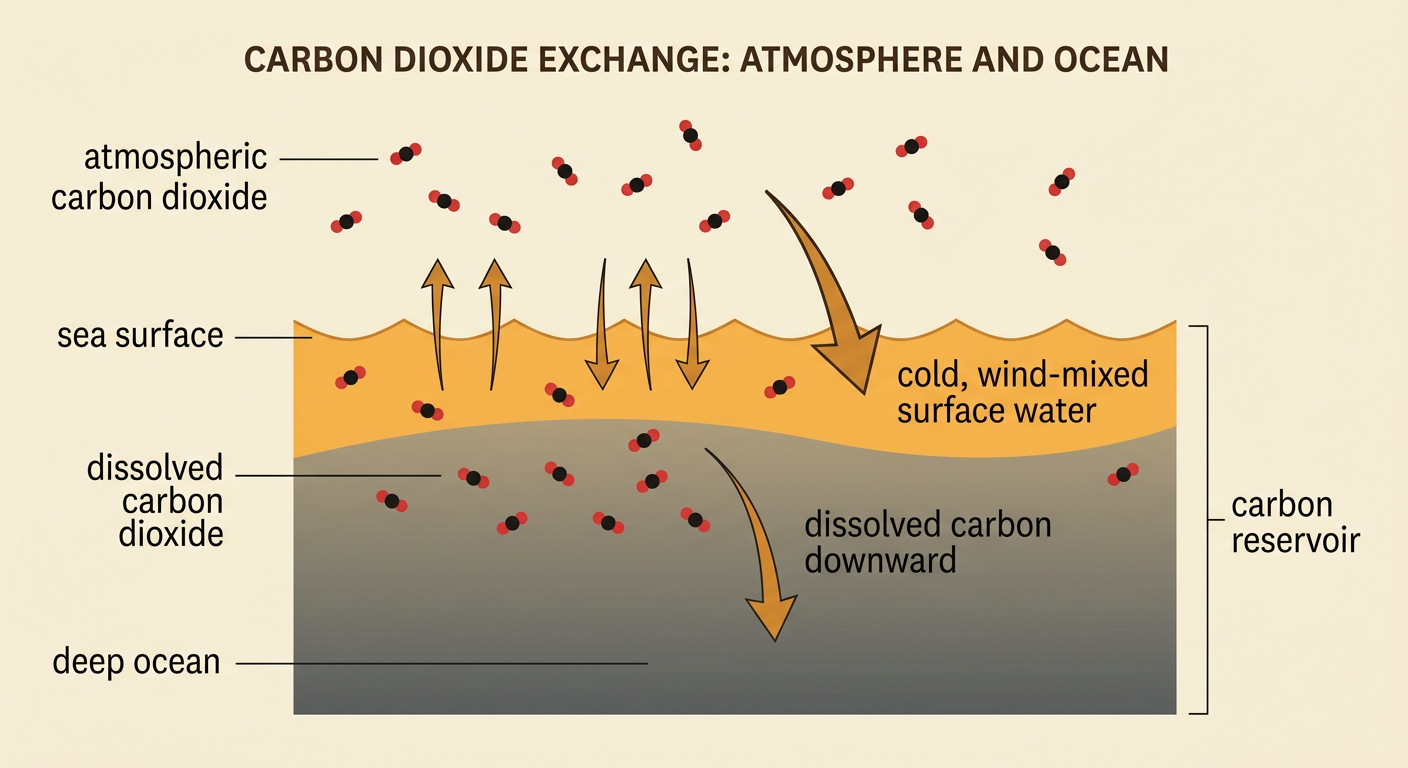
Carbon moves between the atmosphere and the ocean as carbon dioxide gas, CO2. At the sea surface, CO2 molecules continually enter and leave the water. When atmospheric CO2 rises, more CO2 generally dissolves until the air and surface ocean move toward a new balance. Temperature, wind, and mixing affect this exchange: cold water can hold more dissolved CO2 than warm water, while waves increase contact between air and water. For example, if atmospheric CO2 increases above a patch of cold, windy North Atlantic water, the net movement of CO2 is likely into the ocean. Currents can then carry that dissolved carbon into deeper water. This process makes the ocean an important carbon reservoir, but absorbing additional CO2 also changes seawater chemistry.
From Carbonic Acid to Lower pH
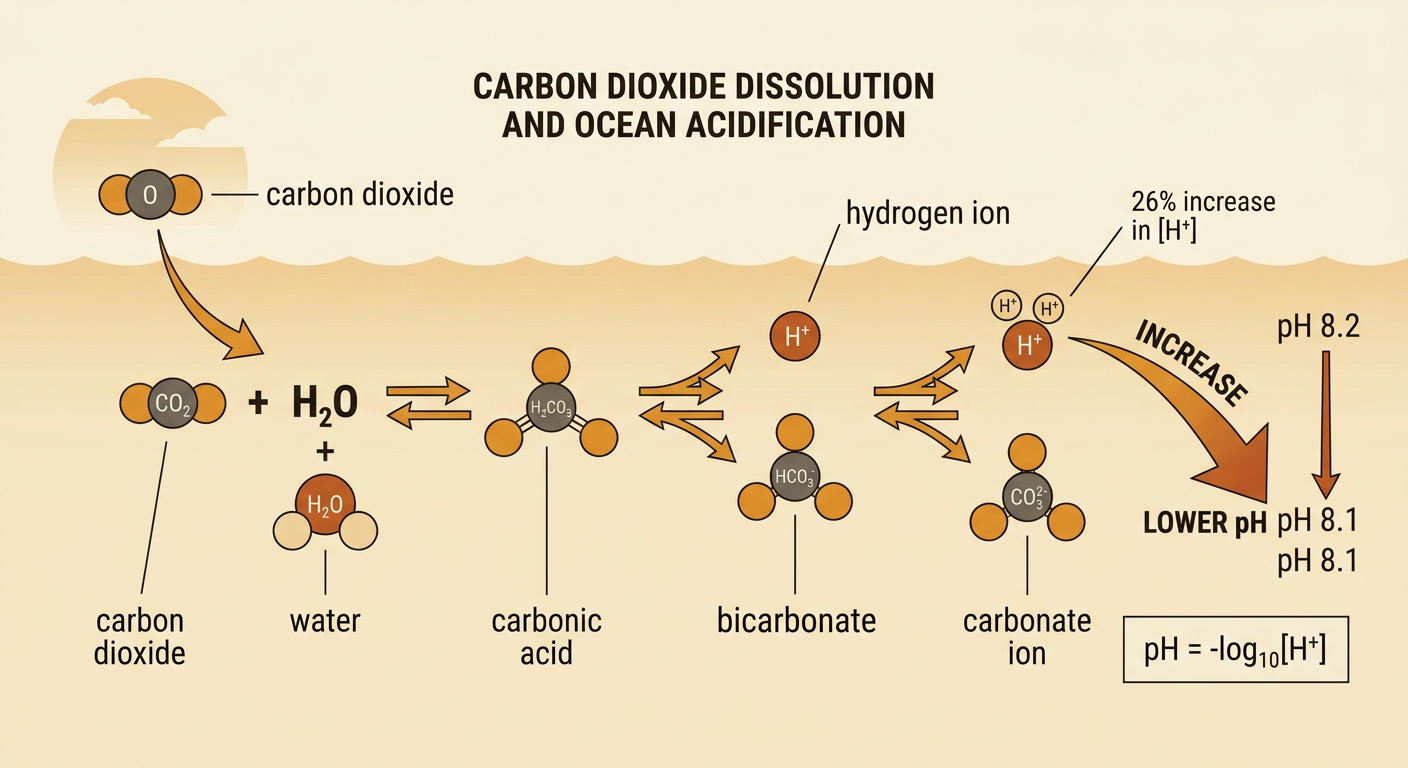
Dissolved carbon dioxide participates in a sequence of reversible reactions. First, CO2 combines with water: CO2 + H2O ⇌ H2CO3. Carbonic acid, H2CO3, can release a hydrogen ion: H2CO3 ⇌ H+ + HCO3−. Some bicarbonate can also react as HCO3− ⇌ H+ + CO3²−. Adding CO2 shifts the connected reactions toward more hydrogen ions. Because pH is related to hydrogen-ion concentration by pH = −log10[H+], more H+ means lower pH. For example, a change from pH 8.2 to 8.1 represents about a 26 percent increase in hydrogen-ion concentration, not merely a small one-percent change. Ocean acidification does not usually make seawater acidic below pH 7; it means seawater becomes less basic.
Interpreting Ocean pH Data
Scientists use time-series graphs, maps, and measurements to identify changes in ocean pH. When reading a graph, first examine the axes, units, time span, location, and uncertainty. Then distinguish a long-term trend from short-term variation caused by seasons, storms, or biological activity. Consider a sample monitoring record in which average surface pH decreases from 8.12 in 2000 to 8.07 in 2025. A linear model gives an average rate of (8.07 − 8.12) ÷ 25 = −0.002 pH unit per year. Because pH is logarithmic, the hydrogen-ion concentration rises by a factor of 10^(8.12 − 8.07), or about 1.12. That is approximately a 12 percent increase. Students should compare this mathematical result with chemical evidence and information about how and where the measurements were collected.

Effects on Shell-Building Organisms
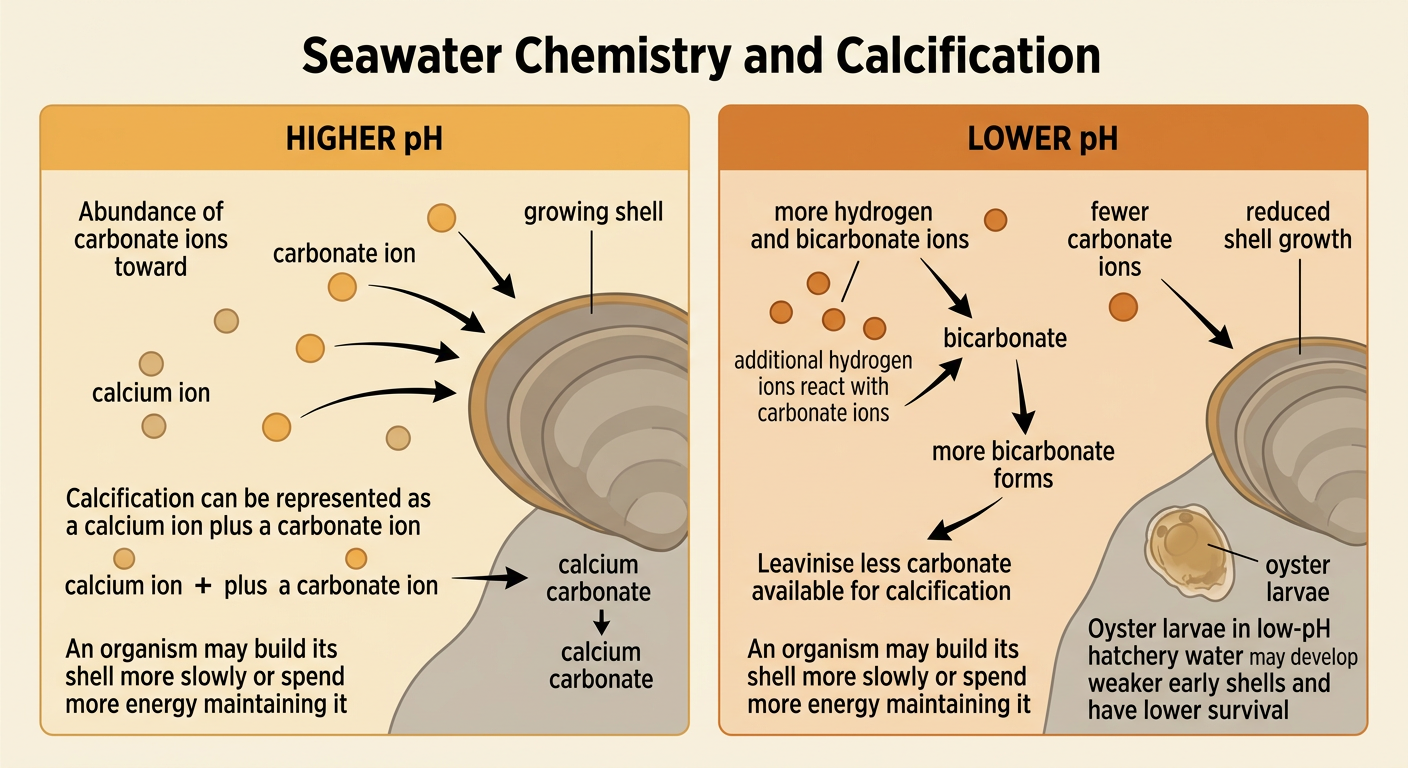
Corals, oysters, clams, sea urchins, and some plankton build shells or skeletons from calcium carbonate, CaCO3. Calcification can be represented as Ca²+ + CO3²− → CaCO3. As added hydrogen ions react with carbonate ions, more bicarbonate forms and less carbonate remains available for calcification. Lower carbonate availability can slow shell growth or require organisms to spend more energy maintaining their structures. Effects vary by species, life stage, food supply, temperature, and local water chemistry. For example, oyster larvae in low-pH hatchery water may form weaker early shells and experience lower survival. These biological changes can affect food webs, fisheries, aquaculture jobs, and coastal resource use. Communities that depend heavily on shellfish may need monitoring systems, water treatment, or changes in harvesting practices.
Modeling Carbon Movement
A quantitative carbon-cycle model represents reservoirs as boxes and carbon transfers as arrows. Relevant reservoirs include the atmosphere, surface ocean, deep ocean, marine organisms, sediments, and rocks. Arrow values can be measured in gigatons of carbon per year. For a simplified example, suppose the surface ocean receives 90 units from the atmosphere and 8 from upwelling, while releasing 88 to the atmosphere and 6 to deeper water. Its net annual change is inputs minus outputs: 98 − 94 = 4 units gained. A complete model should conserve carbon and identify its time scale and assumptions. Photosynthesis moves dissolved carbon into the biosphere, respiration returns it to water, sinking matter transports it downward, and burial stores some carbon in the geosphere. Such models help explain how emissions can alter oceans, ecosystems, fisheries, and long-term coastal resource decisions.

Evidence-Based Exit Explanation
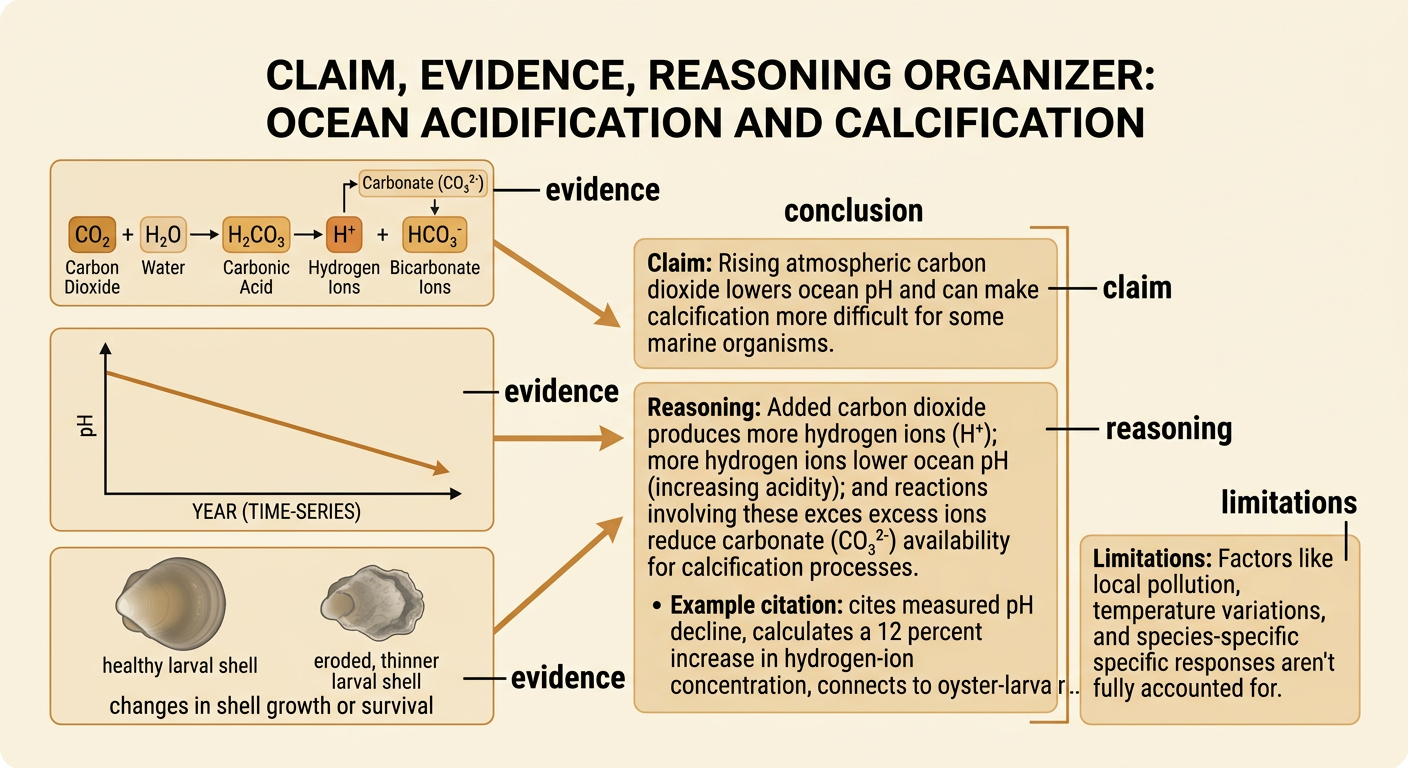
An effective exit explanation should make a claim, support it with multiple forms of evidence, and connect the evidence through scientific reasoning. A strong claim is: Rising atmospheric CO2 lowers ocean pH and can make calcification more difficult for some marine organisms. Chemical equations show that dissolved CO2 increases hydrogen ions, while a pH graph can show change over time. Biological observations can show altered shell growth or survival. The reasoning should explain that additional H+ lowers pH and reduces carbonate-ion availability, linking atmospheric carbon to ecosystem effects. For example, a student might cite a measured pH decline, calculate the corresponding increase in H+, and connect it to oyster-larva results. The explanation should also note limitations, such as species differences and other environmental variables, rather than claiming that every organism responds identically.