Order Objects by Length
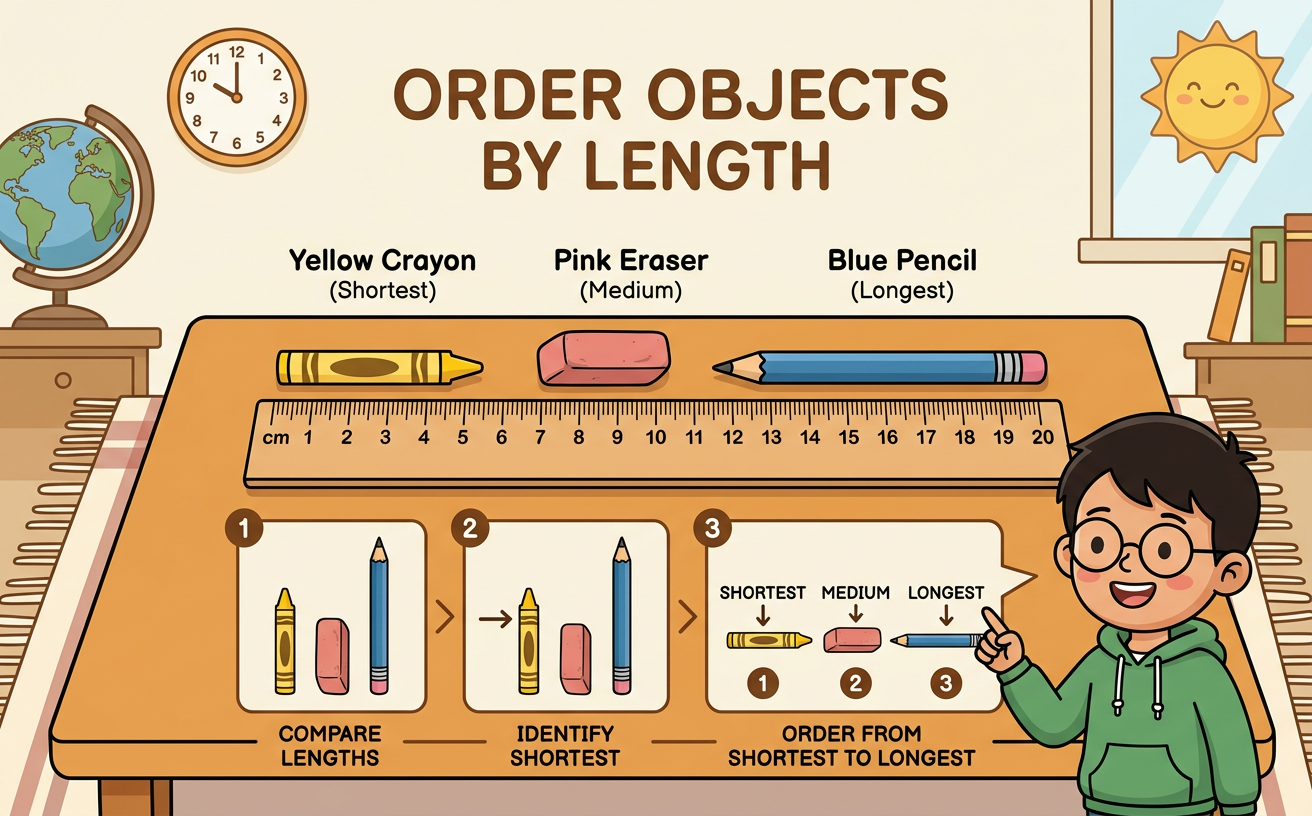
Students compare the lengths of three classroom objects and arrange them from shortest to longest.
Illustrations are auto-generated and may be placeholders. They can be refreshed to match the narration.
Review Longer and Shorter
Length tells how long an object is from one end to the other end. When we compare two objects, we can say one is longer and the other is shorter. Imagine a new pencil and a small crayon. Place them next to each other. The pencil reaches farther, so the pencil is longer than the crayon. The crayon does not reach as far, so it is shorter than the pencil. If two objects reach the same distance, they are the same length. Look carefully at the ends instead of guessing by color, shape, or thickness. A thick object is not always longer than a thin object. Focus only on the distance from one end to the other.

Align Objects at One End
To compare lengths fairly, line up the objects at one end. This means their starting ends must be in the same place. Place a marker and an eraser on a table with their left ends touching the same straight line. Now look at their right ends. The marker reaches farther, so it is longer. The eraser ends sooner, so it is shorter. If the objects begin in different places, your eyes may be tricked. A shorter object might look longer just because it starts farther ahead. You can use the edge of a book, a ruler line, or a drawn line as a starting line. Always align first, and then compare where the other ends stop.

Compare Three Objects
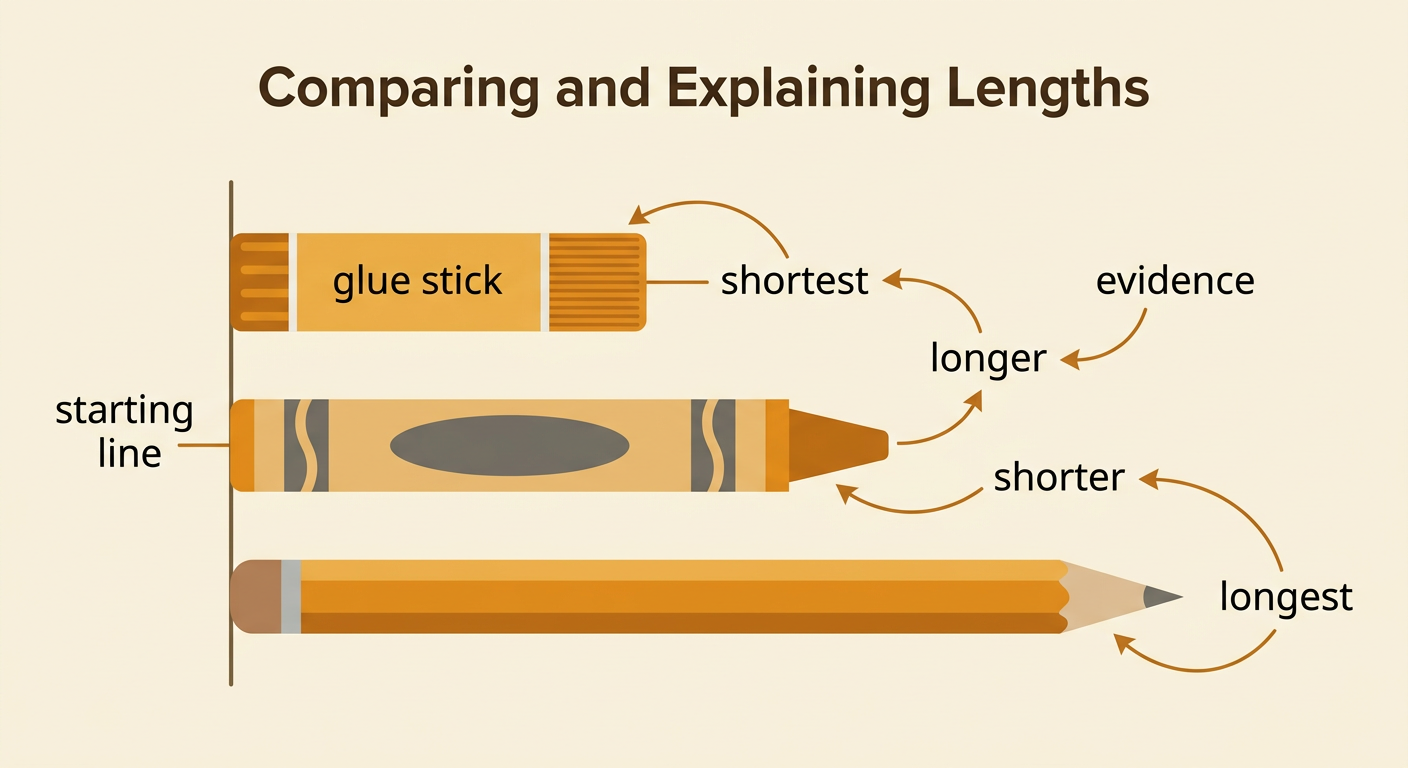
You can compare three objects by checking their lengths carefully. Suppose you have a pencil, a glue stick, and a crayon. Line up one end of all three objects. The pencil reaches farthest, the crayon reaches a middle distance, and the glue stick reaches the shortest distance. You can also compare indirectly when objects cannot be moved together. For example, place a paper strip beside the glue stick and mark its length. Then carry the strip to the crayon. If the crayon extends past the mark, the crayon is longer than the glue stick. The paper strip acts as a third object that helps you compare. Keep the strip straight and begin at the same starting point each time.

Order from Shortest to Longest
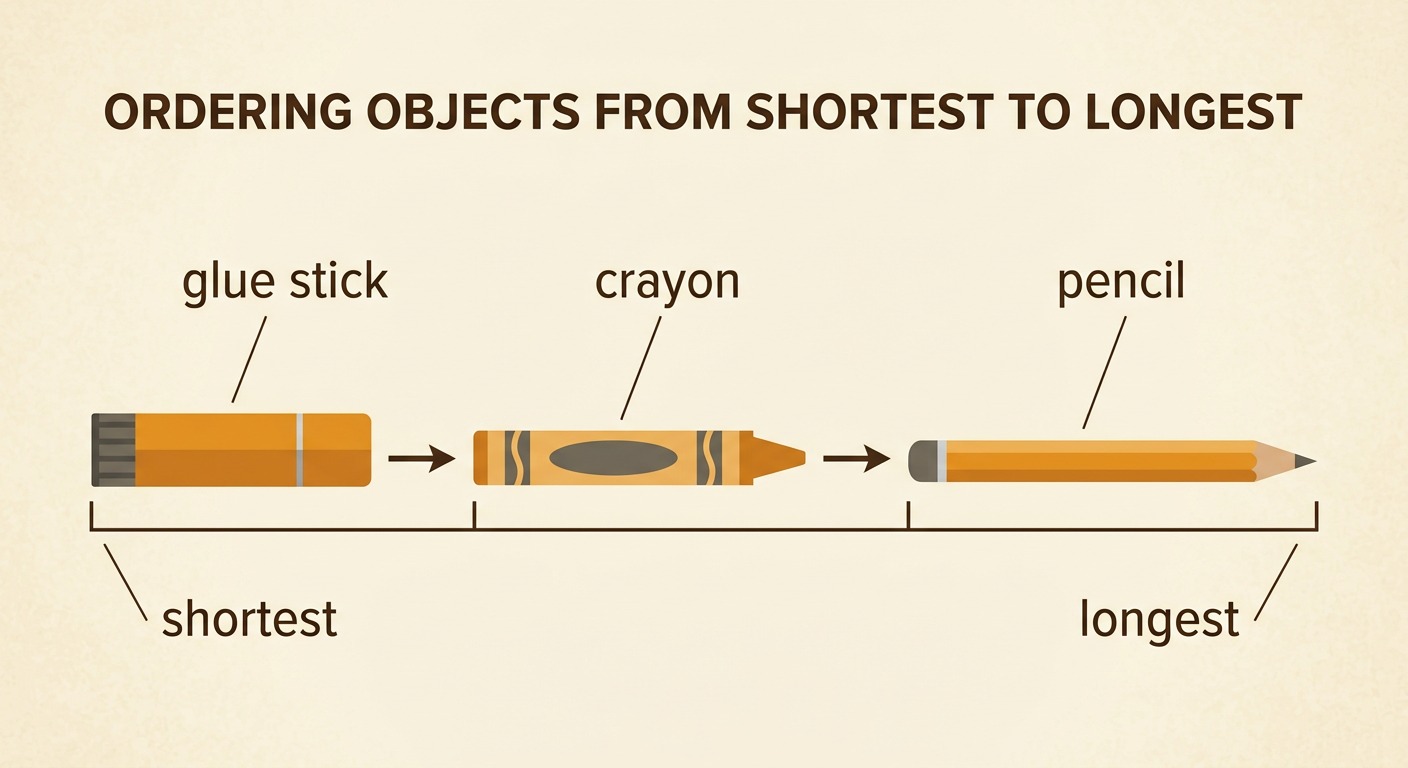
To order objects from shortest to longest, begin with the object that reaches the least distance. Place it first. Next, choose the object that reaches farther than the first object but not as far as the last object. Place it second. Put the object that reaches farthest at the end. For example, compare a glue stick, a crayon, and a pencil. The glue stick is shortest, so it comes first. The crayon is longer than the glue stick but shorter than the pencil, so it belongs in the middle. The pencil is longest, so it comes last. Check your order by making sure each object is longer than the object before it.
Explain the Length Order
After ordering the objects, explain how you know the order is correct. Use the words shorter, longer, shortest, and longest. You might say, “The glue stick is the shortest. The crayon is longer than the glue stick but shorter than the pencil. The pencil is the longest.” This explanation compares neighboring objects and tells where each one belongs. You can also point to the aligned ends as evidence. All three objects begin at the same line, and their other ends stop at different places. If you used a paper strip, explain how the length mark helped you compare. A clear explanation names the objects, uses length words, and tells what you observed rather than making a guess.