Oxidation-Reduction Reactions and Electrochemical Cells
Students track electron transfer in redox reactions, identify oxidation and reduction, and explain how a galvanic cell converts chemical energy into electrical energy.
Illustrations are auto-generated and may be placeholders. They can be refreshed to match the narration.
Recognizing Electron Transfer
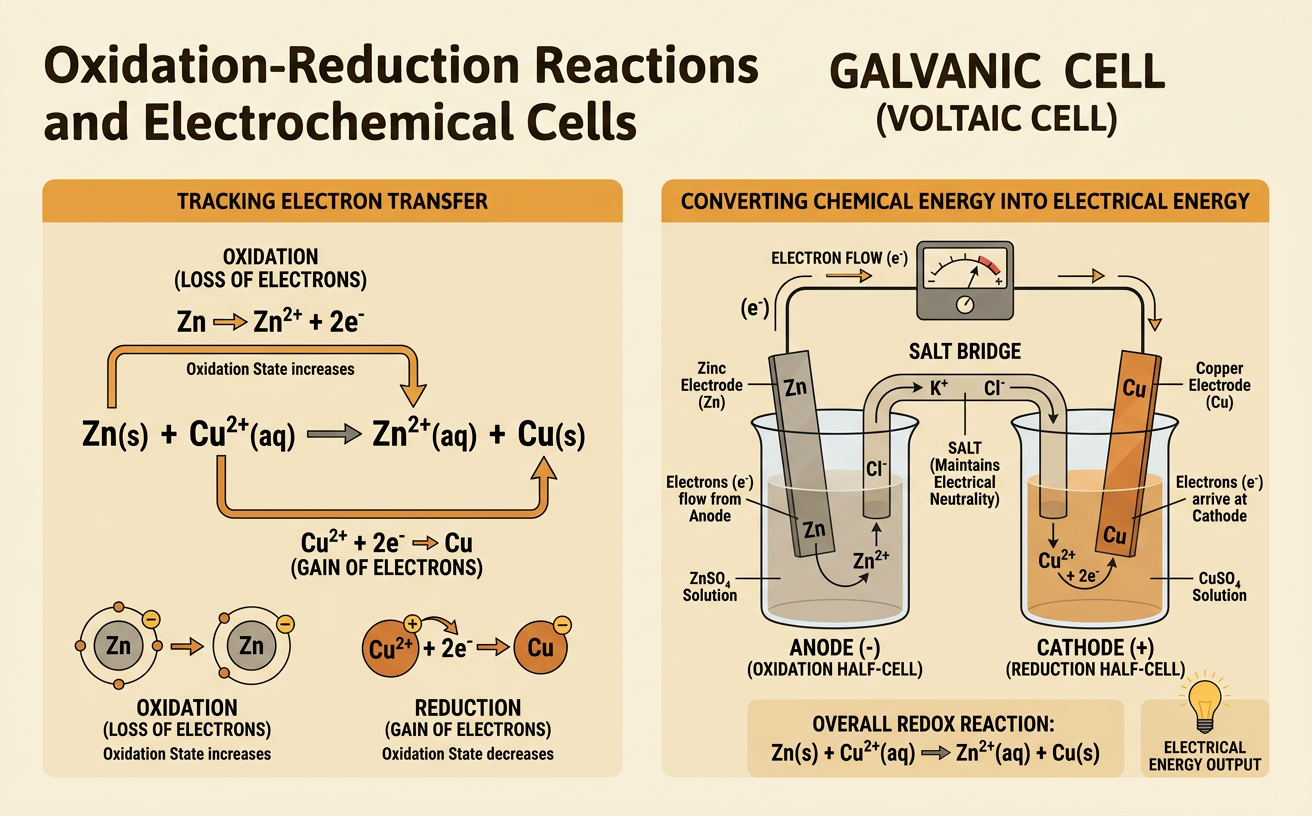
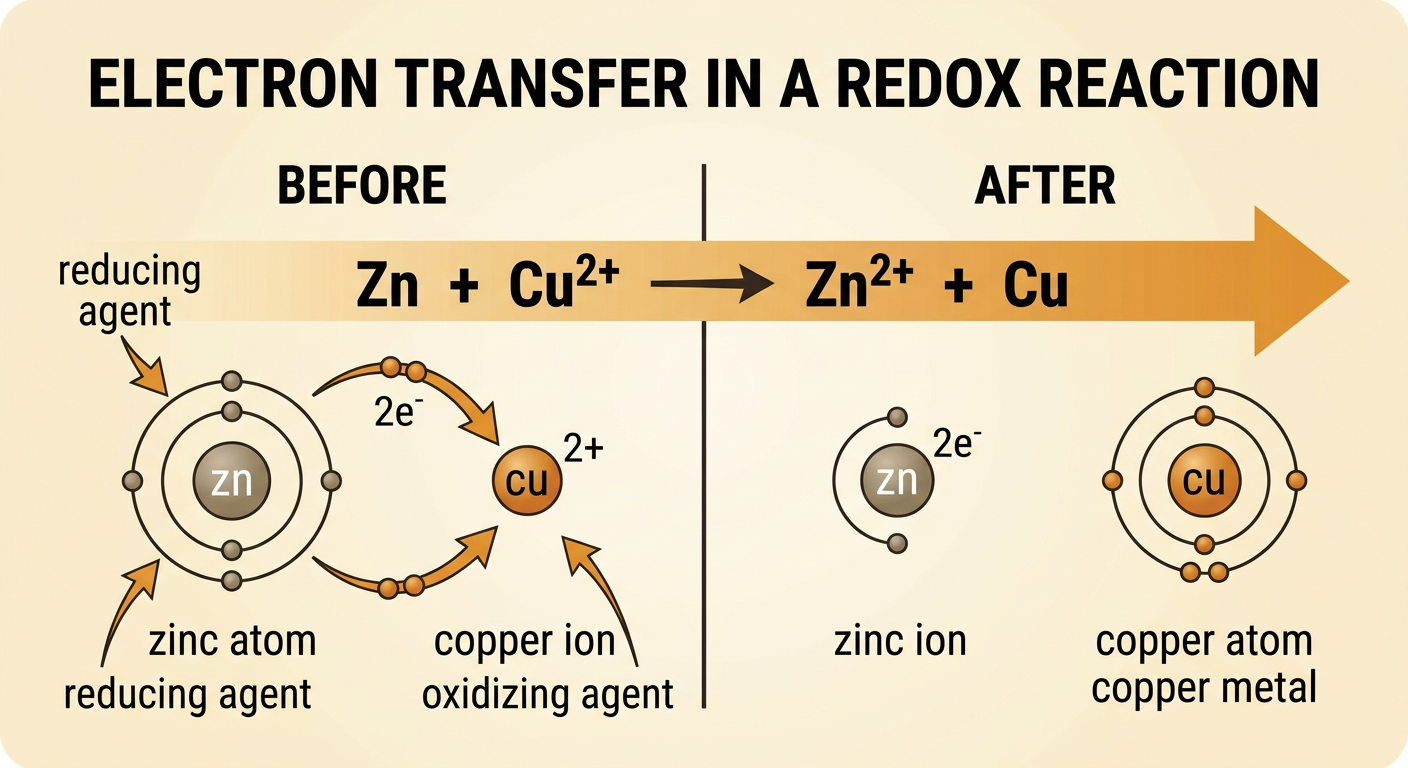
A redox reaction occurs when electrons move from one substance to another. Oxidation is the loss of electrons, while reduction is the gain of electrons. These processes always occur together because electrons lost by one substance must be accepted by another. For example, when zinc metal is placed in a copper(II) sulfate solution, the reaction is Zn + Cu²⁺ → Zn²⁺ + Cu. Each zinc atom loses two electrons and becomes a zinc ion. Each copper ion gains two electrons and becomes copper metal. Zinc is oxidized, so it is the reducing agent. Copper ions are reduced, so they are the oxidizing agent. Changes in charge, oxidation number, or elemental form can provide evidence of electron transfer, even when oxygen is not involved.
Assigning Oxidation Numbers
Oxidation numbers are bookkeeping values used to track electrons in compounds and ions. An element in its uncombined form has an oxidation number of zero. A monatomic ion has an oxidation number equal to its charge. Oxygen is usually −2, hydrogen is usually +1, and the sum of all oxidation numbers equals the overall charge of the substance. Consider Fe₂O₃ + 3CO → 2Fe + 3CO₂. In Fe₂O₃, oxygen is −2, so each iron is +3. Elemental iron is zero; therefore, iron changes from +3 to 0 and is reduced. Carbon is +2 in CO and +4 in CO₂, so carbon is oxidized. Comparing oxidation numbers before and after a reaction reveals which atoms lose electron density and which gain it.

Oxidation and Reduction Half-Reactions
A redox equation can be separated into two half-reactions to show electron transfer explicitly. For the reaction Zn + Cu²⁺ → Zn²⁺ + Cu, the oxidation half-reaction is Zn → Zn²⁺ + 2e⁻. Electrons appear on the product side because zinc loses them. The reduction half-reaction is Cu²⁺ + 2e⁻ → Cu. Electrons appear on the reactant side because copper ions gain them. Each half-reaction must conserve both atoms and electric charge. When the half-reactions are added, the two electrons cancel, producing the balanced overall equation. If the electron counts do not match, multiply one or both half-reactions by whole-number coefficients before adding them. Half-reactions connect symbolic equations with particle-level evidence about changing electron states.

Anatomy of a Galvanic Cell
A galvanic, or voltaic, cell uses a spontaneous redox reaction to convert chemical energy into electrical energy. In a zinc-copper cell, a zinc electrode sits in a solution containing Zn²⁺, and a copper electrode sits in a solution containing Cu²⁺. Zinc is oxidized at the anode: Zn → Zn²⁺ + 2e⁻. Copper ions are reduced at the cathode: Cu²⁺ + 2e⁻ → Cu. A wire provides a path for electrons, while a salt bridge allows ions to move between the half-cells. Anions migrate toward the zinc half-cell to offset newly formed Zn²⁺. Cations migrate toward the copper half-cell as Cu²⁺ leaves the solution. Without this internal ion movement, charge would build up, electron flow would stop, and the cell could not continue operating.

Electron Flow and Cell Voltage
In a galvanic cell, electrons flow through the external circuit from the anode to the cathode. For a standard zinc-copper cell, the standard reduction potential of Cu²⁺/Cu is +0.34 volts, and that of Zn²⁺/Zn is −0.76 volts. Cell voltage is calculated as cathode reduction potential minus anode reduction potential: E°cell = +0.34 V − (−0.76 V) = +1.10 V. The positive voltage indicates that the overall reaction is spontaneous under standard conditions. A voltmeter placed in the wire measures the electrical potential difference, not the number of electrons moving. As the cell operates, reactant concentrations change, so the measured voltage may differ from the standard value. Reading the equation, electrode diagram, and voltage data together provides stronger evidence for how the cell functions.

Evaluating Battery Tradeoffs
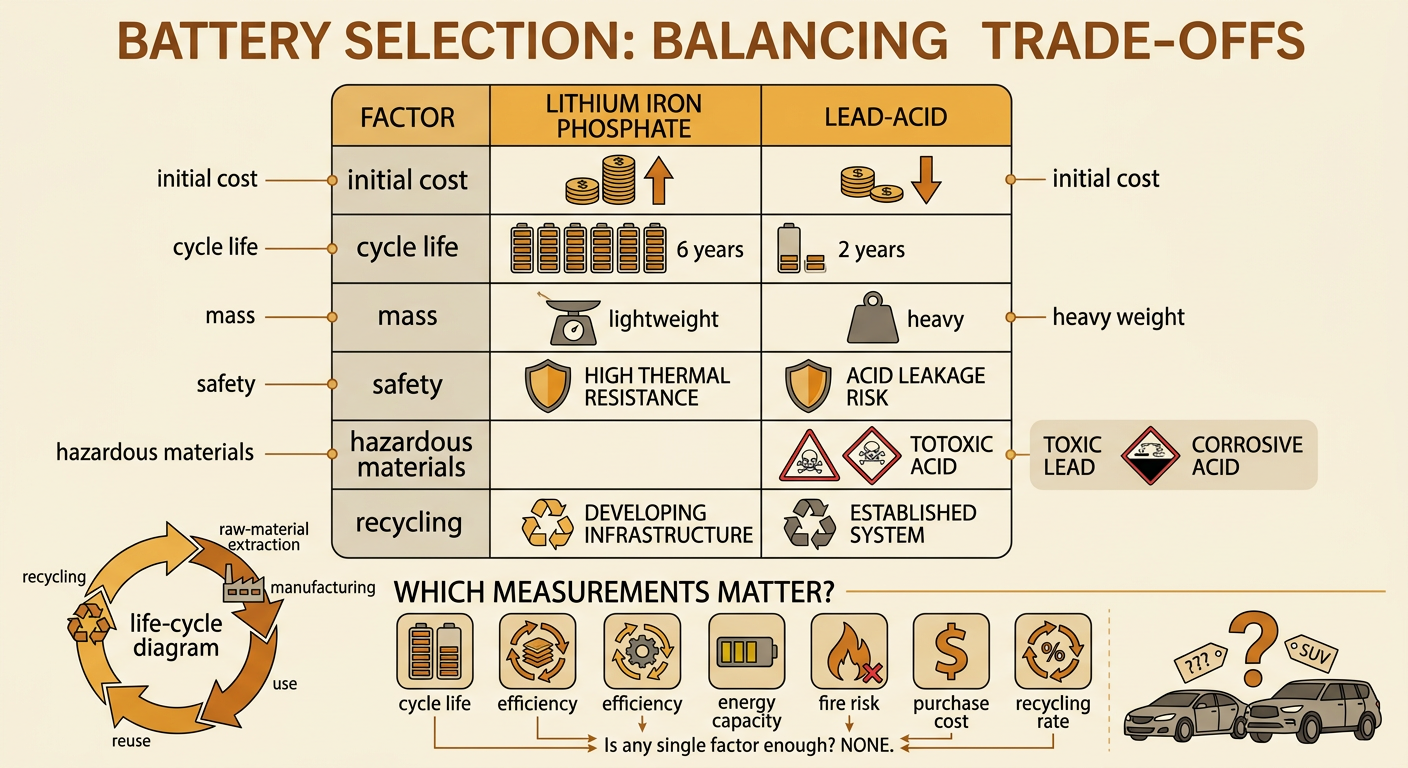
Battery selection requires evidence about performance, cost, safety, resources, and disposal. For example, a lithium iron phosphate battery may be chosen for a school solar-energy system because it has a long cycle life, is relatively resistant to thermal runaway, and does not use cobalt. However, it may cost more initially than a lead-acid battery and still depends on lithium mining and energy-intensive manufacturing. Lead-acid batteries are less expensive and have well-established recycling systems, but they are heavy and contain toxic lead and corrosive acid. A strong recommendation should compare measurable evidence such as energy capacity, lifetime cycles, efficiency, fire risk, purchase cost, and recycling rate. It should also acknowledge counterclaims. Low initial cost may favor lead-acid technology, while longer service life may favor lithium iron phosphate. Disposal plans matter because damaged or discarded batteries can release hazardous materials or cause fires.