Oxidation-Reduction Reactions and Electron Transfer
Students identify oxidation and reduction by tracking electron transfer and oxidation numbers, then connect redox chemistry to batteries and battery recycling.

Illustrations are auto-generated and may be placeholders. They can be refreshed to match the narration.
Electron Transfer in Redox Reactions
Oxidation-reduction, or redox, reactions involve a change in how electrons are distributed. Oxidation is the loss of electrons, while reduction is the gain of electrons. These processes always occur together because electrons lost by one substance must be gained by another. For example, when zinc metal is placed in a solution containing copper(II) ions, the reaction is Zn + Cu²⁺ → Zn²⁺ + Cu. Each zinc atom loses two electrons and becomes a zinc ion. Each copper(II) ion gains two electrons and becomes a copper atom. The electrons and electric charge are conserved: two electrons are transferred for every zinc atom and copper ion that react. Tracking this transfer explains why zinc dissolves while solid copper forms.

Assigning Oxidation Numbers
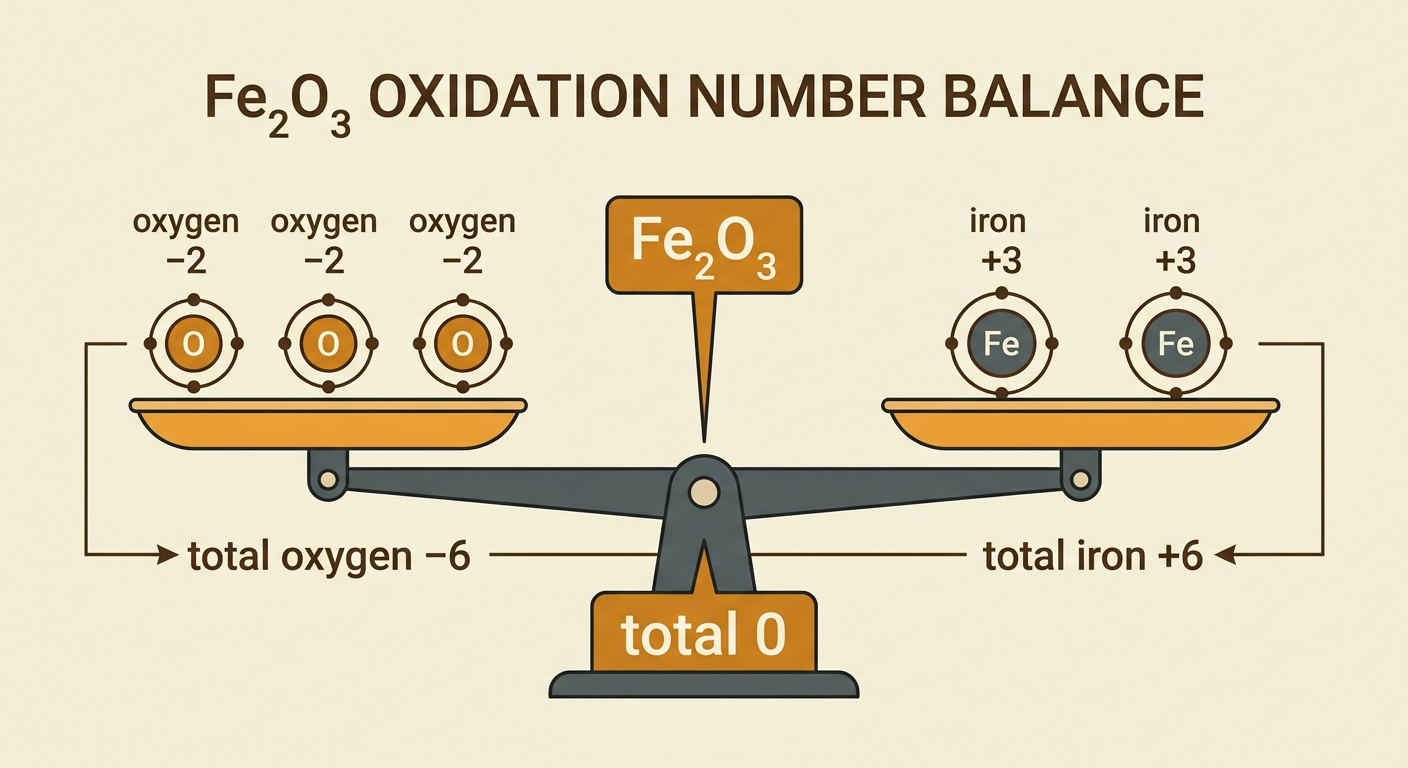
An oxidation number is a bookkeeping value used to track electrons in compounds and ions. An element by itself has an oxidation number of 0, and a one-atom ion has an oxidation number equal to its charge. Oxygen is usually −2, while hydrogen is usually +1 when bonded to nonmetals. The oxidation numbers in a neutral compound must add to 0; in a polyatomic ion, they must add to the ion’s charge. In Fe₂O₃, each oxygen is −2, so three oxygen atoms contribute −6. The two iron atoms must contribute +6 total, making each iron +3. Units are not attached to oxidation numbers because they represent assigned values, not measured charge. Comparing oxidation numbers before and after a reaction reveals which atoms gained or lost electron density.
Identifying Oxidation and Reduction
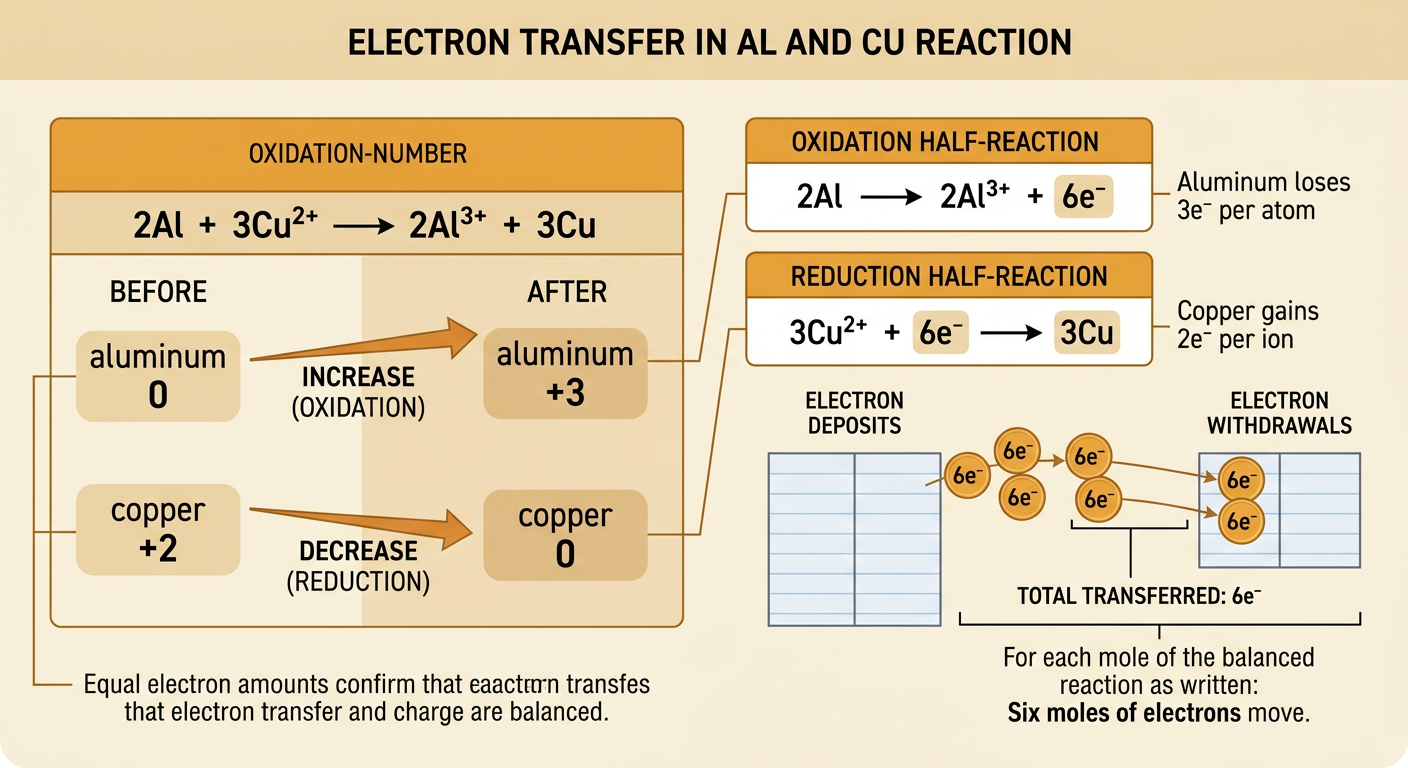
To identify oxidation and reduction, compare each element’s oxidation number before and after the reaction. An increase in oxidation number indicates oxidation, while a decrease indicates reduction. Consider 2Al + 3Cu²⁺ → 2Al³⁺ + 3Cu. Aluminum changes from 0 to +3, so each aluminum atom loses three electrons and is oxidized. Copper changes from +2 to 0, so each copper ion gains two electrons and is reduced. The half-reactions are 2Al → 2Al³⁺ + 6e⁻ and 3Cu²⁺ + 6e⁻ → 3Cu. Both half-reactions involve 6 moles of electrons for each mole of the balanced reaction as written. Equal electron amounts confirm that charge and electron transfer are balanced.
Oxidizing and Reducing Agents
The substances that cause electron transfer are called redox agents. An oxidizing agent causes another substance to be oxidized by accepting its electrons; therefore, the oxidizing agent is itself reduced. A reducing agent causes another substance to be reduced by donating electrons; therefore, the reducing agent is itself oxidized. In the reaction 2Na + Cl₂ → 2NaCl, sodium changes from 0 to +1 and loses electrons. Sodium is oxidized and acts as the reducing agent. Chlorine changes from 0 in Cl₂ to −1 in chloride ions and gains electrons. Chlorine is reduced and acts as the oxidizing agent. Remembering what happens to the agent itself prevents a common error: the oxidizing agent does not undergo oxidation; it makes oxidation happen to the other reactant.

Redox Chemistry in Batteries
A battery uses a spontaneous redox reaction to convert chemical energy into electrical energy. In a simple zinc-copper cell, zinc is the anode and undergoes oxidation: Zn → Zn²⁺ + 2e⁻. The released electrons travel through an external wire, where they can power a device, and reach the copper cathode. There, copper(II) ions are reduced: Cu²⁺ + 2e⁻ → Cu. A salt bridge allows ions to move between the half-cells, preventing charge from building up while keeping the solutions from mixing directly. Electron flow through the wire has direction and can be measured as electric current in amperes. Real batteries use different materials, but their operation still depends on separated oxidation and reduction processes that direct electrons through an external circuit.

Battery Recycling and Public Responsibility
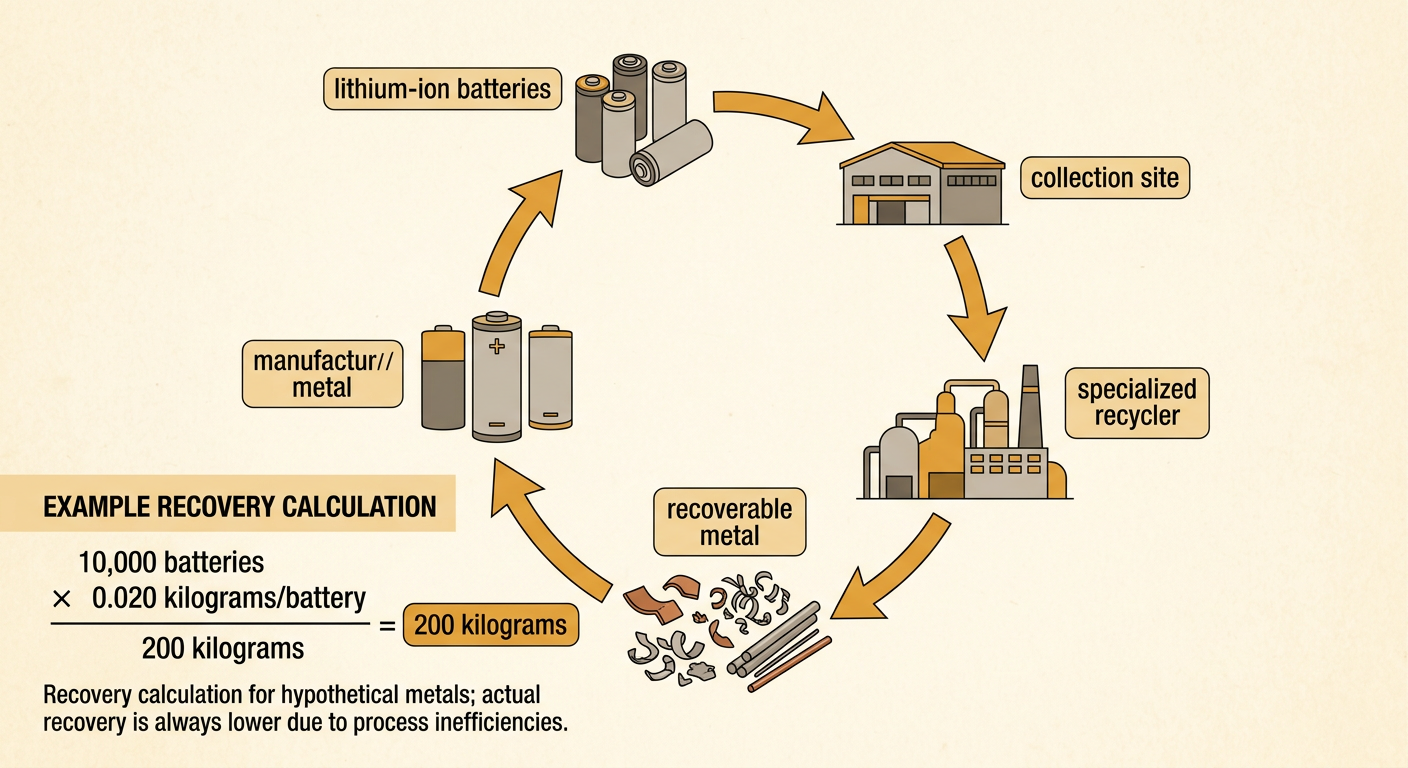
Used batteries contain materials that can create hazards or retain economic value. Lithium-ion batteries should not be placed in household trash because damage or short circuits can cause fires. Specialized recyclers can discharge and sort batteries, then use physical, thermal, or chemical processes to recover materials such as copper, nickel, cobalt, and lithium. Quantities and units help communities evaluate a program. For example, if 10,000 collected batteries each contain a hypothetical 0.020 kilogram of recoverable metal, the maximum available mass is 200 kilograms. Actual recovery would be lower because no process is perfectly efficient. Recycling policy also involves civic choices. Residents may value convenience, businesses may consider costs, workers need safe conditions, and governments must protect the public. Collection sites, producer-funded programs, and clear labeling can balance these interests while encouraging responsible participation.