
Particle Motion, Temperature, and Changes of State
Students use the particle model of matter to explain solids, liquids, gases, temperature, and changes of state caused by transfers of thermal energy.
Illustrations are auto-generated and may be placeholders. They can be refreshed to match the narration.
Particles Are Always Moving
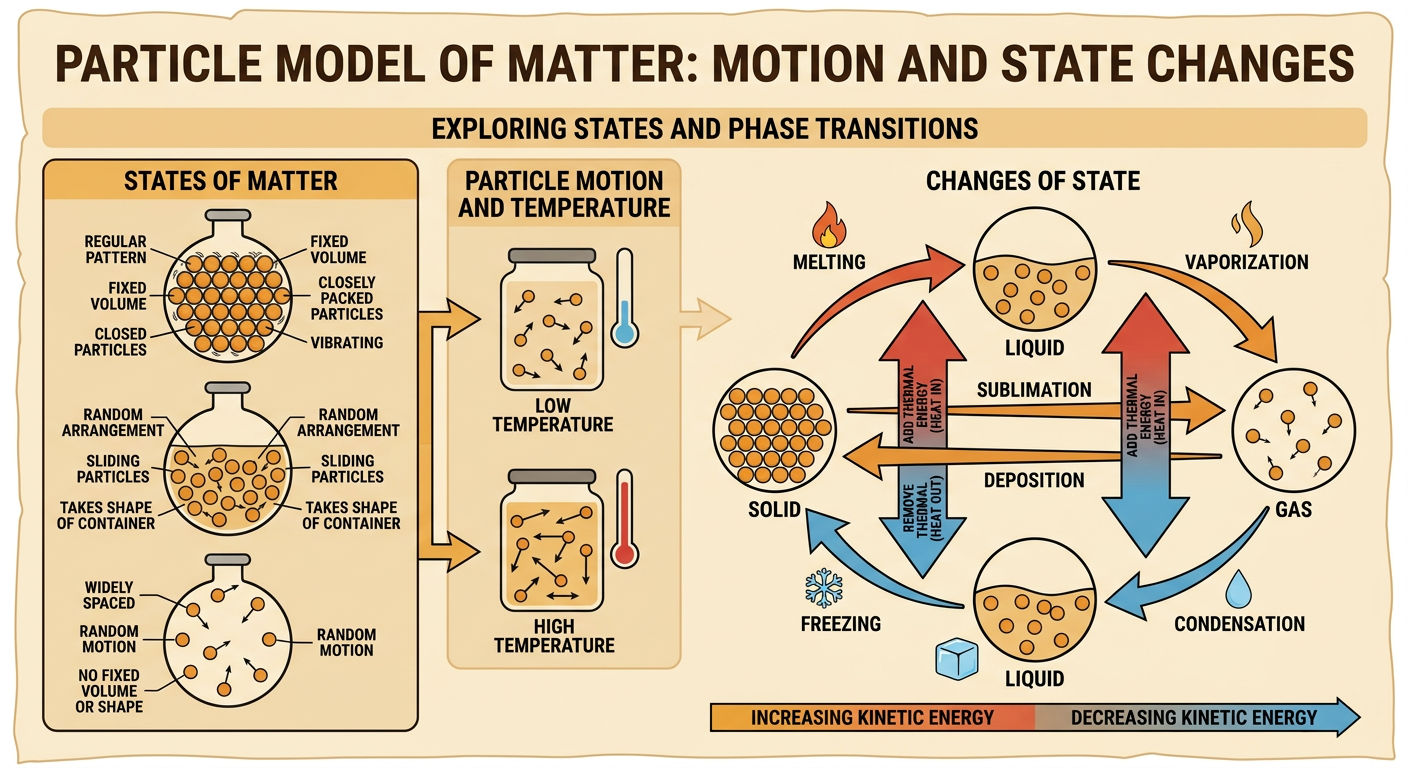
The particles in matter are always moving, although their movement differs among solids, liquids, and gases. In a solid, particles vibrate around fixed positions. In a liquid, particles remain close together but slide past one another. In a gas, particles are far apart and move freely in many directions. These differences help explain each state's properties. A wooden block keeps its own shape because its particles stay in an organized arrangement. Water takes the shape of its cup because its particles can move around one another. Air spreads throughout a room because gas particles travel freely. Particle diagrams can represent these arrangements, but the particles should not be drawn as completely still, even when the substance is solid.

Temperature and Particle Speed
Temperature measures the average kinetic energy of particles in a substance. Kinetic energy is the energy of motion. When a substance becomes warmer, its particles generally move faster. When it becomes cooler, its particles move more slowly. Consider two cups containing equal amounts of water. The particles in the hot cup move faster on average than the particles in the cold cup. Temperature does not measure the total amount of thermal energy, because the amount of matter also matters. A bathtub of warm water can contain more total thermal energy than a small cup of boiling water. Using particle motion to describe temperature provides a deeper explanation than simply saying that one object feels hot and another feels cold.
Melting, Freezing, and Energy Transfer
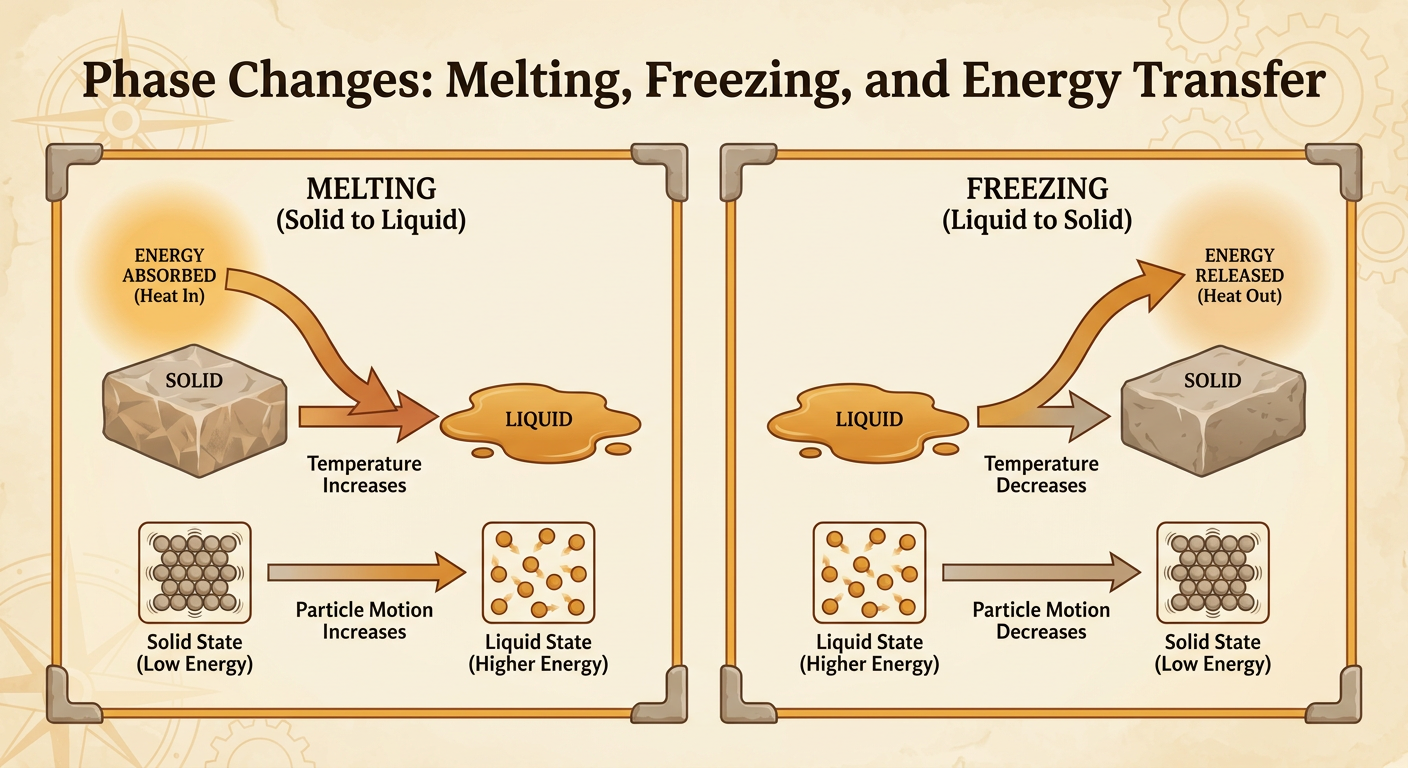
A change of state occurs when matter changes between solid, liquid, and gas without becoming a different substance. During melting, thermal energy is transferred into a solid. Its particles move more strongly until they can slide past one another as a liquid. During freezing, thermal energy leaves a liquid, and its particles settle into more fixed positions. For example, an ice cube melts on a plate because energy transfers from the warmer room and plate into the colder ice. Liquid water freezes in a freezer because energy transfers from the water to the colder surroundings. In both cases, the substance remains H2O. The arrangement and motion of its particles change, but the water molecules do not turn into a new substance.
Evaporation, Boiling, and Condensation
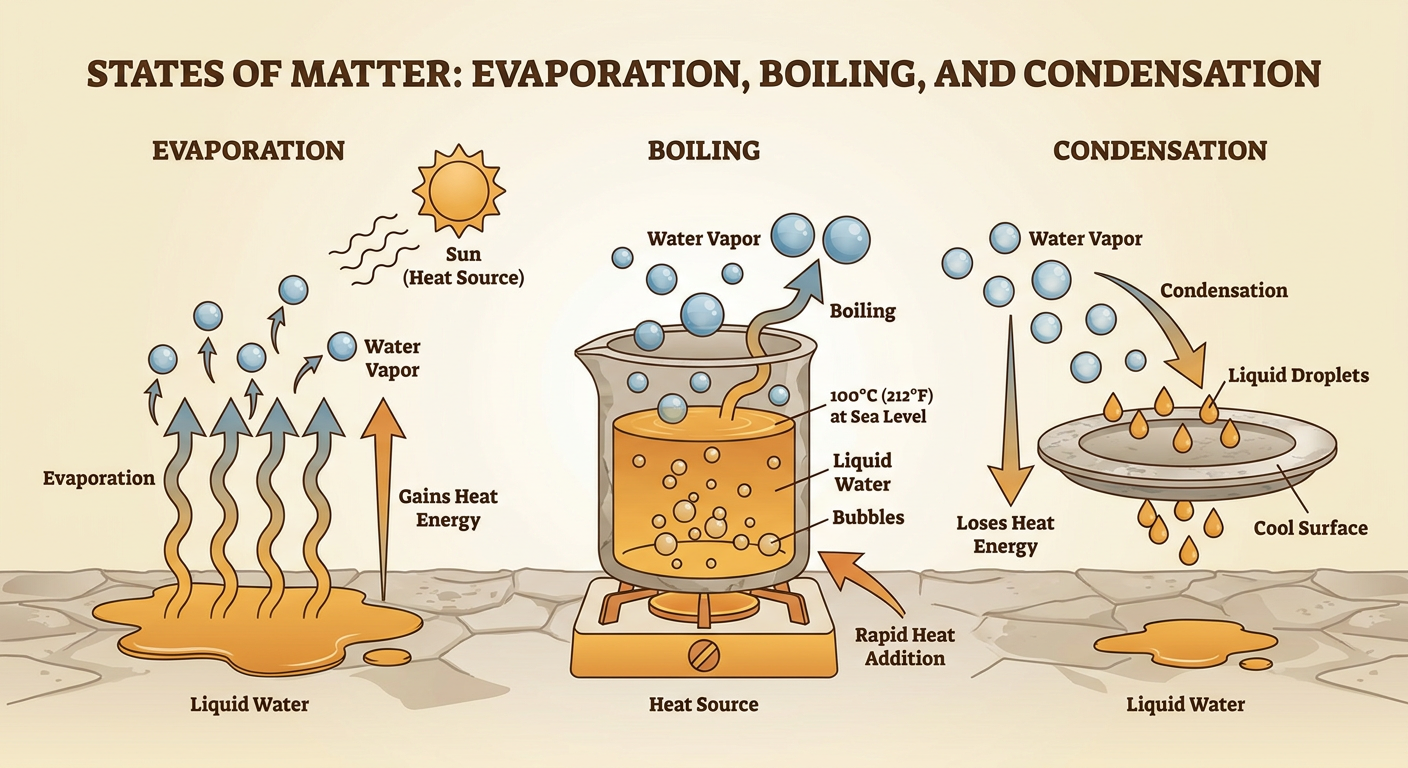
Liquid becomes gas through evaporation or boiling. Evaporation happens at the surface and can occur below the boiling point. The fastest-moving surface particles escape into the air. This is why a wet sidewalk gradually dries after a rainstorm. Boiling occurs throughout a liquid when bubbles of vapor form and rise. Condensation is the reverse process: gas particles lose energy, slow down, and become liquid. Water drops on the outside of a cold glass are an example. The drops do not pass through the glass. Instead, water vapor in the surrounding air cools and condenses on the glass. These processes are physical changes because the identity of the substance remains the same while particle movement and spacing change.
Predicting Changes with a Particle Model
A particle model can be used to predict what happens when thermal energy is added or removed. If energy is added to ice, its particles vibrate faster and may eventually become liquid water. Continued heating can cause water molecules to spread apart as a gas. Removing energy reverses this sequence. Models can also explain expansion. When air inside a balloon is warmed, its particles move faster and collide more forcefully with the balloon's surface, often causing the balloon to expand. A strong prediction should name the energy transfer and describe the resulting particle motion, spacing, or arrangement. It should also be supported by observations, such as temperature measurements, changes in volume, or the appearance of a new state of matter.
