Performing Operations with Scientific Notation
Students multiply, divide, add, and subtract numbers written in scientific notation while interpreting results in real-world contexts.

Illustrations are auto-generated and may be placeholders. They can be refreshed to match the narration.
Review the Structure of Scientific Notation
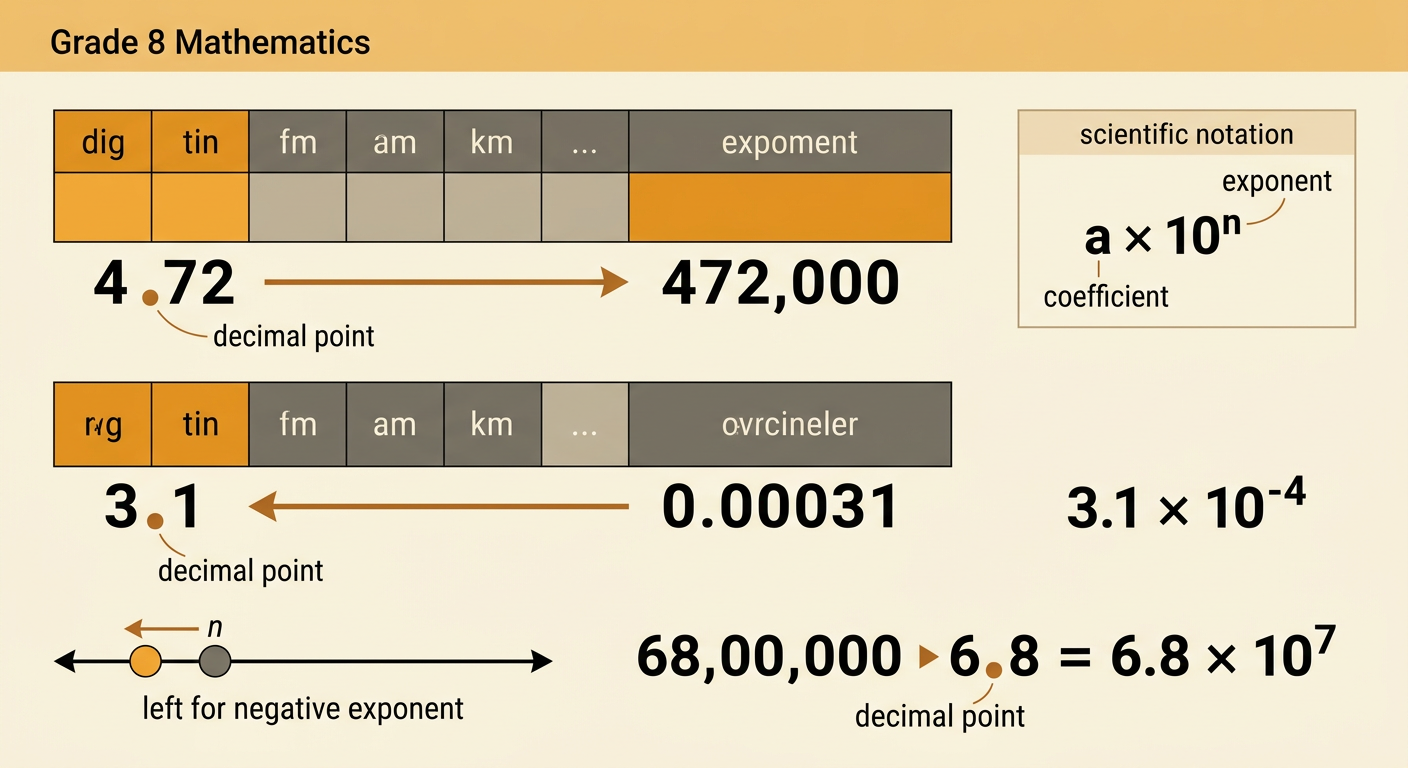
A number in scientific notation has the form a × 10^n, where the coefficient a is at least 1 but less than 10, and n is an integer. The exponent tells how many places the decimal point moves. A positive exponent represents a number greater than or equal to 10, while a negative exponent represents a number between 0 and 1. For example, 4.72 × 10^5 equals 472,000 because the decimal point moves five places right. The number 3.1 × 10^-4 equals 0.00031 because the decimal point moves four places left. To rewrite 68,000,000 in scientific notation, place the decimal after the first nonzero digit to get 6.8. Since the decimal moved seven places left, the result is 6.8 × 10^7.
Multiply Using Exponents
To multiply numbers in scientific notation, multiply the coefficients and add the exponents. For example, (3 × 10^4)(2.5 × 10^3) becomes (3 × 2.5) × 10^(4 + 3), or 7.5 × 10^7. Sometimes the coefficient in the first result is not between 1 and 10. Consider (6 × 10^5)(4 × 10^2). Multiplying gives 24 × 10^7. Rewrite 24 as 2.4 × 10^1, so 24 × 10^7 equals 2.4 × 10^8. This final answer is in proper scientific notation. You can estimate to check: 6 × 4 is about 24, and a number in the hundred-thousands times a number in the hundreds should be in the hundred-millions. The estimate supports 2.4 × 10^8.

Divide Using Exponents
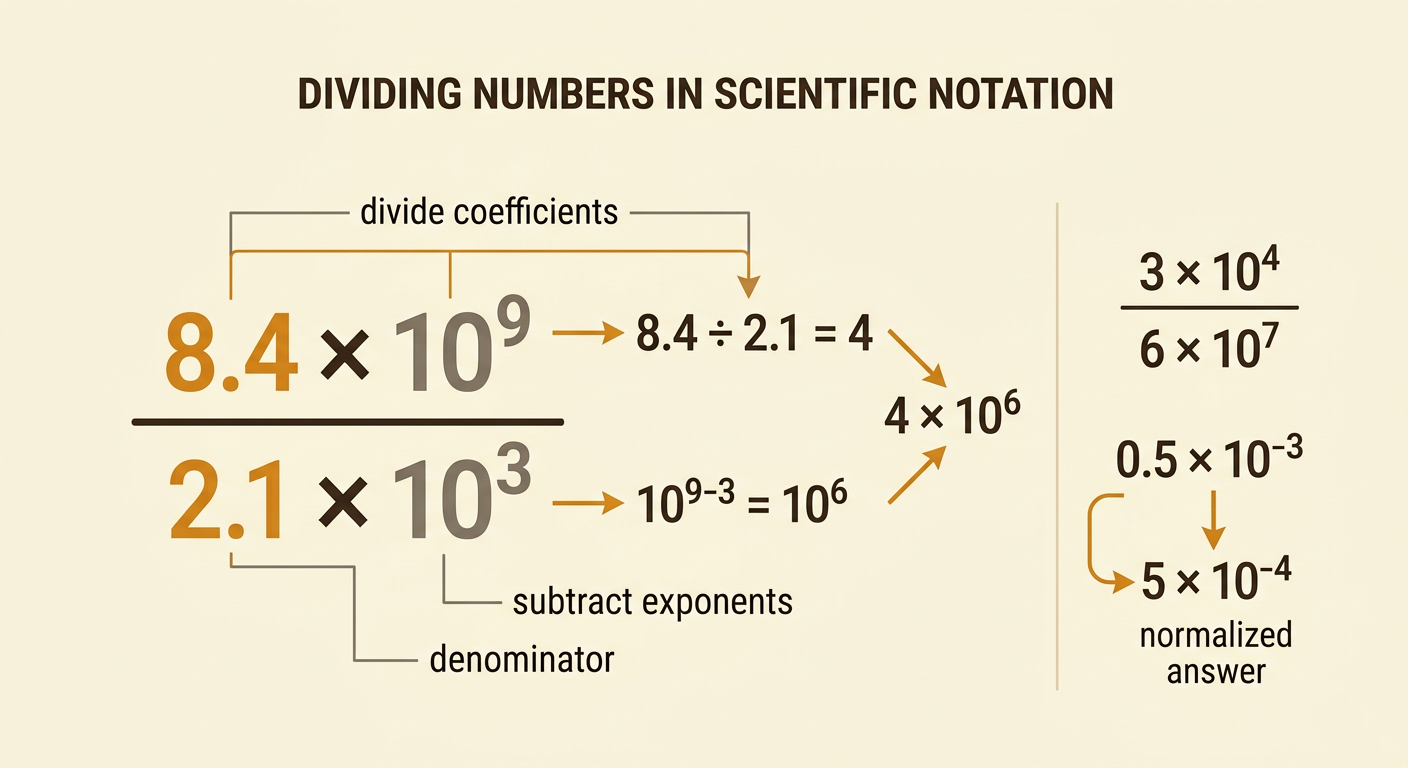
To divide numbers in scientific notation, divide the coefficients and subtract the exponent in the denominator from the exponent in the numerator. For example, (8.4 × 10^9) ÷ (2.1 × 10^3) equals (8.4 ÷ 2.1) × 10^(9 - 3), which is 4 × 10^6. If the coefficient is less than 1, rewrite the answer in proper scientific notation. For instance, (3 × 10^4) ÷ (6 × 10^7) gives 0.5 × 10^-3. Since 0.5 is not an allowed coefficient, move its decimal one place right and decrease the exponent by 1. The result is 5 × 10^-4. Check using size: a number in the ten-thousands divided by a number in the tens of millions should produce a small number, so a negative exponent is reasonable.
Add and Subtract by Matching Powers
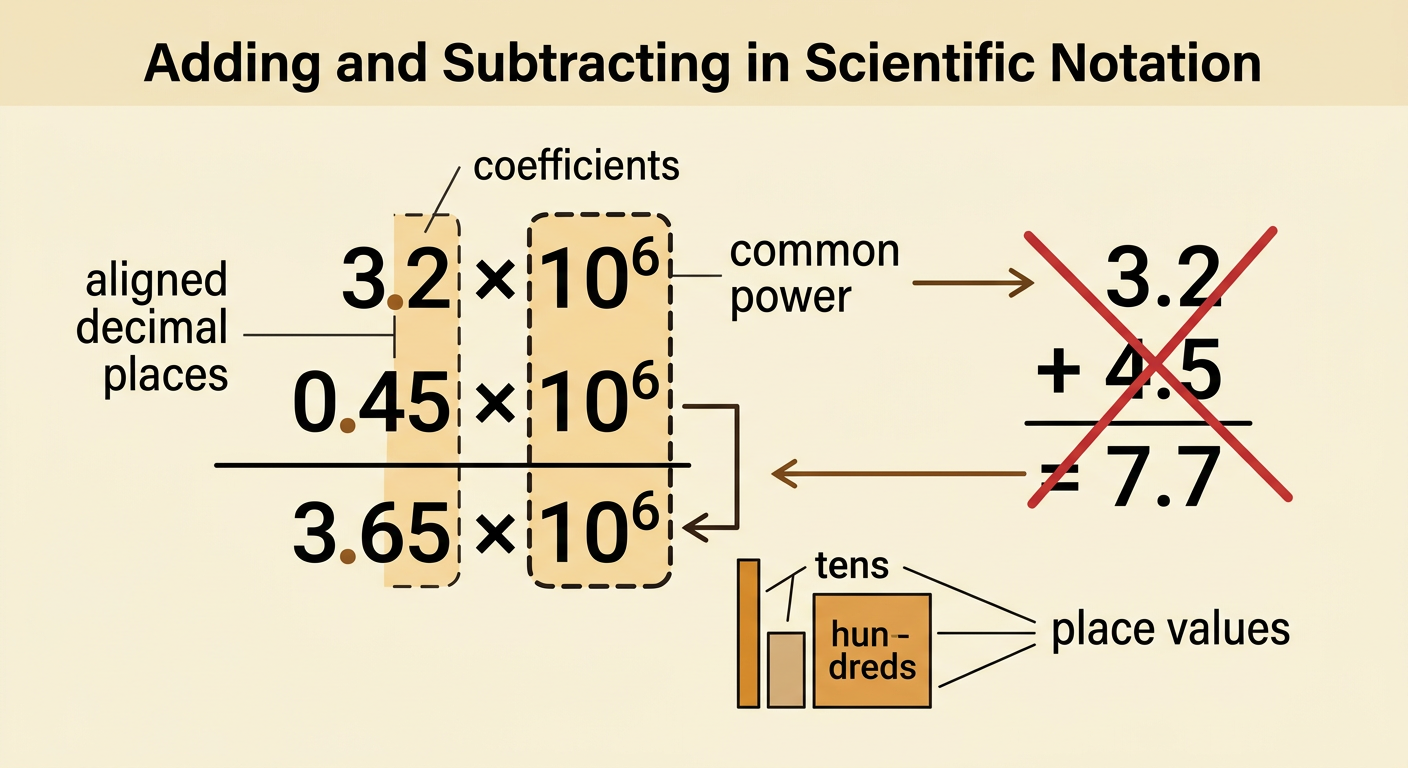
To add or subtract numbers in scientific notation, first rewrite them with the same power of 10. Then add or subtract only the coefficients and keep the common power. For example, 3.2 × 10^6 + 4.5 × 10^5 cannot be combined immediately because the exponents differ. Rewrite 4.5 × 10^5 as 0.45 × 10^6. Now add: (3.2 + 0.45) × 10^6 = 3.65 × 10^6. Subtraction works the same way. To find 7.1 × 10^-3 - 2 × 10^-4, rewrite 2 × 10^-4 as 0.2 × 10^-3. Then subtract to get 6.9 × 10^-3. This method is like aligning decimal places in ordinary addition. Always check that the final coefficient is at least 1 and less than 10.
Interpret and Check Real-World Results
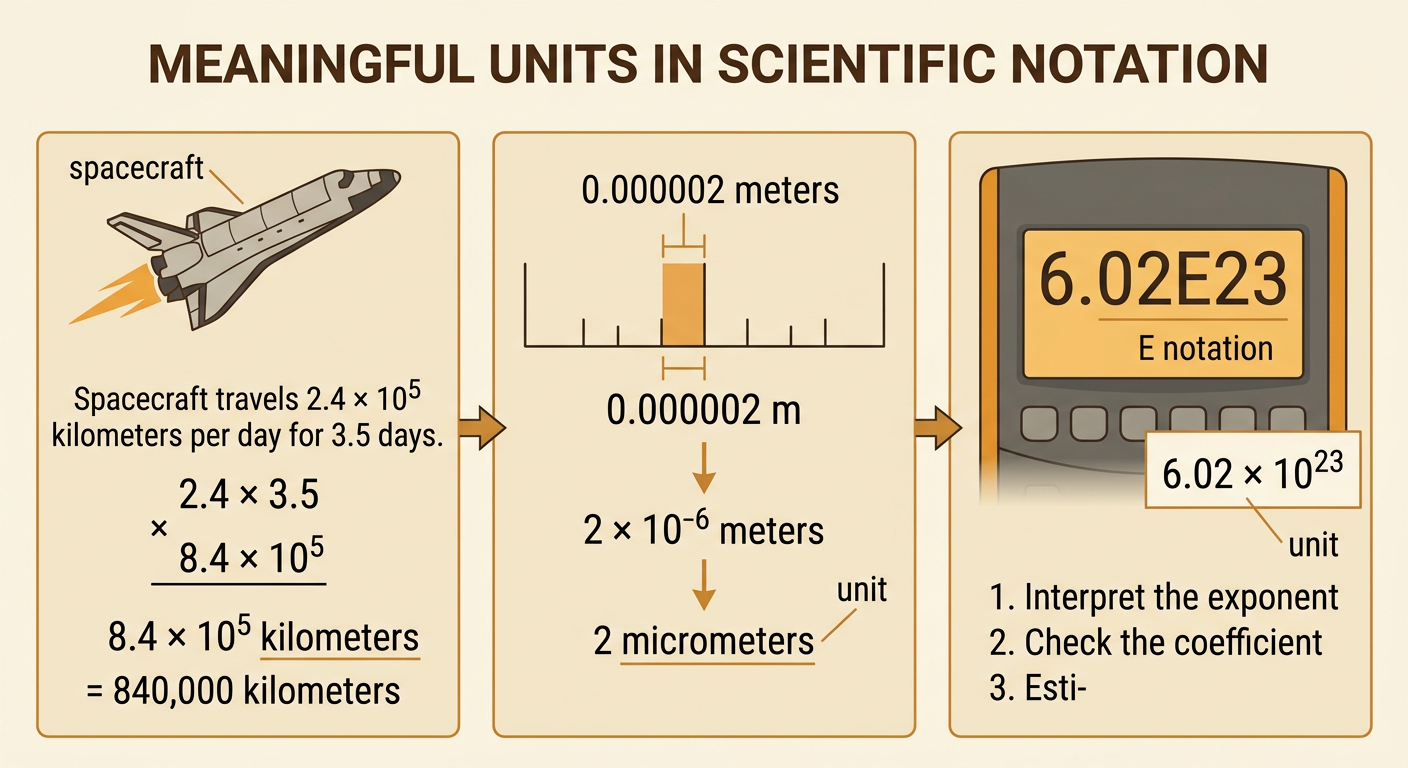
Scientific notation helps describe measurements that are extremely large or small. Suppose a spacecraft travels 2.4 × 10^5 kilometers per day for 3.5 days. Multiplying gives (2.4 × 3.5) × 10^5 = 8.4 × 10^5 kilometers, or 840,000 kilometers. Include the unit because it explains what the number measures. Choose units that make the value easy to understand; 0.000002 meters may be clearer as 2 micrometers, which is 2 × 10^-6 meters. Technology may display 6.02E23. The E notation means “times 10 to the power,” so 6.02E23 equals 6.02 × 10^23. Check every result by estimating its size, confirming the unit, and verifying that the coefficient is at least 1 but less than 10. A calculator display should be interpreted, not copied without thought.