Photosynthesis: From Light Energy to Sugar
Students interpret a simple investigation and construct a model showing how plants transform light energy, carbon dioxide, and water into stored chemical energy and oxygen.
Illustrations are auto-generated and may be placeholders. They can be refreshed to match the narration.
Why Plants Need Light
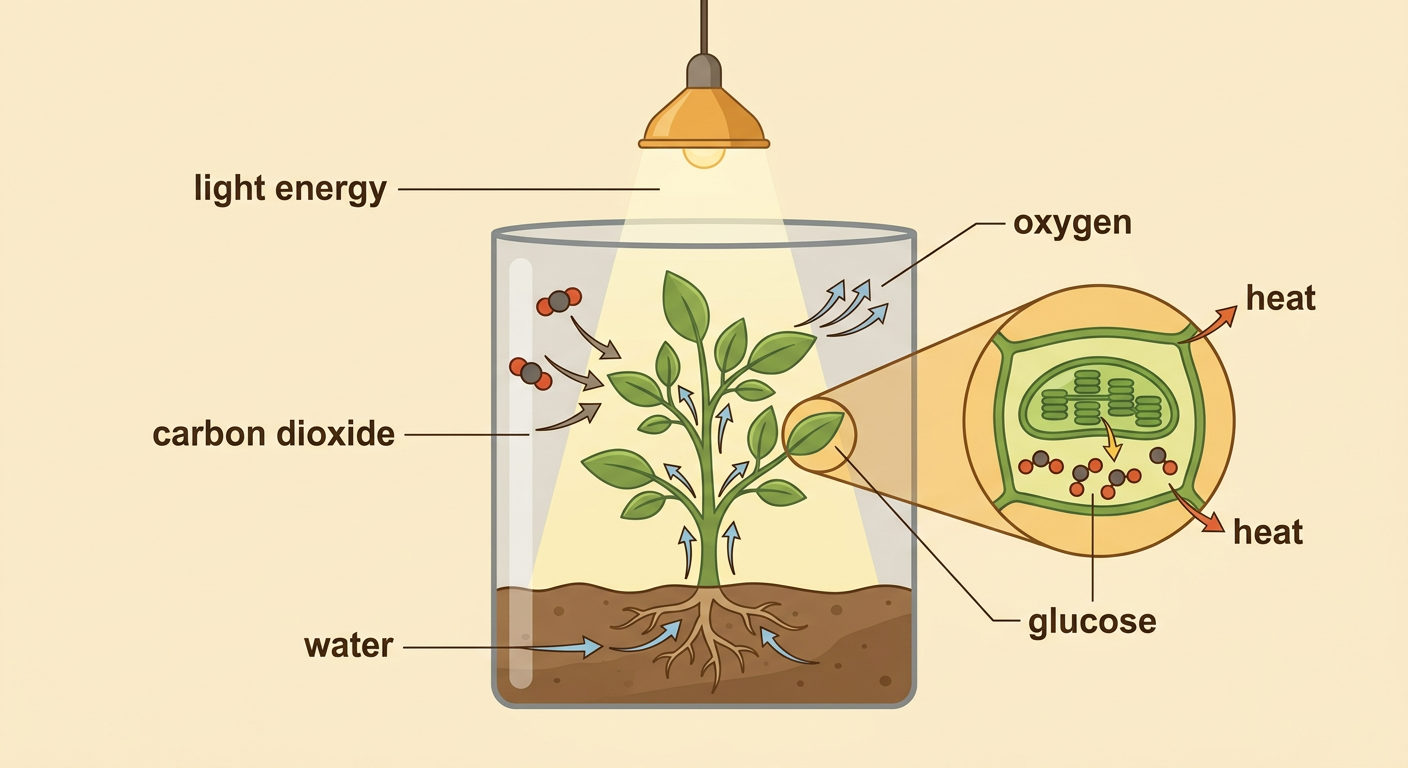
Plants need light because photosynthesis requires an energy source. Chlorophyll pigments in chloroplasts absorb light energy, especially from red and blue wavelengths. That energy drives reactions that help the plant build energy-rich sugar molecules. Light does not become matter, and plants do not get most of their mass from sunlight. Instead, light supplies the energy needed to rearrange atoms from carbon dioxide and water. For example, imagine testing two similar bean plants. One receives light, while the other stays in darkness. If water, temperature, and carbon dioxide remain similar, the plant in light can continue producing sugar and growing. The plant in darkness may survive briefly by using stored sugars, but it cannot keep producing new sugar through photosynthesis. This comparison shows why light is essential for long-term plant growth.

Inputs and Outputs of Photosynthesis
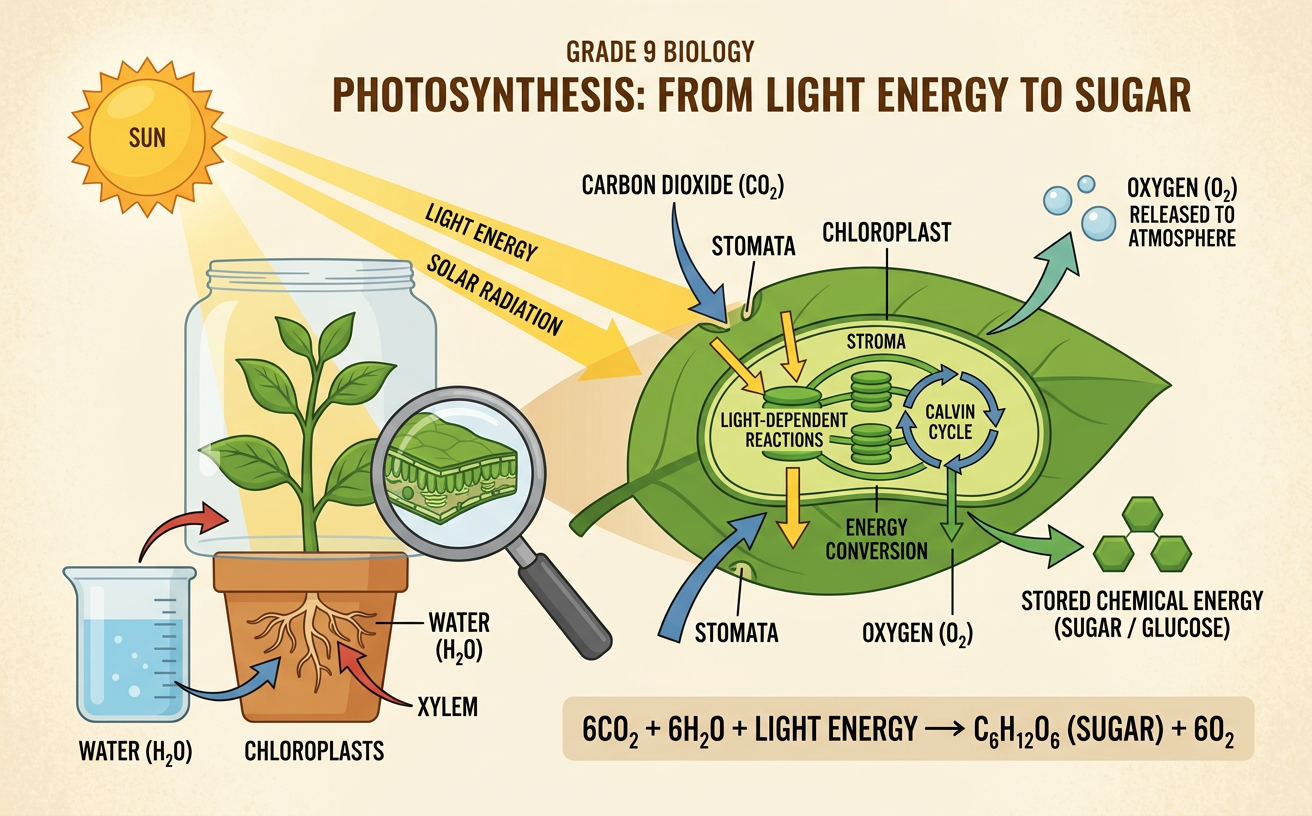
Photosynthesis uses carbon dioxide and water to produce glucose and oxygen. A balanced summary is 6CO2 + 6H2O → C6H12O6 + 6O2, with light energy supplied to the process. Carbon dioxide enters most leaves through tiny openings called stomata, while water moves from the roots through vascular tissue. Inside chloroplasts, atoms from these molecules are rearranged into new substances. Glucose is a sugar that stores chemical energy and provides material for growth. Plants may use it in cellular respiration, transport it, or convert it into starch and cellulose. Oxygen gas is released as a product; the oxygen gas made during photosynthesis comes from splitting water molecules. For example, an aquatic plant in bright light may release visible oxygen bubbles into the surrounding water.

Modeling Energy Transformation
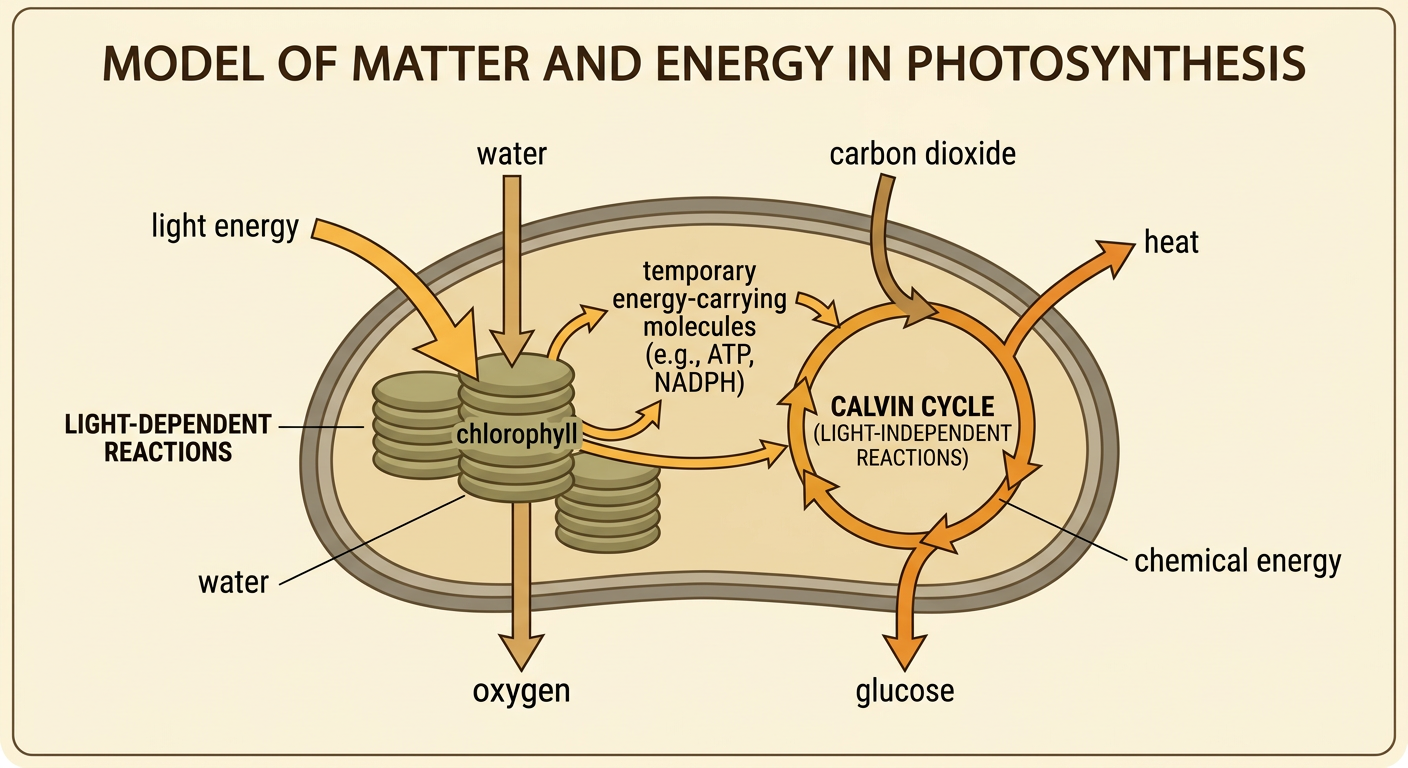
A useful model separates matter from energy. Matter enters as carbon dioxide and water, and its atoms are rearranged into glucose and oxygen. Energy enters as light, is absorbed by chlorophyll, and is transformed into chemical energy. During the light-dependent reactions, captured energy helps produce temporary energy-carrying molecules. Those molecules support reactions that build sugars from carbon dioxide. Some of the captured energy becomes stored in the chemical bonds of glucose, while some energy is transferred to the surroundings as heat. Matter is conserved, but energy flows through the system rather than cycling endlessly. For example, a tomato plant in a greenhouse captures energy from a lamp. The lamp’s light energy does not turn directly into a tomato; it powers reactions that produce sugars used to build the fruit.
Interpreting Photosynthesis-Rate Data
Scientists can estimate photosynthesis rate by measuring oxygen production, carbon dioxide use, or changes in plant mass. Consider an aquatic plant tested at light intensities of 0, 100, 200, and 400 units. Suppose it produces 0, 5, 9, and 10 oxygen bubbles per minute. A graph of these data rises quickly at first and then begins to level off. The increase from 100 to 200 light units adds four bubbles per minute, but the increase from 200 to 400 adds only one. This pattern suggests that light strongly limits photosynthesis at lower intensities. At higher intensities, another factor may become limiting. Bubble counts are only a proxy because bubbles can differ in size, but the measurements still allow comparisons when the method is consistent. The table, graph, and written conclusion represent the same scientific information in different forms.

Limiting Factors and Plant Production
A limiting factor is the resource or condition that most restricts photosynthesis at a particular time. Light intensity, carbon dioxide concentration, water availability, temperature, and mineral nutrients can all become limiting. Increasing one factor helps only until another factor becomes the main constraint. Growers must compare marginal benefits, the added production from one more unit of an input, with marginal costs, the added expense or environmental effect. For example, suppose an extra hour of greenhouse lighting costs $20 and increases tomato sales by $35. The marginal net benefit is $15. A second extra hour might still cost $20 but increase sales by only $8 because carbon dioxide or temperature is now limiting. That second hour has a marginal net cost of $12. A grower could instead improve ventilation, adjust temperature, or accept lower production to reduce energy use.

Quick Model Check
Check a photosynthesis model by asking three questions: Are all major inputs and outputs shown? Does the model distinguish matter from energy? Does it conserve atoms? A complete model should show light energy entering, carbon dioxide and water entering, and glucose and oxygen being produced. It should not show sunlight turning into matter or soil becoming most of the plant’s mass. For example, in a sealed transparent chamber with adequate water, a plant exposed to light may cause carbon dioxide levels to decrease and oxygen levels to increase. The plant may also gain dry mass because carbon atoms from carbon dioxide become part of sugars and other organic molecules. A strong model connects these observations with arrows and labels, includes stored chemical energy in glucose, and shows that some energy eventually leaves as heat.