
Photosynthesis: How Plants Capture and Store Energy
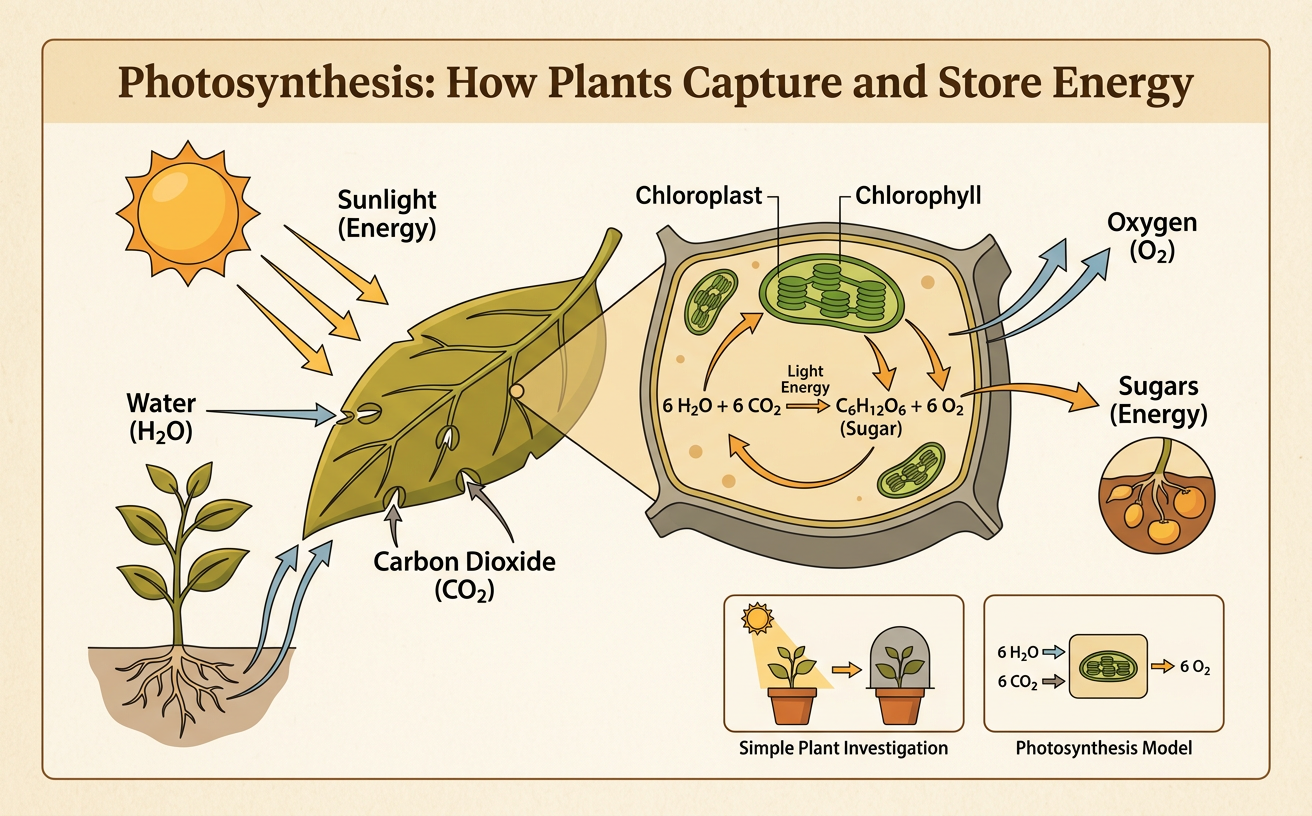
Students use evidence from a simple plant investigation and a photosynthesis model to explain how plants use light energy, water, and carbon dioxide to produce sugars and oxygen.
Illustrations are auto-generated and may be placeholders. They can be refreshed to match the narration.
What Do Plants Need?
Plants need light, water, and carbon dioxide to carry out photosynthesis. Their roots absorb water from soil, while tiny openings called stomata allow carbon dioxide from the air to enter the leaves. Chlorophyll, a green pigment in chloroplasts, captures light energy. Consider an investigation with two similar bean plants. Both plants receive equal amounts of water and air, but one is placed in light and the other in darkness. After several days, the plant in light is more likely to remain green and grow, while the plant in darkness may become pale and weak. Because light is the main changed condition, the results provide evidence that light is needed for plants to make the sugars that support growth. However, one trial is limited, so scientists repeat the investigation with several plants.

Inputs and Outputs of Photosynthesis
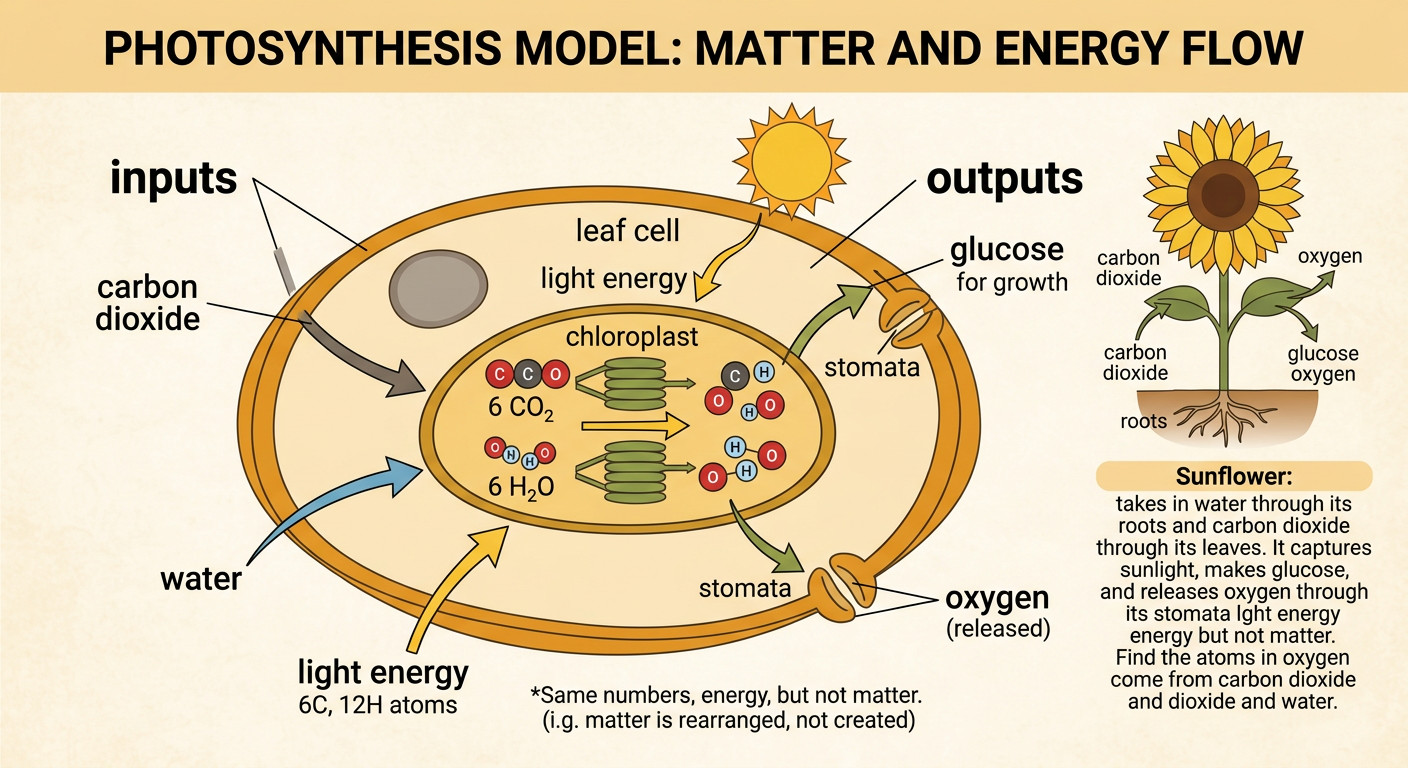
Photosynthesis can be modeled as a process with inputs and outputs. The inputs are carbon dioxide, water, and light energy. The outputs are sugar and oxygen. Inside chloroplasts, plants use light energy to rearrange atoms from carbon dioxide and water into glucose, a type of sugar, and oxygen. The process can be summarized as carbon dioxide plus water plus light energy produces glucose plus oxygen. For example, a sunflower takes in carbon dioxide through its leaves and water through its roots. It uses sunlight to produce glucose that can support growth or be stored, while oxygen leaves through the stomata. The model simplifies many chemical steps, but it clearly shows that matter is rearranged rather than created or destroyed. Light supplies energy, not matter.
Tracing Matter Through a Plant
Matter moves into, through, and out of a plant during photosynthesis. Water enters root hairs and travels upward through tubes called xylem. Carbon dioxide enters leaves through stomata and moves into leaf cells. In chloroplasts, atoms from water and carbon dioxide are rearranged to form glucose and oxygen. A growing maple tree can use glucose to build cellulose, which becomes part of new wood, stems, and leaves. It can also combine glucose with other materials to make additional plant substances. Some oxygen exits the leaf and enters the atmosphere. This means much of a plant’s dry mass does not come directly from soil. Carbon atoms in plant tissue mainly came from carbon dioxide in the air. Tracking atoms shows that matter cycles between the atmosphere, plants, animals, decomposers, water, and soil.

Following Energy from Sunlight to Sugar
Energy flows through photosynthesis differently from the way matter cycles. Sunlight carries energy to a plant. Chlorophyll in chloroplasts captures some of this light energy, and the plant stores it as chemical energy in glucose. For example, grass uses sunlight to make glucose. When a rabbit eats the grass, chemical energy from the grass can move into the rabbit. The rabbit uses some energy for movement, growth, and body functions, and some energy eventually transfers to the surroundings as heat. Matter may be reused through ecosystems, but energy flows in one general direction: from the Sun to producers, then to consumers and decomposers, and finally to the environment as heat. Photosynthesis is the major pathway by which light energy enters most ecosystems.

Analyze the Evidence
Scientists compare evidence from investigations and models before making a claim. Imagine that three plants grown in light gained an average of 4 centimeters in height, while three similar plants kept in darkness gained only 1 centimeter. This pattern supports the claim that light helps plants produce materials needed for growth. A photosynthesis model adds another source of evidence by showing light energy entering the process and glucose being produced. Each source has strengths and limitations. The investigation provides measured observations, but plant height does not directly measure glucose production, and the sample is small. The model clearly identifies inputs and outputs, but it simplifies the many reactions inside chloroplasts. Together, the sources provide stronger support than either source alone. Scientists should also check whether water, plant type, temperature, and starting size were controlled.

Write a Scientific Explanation
A scientific explanation should connect a clear claim, relevant evidence, and reasoning. Begin with a claim such as, “Photosynthesis allows plants to use light energy, water, and carbon dioxide to produce sugars and oxygen.” Next, include evidence from more than one source. For example, plants in light grew more than plants in darkness, and the photosynthesis model shows light, water, and carbon dioxide as inputs and glucose and oxygen as outputs. Then explain the reasoning: greater growth is consistent with sugar production because plants use sugars to build tissues and store chemical energy. Acknowledge limitations by noting that growth is indirect evidence and that a model simplifies the real process. Finish by explaining that photosynthesis cycles matter by rearranging atoms and brings energy into organisms by storing captured light energy in sugar. Use precise scientific terms and complete sentences.
