
Photosynthesis: Moving Matter and Energy into Living Systems
Students use a simple model and evidence to explain how plants transform light energy, water, and carbon dioxide into sugars and oxygen through photosynthesis.
Illustrations are auto-generated and may be placeholders. They can be refreshed to match the narration.
What Plants Need to Make Food
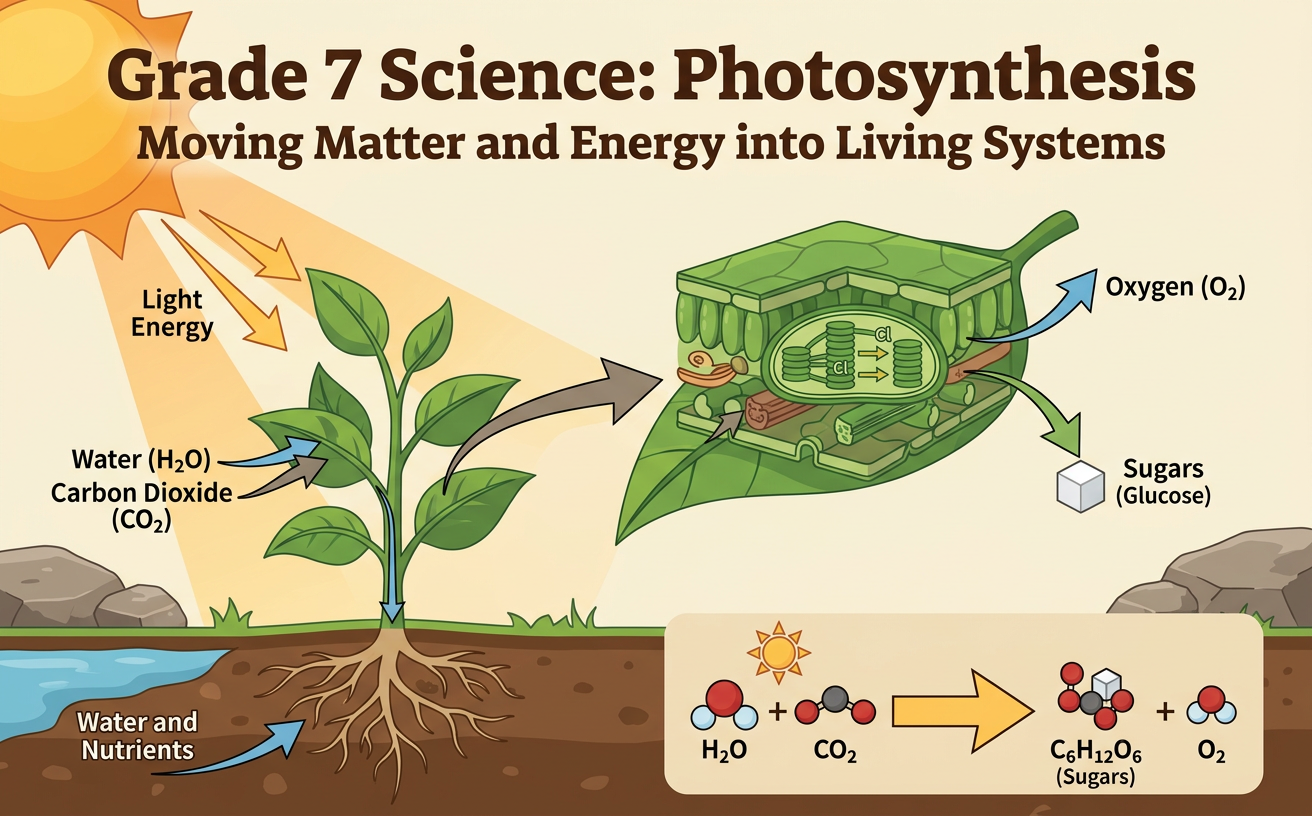
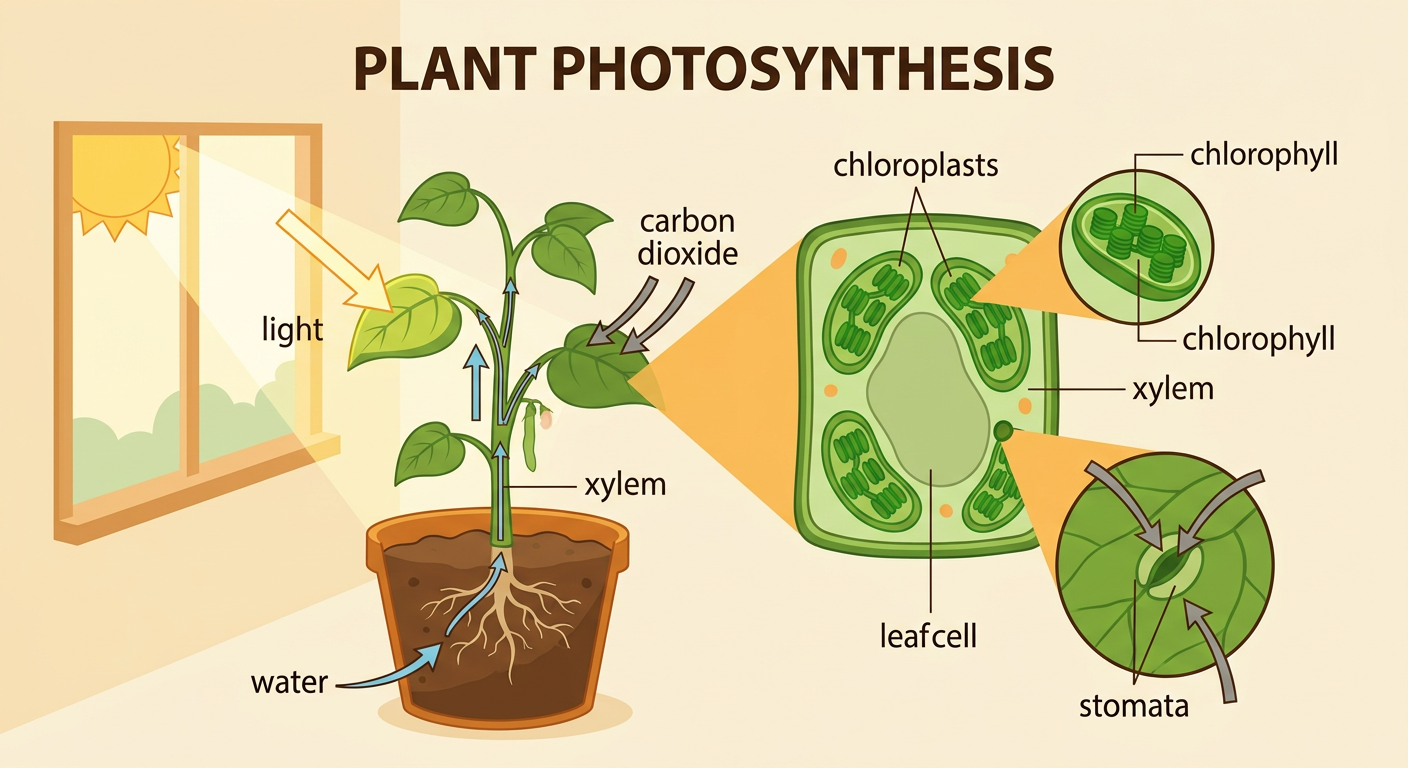
Plants do not get their food from soil. Instead, they make sugars through photosynthesis, mainly in the cells of their leaves. To do this, a plant needs light, water, and carbon dioxide. Chlorophyll, a green pigment inside chloroplasts, absorbs light energy. Roots take in water from the soil, and tubes called xylem carry it to the leaves. Carbon dioxide from the air enters leaves through tiny openings called stomata. For example, a bean plant placed in sunlight can use water from its soil and carbon dioxide from the surrounding air to make sugar. Minerals from soil help the plant grow, but they are not the main source of the plant’s food or mass. Each required input has a different source and role in photosynthesis.
Inputs and Products of Photosynthesis
Photosynthesis transforms carbon dioxide and water into sugar and oxygen using light energy. A simplified chemical equation is: 6 carbon dioxide + 6 water → 1 glucose + 6 oxygen. Light energy is required for this transformation even though it is not matter in the equation. Glucose is a simple sugar that stores chemical energy. A plant may use glucose immediately, join glucose molecules to make starch for storage, or use them to build materials such as cellulose. Oxygen leaves the leaf through stomata, although plants also use some oxygen during cellular respiration. For example, an aquatic plant placed under a bright lamp may release visible gas bubbles. Those bubbles contain oxygen produced during photosynthesis. The inputs are not simply mixed; their atoms are rearranged into new molecules with different properties.

Tracing Matter Through the Process
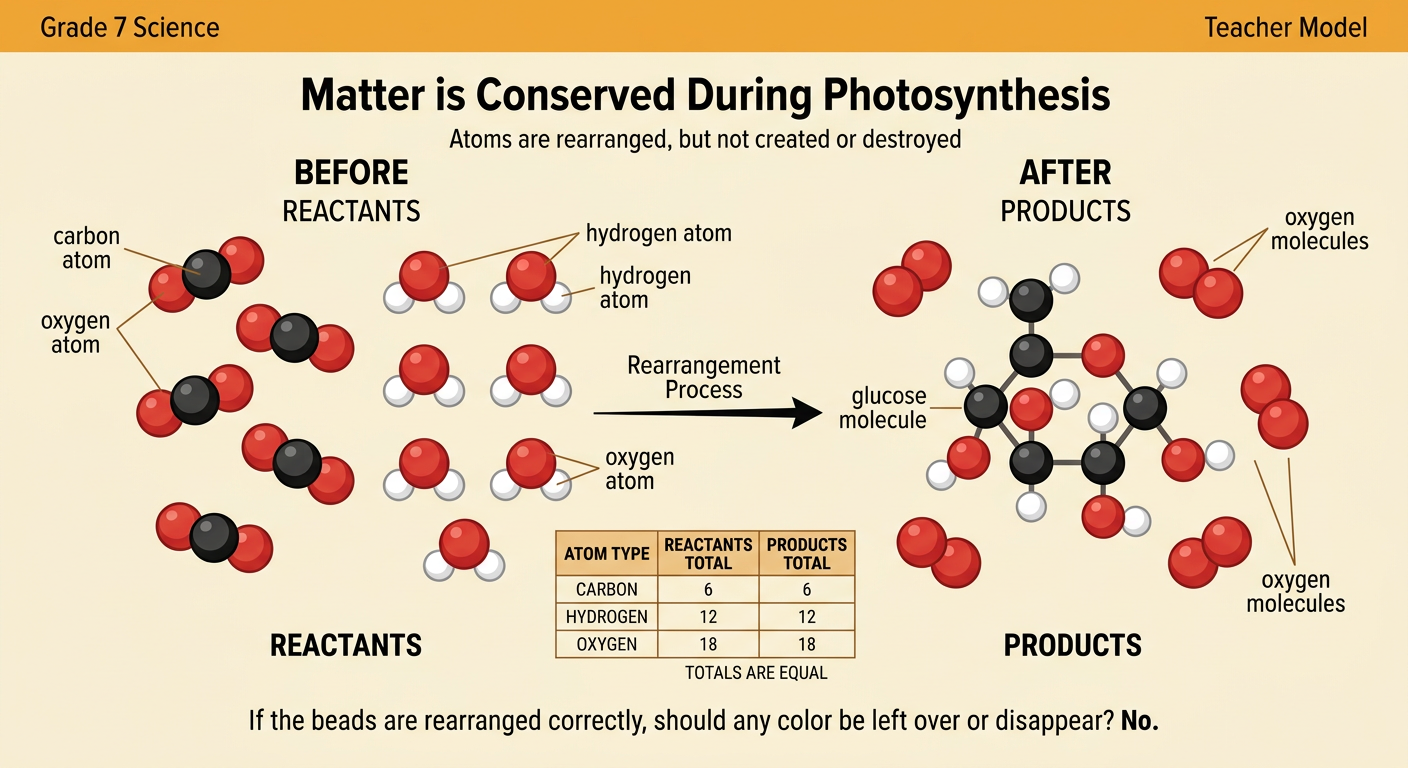
Matter is conserved during photosynthesis: atoms are rearranged, but none are created or destroyed. Carbon dioxide supplies the carbon atoms that become part of glucose. Water supplies hydrogen atoms, and oxygen atoms are found in both the reactants and products. During the reactions of photosynthesis, the oxygen gas released by the plant comes from water molecules. A molecule model can make this easier to see. Suppose colored beads represent atoms: black for carbon, white for hydrogen, and red for oxygen. Students can build six carbon dioxide molecules and six water molecules, then rearrange the same beads to form one glucose molecule and six oxygen molecules. The number of each color remains unchanged. This shows that much of a growing plant’s dry matter comes from carbon dioxide in the air, not from matter taken directly from the soil.
Following the Flow of Energy
Energy flows through living systems rather than cycling in the same way matter does. Photosynthesis begins when chlorophyll absorbs light energy from the Sun. The plant transforms some of that light energy into chemical energy stored in glucose. The plant can use glucose in cellular respiration to power cell activities, or it can store and use the sugar to build new plant tissue. When a caterpillar eats a leaf, some of the chemical energy in the plant moves into the caterpillar. If a bird eats the caterpillar, some energy moves again. At every step, organisms release part of the energy as heat. For example, the energy that powers a bird’s flight may once have entered the ecosystem as sunlight captured by a leaf. Photosynthesis does not create energy; it changes energy from one form to another.

Building a Scientific Explanation
A strong scientific explanation includes a claim, evidence, and reasoning. The claim answers a question, the evidence provides relevant observations or data, and the reasoning connects the evidence to scientific ideas. Consider two equal samples of an aquatic plant: one is placed under a lamp, and the other is covered so that it receives no light. After the same amount of time, an oxygen sensor measures more oxygen around the lighted plant. A claim could state that light allows the plant to produce oxygen through photosynthesis. The oxygen measurement is evidence. The reasoning explains that chlorophyll captures light energy and uses it to transform carbon dioxide and water into sugar and oxygen. The experiment is stronger when plant size, water, temperature, and time are kept the same. Together, the model, balanced equation, and observations support an explanation of how photosynthesis cycles matter and brings energy into living systems.
