
Plant Parts and Their Jobs
Students observe roots, stems, and leaves to learn how each plant part helps a plant live and grow.

Illustrations are auto-generated and may be placeholders. They can be refreshed to match the narration.
Observe Plants in Different Places
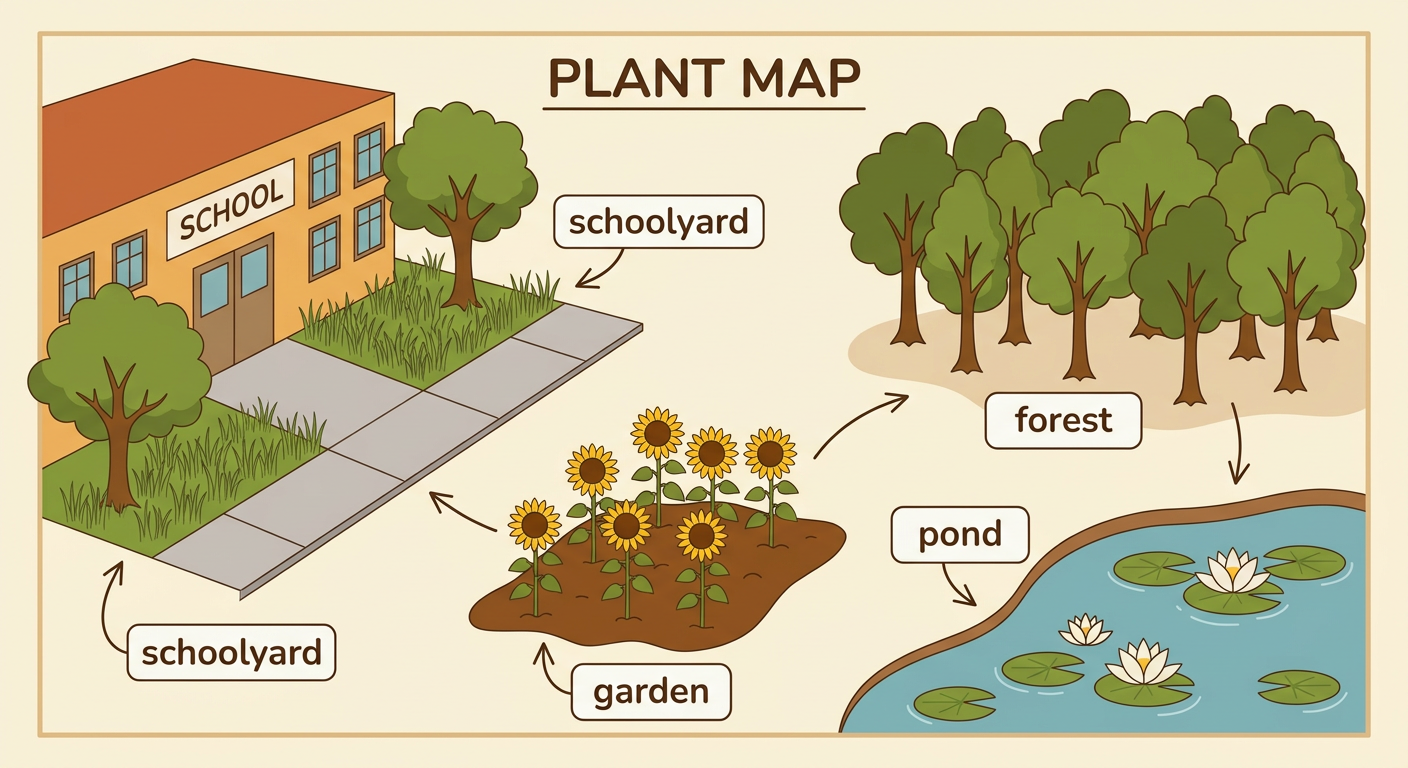
Plants grow in many places. Look at photographs of a schoolyard, a garden, a forest, and a pond. What plants do you notice? A sunflower may grow in sunny garden soil. A water lily grows in a pond, with its leaves floating on the water. Plants can look different because their places provide different amounts of sunlight, water, soil, and space. Use a simple map to mark where plants grow near your school or home. You might mark grass beside a sidewalk and a tree near a playground. Compare the plants in each place with a partner. Tell where each plant grows and what you observe about its size, shape, or color.
Name Roots, Stems, and Leaves
Most plants have roots, stems, and leaves. Roots usually grow under the ground, so we may need to gently lift a small plant from loose soil to see them. Roots often branch out like tiny fingers. The stem grows above the roots and holds up the plant. Leaves grow from the stem. They may be wide, narrow, smooth, or jagged. Look closely at a bean plant. Point to the roots below the soil, the upright stem, and the green leaves. Then compare it with another plant. Its parts may have different shapes, but you can still name them. Handle living plants gently, and return any classroom plant to its soil after observing it.

Match Each Part to Its Job
Each plant part has an important job. Roots hold the plant in place and take in water and minerals from the soil. The stem supports the plant and carries water from the roots toward the leaves. Leaves capture light, which the plant uses to make food. Match each part with its job by asking what would happen without it. For example, a young sunflower needs roots to stay firmly in the ground. Its stem holds its leaves up where they can reach light. Its broad leaves capture that light. These parts work together to help the sunflower live and grow. Act out the jobs: spread your fingers like roots, stand tall like a stem, and hold out your hands like leaves.

Sort and Count Plant-Part Pictures
Scientists organize observations to find patterns. Work with a partner to sort picture cards into three groups: roots, stems, and leaves. Look carefully before choosing a group. A carrot picture belongs with roots because the carrot is a thick root. A celery stalk picture can represent a stem, and a spinach picture belongs with leaves. Count the cards in each group and record the numbers on a picture graph. For example, your graph might show 3 root cards, 4 stem cards, and 6 leaf cards. Compare the categories. Which group has the most cards? Which has the fewest? How many more leaf cards are there than root cards? Explain how your graph helps you answer each question.

Share How Plant Parts Help
Talk with your group about how plant parts help a plant. Take turns speaking, listen closely, and ask questions. Use evidence from your observations. You might say, “Roots help because they hold the plant in the soil.” Then use the job of roots to solve a human problem. Imagine that a small paper sign keeps tipping over. Build a base that acts like branching roots. You can use craft sticks, pipe cleaners, clay, and a paper tube. Test the sign with a gentle fan. If it falls, change the width or number of branches and test it again. Share how your design copies the way roots spread out and anchor a plant. Explain one change that made your sign stand more firmly.