
Plotting Rational Numbers on the Coordinate Plane
Students use ordered pairs, axis directions, and signs to locate and plot rational numbers in all four quadrants of the coordinate plane.
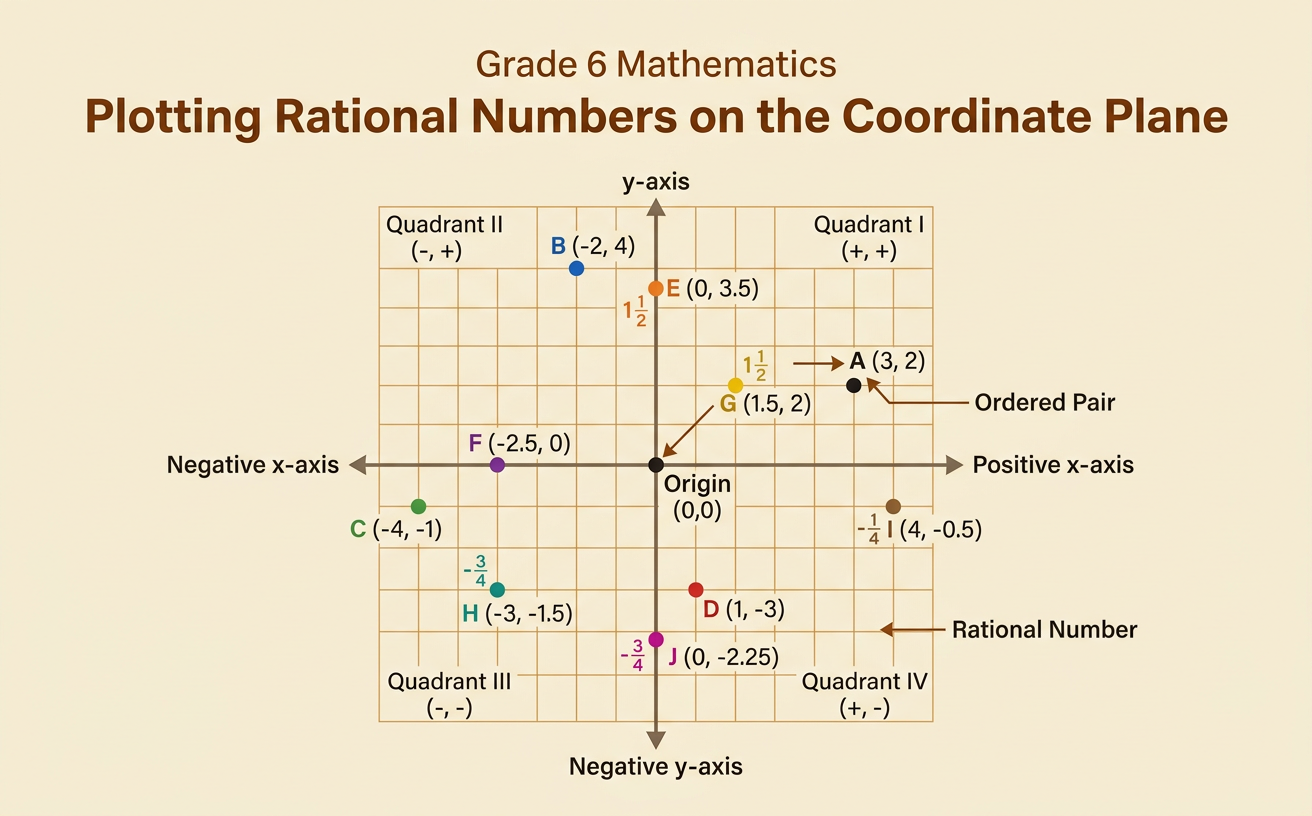
Illustrations are auto-generated and may be placeholders. They can be refreshed to match the narration.
Parts of the Coordinate Plane
A coordinate plane is formed by two perpendicular number lines. The horizontal number line is the x-axis, and the vertical number line is the y-axis. They intersect at the origin, (0, 0). The axes divide the plane into four regions called quadrants. Quadrant I is in the upper right, Quadrant II is in the upper left, Quadrant III is in the lower left, and Quadrant IV is in the lower right. Values increase as you move right on the x-axis or up on the y-axis. They decrease as you move left or down. For example, the point (2, 3) lies in Quadrant I because both coordinates are positive. Points on an axis, such as (0, 4), are not in any quadrant.

Reading Ordered Pairs
A point on the coordinate plane is named with an ordered pair written as (x, y). The first number is the x-coordinate, which tells the point’s horizontal position. The second number is the y-coordinate, which tells its vertical position. The order matters. For example, in (-2.5, 3), the x-coordinate is -2.5 and the y-coordinate is 3. The point is 2.5 units left of the origin and 3 units up. Reversing the coordinates gives (3, -2.5), which is a different point located 3 units right and 2.5 units down. A coordinate of zero places a point on an axis. For instance, (-4, 0) lies on the x-axis, while (0, 1.5) lies on the y-axis.

Moving Along the x- and y-Axes
To plot an ordered pair, always begin at the origin. Use the x-coordinate first to move horizontally along the x-axis. A positive x-coordinate means move right, and a negative x-coordinate means move left. Next, use the y-coordinate to move vertically. A positive y-coordinate means move up, and a negative y-coordinate means move down. Plot a point at the final location. To plot (-3, 2.5), start at (0, 0), move 3 units left, and then move 2.5 units up. Place the point where those movements end. Do not switch the steps: moving up first can make it easier to confuse which number controls each direction. Remember the rule: x tells left or right, while y tells up or down.
Plotting Points in Four Quadrants
The signs of an ordered pair help identify its quadrant. In Quadrant I, both coordinates are positive: (+, +). In Quadrant II, x is negative and y is positive: (-, +). In Quadrant III, both coordinates are negative: (-, -). In Quadrant IV, x is positive and y is negative: (+, -). For example, A(1.5, 2) belongs in Quadrant I, B(-2, 1) belongs in Quadrant II, C(-1.5, -2.5) belongs in Quadrant III, and D(2.5, -1) belongs in Quadrant IV. Use the axis scale carefully when plotting fractions or decimals. If each small interval represents one-half unit, 1.5 is three intervals from zero. A point with a zero coordinate lies on an axis rather than inside a quadrant.
Checking Coordinates and Signs
After plotting a point, check its position by tracing back to each axis. First, look straight down or up from the point to read the x-coordinate. Then look straight left or right to read the y-coordinate. Confirm that the directions match the signs: right and up are positive, while left and down are negative. Also check the scale because one grid interval may represent a fraction or decimal rather than one whole unit. Suppose a point is labeled P(-1.5, -2). It should be left of the y-axis and below the x-axis, so it must be in Quadrant III. Its horizontal position should line up with -1.5, and its vertical position should line up with -2. If either alignment is wrong, move the point before recording the answer.