
Polynomial Structure, Zeros, and Graphs
Students connect polynomial factors and zeros to x-intercepts, multiplicity, and the overall shape of polynomial graphs.

Illustrations are auto-generated and may be placeholders. They can be refreshed to match the narration.
Polynomial Degree and End Behavior
The degree of a polynomial is the greatest exponent after like terms are combined. The leading term, which contains the highest power, determines the graph’s end behavior. For an even degree, both ends point in the same direction. For an odd degree, the ends point in opposite directions. A positive leading coefficient makes the right end rise, while a negative leading coefficient makes the right end fall. For example, f(x) = −2x⁴ + 3x² − 1 has degree 4 and leading term −2x⁴. Because the degree is even and the leading coefficient is negative, f(x) approaches negative infinity as x approaches either positive or negative infinity. Therefore, both ends of its graph point downward, even though the graph may turn several times between the ends.

Factors and Zeros
A zero of a polynomial is an x-value that makes the function equal to zero. If a polynomial is written in factored form, set each factor equal to zero. This follows from the zero-product property: when a product equals zero, at least one factor must equal zero. For example, let f(x) = (x − 3)(x + 1)(x² + 4). The factor x − 3 gives the real zero x = 3, and x + 1 gives the real zero x = −1. The equation x² + 4 = 0 has no real solutions because it requires x² = −4. Thus, the graph has x-intercepts at (3, 0) and (−1, 0). In general, a linear factor x − r corresponds to the zero x = r and an x-intercept at (r, 0).
Multiplicity
Multiplicity tells how many times a factor is repeated. In f(x) = (x + 2)²(x − 1)³, the zero x = −2 has multiplicity 2, and the zero x = 1 has multiplicity 3. A zero with even multiplicity usually makes the graph touch the x-axis and turn around without changing sign. A zero with odd multiplicity makes the graph cross the x-axis and change sign. Greater multiplicities also make the graph flatter near the intercept. Therefore, at x = −2 the graph touches and turns because the multiplicity is even. At x = 1 it crosses with noticeable flattening because the multiplicity is 3. The multiplicities add to 5, which is the polynomial’s degree. This agrees with its odd-degree end behavior: the left end falls and the right end rises.
Intercepts and Graph Shape
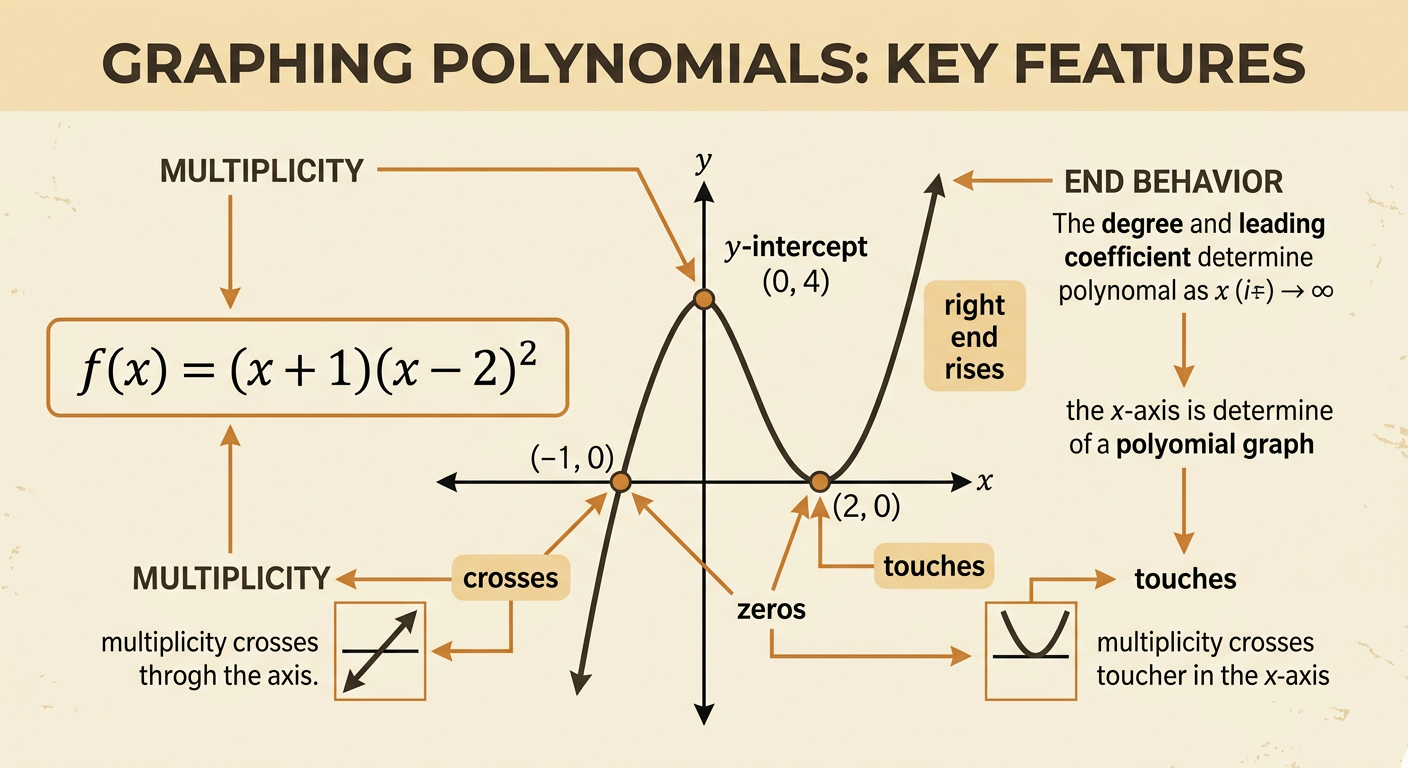
Intercepts provide anchor points for a polynomial graph. The x-intercepts come from the real zeros, while the y-intercept is found by evaluating f(0). Consider f(x) = (x + 1)(x − 2)². Its zeros are x = −1 and x = 2, so the x-intercepts are (−1, 0) and (2, 0). Because x = 2 has multiplicity 2, the graph touches the axis there; it crosses at x = −1, which has multiplicity 1. The y-intercept is f(0) = (1)(−2)² = 4, giving the point (0, 4). The polynomial has degree 3 with a positive leading coefficient, so its left end falls and its right end rises. A degree-n polynomial can have at most n − 1 turning points, which helps keep a rough sketch realistic.
Sketching Polynomial Graphs
To sketch a polynomial from its factorization, first identify its degree and leading coefficient to determine end behavior. Next, find each real zero and its multiplicity. Plot the x-intercepts, decide whether the graph crosses or touches at each one, and calculate the y-intercept. Then connect the points with a smooth, continuous curve that follows the required end behavior. For example, f(x) = −(x + 3)(x − 1)² has degree 3 and a negative leading coefficient, so the left end rises and the right end falls. The graph crosses at x = −3, touches and turns at x = 1, and has y-intercept f(0) = −3. Helpful test points, such as (−2, −9) and (2, −5), show that the graph remains below the x-axis on both sides of x = 1.