
Potential Energy and Energy Transfer
Students model stored energy and explain how energy transfers produce changes in kinetic and potential energy within a system.
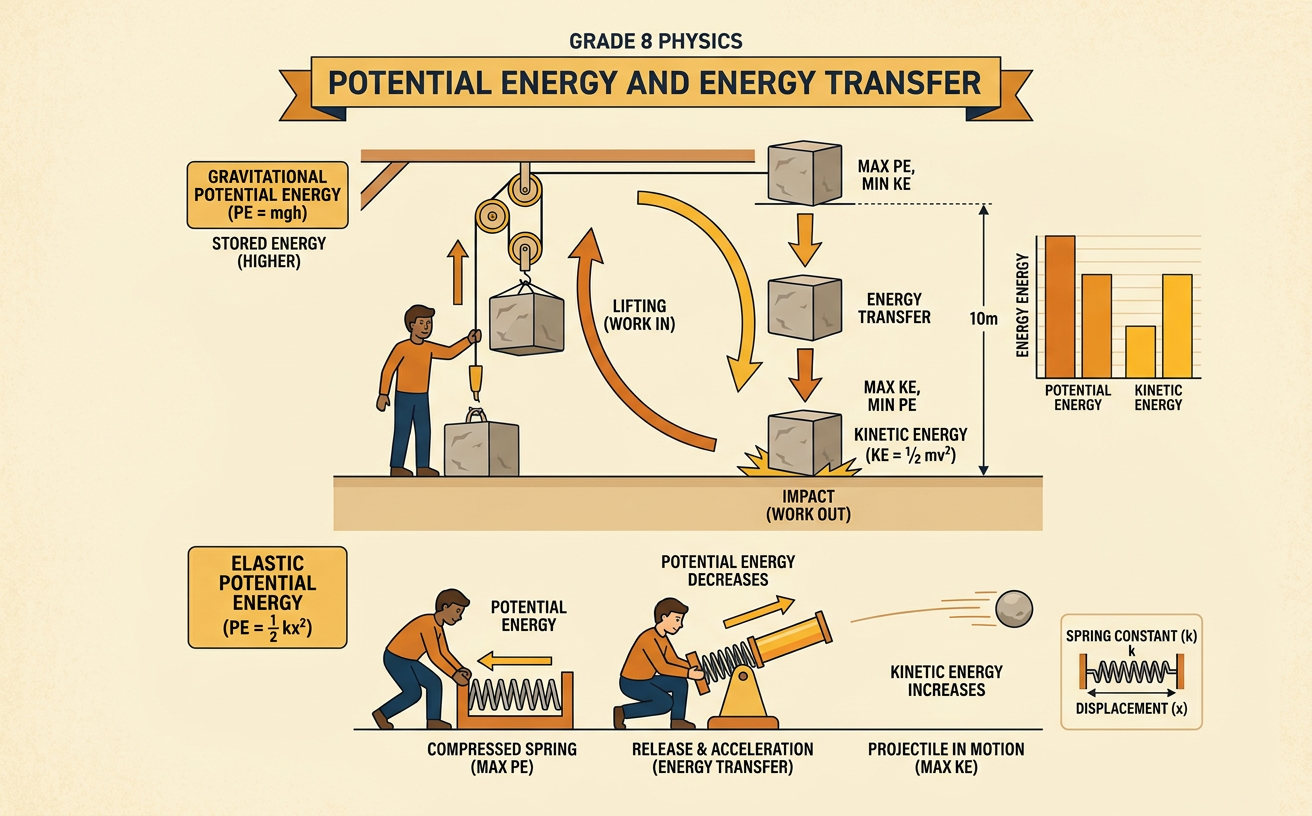
Illustrations are auto-generated and may be placeholders. They can be refreshed to match the narration.
Stored Potential Energy
Potential energy is stored energy associated with the arrangement of interacting objects. It does not belong to one object alone; it depends on the positions of objects in a system. For example, two magnets with like poles facing each other repel. Pushing them closer together requires a force applied over a distance, transferring energy into the magnet system. If released, the magnets move apart, and the stored potential energy changes into kinetic energy. A model can use object positions, force arrows, and energy bars to show this relationship. The amount of potential energy is measured relative to a chosen reference arrangement. Changing the reference changes the numerical value assigned to potential energy, but it does not change the observable energy transferred as the arrangement changes.
Gravitational and Elastic Energy
Gravitational potential energy depends on the positions of objects that attract one another, such as an object and Earth. Near Earth’s surface, lifting an object higher increases its gravitational potential energy. The relationship can be modeled as gravitational potential energy equals mass times gravitational field strength times height, or Ug = mgh. A heavy book on a high shelf therefore has more gravitational potential energy than the same book on a lower shelf. Elastic potential energy is stored when an elastic object is stretched or compressed. Pulling back a bowstring or compressing a spring transfers energy into the elastic system. When released, the system can transfer that energy into motion. Greater height, greater mass, or greater elastic deformation generally means more stored potential energy.
Defining an Energy System
An energy system is the object or group of interacting objects selected for study. A system boundary separates the system from its surroundings. Defining the boundary helps identify where energy is stored and whether energy crosses into or out of the system. Consider a ball falling toward Earth. If the system includes both the ball and Earth, gravitational potential energy is stored in their interaction and changes into the ball’s kinetic energy within the system. If the system includes only the ball, gravity is an external force that transfers energy into the ball as it falls. Both descriptions can be useful, but the chosen boundary must be stated clearly. Diagrams often use a dashed line as the system boundary and arrows to show energy crossing it.
Energy Transformations
An energy transformation occurs when energy changes from one form to another within a system. On a roller coaster, the car has its greatest gravitational potential energy near the top of a hill. As the car moves downward, its height and gravitational potential energy decrease while its speed and kinetic energy increase. On the next upward slope, some kinetic energy changes back into gravitational potential energy. Real systems also transfer some energy into thermal energy because of friction between wheels and track and air resistance. This thermal energy is spread through the coaster, track, air, and surroundings. Energy transformations do not make energy disappear. Instead, energy becomes stored in different forms or is transferred to other parts of the system and its surroundings.
Conservation and Transfer
The law of conservation of energy states that energy cannot be created or destroyed, although it can be transferred and transformed. An object’s kinetic energy changes when energy is transferred to or from it. For example, when a bat strikes a stationary baseball, the bat exerts a force through a distance and transfers energy to the ball. The ball’s speed increases, so its kinetic energy increases. At the same time, the bat loses some kinetic energy, and some energy becomes thermal energy and sound. During a collision or another interaction, evidence such as changes in speed, temperature, shape, or sound can show that energy transfer occurred. A complete explanation must identify the interacting objects, the direction of transfer, and the observed change caused by that transfer.
Evidence from Energy Diagrams
Energy diagrams provide visual evidence for claims about energy transfer and transformation. An energy bar chart compares the amounts of different energy forms at two or more moments. For a cart released from a compressed spring, the initial chart shows high elastic potential energy and little kinetic energy. After release, the spring has less elastic potential energy while the moving cart has more kinetic energy. If friction is present, a thermal-energy bar also increases. The total height of all energy bars should remain constant when the diagram includes the complete system and all important energy forms. If the system is not closed, an arrow must show energy entering or leaving. These patterns support the claim that a change in kinetic energy results from energy transferred to or from an object.