
Potential Energy in Systems
Students build and interpret models showing how position and arrangement affect gravitational, elastic, and magnetic potential energy.
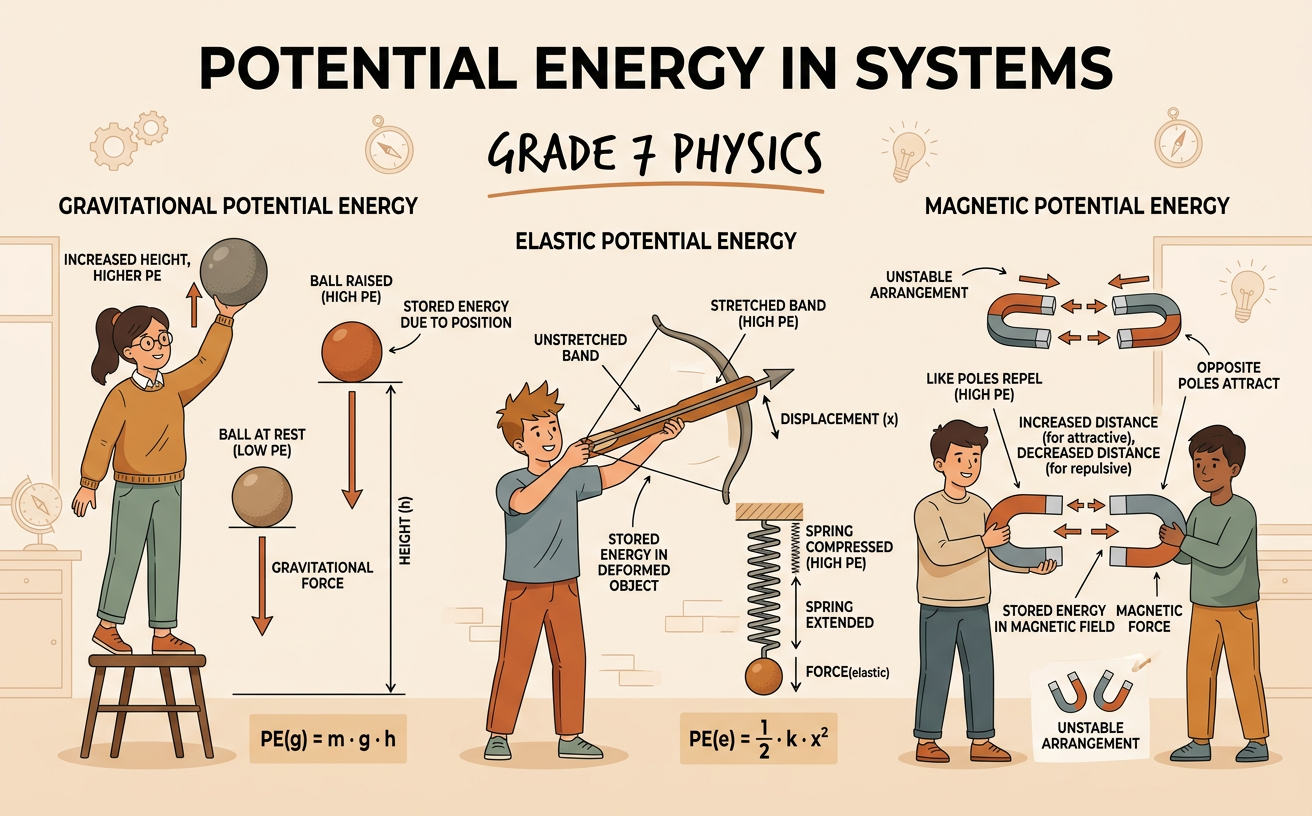
Illustrations are auto-generated and may be placeholders. They can be refreshed to match the narration.
Stored Energy
Potential energy is energy stored in a system because of the positions or arrangement of its parts. A system is the group of objects chosen for study. The energy belongs to the whole system, not to one object by itself. When the arrangement changes, potential energy can increase or decrease. Work done on a system can add potential energy, and stored energy can later change into motion, sound, or thermal energy. For example, winding a toy twists its internal spring. Your hand transfers energy to the toy-spring system. When released, the spring returns toward its original shape and the toy moves. To compare potential energy, identify the same system in each arrangement and choose a consistent reference arrangement.
Gravitational Potential Energy
Gravitational potential energy depends on the positions of objects that attract through gravity. Near Earth’s surface, raising an object increases the potential energy of the object-Earth system. A greater height means more gravitational potential energy when mass stays the same. At the same height, a more massive object has more gravitational potential energy than a less massive one. Imagine lifting a backpack from the floor onto a desk. You do work against gravity, changing the backpack’s position relative to Earth. If the backpack falls, gravitational potential energy decreases while its kinetic energy increases. Height must be measured from a chosen reference level, such as the floor. Changing the reference changes the numerical value, but it does not change the energy difference between two heights.
Elastic Potential Energy
Elastic potential energy is stored when an elastic object is stretched or compressed away from its resting shape. Springs, rubber bands, and bows can store this kind of energy. In general, a greater stretch or compression stores more elastic potential energy, as long as the object remains within its elastic limit and can return to its original shape. For example, pulling back a toy launcher compresses its spring. Your hand does work on the launcher-spring system. When the spring is released, it pushes the toy forward, changing elastic potential energy into kinetic energy. A spring that is not stretched or compressed is at its resting length and usually has the least elastic potential energy. Stretching too far can permanently deform the material, so it may no longer behave elastically.
Magnetic Interactions
Magnets interact at a distance through magnetic forces. The potential energy of a magnetic system depends on both the distance between the magnets and the direction of their poles. Like poles repel. Pushing two north poles closer together requires work and increases the system’s magnetic potential energy. When released, the magnets move apart as that potential energy changes into kinetic energy. Opposite poles attract. Pulling a north pole and a south pole farther apart also requires work and increases potential energy. If released, they move together. Therefore, distance alone does not tell the whole story; pole orientation must also be shown in a model. For example, two repelling magnets mounted on low-friction carts speed away from each other after being held close together and released.
Modeling a System
A scientific model highlights the parts and relationships needed to explain a system. Begin by drawing a system boundary and labeling the interacting objects. Then show position, distance, direction, or deformation with measurements and arrows. Compare two or more arrangements using relative energy bars labeled lower and higher rather than claiming an exact value without data. For example, model two carts carrying north poles that face each other. In arrangement A, the carts are far apart. In arrangement B, they are held close together. The closer arrangement has more magnetic potential energy because work was required to push the repelling magnets together. An accurate model should also predict what happens next: when released, the carts move apart while potential energy decreases and kinetic energy increases. Models can be revised when observations do not match predictions.